Introduction
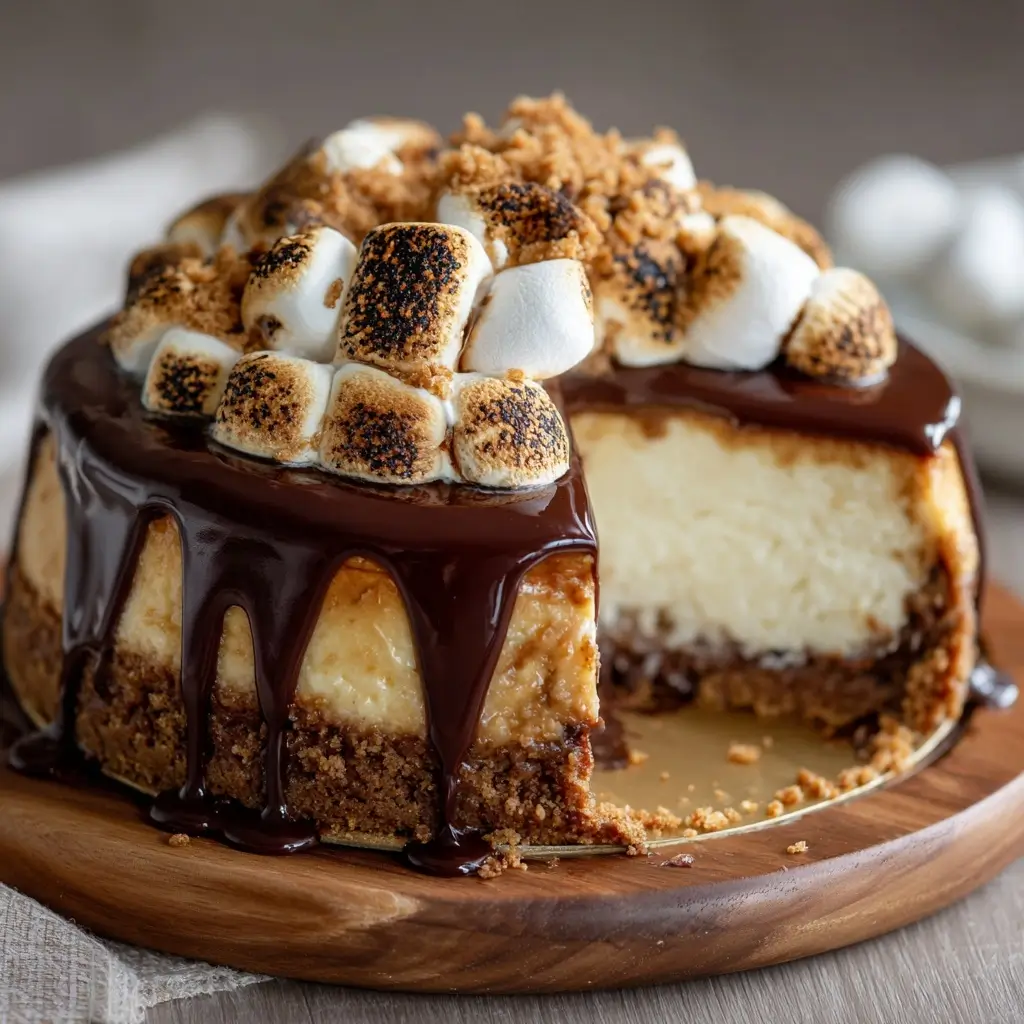
Imagine the nostalgic crackle of a campfire, the gooey stretch of toasted marshmallow, the rich snap of dark chocolate, and the buttery crumble of graham cracker — now seamlessly transformed into an elegant, creamy, no-bake (or baked, depending on your preference) decadent dessert that wows at every gathering. S’mores Cheesecake is more than just a fusion of two beloved classics; it’s a masterful reimagining of childhood magic through the lens of sophisticated baking science. This dessert bridges generations — delighting kids with its familiar flavors while earning nods of approval from adult palates seeking depth, texture contrast, and refined balance. Whether served at summer BBQs, holiday dessert tables, bridal showers, or cozy weeknight treats, S’mores Cheesecake delivers an unforgettable sensory experience: velvety New York–style cheesecake filling infused with real chocolate ganache, crowned with torched marshmallow meringue, all resting on a deeply caramelized, cinnamon-kissed graham cracker crust. It’s not just a dessert — it’s a multisensory celebration of warmth, memory, and culinary craftsmanship.
The History
The origins of S’mores Cheesecake are delightfully modern and wonderfully organic — a delicious inevitability born from the collision of two iconic American desserts. The s’more itself traces back to at least the early 1920s, first appearing in the 1927 Girl Scouts handbook *Tramping and Trailing with the Girl Scouts*, where it was called “Some More!” — a playful plea for another helping. Graham crackers (invented by Sylvester Graham in the 1830s as part of a health reform movement), milk chocolate (popularized in the U.S. by Hershey’s in the early 1900s), and marshmallows (evolving from ancient Egyptian honey-root confections to modern gelatin-based versions by the 19th century) converged into the portable, open-fire treat we cherish today.
Cheesecake, meanwhile, boasts ancient roots — with earliest forms dating to Ancient Greece (served to athletes at the first Olympic Games in 776 BCE) and later refined by Romans — but the American version truly blossomed in the late 19th and early 20th centuries, especially with the advent of cream cheese (introduced by William Lawrence in Chester, NY, in 1872) and the iconic New York–style baked cheesecake pioneered by Arnold Reuben and later perfected at places like Lindy’s and Junior’s.
S’mores Cheesecake emerged organically in the early 2000s as food bloggers and home bakers began experimenting with flavor crossovers. Early iterations appeared on sites like Smitten Kitchen and Food52 around 2008–2010, often as no-bake variations using whipped cream stabilizers and chilled chocolate layers. By the mid-2010s, professional pastry chefs—including Dominique Ansel (known for the Cronut®) and Christina Tosi of Milk Bar—began incorporating s’mores elements into high-end dessert menus, lending legitimacy and technique refinement. The dessert gained viral momentum on Pinterest and Instagram circa 2016–2018, with dramatic torch-finished marshmallow tops becoming signature visual hallmarks. Today, S’mores Cheesecake appears in bakery case displays nationwide, features in cooking competitions like *Holiday Baking Championship*, and is routinely adapted for dietary needs (vegan, gluten-free, keto), proving its status as a true American dessert evolution — rooted in tradition, elevated by innovation, and endlessly adaptable.
Ingredients Breakdown
Every exceptional S’mores Cheesecake begins with intentional, high-quality ingredients — each selected not only for flavor but for its functional role in texture, stability, and mouthfeel. Below is a granular breakdown of why each component matters:
- Graham Crackers (Full Sheet, Honey Variety Preferred): Not just for crunch — their subtle molasses sweetness and gentle spice (cinnamon, nutmeg, sometimes ginger) provide foundational warmth that balances the richness of cream cheese. Honey-sweetened versions yield superior caramelization and crust adhesion versus plain or cinnamon-only variants. For optimal crust integrity, pulse until fine crumbs form — no large shards — and always include the full fat content (butter binds best with natural oils in the cracker).
- Unsalted Butter (European-style, 82–84% fat recommended): Critical for both flavor and structure. Higher-fat butter yields a richer, more tender crust with enhanced browning and deeper nutty notes when pre-baked. Salt level must be controlled separately (via added sea salt) to avoid over-salting, especially since many graham crackers already contain sodium.
- Cream Cheese (Full-Fat, Brick Style, Philadelphia or Boar’s Head Preferred): Must be at true room temperature (68–72°F) — cold cream cheese causes lumps; overheated cheese breaks emulsification. Full-fat ensures proper body and prevents weeping or graininess. Avoid low-fat, Neufchâtel, or spreadable varieties — their altered protein/fat ratios destabilize the batter and compromise set.
- Granulated Sugar (Cane, Not Beet): Cane sugar dissolves more evenly and contributes cleaner sweetness. Its crystalline structure also aids aeration during mixing. For ultra-smooth texture, some bakers prefer superfine sugar — especially in no-bake versions where residual grit is more noticeable.
- Sour Cream & Heavy Cream (Both Cultured & High-Fat): Sour cream adds tang, moisture, and slight acidity to balance sweetness and enhance shelf life; heavy cream (minimum 36% fat) contributes luxurious mouthfeel and improves sliceability. Both must be cold when added to prevent premature softening of cream cheese.
- Vanilla Extract (Pure, Madagascar Bourbon, Alcohol-Based): Not imitation — real vanilla provides floral, woody complexity that complements chocolate and caramel notes. Alcohol acts as a solvent, releasing volatile compounds for maximum aromatic impact.
- Large Eggs (Grade A, Cold, Cage-Free Preferred): Act as emulsifiers and structural agents. Added one at a time ensures thorough incorporation and prevents curdling. Overmixing after eggs are added introduces excess air, leading to cracks during baking — a key technical nuance.
- Dark Chocolate (60–70% Cacao, Callebaut or Valrhona Recommended): Provides deep, nuanced bitterness that offsets sweetness and enhances perceived richness. Couverture chocolate ensures proper cocoa butter content for glossy, stable ganache layers. Avoid Dutch-processed unless specified — natural cocoa powder reacts differently with leaveners and acids.
- Mini Marshmallows (Kraft Jet-Puffed or Dandies Vegan): Used in crust reinforcement, swirls, or as base for torched topping. Their gelatin (or plant-based agar/tapioca in vegan versions) provides melt-in-mouth texture and ideal browning response under broiler or torch.
- Sea Salt Flakes (Maldon or Fleur de Sel): Applied as finishing salt — not mixed in — to heighten all other flavors via contrast and umami enhancement. A tiny amount on the marshmallow peak makes the entire dessert taste brighter and more dimensional.
Step-by-Step Recipe
Note: This is a hybrid method — a lightly baked, water-bath–protected cheesecake base with layered chocolate and no-bake marshmallow meringue topping. Yields one 9-inch springform cake (12–14 servings). Prep time: 45 min | Chill time: 16–24 hours | Bake time: 1 hr 20 min (plus cooling)
- Prepare the Graham Cracker Crust: Preheat oven to 350°F (175°C). Pulse 1 ½ cups (150g) finely crushed honey graham crackers, 2 tbsp granulated sugar, and ¼ tsp fine sea salt in a food processor until powdery. Add 6 tbsp (85g) melted unsalted butter and 2 tbsp mini marshmallows; pulse until mixture resembles wet sand and holds together when pinched. Press firmly and evenly into bottom and 1 inch up sides of a 9-inch springform pan using the bottom of a measuring cup. Bake 10 minutes until fragrant and lightly golden. Cool completely on wire rack (at least 30 min).
- Make the Chocolate Ganache Layer: Heat ½ cup (120ml) heavy cream in a small saucepan until steaming (do not boil). Pour over 4 oz (113g) finely chopped 65% dark chocolate in a heatproof bowl. Let sit 2 minutes, then stir gently with silicone spatula until smooth and glossy. Stir in 1 tbsp light corn syrup (for sheen and anti-crystallization) and ¼ tsp espresso powder (enhances chocolate depth without tasting like coffee). Cool to lukewarm (about 85°F), stirring occasionally to prevent skin formation. Pour evenly over cooled crust and refrigerate 20 minutes until set but not hard.
- Prepare the Cheesecake Batter: In stand mixer fitted with paddle attachment, beat 24 oz (680g / 3 bricks) full-fat cream cheese on medium-low 2 minutes until perfectly smooth and lump-free. Scrape bowl thoroughly. Add 1 cup (200g) granulated sugar and beat 2 minutes until pale and fluffy. Add 1 tsp pure vanilla extract and ½ tsp almond extract (optional but highly recommended for nutty-marshmallow synergy) and beat 30 seconds. Add 1 cup (240g) full-fat sour cream and ½ cup (120ml) cold heavy cream; mix on low just until combined — do not overmix. One at a time, add 3 large cold eggs, mixing on low 15 seconds after each addition and scraping bowl each time. Batter should be silky, homogeneous, and free of streaks.
- Bake Using Water Bath: Wrap exterior of springform pan tightly with two overlapping sheets of heavy-duty aluminum foil (to prevent water seepage). Place pan inside a larger roasting pan. Carefully pour batter over set ganache layer. Fill roasting pan with 1–2 inches of hot tap water (water bath). Bake at 325°F (165°C) for 65–75 minutes — center should jiggle slightly like Jell-O (not liquid), edges set. Turn off oven, crack door open 2 inches with wooden spoon, and let cool inside oven 1 hour.
- Chill and Set: Remove from water bath, discard foil, run thin knife around edge to loosen. Refrigerate uncovered for minimum 12 hours — preferably 24 — to fully set, develop flavor, and ensure clean slicing.
- Prepare Torched Marshmallow Meringue: At least 2 hours before serving, make Swiss meringue: Combine 3 large egg whites, ¾ cup (150g) granulated sugar, and ¼ tsp cream of tartar in heatproof bowl of stand mixer. Set over simmering water (double boiler), whisk constantly until sugar dissolves and mixture reaches 160°F (71°C) on instant-read thermometer. Transfer to mixer, beat with whisk attachment on high 8–10 minutes until stiff, glossy, and cooled to room temperature. Fold in 1 cup (60g) mini marshmallows (cut in half) and 1 tsp vanilla. Pile generously onto chilled cheesecake.
- Torch & Finish: Using culinary torch, evenly toast meringue until peaks are golden brown and delicately blistered (avoid blackening). Sprinkle immediately with flaky sea salt and optional shaved dark chocolate or crushed graham cracker dust. Serve chilled with extra chocolate shavings and a side of warm chocolate sauce for drizzling.
Tips
- Room Temperature Mastery: Take cream cheese out 3–4 hours ahead. If rushed, unwrap bricks and microwave at 20% power for 15-second bursts — check frequently. Never use warm/hot cream cheese — it melts butterfat prematurely and causes separation.
- No-Lump Guarantee: After beating cream cheese alone, pass batter through a fine-mesh sieve before adding eggs — this catches any stubborn micro-lumps and guarantees silkiness.
- Water Bath Wisdom: Use a tea kettle to pour hot water into the roasting pan — it’s safer and less likely to splash into the springform. Line the bottom of the roasting pan with a kitchen towel to stabilize the springform and absorb minor spills.
- Crack Prevention Protocol: In addition to the water bath, add 2 tbsp sour cream to batter (already included above) and avoid opening oven during first 50 minutes. Cool gradually — the oven-cooling step is non-negotiable for structural integrity.
- Marshmallow Meringue Science: Swiss meringue is essential — raw egg whites are unsafe, and Italian meringue can be overly sweet and dense. Stabilize further by adding 1 tsp unflavored powdered gelatin (bloomed in 1 tbsp cold water, then microwaved 5 seconds until liquid) to the warm meringue base before whipping.
- Slicing Like a Pro: Dip a long, thin knife in hot water, wipe dry, and slice in one confident motion. Clean and reheat knife between every slice. For picture-perfect layers, chill knife in freezer 5 minutes before cutting.
- Flavor Depth Boosters: Add 1 tbsp bourbon or smoked maple syrup to the batter for sophisticated nuance. Infuse the heavy cream for ganache with a cinnamon stick or star anise (steep 10 min, then strain) for aromatic intrigue.
- Make-Ahead Magic: Crust and ganache layer can be made 3 days ahead and refrigerated. Fully baked and chilled cheesecake keeps flawlessly for 5 days covered. Meringue is best made day-of — but can be piped onto cake and refrigerated (un-torched) for up to 8 hours before finishing.
Variations and Customizations
S’mores Cheesecake is gloriously versatile — a canvas for creativity, dietary adaptation, and seasonal expression. Here are meticulously tested, chef-approved variations:
- No-Bake Version: Replace baked batter with no-bake base: Whip 2 cups cold heavy cream to stiff peaks; fold into 24 oz softened cream cheese + 1 cup powdered sugar + 2 tsp vanilla + ½ cup melted white chocolate (for stability). Layer over crust and ganache, then chill 8+ hours. Top with stabilized whipped cream instead of meringue.
- Vegan S’mores Cheesecake: Use soaked cashews (2 cups), coconut cream (1 cup), maple syrup (⅔ cup), lemon juice (3 tbsp), vanilla, and 4 oz dairy-free dark chocolate for filling. Crust: vegan graham crackers + coconut oil. Meringue: aquafaba (1 cup chickpea brine) + 1 cup cane sugar + 1 tsp cream of tartar, whipped 12+ minutes.
- Gluten-Free Adaptation: Substitute GF graham crackers (like Pamela’s or Schär) — ensure they’re certified GF due to cross-contamination risks. Add 1 tsp xanthan gum to crust mixture to improve binding. Verify all chocolate and marshmallows are GF-certified.
- Keto/Low-Carb Version: Crust: almond flour (1 cup) + coconut flour (¼ cup) + erythritol (⅓ cup) + butter + sugar-free mini marshmallows. Filling: full-fat cream cheese, sour cream, heavy cream, Swerve Confectioners, eggs, and sugar-free chocolate (Lily’s). Meringue: use egg white protein powder + erythritol + xanthan gum instead of sugar.
- Mini Mason Jar Individual Servings: Layer crushed graham + melted butter in ½-pint jars, top with mini ganache dollop, chilled no-bake cheesecake, and toasted marshmallow fluff. Perfect for picnics, parties, or portion control.
- Smoked S’mores Cheesecake: Add ¼ tsp natural hickory or applewood liquid smoke to batter — or cold-smoke the finished, chilled cake for 15 minutes using a stovetop smoker. Deepens campfire essence without overpowering.
- Seasonal Twists: Fall: Add 1 tsp pumpkin pie spice + 2 tbsp canned pumpkin purée to batter. Winter: Infuse ganache with orange zest + Grand Marnier. Spring: Top with fresh raspberries and mint. Summer: Swirl in strawberry coulis before baking.
- Texture Play: Embed a hidden layer of crushed pretzels or salted caramel bits between ganache and cheesecake for sweet-salty-crunch contrast.
Health Considerations and Nutritional Value
While S’mores Cheesecake is inherently indulgent, understanding its nutritional profile empowers mindful enjoyment and informed customization. Per standard slice (1/12 of recipe, approx. 220g):
- Calories: ~580 kcal — primarily from healthy fats (cream cheese, butter, chocolate), complex carbs (graham crackers), and protein (eggs, dairy).
- Fat: 38g total (22g saturated) — mostly from whole dairy and dark chocolate. Dark chocolate contributes heart-healthy flavonoids and monounsaturated fats.
- Carbohydrates: 47g (32g sugars) — naturally occurring lactose + added sucrose. Substituting coconut sugar or monk fruit reduces glycemic load.
- Protein: 11g — high-quality complete protein from eggs and dairy supports satiety.
- Fiber: 2g — from whole-grain graham crackers (choose brands with ≥3g fiber/serving for boost).
- Sodium: 320mg — moderate; easily reduced by omitting added salt in crust and using low-sodium butter.
- Key Micronutrients: Calcium (25% DV), Vitamin B12 (30% DV), Phosphorus (20% DV), and antioxidants (epicatechin from dark chocolate).
Dietary Notes: Naturally low in gluten (unless GF crackers used), contains dairy and eggs (not suitable for strict vegans or those with severe allergies). Contains gelatin (in marshmallows) — halal/kosher certification varies by brand. For those managing blood sugar, pairing with a green salad or berries slows glucose absorption. Nutritionally, it’s best enjoyed as an occasional treat — but its balanced macros make it more satisfying and less likely to trigger reactive hunger than ultra-processed sweets.
Ingredients
Makes one 9-inch cheesecake (12–14 servings)
For the Crust:
- 1 ½ cups (150g) finely crushed honey graham crackers (about 12 full sheets)
- 2 tablespoons (25g) granulated sugar
- ¼ teaspoon fine sea salt
- 6 tablespoons (85g) unsalted butter, melted
- 2 tablespoons (15g) mini marshmallows, roughly chopped
For the Chocolate Ganache Layer:
- ½ cup (120ml) heavy cream (36% fat)
- 4 ounces (113g) high-quality 65% dark chocolate, finely chopped
- 1 tablespoon (15ml) light corn syrup
- ¼ teaspoon instant espresso powder
For the Cheesecake Batter:
- 24 ounces (680g / three 8-oz bricks) full-fat brick cream cheese, at room temperature
- 1 cup (200g) granulated sugar
- 1 teaspoon pure vanilla extract
- ½ teaspoon pure almond extract (optional but recommended)
- 1 cup (240g) full-fat sour cream, cold
- ½ cup (120ml) cold heavy cream (36% fat)
- 3 large eggs, cold
- ¼ teaspoon fine sea salt
For the Torched Marshmallow Meringue:
- 3 large egg whites
- ¾ cup (150g) granulated sugar
- ¼ teaspoon cream of tartar
- 1 cup (60g) mini marshmallows, halved
- 1 teaspoon pure vanilla extract
- Flaky sea salt (Maldon or Fleur de Sel), for finishing
- Optional garnish: shaved dark chocolate or graham cracker dust
Directions
- Preheat oven to 350°F (175°C). Prepare springform pan: Wrap the exterior of a 9-inch springform pan tightly with two overlapping sheets of heavy-duty aluminum foil — ensure no gaps at the seam or base. Set aside.
- Make the crust: In a food processor, pulse graham crackers, 2 tbsp sugar, and ¼ tsp salt until fine crumbs form (about 30 seconds). Add melted butter and chopped mini marshmallows. Pulse until mixture resembles wet sand and holds together when squeezed. Press firmly and evenly into bottom and 1 inch up sides of prepared pan using flat-bottomed measuring cup. Bake 10 minutes until fragrant and lightly golden. Cool completely on wire rack — minimum 30 minutes.
- Prepare ganache: Heat heavy cream in small saucepan over medium heat until steaming and tiny bubbles form at edges (do not boil). Pour over chopped chocolate in heatproof bowl. Let stand 2 minutes. Gently stir with silicone spatula in concentric circles until smooth and glossy. Stir in corn syrup and espresso powder until fully incorporated. Let cool, stirring occasionally, until lukewarm (approx. 85°F / 29°C) — about 15–20 minutes. Pour evenly over cooled crust. Tap pan gently on counter to remove air bubbles. Refrigerate 20 minutes until surface is set but not firm.
- Make cheesecake batter: In stand mixer fitted with paddle attachment, beat cream cheese on medium-low speed 2 minutes until perfectly smooth and lump-free. Scrape bowl and paddle thoroughly. Add sugar and beat 2 minutes until pale and airy. Add vanilla and almond extract; beat 30 seconds. Add sour cream and cold heavy cream; mix on low just until combined (15 seconds). Add eggs one at a time, mixing on low 15 seconds after each addition and scraping bowl each time. Batter should be thick, smooth, and uniform. Do not overmix.
- Bake with water bath: Pour batter gently over set ganache. Smooth top with offset spatula. Place springform pan inside larger roasting pan. Carefully pour hot tap water into roasting pan until it reaches halfway up sides of springform (1–2 inches). Bake at 325°F (165°C) for 65–75 minutes — center should jiggle slightly like Jell-O when gently shaken; edges will be set and lightly golden. Turn off oven, crack door open 2 inches with wooden spoon, and let cake cool inside oven for 1 hour.
- Chill thoroughly: Carefully remove springform from water bath. Discard foil. Run thin knife around edge to loosen. Cool on wire rack 1 hour at room temperature. Refrigerate uncovered for minimum 12 hours — ideally 24 — to fully set and develop flavor.
- Prepare meringue: At least 2 hours before serving, combine egg whites, sugar, and cream of tartar in heatproof bowl of stand mixer. Set bowl over saucepan of gently simmering water (ensure water doesn’t touch bottom of bowl). Whisk constantly until mixture reaches 160°F (71°C) and sugar fully dissolves (rub a bit between fingers — no grit). Immediately transfer bowl to mixer. Beat with whisk attachment on high speed 8–10 minutes until stiff, glossy, and cooled to room temperature (bowl no longer warm). Gently fold in halved mini marshmallows and vanilla.
- Finish and serve: Spread meringue generously over chilled cheesecake, swirling decoratively. Use culinary torch to evenly toast until golden brown and delicately blistered. Immediately sprinkle with flaky sea salt and optional garnishes. Slice with hot, clean knife. Serve chilled. Store leftovers covered in refrigerator up to 5 days.
FAQ
- Can I make this without a springform pan?
- Yes — use a 9-inch cake pan lined with two overlapping sheets of parchment paper (overhanging edges act as lift handles). Grease pan and parchment well. Crust may be slightly harder to remove cleanly, but it works beautifully.
- Why did my cheesecake crack?
- Most common causes: overmixing after adding eggs, rapid temperature changes (opening oven too soon, skipping oven-cool step), insufficient water in bath, or cooling too quickly. Swiss meringue topping also hides minor surface fissures!
- Can I freeze S’mores Cheesecake?
- Absolutely — freeze unbaked crust + ganache layer for up to 1 month. Fully baked, chilled (but untorched) cheesecake freezes well for 2 months: wrap tightly in plastic + foil. Thaw overnight in fridge before torching meringue.
- What if I don’t have a kitchen torch?
- You can carefully broil: place chilled cheesecake (with meringue) on middle rack under preheated broiler for 60–90 seconds — watch constantly! Rotate pan if browning unevenly. A cast-iron skillet heated on stove then inverted over meringue also