Introduction
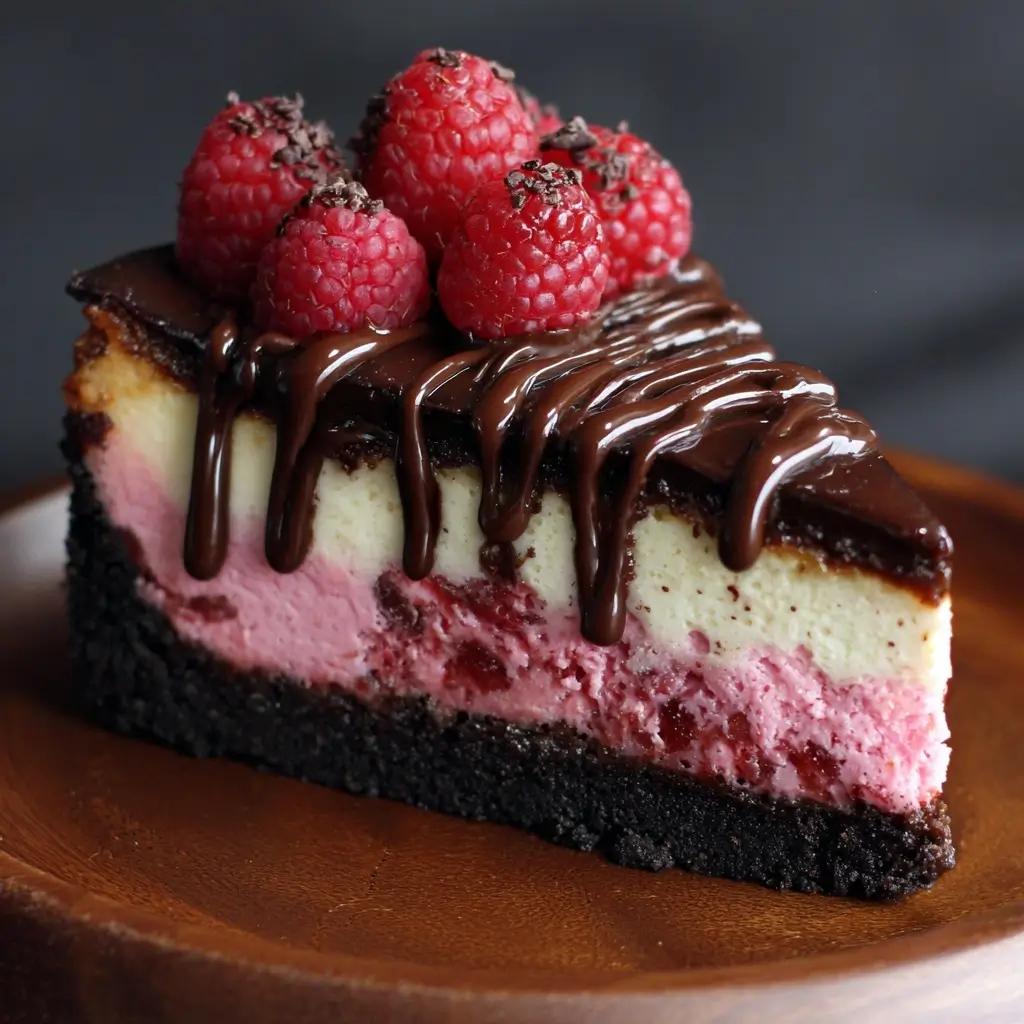
Indulge in the luxurious marriage of rich, velvety dark chocolate and bright, tart raspberries—elevated to decadent perfection in our Dark Chocolate Raspberry Cheesecake. This isn’t just a dessert; it’s a symphony of contrasts: the deep, bittersweet intensity of premium 70% cacao dark chocolate harmonizes with the vibrant acidity and floral sweetness of fresh or frozen raspberries. Creamy New York–style cheesecake forms the luscious, dense foundation, while a buttery dark chocolate cookie crust anchors every bite with subtle crunch and roasted cocoa notes. Whether served at an elegant dinner party, as a celebratory centerpiece, or simply as a soul-soothing weekend treat, this cheesecake delivers sophistication, balance, and unforgettable depth—proving that dessert can be both profoundly comforting and exquisitely refined.
The History
The evolution of the Dark Chocolate Raspberry Cheesecake is a delicious convergence of centuries-old traditions and modern culinary innovation. Cheesecake itself traces its origins to ancient Greece—where early versions made with honey-sweetened cheese and flour were served to athletes at the first Olympic Games in 776 BCE—and later evolved through Roman adaptations before flourishing in Renaissance Europe. The American “New York-style” cheesecake emerged in the late 19th century, popularized by Jewish immigrant bakeries on the Lower East Side of Manhattan, where cream cheese (invented by William Lawrence in 1872) became the creamy cornerstone of dense, oven-baked cakes.
Chocolate entered the Western dessert lexicon much later—after Spanish explorers brought cacao from Mesoamerica in the 16th century—but it wasn’t until the Industrial Revolution that solid chocolate bars became widely available. Dark chocolate, once considered medicinal and overly bitter, gained gourmet appeal in the early 20th century thanks to Swiss and Belgian chocolatiers who mastered conching and precise cocoa bean roasting. Raspberries, native across the Northern Hemisphere and cultivated since the 17th century, were long prized for their delicate flavor and high pectin content—making them ideal for jams, coulis, and elegant garnishes.
The pairing of dark chocolate and raspberry, however, is rooted in classic French *haute pâtisserie*, where flavor affinities are studied like chemistry. Their compatibility lies in science: raspberries’ natural malic and citric acids cut through chocolate’s fat and tannins, while chocolate’s roasted, earthy notes ground the berry’s volatile aromatic compounds (like raspberry ketone). This dynamic duo rose to prominence in fine-dining menus and artisanal bakeries in the 1990s and 2000s—and today, the Dark Chocolate Raspberry Cheesecake stands as a beloved signature dessert in upscale cafés, wedding bakeries, and home kitchens alike—honoring tradition while embracing bold, contemporary flavor storytelling.
Ingredients Breakdown
Every element of this cheesecake is intentionally chosen—not just for taste, but for function, texture, and balance. Here’s why each ingredient matters:
- Graham crackers or dark chocolate wafer cookies (for crust): Provide structure, neutral sweetness, and a hint of caramelized grain. Dark chocolate wafers add extra cocoa depth and visual harmony with the filling.
- Unsalted butter (melted): Binds the crust crumbs and adds richness and sheen. Using unsalted butter gives precise control over sodium levels.
- Cream cheese (full-fat, brick-style, room temperature): The backbone of texture and tang. Must be truly softened (not melted) to ensure smooth, lump-free batter—cold cream cheese causes curdling.
- Granulated sugar: Sweetens and stabilizes the protein matrix in the cheese, contributing to the cake’s characteristic dense-yet-creamy mouthfeel.
- Sour cream & full-fat Greek yogurt (or crème fraîche): Adds acidity for brightness, moisture for tenderness, and a subtle tang that prevents cloying sweetness. Sour cream contributes fat and body; Greek yogurt adds gentle tang and slight thickness.
- Large eggs (room temperature): Act as emulsifiers and leaveners. They provide structure when coagulated gently during baking—but overmixing or overheating leads to cracks. Room temperature ensures even incorporation.
- Vanilla extract (pure, not imitation): Enhances all other flavors with warm, floral, and woody undertones—especially vital for rounding out dark chocolate’s bitterness.
- High-quality dark chocolate (70% cacao minimum, finely chopped or grated): Not cocoa powder—real chocolate adds cocoa butter for silkiness, depth of flavor, and superior melt-in-mouth quality. Avoid “chocolate-flavored” chips with added stabilizers.
- Heavy cream (36–40% fat): Used to melt chocolate smoothly and enrich the batter without thinning it. Its high fat content ensures a luxuriously creamy, non-grainy texture.
- Fresh or frozen (unsweetened) raspberries: Fresh berries offer peak aroma and juiciness; frozen work beautifully year-round (no need to thaw—they’ll release controlled moisture during baking). Avoid canned or syrup-packed berries, which add excess sugar and water.
- Lemon zest and juice: A secret weapon—the citrus oils in zest amplify raspberry’s floral top notes, while the acid balances both chocolate and cream cheese.
- Pinch of fine sea salt: Heightens sweetness, suppresses bitterness, and unifies all flavor components—essential for complexity.
Step-by-Step Recipe
- Prepare the Crust: Preheat oven to 325°F (163°C). In a food processor, pulse 1 ½ cups dark chocolate wafer cookies (about 120g) with 2 tbsp granulated sugar until fine crumbs form. Add 6 tbsp (85g) melted unsalted butter and pulse until moistened and clumping. Press firmly into the bottom and 1 inch up the sides of a 9-inch springform pan lined with parchment on the bottom. Chill for 20 minutes (or freeze for 10) to set.
- Blind-Bake the Crust: Line chilled crust with parchment and fill with pie weights or dried beans. Bake for 12 minutes. Remove weights and parchment; bake 5–6 more minutes until fragrant and dry to the touch. Cool completely on a wire rack.
- Melt the Chocolate: Heat ¾ cup (170g) heavy cream in a small saucepan over medium-low heat until steaming (do not boil). Pour over 10 oz (285g) finely chopped 70% dark chocolate in a heatproof bowl. Let sit 2 minutes, then stir gently until smooth and glossy. Cool to lukewarm (~90°F/32°C)—critical to avoid cooking eggs later.
- Beat the Cream Cheese Base: In a stand mixer fitted with the paddle attachment, beat 24 oz (680g) full-fat cream cheese on medium speed for 2 minutes until ultra-smooth and airy. Scrape bowl. Add 1 cup (200g) granulated sugar and beat 2 more minutes until lightened. Add ⅔ cup (160g) sour cream, ⅓ cup (80g) full-fat Greek yogurt, and 2 tsp pure vanilla extract—beat 1 minute until homogenous.
- Incorporate Eggs Carefully: Add eggs one at a time on low speed, beating just until yolk disappears (about 15 seconds per egg). Scrape bowl thoroughly after each addition. Overbeating incorporates too much air—leading to cracks and collapse.
- Combine Chocolate and Cheese Batter: With mixer on lowest speed, slowly drizzle in the cooled chocolate mixture in a steady stream. Mix only until fully incorporated—no more than 30 seconds. Overmixing causes separation.
- Fold in Raspberries: Gently fold in 1 ¼ cups (165g) fresh or frozen raspberries using a silicone spatula—just until evenly distributed. Avoid crushing berries; a few whole ones should remain intact for bursts of flavor.
- Add Brightness & Balance: Stir in 1 tbsp fresh lemon juice and 1 tsp finely grated lemon zest. Sprinkle in ¼ tsp fine sea salt. Fold 2–3 times to distribute.
- Pour & Smooth: Pour batter into prepared, cooled crust. Tap pan firmly on counter 3x to release air bubbles. Smooth top with an offset spatula. Run a knife around inner edge to prevent sticking during baking.
- Water Bath Baking (Essential): Wrap the *outside* of the springform pan tightly with two layers of heavy-duty aluminum foil (to prevent leaks). Place pan inside a larger roasting pan. Carefully pour hot (not boiling) water into the roasting pan until it reaches halfway up the springform pan’s sides.
- Bake Low & Slow: Place roasting pan in preheated 325°F (163°C) oven. Bake for 1 hour 25 minutes–1 hour 40 minutes. The cheesecake is done when edges are set and center jiggles slightly like Jell-O (not sloshes). A thermometer inserted 1 inch from center should read 150–152°F (65–67°C).
- Cool Gradually (Non-Negotiable): Turn off oven. Crack door open 1 inch with a wooden spoon. Let cheesecake cool in water bath for 1 hour. Remove from water bath; run knife around edge again. Cool on wire rack for 2 hours at room temperature.
- Chill Overnight: Cover loosely with plastic wrap (not touching surface) and refrigerate for *at least 12 hours*, ideally 24–48 hours. This allows textures to fully set, flavors to meld, and slicing to become clean and effortless.
Tips
- Room Temperature Is Non-Negotiable: All dairy—cream cheese, sour cream, yogurt, eggs, and even butter for the crust—must be at true room temperature (68–72°F / 20–22°C) for at least 2 hours before starting. Cold ingredients cause lumps, curdling, and uneven baking.
- Use a Digital Kitchen Scale: Precision matters—especially with cream cheese (24 oz = 680g) and chocolate (10 oz = 285g). Volume measurements (cups) vary wildly with packing and humidity.
- Don’t Skip the Water Bath: It creates gentle, even, humid heat—preventing cracks, drying, and curdling. Foil-wrap technique is critical; test for leaks by filling foil-wrapped pan with water before baking.
- Chill the Pan Before Adding Batter: A cool crust prevents premature melting of the batter’s fats and helps maintain sharp edges during baking.
- Freeze Raspberries? No Thawing Needed: Toss frozen berries in 1 tsp cornstarch before folding in—this absorbs excess juice and prevents soggy pockets.
- Resist the Urge to Rush Cooling: Sudden temperature shifts are the #1 cause of cracks. The oven-door-crack method is essential. Never refrigerate a warm cake—it will sweat and weep.
- Sharp Knife, Hot Water, Clean Wipe: For perfect slices: dip a thin, sharp chef’s knife in hot water, wipe dry, slice, repeat. Warm the knife—not the cake.
- Crust Too Crumbly?: Add 1 tsp cold water or extra melted butter, ½ tsp at a time, until it holds together when pinched.
- No Springform? Use a Cake Pan + Foil Lining: Line a 9-inch round cake pan with two overlapping sheets of heavy-duty foil, extending well over edges. Grease foil thoroughly. Lift out by foil tabs after chilling.
- Save Leftover Berry Coulis: Simmer reserved raspberries (see Variations) with 1 tbsp sugar and 1 tsp lemon juice until broken down. Strain, cool, and swirl into unbaked batter—or drizzle over finished slices.
Variations and Customizations
- Gluten-Free Version: Substitute certified GF dark chocolate cookies (like Schär Chocolate Wafers) or GF graham crackers. Ensure all other ingredients (vanilla, baking powder if used) are certified gluten-free.
- Vegan Adaptation: Use soaked cashews (blended with coconut cream, maple syrup, lemon, and melted vegan dark chocolate) for the filling; GF oat or almond flour crust with coconut oil. Note: texture and baking behavior differ significantly—requires dedicated vegan cheesecake methodology.
- White Chocolate-Raspberry Swirl: Reserve ½ cup batter. Melt 4 oz white chocolate with 2 tbsp cream; cool. Swirl into main batter with a knife before baking for marbled elegance.
- Espresso-Dark Chocolate Fusion: Dissolve 1 ½ tsp instant espresso powder into the warm cream before melting chocolate—enhances chocolate’s depth without adding bitterness.
- Boozy Infusion: Add 1 tbsp Chambord (raspberry liqueur) or Grand Marnier to the batter with the vanilla. Reduce lemon juice by ½ tsp to preserve balance.
- Layered Raspberry Jam Core: After pouring half the batter, spread ⅓ cup seedless raspberry jam (simmered with 1 tsp lemon juice and cooled) in a thin layer. Top with remaining batter and bake as directed.
- Decadent Ganache Topping: After chilling, prepare a 2:1 dark chocolate ganache (8 oz chocolate + ½ cup hot cream), cool to thick-pouring consistency, and pour over top. Let set 2 hours before slicing.
- Nutty Crust Upgrade: Add ¼ cup finely toasted walnuts or hazelnuts to crust crumbs for earthy crunch and complementary tannins.
- Mini Individual Cheesecakes: Bake in lined muffin tins (with foil or paper liners) at 325°F for 22–26 minutes. Cool in pan 10 min, then chill 8+ hours. Garnish with single fresh raspberry.
- Seasonal Fruit Swaps: Blackberries (earlier summer), boysenberries (late summer), or poached dried figs (fall) offer stunning alternatives—adjust lemon/zest to match fruit acidity.
Health Considerations and Nutritional Value
This Dark Chocolate Raspberry Cheesecake is undeniably indulgent—but mindful preparation allows for nuanced enjoyment within a balanced diet. Let’s explore its nutritional landscape honestly and constructively:
Nutrient Highlights:
- Antioxidant Powerhouse: Dark chocolate (70%+) delivers flavanols—linked to improved endothelial function, reduced oxidative stress, and modest blood pressure support. Raspberries contribute ellagic acid, vitamin C, and anthocyanins—potent anti-inflammatory compounds.
- Fiber & Phytonutrients: One serving (1/12 of cake) provides ~2g dietary fiber (from berries and crust), supporting gut health and satiety. Raspberries are among the highest-fiber fruits (8g per cup).
- Healthy Fats: Cocoa butter contains stearic acid—a saturated fat shown in studies to have a neutral effect on LDL cholesterol when consumed in moderation. The monounsaturated fats in nuts (if added to crust) and dairy contribute to heart-healthy lipid profiles.
- Calcium & Protein: Cream cheese and yogurt supply bioavailable calcium and high-quality dairy protein—supporting bone density and muscle maintenance.
Mindful Considerations:
- Sugar Content: While raspberries contain natural sugars, the recipe uses moderate added sugar (1 cup total for entire cake = ~30g per slice). Opt for organic cane sugar or coconut sugar for trace minerals—but note: all caloric sweeteners impact blood glucose similarly.
- Saturated Fat: Dairy fat is nutrient-dense but calorie-concentrated. A standard slice contains ~18–22g total fat, ~11g saturated. Enjoying 1–2 slices weekly fits comfortably within most heart-healthy guidelines (AHA recommends <13g sat fat/day for 2,000-calorie diet).
- Portion Mindfulness: The rich density means smaller servings satisfy deeply. Serve 1.5-inch slices—not 2-inch wedges—and pair with herbal tea or a small handful of almonds to slow sugar absorption.
- Allergen Notes: Contains dairy, eggs, wheat (unless GF crust used), and soy (often in chocolate). Always check chocolate labels for shared equipment warnings if severe allergies exist.
- Not Low-Carb or Keto-Friendly: Due to sugar and grain-based crust. For keto adaptation, use almond flour + cocoa powder crust, erythritol/monk fruit blend, and reduce berries to ½ cup (accounting for net carbs).
Ultimately, this cheesecake shines as a joyful, intentional treat—not “health food,” but *food with health-supportive qualities* when savored consciously, in appropriate portions, and as part of an overall nutrient-rich, varied diet.
Ingredients
For the Dark Chocolate Cookie Crust:
- 1 ½ cups (120g) dark chocolate sandwich cookies (e.g., Nabisco Famous Chocolate Wafers), finely crushed (or GF equivalent)
- 2 tablespoons (25g) granulated sugar
- 6 tablespoons (85g) unsalted butter, melted and cooled slightly
For the Dark Chocolate Raspberry Cheesecake Filling:
- 24 ounces (680g) full-fat brick-style cream cheese, at room temperature (do NOT use whipped or low-fat)
- 1 cup (200g) granulated sugar
- ⅔ cup (160g) full-fat sour cream
- ⅓ cup (80g) full-fat plain Greek yogurt (or crème fraîche)
- 2 large eggs + 1 large egg yolk (all at room temperature)
- 2 teaspoons pure vanilla extract
- 10 ounces (285g) high-quality dark chocolate (70–72% cacao), finely chopped
- ¾ cup (170g) heavy cream (36–40% fat)
- 1 ¼ cups (165g) fresh or unsweetened frozen raspberries
- 1 tablespoon (15ml) fresh lemon juice
- 1 teaspoon (3g) finely grated lemon zest
- ¼ teaspoon fine sea salt
Directions
- Prep & Preheat: Center rack in oven. Preheat to 325°F (163°C). Lightly grease the bottom and sides of a 9-inch springform pan. Line bottom with parchment paper (cut to fit); set aside.
- Make the Crust: In a food processor, combine crushed chocolate cookies and 2 tbsp sugar. Pulse until fine, sandy crumbs form. Add melted butter and pulse until mixture resembles wet sand and holds together when pinched. Press firmly and evenly into bottom and 1 inch up sides of prepared pan. Refrigerate 20 minutes (or freeze 10) to firm.
- Blind-Bake Crust: Line chilled crust with parchment paper. Fill with pie weights or dried beans. Bake 12 minutes. Carefully remove weights and parchment. Return crust to oven and bake 5–6 minutes more until dry, matte, and fragrant. Cool completely on wire rack—minimum 30 minutes.
- Melt Chocolate: In a small saucepan, heat heavy cream over medium-low heat until steaming and tiny bubbles appear at edges (do not boil). Meanwhile, place chopped chocolate in heatproof bowl. Pour hot cream over chocolate. Let sit 2 minutes. Stir gently with silicone spatula in concentric circles until smooth, glossy, and fully melted. Set aside to cool to lukewarm (~90°F / 32°C)—stir occasionally. Do not rush this step.
- Beat Cream Cheese Base: Using stand mixer with paddle attachment (or hand mixer), beat cream cheese on medium speed for 2 minutes until completely smooth, creamy, and free of lumps. Scrape bowl. Add sugar; beat 2 minutes until lightened and fluffy. Scrape bowl. Add sour cream, Greek yogurt, and vanilla; beat 1 minute on medium until fully combined and silky.
- Add Eggs: Reduce speed to low. Add eggs one at a time, beating just until yolk disappears (approx. 15 seconds each). Add egg yolk last. Scrape bowl thoroughly after each addition. Batter should be thick and cohesive—no streaks.
- Incorporate Chocolate: With mixer on lowest speed, slowly drizzle in cooled chocolate mixture in a thin, steady stream. Mix only until fully blended—about 25–30 seconds. Stop immediately when uniform. Overmixing causes separation.
- Fold in Berries & Brightness: Gently fold in raspberries with silicone spatula—just until evenly dispersed, leaving many whole. Add lemon juice, lemon zest, and salt. Fold 2–3 times until just combined.
- Fill & Smooth: Pour batter into cooled crust. Tap pan firmly on counter 3 times to release air bubbles. Smooth top with offset spatula. Run thin knife around inner edge to loosen batter from pan.
- Prepare Water Bath: Place springform pan inside a larger roasting pan. Wrap *entire outer surface* of springform pan tightly with two overlapping layers of heavy-duty aluminum foil—ensure no gaps or tears. Test seal by placing wrapped pan in sink and filling roasting pan with 1 inch warm water. If no leaks, proceed.
- Bake: Carefully pour hot (not boiling) water into roasting pan until it reaches halfway up springform pan’s sides. Place roasting pan on center oven rack. Bake 1 hour 25 minutes to 1 hour 40 minutes. Cheesecake is done when edges are puffed and set, and center jiggles slightly (like Jell-O) when gently shaken. Internal temp should read 150–152°F (65–67°C).
- Cool Gradually: Turn oven off. Crack oven door open 1 inch using wooden spoon. Leave cheesecake in water bath inside oven for 1 hour. Carefully lift springform pan out of water bath. Run knife around edge again. Cool on wire rack for 2 hours at room temperature.
- Chill Thoroughly: Cover loosely with plastic wrap (tented so it doesn’t touch surface). Refrigerate for minimum 12 hours—ideally 24–48 hours—for optimal texture, clean slicing, and flavor development.
- Serve: Run warm knife around edge before releasing springform latch. Slide thin metal spatula under crust to lift onto serving platter. Slice with hot, clean knife between servings. Optional garnishes: fresh raspberries, edible flowers, dark chocolate curls, or a light dusting of cocoa powder.
FAQ
- Can I make this cheesecake ahead of time?
- Absolutely—and it’s highly recommended! This cheesecake tastes even better after 48 hours of chilling. It keeps beautifully, covered, in the refrigerator for up to 5 days. You can also freeze unfrosted, fully chilled cheesecake (wrapped tightly in plastic + foil) for up to 3 months. Thaw overnight in fridge before serving.
- Why did my cheesecake crack?
- Cracks usually stem from rapid temperature change (cooling too fast), overmixing the batter (incorporating too much air), or overbaking. Always use a water bath, cool gradually in the oven, and rely on jiggle-test—not time—to determine doneness. Also, avoid opening the oven door during the first 75 minutes of baking.
- Can I use milk or semi-sweet chocolate instead of dark?
- You can—but the flavor profile changes dramatically. Milk chocolate adds excessive sweetness and masks raspberry’s brightness. Semi-sweet (50–60%) works in a pinch but lacks the sophisticated bitterness that balances the fruit. For authenticity and balance, stick with 70% or higher.
- My batter looks curdled—did I ruin it?
- Not necessarily. Curdling often occurs if cream cheese was too cold or if cold eggs were added to warm chocolate. As long as you continued mixing gently on low speed and the batter smoothed out, it will likely bake beautifully. Next time, ensure *all* ingredients are truly room temperature.
- Can I omit the sour cream or yogurt?
- Not without significant trade-offs. These ingredients provide essential moisture, acidity, and tenderizing power. Substituting with more cream cheese makes the cake dense and chalky; using milk or half-and-half adds unwanted water and causes cracking. If allergic, crème fraîche is the closest functional substitute.
- How do I prevent a soggy crust?
- Blind-baking is key. Ensure the crust is fully cooled before adding batter. Also, tossing frozen raspberries in 1 tsp cornstarch before folding in helps absorb excess juice released during baking.
- Is a water bath really necessary?
- Yes—for this recipe, it is indispensable. The humid, gentle heat prevents surface drying, curdling, and cracking while ensuring even, slow setting of the delicate proteins. Skipping it risks a fragile, uneven