Introduction
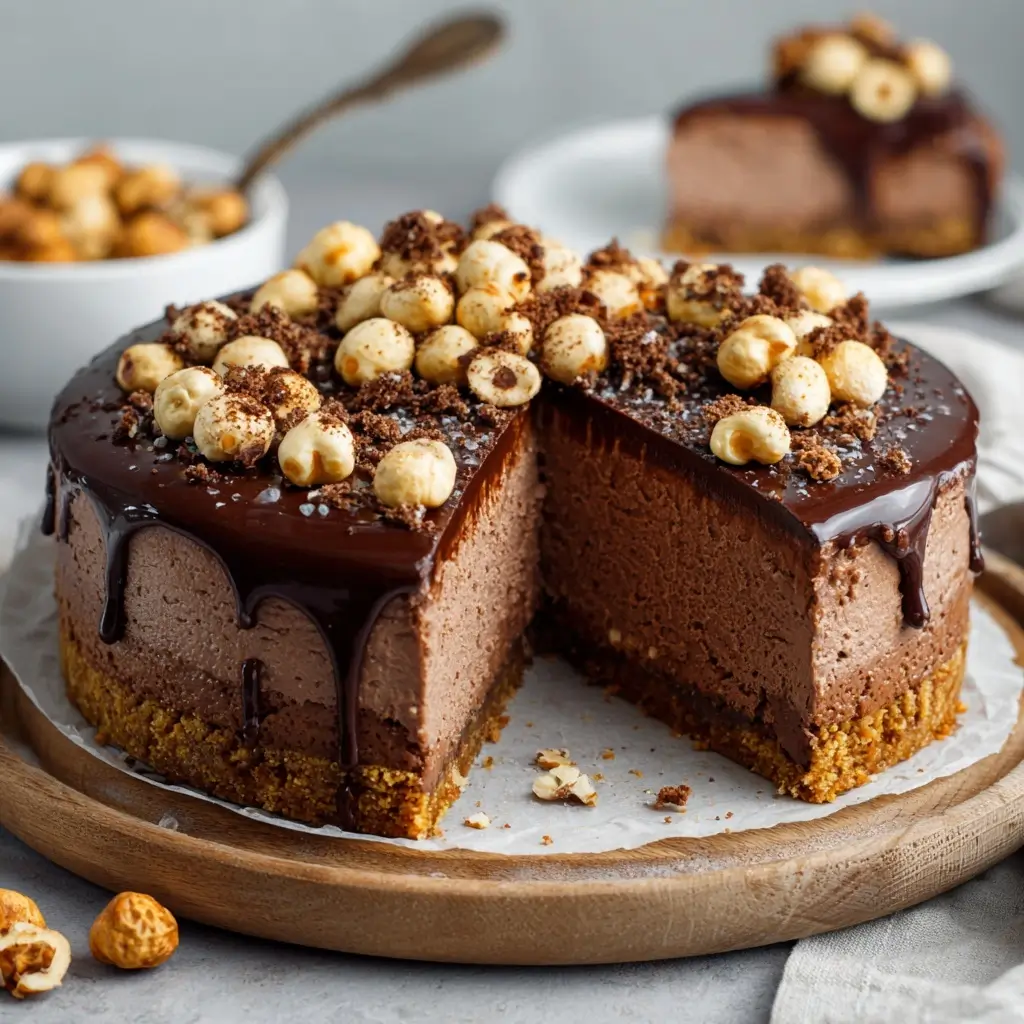
Indulge in the luxurious marriage of rich chocolate and toasted hazelnut—a decadent symphony reimagined in cheesecake form. The Chocolate Hazelnut Cheesecake is more than a dessert; it’s an experience—an elegant fusion of velvety New York–style creaminess, deep cocoa intensity, and the warm, nutty aroma of roasted hazelnuts. Whether served at a milestone celebration, a quiet dinner for two, or as a weekend treat that feels like self-care in edible form, this dessert commands attention with every slice. Its glossy ganache top, crumbly praline-studded crust, and whisper-thin layer of silky Nutella-infused filling deliver layers of texture and flavor that evolve from first bite to final crumb—making it not just a cake, but a narrative told in cocoa butter, cream cheese, and caramelized nuts.
The History
The origins of the Chocolate Hazelnut Cheesecake are delightfully layered—like the dessert itself—rooted in centuries of culinary evolution across Europe and North America. Cheesecake traces its lineage back to ancient Greece, where early versions made with honey-sweetened cheese and flour were served to athletes at the first Olympic Games in 776 BCE. By the Renaissance, Italian ricotta- and mascarpone-based cheesecakes flourished, while German and Eastern European bakers developed dense, baked quark- or farmer’s cheese cakes. In the United States, the modern “New York” style emerged in the early 20th century, popularized by Arnold Reuben and later perfected by Leo Strohm at Lindy’s Restaurant—characterized by its dense, ultra-creamy texture achieved through full-fat cream cheese, sour cream, and precise water-bath baking.
Meanwhile, hazelnuts have been cultivated in the Mediterranean and Black Sea regions since 4000 BCE. Italy’s Piedmont region became globally synonymous with premium hazelnuts—particularly the prized Tonda Gentile Trilobata—and by the 1940s, Pietro Ferrero transformed wartime cocoa shortages into innovation: grinding hazelnuts into paste, adding minimal cocoa, and creating Gianduja—a precursor to Nutella® (launched in 1964). As Nutella gained worldwide affection and artisanal chocolate-making surged in the late 20th century, home bakers and patisseries began experimenting—marrying Ferrero’s legacy with American cheesecake technique. The Chocolate Hazelnut Cheesecake thus represents a transatlantic love story: Old World nut craftsmanship meets New World dairy mastery, refined over decades into what we now savor as a globally beloved gourmet dessert.
Ingredients Breakdown
Every element in this recipe serves both functional and sensory purpose—no ingredient is arbitrary. Below is a meticulous breakdown of *why* each component matters:
- Graham Cracker Crust Base: Graham crackers provide structure and subtle molasses sweetness. Their fine crumb yields a tender yet sturdy foundation that won’t disintegrate under the weight of the filling—especially critical when soaked with melted butter and brown sugar syrup.
- Toasted Hazelnuts (Whole & Ground): Toasting unlocks volatile aromatic compounds (like pyrazines and aldehydes), transforming raw nuttiness into deep, roasted, almost coffee-like complexity. Skinning removes bitter tannins and ensures smooth texture—both in the crust and in the praline swirl. Finely ground hazelnuts integrate seamlessly; coarsely chopped add delightful crunch in the garnish.
- Unsweetened Dutch-Process Cocoa Powder: Alkalized to neutralize acidity, it delivers intense, mellow chocolate flavor without bitterness—ideal for balancing the richness of cream cheese. Its fine particle size dissolves evenly and contributes to a darker, more uniform color.
- High-Quality Bittersweet Chocolate (68–72% cacao): Contains sufficient cocoa butter to melt smoothly and emulsify into the batter without seizing. Avoid chocolate chips—they contain stabilizers that hinder proper incorporation and can cause graininess.
- Full-Fat Cream Cheese (Brick Style, Not Spreadable): Must be at true room temperature (68–72°F/20–22°C)—not just “softened.” Cold cream cheese creates lumps; overheated or microwaved cheese breaks its emulsion. Philadelphia-brand or similar high-butterfat varieties yield optimal density and tang.
- Sour Cream & Heavy Cream: Sour cream adds acidity to balance sweetness and contributes fat + moisture for tenderness. Heavy cream (not half-and-half or milk) supplies additional dairy fat and viscosity—critical for preventing cracks and yielding a luxuriously satiny mouthfeel.
- Granulated & Brown Sugar: Granulated sugar dissolves cleanly and aids in aeration during mixing. Brown sugar (dark preferred) introduces molasses notes that harmonize with hazelnut and deepen chocolate flavor—plus its moisture helps retain chewiness in the crust.
- Pure Vanilla Extract & Hazelnut Extract: Madagascar bourbon vanilla provides floral, woody warmth; natural hazelnut extract (not imitation) amplifies roasted nuance without artificial aftertaste. Alcohol-based extracts fully integrate and volatilize during baking, leaving only pure aroma.
- Large Eggs (Room Temperature): Essential for proper emulsification and leavening. Cold eggs cause the batter to seize; overly warm eggs risk premature cooking. Add one at a time, mixing just until incorporated—overbeating incorporates excess air, leading to collapse or cracking.
- Espresso Powder (Optional but Recommended): A mere ½ tsp enhances chocolate’s depth via umami synergy without imparting coffee flavor—a classic “secret weapon” used by professional chocolatiers.
- Heavy Whipping Cream (for Ganache): Heated to scalding (180°F/82°C) to fully melt chocolate and create a stable, glossy emulsion. The high fat content ensures a firm set at room temperature yet creamy melt-on-the-tongue.
- Sea Salt Flakes (Maldon or Fleur de Sel): Applied post-baking, these delicate crystals offer bursts of salinity that cut through sweetness and elevate every other flavor—acting as the “bridge” between chocolate, hazelnut, and cream.
Step-by-Step Recipe
- Prep & Toast Hazelnuts (1 hr ahead): Preheat oven to 350°F (175°C). Spread 1½ cups raw hazelnuts on a parchment-lined baking sheet. Roast 10–12 minutes, shaking pan halfway, until fragrant and skins blister. Transfer to a clean kitchen towel, fold edges over nuts, and rub vigorously for 60 seconds to remove ~90% of skins. Cool completely. Reserve ¼ cup whole toasted nuts for garnish; finely grind ¾ cup for crust; coarsely chop remaining ½ cup for praline swirl.
- Make Crust (15 min + 30 min chill): Pulse 1½ cups graham cracker crumbs (about 12 full sheets), ¼ cup brown sugar, 2 tbsp granulated sugar, ¼ tsp salt, and ¾ cup finely ground hazelnuts in food processor until uniform. Add 6 tbsp unsalted butter (melted and cooled) and 2 tbsp honey; pulse until mixture resembles wet sand. Press firmly into bottom and 1 inch up sides of a 9-inch springform pan lined with parchment. Chill 30+ minutes—or freeze 15 min—to set.
- Prepare Water Bath (Crucial!): Wrap *outside* of springform pan tightly with two overlapping layers of heavy-duty aluminum foil (prevents leaks). Place pan inside a larger roasting pan. Boil kettle water—enough to reach halfway up springform sides.
- Make Filling (25 min prep): Using stand mixer with paddle attachment, beat 24 oz (3 bricks) room-temp cream cheese on medium-low 2 minutes until perfectly smooth—scrape bowl often. Add 1 cup granulated sugar + ½ cup brown sugar; beat 2 min until fluffy. Scrape down. Add 1 cup room-temp sour cream, ½ cup heavy cream, 2 tsp vanilla, 1 tsp hazelnut extract, and 1 tsp espresso powder; mix 1 min. Melt 8 oz bittersweet chocolate (chopped) with ¼ cup cocoa powder in microwave (30-sec bursts, stirring) or double boiler until fluid and glossy. Cool to 90°F (32°C). With mixer on low, slowly drizzle in cooled chocolate mixture—beat 1 minute until homogenous. Add 4 large room-temp eggs one at a time, mixing *just until yolk disappears* after each (≈15 sec). Overmixing = cracks. Gently fold in ½ cup coarsely chopped toasted hazelnuts.
- Bake with Precision: Pour filling over chilled crust. Smooth top. Carefully place springform pan into roasting pan. Pour hot water into roasting pan until it reaches halfway up springform. Bake at 325°F (165°C) for 1 hour 15 minutes—edges should be set, center should jiggle like Jell-O (not liquid). Turn off oven, crack door open 2 inches with wooden spoon, let cool inside oven 1 hour. Remove from water bath. Run thin knife around edge to loosen. Chill *uncovered* 12+ hours (ideally 24) in fridge—this sets texture, deepens flavor, and prevents condensation.
- Make Hazelnut Praline Swirl (Optional but Stunning): While cake chills, make praline: Combine ½ cup sugar + 2 tbsp water in small saucepan. Cook over medium heat (no stirring!) until amber (340°F/170°C). Off heat, whisk in 2 tbsp heavy cream, 1 tbsp butter, 1 tsp vanilla, pinch salt. Stir in ⅓ cup finely ground hazelnuts. Cool 10 min. Before serving, dollop 3–4 tsp praline onto chilled cake surface and drag with toothpick in concentric circles.
- Ganache Finish: Heat 1 cup heavy cream until steaming (do not boil). Pour over 8 oz finely chopped dark chocolate (68–72%). Let sit 3 min. Whisk gently from center outward until smooth and glossy. Cool 15 min until thickened but still pourable. Pour over chilled cake, tilting pan to cover evenly. Refrigerate 30 min to set.
- Final Garnish & Serve: Unmold cake: Warm side of pan with kitchen torch or hot towel for 10 sec. Release latch and lift off ring. Place on serving plate. Sprinkle with flaky sea salt and reserved whole toasted hazelnuts. Slice with a *hot, dry knife* (dip in hot water, wipe dry between cuts) for clean edges.
Tips
- Temperature Is Non-Negotiable: All dairy and eggs must be truly room temperature—not just “out of the fridge.” Leave cream cheese out 4–6 hours (or overnight, covered); eggs 2 hours. Cold ingredients cause lumps, poor emulsification, and uneven baking.
- No Substitutions for Full-Fat Dairy: Low-fat cream cheese yields watery, crumbly texture. Sour cream cannot be replaced with yogurt (too acidic/thin) or Greek yogurt (too thick/grainy). Heavy cream is essential—half-and-half lacks fat to stabilize structure.
- Water Bath Mastery: Foil wrapping must be *leak-proof*. Test by pouring ¼ cup water into foil-wrapped pan before adding batter. If water seeps in, rewrap. Use boiling water—not warm—to maintain consistent oven temp.
- Patience with Chilling: Do not skip the 12+ hour refrigeration. This allows proteins to relax, fats to fully solidify, and flavors to meld. Cutting too soon causes smearing and loss of defined layers.
- Avoid Overmixing at All Costs: Especially after adding eggs. Mix on lowest speed possible. Stop the moment the batter looks uniform. Overbeaten batter traps air bubbles that expand then collapse—causing cracks and sunken centers.
- Crack Prevention Trio: (1) Room-temp ingredients, (2) Water bath, (3) Gradual cooling (oven-off rest). If cracks appear, they’re cosmetic—cover with ganache or praline swirl.
- Cutting Like a Pro: Use a long, thin, non-serrated knife. Heat under hot tap water, dry *thoroughly*, slice, then repeat. Wiping the knife clean between slices prevents dragging.
- Storage Wisdom: Keep covered in fridge up to 5 days. Freeze unfrosted cake (well-wrapped) up to 3 months—thaw overnight in fridge before glazing and serving.
Variations and Customizations
- Gluten-Free Version: Swap graham crackers for gluten-free honey graham-style cookies or almond flour + oat flour blend (1:1 ratio). Verify all extracts and chocolate are GF-certified.
- Vegan Adaptation: Use soaked cashews (blended smooth) + silken tofu base; coconut cream instead of sour cream/heavy cream; date paste + maple syrup for sweetener; vegan chocolate; hazelnut butter instead of extracts. Requires precise pH balancing (add 1 tsp apple cider vinegar) and no-bake chilling.
- Decadent Layered Version: After first bake and chill, spread ½ cup salted caramel between cake and ganache. Or pipe a ring of Nutella around outer edge before ganache for a hidden “chocolate river.”
- Mini Individual Cheesecakes: Use lined muffin tin. Reduce bake time to 22–26 minutes. Chill 6+ hours. Top with mini praline pearls and gold leaf for elegance.
- Spiced Variation: Add ½ tsp ground cardamom + ¼ tsp cinnamon to crust; infuse cream for ganache with star anise or orange zest.
- Boozy Upgrade: Fold 2 tbsp Frangelico or Amaretto into filling with extracts. Brush cooled cake base with 1 tbsp liqueur before ganache.
- White Chocolate-Hazelnut: Replace bittersweet chocolate with 8 oz high-quality white chocolate + increase cocoa powder to 3 tbsp for depth. Garnish with candied hazelnuts.
- Raw No-Bake Option: Blend soaked cashews, dates, coconut oil, cocoa, hazelnut butter, and vanilla. Press into crust, chill 8+ hours. Soak in luxury—but lacks baked cheesecake’s signature density.
Health Considerations and Nutritional Value
This Chocolate Hazelnut Cheesecake is intentionally crafted as an occasional indulgence—not an everyday food—but it does offer meaningful nutritional attributes when viewed holistically. Per standard slice (1/12 of 9-inch cake, approx. 280g), estimates are: Calories: 620–680 | Total Fat: 44–48g (26–29g saturated) | Carbohydrates: 48–52g (38–42g sugars) | Protein: 9–11g | Fiber: 3–4g | Sodium: 320–360mg.
Nutrient Highlights:
- Hazelnuts: Rich in monounsaturated fats (heart-healthy oleic acid), vitamin E (a potent antioxidant), magnesium (supports nerve/muscle function), and dietary fiber—contributing ~3g fiber per slice and supporting gut microbiota diversity.
- Dark Chocolate (70%+): Contains flavanols linked to improved endothelial function, reduced blood pressure, and enhanced cognitive blood flow. Antioxidant ORAC value is significantly higher than milk chocolate or cocoa powder alone.
- Probiotic Potential: Full-fat dairy provides conjugated linoleic acid (CLA) and bioavailable calcium—especially when sourced from grass-fed cows. Sour cream adds trace beneficial bacteria (though heat-treated, residual enzymes may support digestion).
Mindful Modifications: Reduce sugar by 25% (replace with erythritol + monk fruit blend for keto-friendly version); use low-sodium butter and omit added salt; substitute ¼ cup cream cheese with Greek yogurt to lower fat slightly; add 2 tbsp ground flaxseed to crust for omega-3s and extra fiber. Note: “Light” or “reduced-fat” versions compromise structural integrity and mouthfeel—this recipe celebrates ingredient integrity over compromise.
Dietary Notes: Naturally contains gluten (graham crackers), dairy, eggs, and tree nuts. Not suitable for those with severe allergies. Vegan, paleo, or keto versions require full reformulation—not simple swaps—as core chemistry changes drastically.
Ingredients
For the Hazelnut-Graham Crust:
- 1½ cups graham cracker crumbs (about 12 full rectangles)
- ¾ cup finely ground toasted hazelnuts (from ~1 cup whole)
- ¼ cup packed dark brown sugar
- 2 tablespoons granulated sugar
- ¼ teaspoon fine sea salt
- 6 tablespoons unsalted butter, melted and cooled
- 2 tablespoons mild honey (e.g., clover or orange blossom)
For the Chocolate Hazelnut Cheesecake Filling:
- 24 ounces full-fat brick-style cream cheese (3 x 8-oz packages), room temperature
- 1 cup granulated sugar
- ½ cup packed dark brown sugar
- 1 cup full-fat sour cream, room temperature
- ½ cup heavy whipping cream, room temperature
- 2 teaspoons pure vanilla extract
- 1 teaspoon natural hazelnut extract
- 1 teaspoon instant espresso powder (optional but recommended)
- 8 ounces high-quality bittersweet chocolate (68–72% cacao), finely chopped
- ¼ cup unsweetened Dutch-process cocoa powder
- 4 large eggs, room temperature
- ½ cup coarsely chopped toasted hazelnuts
For the Hazelnut Praline Swirl (Optional but Highly Recommended):
- ½ cup granulated sugar
- 2 tablespoons water
- 2 tablespoons heavy cream
- 1 tablespoon unsalted butter
- 1 teaspoon pure vanilla extract
- Pinch of fine sea salt
- ⅓ cup finely ground toasted hazelnuts
For the Dark Chocolate Ganache:
- 1 cup heavy whipping cream
- 8 ounces high-quality dark chocolate (68–72% cacao), finely chopped
For Garnish:
- ¼ cup whole toasted hazelnuts, roughly chopped
- Fine flaky sea salt (e.g., Maldon or Fleur de Sel)
Directions
- Toast and Skin Hazelnuts: Preheat oven to 350°F (175°C). Spread 1 cup raw hazelnuts on a parchment-lined rimmed baking sheet. Roast 10–12 minutes, until deeply fragrant and skins blister and darken. Immediately transfer to a clean kitchen towel. Fold towel over nuts and rub vigorously for 60 seconds to loosen skins. Discard loose skins (some stubborn bits are fine). Cool completely on wire rack. Reserve ¼ cup whole nuts for garnish. Finely grind ¾ cup for crust. Coarsely chop remaining ½ cup for filling swirl.
- Prepare Crust: In food processor, combine graham cracker crumbs, ¾ cup ground hazelnuts, brown sugar, granulated sugar, and salt. Pulse until uniform. Add melted butter and honey; pulse until mixture resembles damp sand and holds together when pinched. Press firmly and evenly into bottom and 1 inch up sides of 9-inch springform pan lined with parchment. Chill at least 30 minutes (or freeze 15 minutes).
- Set Up Water Bath: Wrap *outside* of chilled springform pan tightly with two overlapping sheets of heavy-duty aluminum foil—ensure no gaps at base or seams. Place foil-wrapped pan inside a large roasting pan. Set aside.
- Make Filling: Using stand mixer with paddle attachment, beat cream cheese on medium-low 2 minutes until completely smooth and lump-free—scrape bowl and beater thoroughly. Add both sugars; beat 2 minutes until light and fluffy. Scrape bowl. Add sour cream, heavy cream, vanilla, hazelnut extract, and espresso powder; beat 1 minute until combined. In separate bowl, melt chocolate and cocoa powder in microwave (30-sec bursts, stirring between) or double boiler until smooth and glossy. Cool to 90°F (32°C)—test with thermometer or wrist-test (warm, not hot). With mixer on low, slowly drizzle in chocolate mixture; beat 1 minute until fully incorporated. Add eggs one at a time, mixing on low *just until yolk disappears* (≈15 seconds per egg). Gently fold in coarsely chopped hazelnuts with spatula.
- Bake: Pour filling over chilled crust. Smooth top with offset spatula. Carefully place springform pan into roasting pan. Pour enough boiling water into roasting pan to reach halfway up sides of springform. Bake at 325°F (165°C) for 1 hour 15 minutes—cake should be puffed, edges set, and center should jiggle slightly like firm Jell-O (not slosh). Turn off oven, crack door open 2 inches with wooden spoon, and let cake cool inside oven for 1 hour. Carefully remove from water bath. Run thin knife around edge to loosen. Cool on wire rack 1 hour at room temperature. Refrigerate *uncovered* for minimum 12 hours (preferably 24) to fully set and develop flavor.
- Make Praline Swirl (Optional): While cake chills, combine sugar and water in small heavy-bottomed saucepan. Cook over medium heat—do not stir—until mixture turns deep amber (~340°F/170°C, 6–8 min). Immediately remove from heat. Carefully whisk in heavy cream (it will bubble vigorously), butter, vanilla, and salt until smooth. Whisk in ground hazelnuts. Cool 10 minutes until thick but pourable.
- Finish with Ganache: Heat heavy cream in small saucepan until steaming (180°F/82°C)—do not boil. Pour over chopped chocolate in heatproof bowl. Let sit 3 minutes. Gently whisk from center outward until smooth and glossy. Cool 15 minutes until thickened but still fluid. Pour over chilled cake, tilting pan to coat evenly. Refrigerate 30 minutes.
- Unmold & Garnish: To release: Warm side of pan with kitchen torch or hot damp towel for 10 seconds. Open latch and lift off outer ring. Place cake on serving platter. Drizzle with 3–4 tsp praline (if using) and swirl with toothpick. Sprinkle with flaky sea salt and reserved whole toasted hazelnuts.
- Serve: Cut with hot, dry knife (dip in hot water, wipe dry between slices). Best served chilled, but allow 15 minutes at room temperature for optimal creaminess and flavor bloom.
FAQ
- Can I make this without a water bath?
- No—water bath is non-negotiable for this recipe. It moderates oven temperature, prevents rapid expansion/cracking, and ensures gentle, even cooking. Skipping it risks severe cracking, curdling, or dry, rubbery texture. If foil-wrapping intimidates you, use a slow cooker liner bag inside the roasting pan as backup seal.
- Why did my cheesecake crack?
- Most common causes: (1) Overmixing after adding eggs, (2) Sudden temperature change (opening oven door early or cooling too fast), (3) Under-chilling before unmolding, (4) Overbaking (center should jiggle). Cracks are purely cosmetic—ganache hides them beautifully.
- Can I use Nutella instead of pure hazelnut extract/chocolate?
- Nutella is not recommended in the filling—it contains palm oil, skim milk, and stabilizers that destabilize the delicate emulsion, causing separation or greasiness. Use *pure* hazelnut extract and high-cocoa chocolate for control and quality. Nutella works well *as a swirl* if swirled in sparingly pre-bake—but expect slight textural variance.
- How do I store leftovers?
- Keep tightly covered in refrigerator for up to 5 days. For longer storage, freeze *unfrosted* cake (wrap in plastic + foil) up to 3 months. Thaw overnight in fridge, then apply ganache and garnish before serving.
- Can I bake this in a regular cake pan?
- No—springform is essential for clean release and water bath compatibility. A fixed-bottom pan will leak, ruin the crust, and make unmolding impossible without destruction.
- What if I don’t have hazelnut extract?
- You can omit it—but the nuanced roasted-hazelnut aroma will be less pronounced. Boost with 1 extra tablespoon of finely ground toasted hazelnuts in the filling, or infuse the sour cream by warming it gently with 2 tbsp ground hazelnuts, steeping 10 minutes, then straining.
- Is there a