Introduction
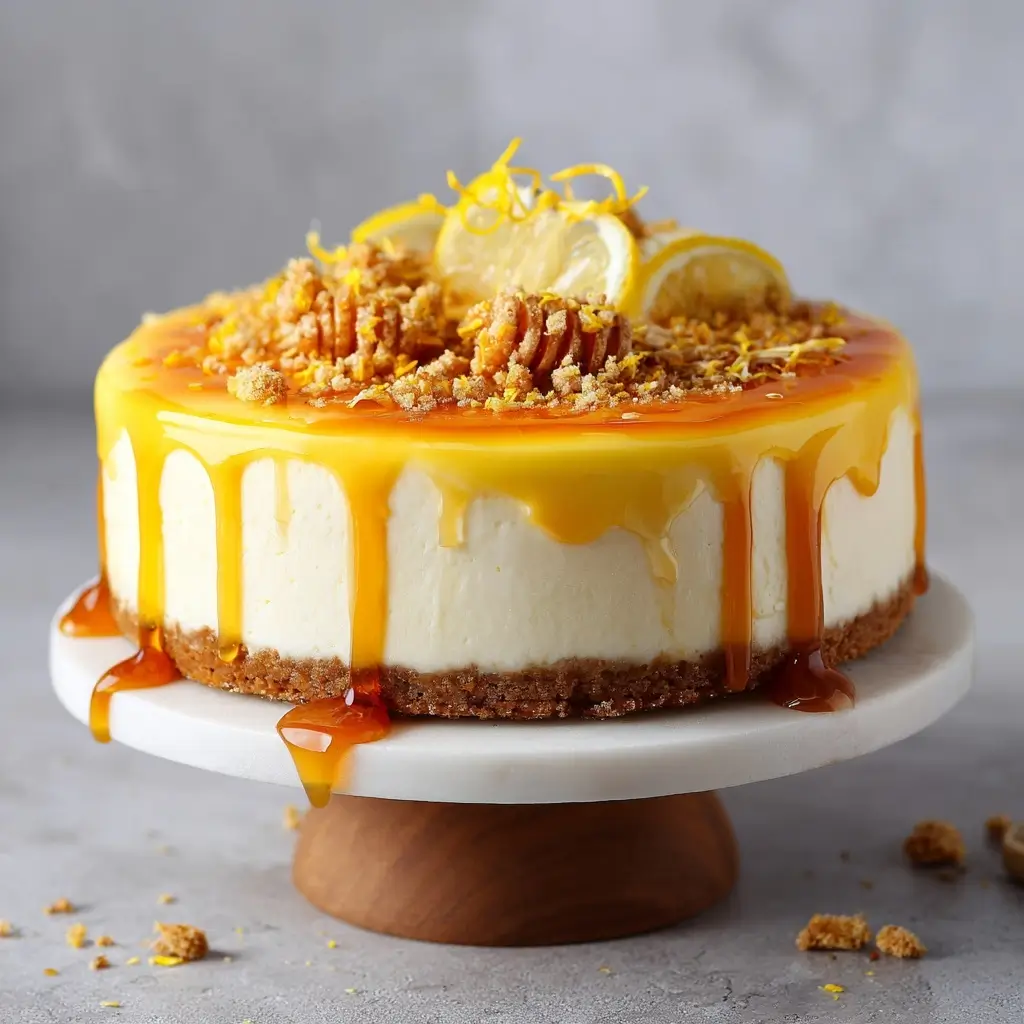
Welcome to the luscious, bright, and irresistibly creamy world of Honey Lemon Cheesecake — a harmonious marriage of velvety New York–style richness and the vibrant, zesty lift of fresh citrus, all elegantly sweetened with the floral depth and natural complexity of raw, unfiltered honey. Unlike traditional cheesecakes that rely heavily on granulated sugar, this iteration swaps refined sweetness for honey’s nuanced profile—adding subtle notes of wildflower, clover, or orange blossom depending on your choice—while lemon juice and zest cut through the density with refreshing acidity and aromatic brightness. It’s not just a dessert—it’s a celebration of balance: rich yet light, indulgent yet refreshingly tart, comforting yet sophisticated. Whether served at a summer garden party, a holiday gathering, or as a quiet weeknight treat with a cup of herbal tea, Honey Lemon Cheesecake delivers an unforgettable sensory experience that lingers long after the last bite.
The History
The origins of cheesecake stretch back over 2,000 years—to ancient Greece, where early versions made with fresh cheese, honey, and wheat were served to athletes at the first Olympic Games in 776 BCE as a source of sustained energy. The Romans later adopted and adapted the recipe, spreading it across their empire. Fast forward to the 18th and 19th centuries, when cream cheese was developed in the United States (notably by William Lawrence in Chester, NY, in 1872), paving the way for the dense, smooth, baked “New York style” we know today. Lemon and honey, meanwhile, have ancient culinary roots: lemons were cultivated in Southeast Asia and introduced to Europe via Arab traders in the Middle Ages, while honey has been humanity’s primary sweetener since prehistoric times—used in sacred rituals, medicinal tonics, and celebratory feasts across Mesopotamia, Egypt, and Greece. The modern fusion of honey and lemon in cheesecake is a relatively recent innovation—gaining momentum in the early 2000s alongside the artisanal food movement, farm-to-table ethos, and growing consumer interest in natural, minimally processed ingredients. Chefs and home bakers alike began experimenting with honey as a functional and flavorful sugar substitute, discovering its humectant properties enhanced cheesecake’s moist crumb, while its enzymatic activity subtly influenced texture and shelf life. Today, Honey Lemon Cheesecake stands as both a nostalgic homage and a contemporary evolution—honoring time-honored techniques while embracing clean-label values, seasonal awareness, and bold, ingredient-driven flavor storytelling.
Ingredients Breakdown
Every element in this Honey Lemon Cheesecake serves a precise structural, textural, or flavor purpose—no ingredient is arbitrary. Let’s explore them in detail:
- Graham Cracker Crust Base: Whole-grain graham crackers provide a nutty, slightly caramelized foundation. Their natural molasses content adds depth and helps bind the crust. Finely crushed crumbs ensure uniform texture and prevent graininess.
- Unsalted Butter (melted): Acts as the binding agent for the crust—and crucially, must be unsalted to control sodium levels, preserving the delicate balance between sweet, tart, and savory notes.
- Full-Fat Cream Cheese (brick-style, room temperature): The cornerstone of structure and mouthfeel. Philadelphia or similar high-fat (33–36% milkfat), low-moisture brands are ideal. Room temperature ensures smooth incorporation without lumps or overmixing—critical to avoiding cracks and air pockets.
- Full-Fat Sour Cream: Adds tang, moisture, and tenderness. Its acidity reacts gently with baking soda (if used) and helps stabilize proteins during baking, contributing to a luxuriously creamy, jiggle-free set.
- Plain Full-Fat Greek Yogurt (optional but recommended): An increasingly popular addition for extra protein, subtle tang, and improved slice integrity—especially helpful in no-bake or lightly baked variations. Choose strained, non-GMO, additive-free varieties for purity of flavor.
- Large Eggs (room temperature): Provide essential leavening and binding. Yolks add fat and emulsification; whites contribute structure. Cold eggs can cause curdling—always bring to room temp (about 30 minutes out of the fridge).
- Raw, Unfiltered Honey (e.g., local wildflower or orange blossom): Not merely a sweetener—but a multifunctional powerhouse. Its natural fructose content lowers the freezing point (enhancing creaminess), its enzymes aid in gentle coagulation, and its complex volatile compounds (e.g., benzaldehyde, limonene) echo citrus aromatics. Avoid pasteurized or ultra-filtered honeys—they lack enzymatic activity and nuanced flavor.
- Fresh Lemon Juice (from about 3–4 medium lemons): Must be freshly squeezed—not bottled—for peak acidity, volatile oils, and absence of preservatives or sulfites that dull flavor and destabilize proteins. Juice contributes pH balance critical for proper setting and brightness that cuts through fat.
- Fresh Lemon Zest (finely grated, using a microplane): Contains the aromatic citrus oils (limonene, γ-terpinene) stored in the flavedo—the colorful outer peel. Zest adds heady fragrance and layered complexity absent in juice alone. Avoid white pith—it’s intensely bitter.
- Cornstarch or Arrowroot Powder: A small amount (1–2 tsp) acts as a “safety net”—reinforcing the protein network, minimizing surface cracks, and yielding a smoother, more stable custard-like texture. Arrowroot is preferred for gluten-free versions and offers superior freeze-thaw stability.
- Vanilla Extract (pure, Madagascar Bourbon): Enhances honey’s floral notes and rounds out lemon’s sharpness. Alcohol-based extract carries volatile compounds better than paste or powder.
- Sea Salt (fine, non-iodized): A mere ¼ tsp amplifies sweetness, balances acidity, and heightens all other flavors—a foundational principle of professional pastry science.
- Optional Garnishes: Edible lemon verbena leaves, candied lemon slices, toasted bee pollen, honeycomb pieces, crumbled shortbread, or a glossy honey-lemon glaze made from reduced juice + honey + a touch of agar or gelatin for sheen and hold.
Step-by-Step Recipe
- Prepare the Pan (Minimum 24 hours ahead): Wrap the exterior of a 9-inch springform pan *tightly* with two overlapping layers of heavy-duty aluminum foil—ensure no gaps at the base or seams. This prevents water seepage during the essential water bath. Lightly grease the inside rim and base with softened butter, then line the bottom with a parchment round (cut to fit perfectly). Set aside.
- Make the Crust (Day Before Recommended): In a food processor, pulse 1 ½ cups finely crushed graham crackers (about 10 full sheets), 2 tbsp raw honey, 6 tbsp melted unsalted butter, and ¼ tsp sea salt until mixture resembles wet sand. Press firmly and evenly into the bottom and 1 inch up the sides of the prepared pan using the flat bottom of a measuring cup or glass. Chill uncovered for at least 1 hour—or preferably overnight—to fully set and prevent slippage during filling.
- Preheat & Prep Water Bath: At least 45 minutes before baking, preheat oven to 325°F (163°C). Place a large, deep roasting pan (minimum 3-inch depth) on the center rack. Fill halfway with hot tap water (about 2–3 inches deep)—this creates steam and ensures even, gentle heat transfer. Let water warm as oven preheats.
- Cream the Cheese Base: In a large bowl of a stand mixer fitted with the paddle attachment (or using a hand mixer on low speed), beat room-temperature cream cheese on medium-low for 2 minutes until completely smooth and glossy—scraping down bowl and paddle frequently. Add sour cream and Greek yogurt (if using); beat 1 minute until homogenous. Add honey in a slow, steady stream while mixing on low—do not rush. Beat just until incorporated (≈30 seconds). Scrape thoroughly.
- Incorporate Eggs Gently: One at a time, add room-temperature eggs, mixing on *lowest possible speed* just until yolk disappears (≈10–15 seconds per egg). Overmixing introduces excess air → cracks and sinking. Scrape bowl meticulously after each addition.
- Add Citrus & Stabilizers: Whisk together lemon juice, zest, cornstarch/arrowroot, vanilla, and salt in a small bowl until smooth and lump-free. With mixer on lowest speed, slowly drizzle this mixture into the batter over 20 seconds. Mix only until fully blended—no more than 15 seconds total. Overmixing at this stage risks gluten development (if flour is substituted) or protein denaturation.
- Strain for Perfection: Pour batter through a fine-mesh sieve into a large, spouted liquid measuring cup. This eliminates any undissolved cornstarch, stray zest bits, or tiny lumps—ensuring silkiness. Discard solids caught in sieve.
- Fill & Smooth: Carefully pour strained batter over chilled crust. Tap pan sharply 3–4 times on counter to release trapped air bubbles. Run an offset spatula around interior edge to detach batter from side—prevents “cheesecake collar” formation. Smooth top with an icing spatula dipped in hot water and wiped dry.
- Bake in Water Bath: Carefully place foil-wrapped springform pan into the preheated water bath. Water should reach halfway up the pan’s exterior. Bake for 1 hour 15 minutes—rotating pan 180° at 45 minutes. Cheesecake is done when edges are set and center jiggles *slightly*, like firm Jell-O—not liquid. An instant-read thermometer inserted 1 inch from center should read 150–152°F (65–67°C).
- Cool Gradually (Non-Negotiable Step): Turn off oven. Crack door open 1 inch with a wooden spoon. Let cheesecake cool *in oven* for 1 hour. Then carefully remove from water bath, discard foil, run a thin knife around inner edge to loosen, and cool on wire rack for another 2 hours at room temperature. This ultra-slow cooling prevents thermal shock, condensation, and catastrophic cracking.
- Chill Thoroughly: Refrigerate uncovered for *minimum 12 hours*, preferably 24–48 hours. This allows starches to fully hydrate, proteins to relax, and flavors to meld. Do not cover until fully chilled—condensation ruins surface texture.
- Unmold & Serve: Run warm knife around perimeter again. Release springform clasp. Slide thin, flexible offset spatula under crust to lift onto serving plate. For clean slices, dip knife in hot water, wipe dry, and cut between servings.
Tips
- Temperature Discipline Is Everything: All dairy ingredients—cream cheese, sour cream, yogurt, eggs, even honey (if crystallized, gently warm jar in warm water)—must be at true room temperature (68–72°F / 20–22°C). Cold ingredients cause separation, lumps, and poor emulsion.
- Scrape Relentlessly: Use a silicone spatula to scrape *every* surface—bowl, paddle, spatula, sieve—after every step. Even a teaspoon of unmixed honey or zest can create flavor imbalances or texture inconsistencies.
- Low Speed Saves Lives (and Cheesecakes): Never exceed low or medium-low speed after adding eggs. High speed whips in air → bubbles → cracks → collapse. If using a stand mixer, consider the “reverse paddle” technique: mix on reverse for final blending to minimize shear force.
- Water Bath Wisdom: Use hot (not boiling) water—too-hot water can cause rapid expansion and cracking. Ensure foil is double-wrapped and sealed at seams. If water seeps in, don’t panic—just pat crust dry with paper towel and continue chilling.
- Zest First, Juice After: Always zest lemons *before* juicing—they’re easier to handle and yield more oil when cold and firm.
- Honey Substitution Note: If substituting maple syrup or agave, reduce by 10–15% (they’re sweeter and thinner) and add ½ tsp extra cornstarch to compensate for lower viscosity and higher water content.
- No-Bake Option: For a chilled version, replace eggs with 1 ½ tsp unflavored gelatin (bloomed in 2 tbsp cold water), omit cornstarch, and increase honey by 1 tbsp. Set in fridge 6+ hours.
- Freezing Success: Wrap *fully chilled*, unsliced cheesecake tightly in plastic wrap + aluminum foil. Freeze up to 3 months. Thaw overnight in fridge—never at room temp—to preserve texture and prevent sweating.
- Slice Like a Pro: For picture-perfect servings, chill knife blade in ice water for 30 seconds before each cut—and always wipe dry between slices.
- Troubleshooting Cracks: If minor cracks appear, embrace them—fill with lemon curd or honey glaze. For prevention: avoid opening oven early, skip overmixing, and never rush cooling.
Variations and Customizations
This Honey Lemon Cheesecake is a master canvas—adaptable to dietary needs, seasonal produce, global inspirations, and personal whims. Explore these thoughtfully engineered variations:
- Gluten-Free: Swap graham crackers for certified GF digestive biscuits, almond flour + oat flour blend (¾ cup almond, ¼ cup GF oats, 2 tbsp coconut sugar), or crushed gluten-free shortbread. Add 1 tsp xanthan gum to crust if binder feels loose.
- Vegan: Use soaked cashews (2 cups), silken tofu (12 oz), coconut cream (¾ cup), lemon juice/zest, ⅓ cup maple syrup, 3 tbsp lemon-infused coconut oil, 2 tsp apple cider vinegar, and 1 ½ tsp agar-agar (bloomed). Blend until ultra-smooth, strain, pour, and chill 10+ hours.
- Protein-Boosted: Stir in 2 scoops unflavored whey or plant-based protein isolate *after* straining batter. Add 1 tbsp extra cornstarch to prevent graininess.
- Lavender-Honey Lemon: Infuse ¼ cup honey with 1 tsp culinary-grade dried lavender (steep 20 min in warm water bath, then strain). Replace regular honey with infused version. Garnish with edible lavender buds.
- Blueberry Swirl: Fold ⅓ cup gently mashed, simmered-and-cooled blueberries (with 1 tsp lemon juice) into batter in ribbons—don’t overmix. Or layer 2 tbsp compote on crust before pouring batter.
- Matcha-Honey Lemon: Whisk 1 ½ tsp ceremonial-grade matcha with 1 tbsp warm honey until smooth. Swirl into batter or add directly (reducing regular honey by 1 tbsp).
- Herbal Infusion: Steep 2 tbsp fresh lemon balm or lemon thyme in warmed honey for 1 hour. Strain and use as base sweetener. Garnish with fresh herbs.
- Mini Mason Jar Version: Scale down for individual servings: use 4-oz jars, bake in shallow water bath at 300°F for 35–40 minutes. Chill 8+ hours.
- Crustless “Cloud” Cheesecake: Omit crust entirely. Line pan with parchment extending 2 inches above rim. Bake as directed—yields ethereal, cloud-like texture perfect for keto adaptations (replace honey with monk fruit–erythritol blend).
- Smoked Honey Variation: Use small-batch smoked honey (applewood or cherrywood) for a campfire-kissed depth—pair with black sesame crust and yuzu zest for avant-garde appeal.
Health Considerations and Nutritional Value
While Honey Lemon Cheesecake is inherently a celebratory dessert, thoughtful formulation elevates its nutritional profile far beyond traditional versions. A standard slice (1/12 of 9-inch cake, approx. 180g) contains approximately:
- Calories: 340–380 kcal (moderately lower than sugar-sweetened versions due to honey’s higher sweetening power)
- Total Fat: 24–27g (mostly unsaturated from cream cheese, sour cream, and honey’s trace fatty acids; includes beneficial CLA from grass-fed dairy options)
- Protein: 8–10g (high-quality complete protein from dairy—supports satiety and muscle maintenance)
- Carbohydrates: 26–29g (of which 22–25g are naturally occurring sugars: fructose/glucose from honey + lactose from dairy)
- Dietary Fiber: 0.3–0.5g (increases to 2–3g with GF oat-almond crust or added psyllium)
- Vitamins & Minerals: Rich in calcium (18% DV), phosphorus (22% DV), vitamin A (15% DV), and B12 (20% DV) — especially when using grass-fed or organic dairy. Lemon contributes ~15% DV vitamin C per slice (bioavailable due to fat matrix enhancing absorption).
- Phytonutrients & Enzymes: Raw honey provides diastase, invertase, and glucose oxidase—supporting gut microbiome diversity. Lemon zest delivers limonene (studied for antioxidant and anti-inflammatory effects) and flavonoids like hesperidin.
- Glycemic Impact: Honey has a lower glycemic index (GI ≈ 58) than table sugar (GI ≈ 65), and the high-fat, high-protein matrix further blunts blood sugar spikes—making it more diabetes-friendly *in controlled portions* when paired with mindful eating practices.
- Allergen Notes: Contains dairy and gluten (in standard crust). Easily adaptable for nut allergies (avoid almond flour crusts) or egg allergies (see vegan variation). Always verify honey is unpasteurized if feeding infants under 12 months—not safe due to potential Clostridium botulinum spores.
- Mindful Enjoyment: Nutrition is not just chemistry—it’s context. Savoring this dessert slowly, with gratitude and presence, activates parasympathetic response, improving digestion and satisfaction—making it, paradoxically, one of the healthiest desserts you’ll ever eat.
Ingredients
- For the Crust:
- 1 ½ cups (150g) finely crushed whole-grain graham crackers (about 10 full sheets)
- 6 tablespoons (85g) unsalted butter, melted
- 2 tablespoons (45g) raw, unfiltered honey
- ¼ teaspoon fine sea salt
- For the Filling:
- 24 ounces (680g) full-fat brick-style cream cheese, room temperature (e.g., Philadelphia)
- 1 cup (240g) full-fat sour cream, room temperature
- ½ cup (120g) plain full-fat Greek yogurt, room temperature (optional but recommended)
- 4 large eggs, room temperature
- ⅔ cup (225g) raw, unfiltered honey (e.g., local wildflower or orange blossom)
- ⅓ cup (80ml) freshly squeezed lemon juice (from ~3–4 medium lemons)
- 2 tablespoons (6g) finely grated lemon zest (use a microplane; avoid pith)
- 1 ½ teaspoons cornstarch or arrowroot powder
- 1 ½ teaspoons pure Madagascar bourbon vanilla extract
- ¼ teaspoon fine sea salt
- For Garnish (Optional):
- Fresh lemon twists, edible flowers (violets, pansies), bee pollen, honeycomb shards, or a glossy honey-lemon glaze (simmer ¼ cup honey + 2 tbsp lemon juice + ½ tsp agar-agar for 2 minutes; cool slightly before brushing)
Directions
- Prep Pan & Chill Crust: Wrap exterior of 9-inch springform pan with two layers heavy-duty foil. Grease interior and line bottom with parchment. In food processor, pulse graham crackers, melted butter, honey, and salt until moist crumbs form. Press firmly into pan. Chill 1+ hours or overnight.
- Preheat Oven & Water Bath: Preheat oven to 325°F (163°C). Place large roasting pan on center rack; fill halfway with hot water.
- Cream Base: Using stand mixer with paddle, beat cream cheese on medium-low 2 min until smooth. Add sour cream and yogurt; beat 1 min. Add honey slowly; beat 30 sec. Scrape bowl.
- Add Eggs: Add eggs one at a time on lowest speed—mix just until yolk disappears (10–15 sec each). Scrape bowl after each.
- Incorporate Citrus Mixture: Whisk lemon juice, zest, cornstarch, vanilla, and salt. Drizzle into batter on lowest speed; mix 15 sec max. Scrape.
- Strain & Pour: Strain batter through fine-mesh sieve into spouted measuring cup. Pour over chilled crust. Tap pan; smooth top.
- Bake: Place pan in water bath. Bake 1 hr 15 min—rotate at 45 min. Center should jiggle slightly. Internal temp: 150–152°F.
- Cool Slowly: Turn off oven. Crack door open 1 inch; cool 1 hr in oven. Remove from water bath, cool on rack 2 hrs.
- Chill: Refrigerate uncovered 24–48 hours.
- Serve: Loosen edges, release pan, slide onto plate. Slice with hot, wiped knife.
FAQ
- Can I use store-bought lemon juice?
- No—bottled juice lacks volatile oils, contains preservatives (sodium benzoate), and has inconsistent acidity. Fresh juice is non-negotiable for flavor, texture, and food safety (pH affects microbial stability).
- Why does my cheesecake crack?
- Most commonly: overmixing after eggs, rapid temperature changes (opening oven too soon or cooling too fast), or insufficient cornstarch. Follow gradual cooling and low-speed mixing religiously.
- Can I make this ahead?
- Absolutely—and you should. Flavor peaks at 48 hours. Fully assembled, it keeps refrigerated 5 days or frozen 3 months. Thaw overnight in fridge.
- Is raw honey safe to use in baked goods?
- Yes. While raw honey contains beneficial enzymes, they’re heat-sensitive and denature above 118°F—so baking neutralizes them, but honey’s flavor, antioxidants, and mineral content remain intact.
- Can I reduce the honey?
- You may reduce by up to 2 tbsp—but expect diminished moisture, less pronounced floral notes, and potentially drier texture. Never eliminate entirely—honey contributes functional properties beyond sweetness.
- What if I don’t have a water bath?
- A water bath is strongly advised—but if unavoidable, place a pan of boiling water on the lowest oven rack *below* the cheesecake and bake at 300°F for 1 hr 30 min. Expect slightly higher risk of cracking.
- Can I use low-fat cream cheese?
- Not recommended. Reduced-fat versions contain stabilizers, gums, and added water that disrupt emulsion, cause weeping, and yield rubbery or chalky texture. Full-fat is essential.
- How do I fix a soggy crust?
- If water seeped in, gently pat dry with paper towel, then return to fridge for 1 hr to re-chill and firm. Next time, double-wrap foil and check for pinholes.
- Can kids eat this?
- Yes—with one critical exception: do not feed raw honey to infants under 12 months due to infant botulism risk. For older children and adults, it’s perfectly safe—and nutritionally supportive.
- Why does the recipe specify “room temperature” eggs?
- Cold eggs cause fat in cream cheese to seize, creating lumps that won’t reincorporate—even with prolonged mixing. Room-temp eggs ensure seamless emulsion and airy, tender crumb.
Summary
Honey Lemon Cheesecake is a masterclass in balanced indulgence—where the floral sweetness of raw, unfiltered honey meets the radiant acidity of fresh lemon juice and zest, all enrobed in a luxuriously dense yet cloud-soft cream cheese filling atop a warmly spiced graham crust, perfected through meticulous technique including a gentle water bath and unhurried cooling.
It honors ancient traditions while embracing modern wellness—offering meaningful nutrition, adaptability for diverse diets, and profound sensory joy—proving that the most