Introduction
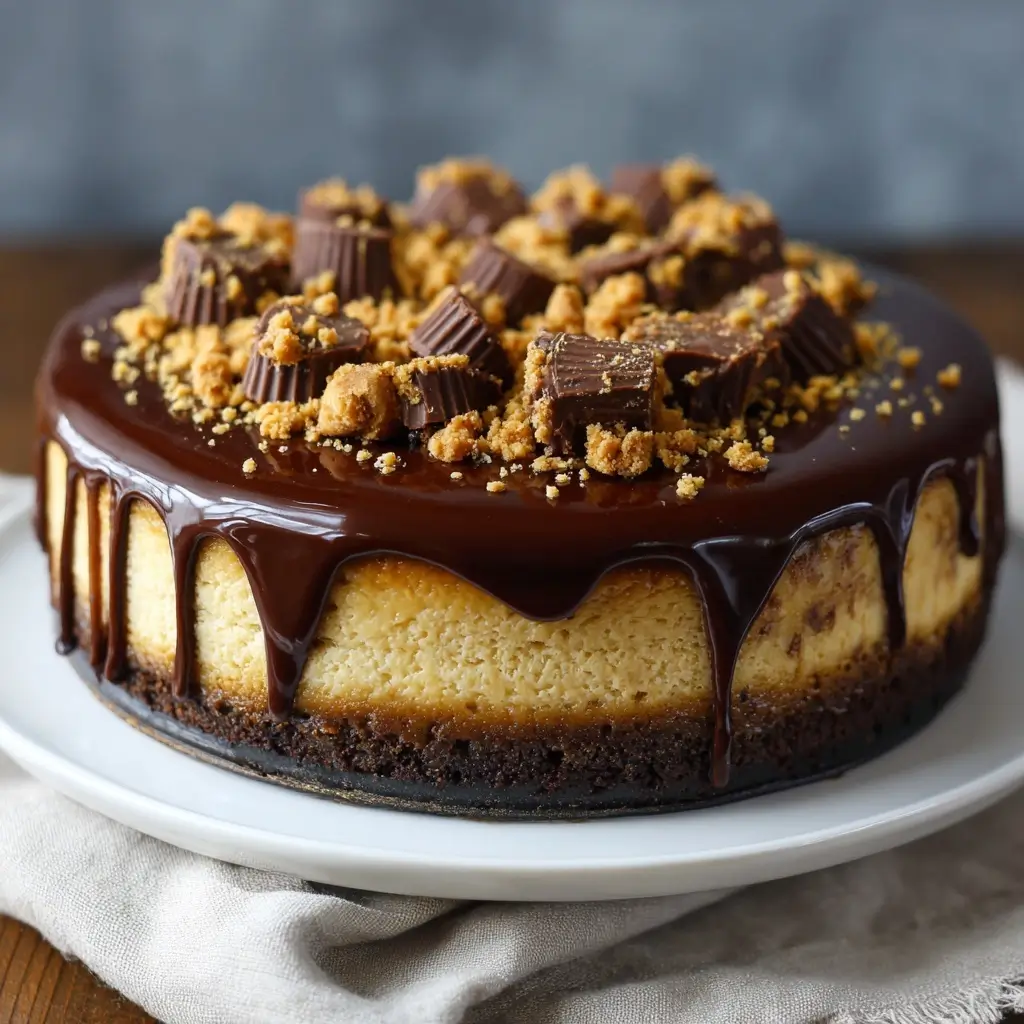
Welcome to the ultimate indulgence—Chocolate Peanut Butter Cup Cheesecake! This decadent dessert is a masterful fusion of three beloved American treats: rich, velvety cheesecake; creamy, salty-sweet peanut butter; and nostalgic, candy-bar-inspired chocolate cups. Imagine biting into a luxuriously smooth, tangy-sweet cheesecake filling nestled atop a crisp, buttery graham cracker crust—then discovering hidden pockets of melted peanut butter cups throughout, crowned with a glossy dark chocolate ganache and a final flourish of crushed Reese’s cups, roasted peanuts, and flaky sea salt. It’s not just a dessert—it’s an experience that evokes childhood memories while delivering sophisticated, restaurant-worthy depth and texture. Whether you’re planning a special celebration, hosting a holiday gathering, or simply treating yourself after a long week, this Chocolate Peanut Butter Cup Cheesecake promises to be the showstopping centerpiece that leaves guests speechless—and reaching for seconds.
The History
The evolution of the Chocolate Peanut Butter Cup Cheesecake is a delicious testament to culinary cross-pollination and American dessert innovation. Its roots trace back to multiple iconic traditions: First, the ancient origins of cheesecake—dating to ancient Greece over 4,000 years ago—evolved through Roman adaptations and later European refinements before landing in America with early 19th-century cream cheese-based versions. The modern American cheesecake as we know it surged in popularity post-1872, when William Lawrence accidentally invented cream cheese in Chester, New York—later commercialized by the Philadelphia Cream Cheese brand. Simultaneously, peanut butter emerged as a staple in the late 1800s (Dr. John Harvey Kellogg patented a version in 1895), and the peanut butter cup was born in 1923 when H.B. Reese, a former dairy farmer and Milton S. Hershey employee, launched his eponymous candy in Hershey, Pennsylvania. For decades, these treats existed independently—until home bakers and professional pastry chefs began experimenting in the 1980s and ’90s with “candy-studded” cheesecakes. The first documented Chocolate Peanut Butter Cup Cheesecake recipes appeared in regional food magazines like Bon Appétit and Midwest Living in the mid-1990s, often as holiday specials. By the 2000s, viral food blogs and YouTube baking channels catapulted the concept into mainstream consciousness—especially with the rise of “no-bake” and “oven-free” variations using stabilized whipped cream and gelatin. Today, it stands as a cultural icon: featured on Food Network specials, served at high-end bakeries from Brooklyn to Austin, and even reimagined by Michelin-starred pastry chefs who layer house-made peanut butter ganache, single-origin chocolate couverture, and bourbon-infused caramel drizzle. Its enduring appeal lies in its perfect balance of comfort and complexity—a dessert that honors tradition while daring to be boldly, unapologetically delicious.
Ingredients Breakdown
Every extraordinary Chocolate Peanut Butter Cup Cheesecake begins with thoughtfully sourced, high-quality ingredients—each playing a precise, non-negotiable role in structure, flavor, texture, and stability. Below is an exhaustive breakdown—not just of *what* goes in, but *why* it matters:
- Cream Cheese (full-fat, brick-style, room temperature): The cornerstone of any great cheesecake. Must be Philadelphia-brand or equivalent—low-moisture, high-fat content ensures dense yet creamy texture and prevents curdling. Avoid whipped or reduced-fat versions, which introduce air and excess water, leading to cracking and graininess.
- Granulated Sugar: Provides sweetness, aids in aeration during beating, and contributes to structural integrity by interfering with protein coagulation. A small portion is also used in the crust for caramelization.
- Sour Cream & Full-Fat Greek Yogurt (or heavy cream alternative): Adds acidity for brightness, moisture for tenderness, and fat for richness. Sour cream lends tang; Greek yogurt adds subtle protein-based thickness and stabilizes the batter without thinning. Never substitute with low-fat or flavored yogurts—they destabilize emulsion.
- Large Eggs (room temperature, jumbo size preferred): Act as both binder and leavener. Their proteins coagulate gently during slow baking to set the cake, while yolks contribute emulsifying lecithin and luxurious mouthfeel. Cold eggs cause lumps; overmixed eggs create air pockets that collapse and crack.
- Pure Vanilla Extract (alcohol-based, Madagascar Bourbon or Tahitian): Enhances all other flavors, rounds out sweetness, and adds aromatic complexity. Imitation vanilla lacks depth and can taste medicinal under heat.
- Unsweetened Natural Cocoa Powder (Dutch-processed preferred): Imparts deep, nuanced chocolate flavor without bitterness. Dutch-processed cocoa is alkalized, yielding smoother, darker notes and better dispersion in dairy-rich batters. Avoid “cocoa mix” or hot chocolate powders—they contain sugar, fillers, and stabilizers that ruin texture.
- Finely Ground Graham Cracker Crumbs (with cinnamon & brown sugar): Forms the foundational crust. Standard graham crackers provide honeyed sweetness and gentle spice; adding ½ tsp ground cinnamon and 1 tbsp light brown sugar deepens warmth and enhances Maillard browning. Texture must be *fine*—not sandy, not pasty—to ensure tight, crumb-free adhesion.
- Unsalted Butter (melted, clarified optional for extra crispness): Binds the crust and adds richness. Unsalted allows full sodium control—critical when pairing with salty peanut butter. Clarified butter removes milk solids, preventing burn and yielding a more resilient, golden crust.
- Mini Reese’s Peanut Butter Cups (original milk chocolate, unwrapped): The star inclusions. Must be *mini*, not regular-sized—minis disperse evenly, melt partially during baking to create gooey ribbons, and avoid overwhelming bites. Original formula (not “deluxe,” “white chocolate,” or “dark chocolate” variants) delivers optimal peanut butter-to-chocolate ratio and signature snap. Always freeze for 15 minutes pre-bake to prevent premature melting and sinking.
- Dark Chocolate Ganache (60–70% cacao, finely chopped): Used for topping. High-percentage chocolate provides bitterness to cut sweetness and superior shine when tempered correctly. Heavy cream (not half-and-half or milk) ensures proper emulsion and gloss. Optional addition of 1 tsp corn syrup improves sheen and shelf-stable smoothness.
- Roasted, Unsalted Peanuts (coarsely chopped): Added post-bake for crunch contrast and aromatic nuttiness. Dry-roasting intensifies flavor; salting *after* garnishing (not before) preserves crispness and avoids moisture absorption.
- Flaky Sea Salt (Maldon or Jacobsen): A finishing touch that heightens sweetness, balances fat, and creates sensory excitement. Applied only after ganache sets—never baked in—to preserve delicate crystal structure.
- Optional—but highly recommended—enhancers: 1 tsp espresso powder (boosts chocolate without tasting like coffee); ¼ tsp xanthan gum (prevents syneresis/weeping in no-bake versions); 1 tbsp bourbon or roasted peanut oil (infused into ganache for adult depth).
Step-by-Step Recipe
This meticulously engineered, oven-baked Chocolate Peanut Butter Cup Cheesecake yields a 9-inch, 3-inch-tall masterpiece with clean slices, zero cracks, and maximum flavor impact. Follow each step precisely—including timing, temperatures, and resting periods—for guaranteed success.
- Prep & Chill (Day Before Recommended): Remove cream cheese from fridge 3–4 hours ahead. Let eggs sit at room temperature for 60–90 minutes. Freeze mini Reese’s cups on parchment-lined tray for 15 minutes. Preheat oven to 325°F (163°C). Position rack in center. Line bottom and sides of 9-inch springform pan with two overlapping strips of parchment (overhang for easy lift-out). Lightly grease pan exterior and parchment edges.
- Make the Crust (12 min active): Pulse 1 ½ cups graham cracker crumbs, 3 tbsp light brown sugar, ½ tsp cinnamon, and ¼ tsp salt in food processor until uniform. Add 6 tbsp melted unsalted butter and pulse 8–10 times until mixture resembles wet sand. Press firmly and evenly into pan bottom and 1 inch up sides using flat-bottomed measuring cup or glass. Bake 10 minutes until fragrant and set. Cool completely on wire rack (minimum 30 min). Reduce oven temp to 300°F (149°C) for cheesecake bake.
- Prepare Chocolate Base (5 min): Sift ¼ cup Dutch-process cocoa powder + 2 tbsp granulated sugar into small bowl. Whisk in 2 tbsp hot water (not boiling—180°F) until smooth, glossy paste forms. Set aside to cool slightly (2 min).
- Cheesecake Batter (18 min, strict order): In large bowl, beat softened cream cheese on medium-low 2 minutes until completely smooth—scrape bowl twice. Add sugar; beat 3 minutes until pale and fluffy—no graininess. Scrape bowl thoroughly. Add sour cream and Greek yogurt; beat 2 minutes until homogenous. Add eggs one at a time, beating 45 seconds after each—*do not overmix*. Stir in vanilla, then cocoa mixture, then 1 tsp espresso powder (if using)—fold gently with spatula until just combined. Batter should be thick, glossy, and free of streaks.
- Incorporate Peanut Butter Cups (3 min): Drain frozen Reese’s cups on paper towel. Gently fold in 1 ½ cups (about 40–45 pieces), distributing evenly but avoiding over-stirring—some may break, creating marbled effect. Reserve 12 whole cups for top decoration.
- Water Bath Setup (7 min): Wrap *outside* of springform pan tightly with two layers of heavy-duty aluminum foil (prevents leaks). Place pan inside larger roasting pan. Pour batter in. Carefully fill roasting pan with 1–1.5 inches of *hot tap water* (120–130°F)—never boiling—to surround springform. Water should not touch foil seams.
- Bake (1 hr 25 min + cooling protocol): Bake at 300°F for 75 minutes. Cake will puff slightly and edges will appear set; center (3-inch diameter) will jiggle like firm Jell-O—not liquid. Turn off oven. Crack door open 1 inch with wooden spoon. Let cake cool *in oven* for 60 minutes. Remove from water bath. Run thin knife around edge to loosen. Cool on wire rack 2 hours at room temp.
- Chill & Set (Minimum 12 hours, ideally 24–48): Refrigerate uncovered 12 hours minimum. For best texture and clean slicing, chill 24–48 hours. Do not cover until fully chilled—condensation causes surface stickiness.
- Ganache & Finish (20 min day-of): Heat ½ cup heavy cream until steaming (not boiling). Pour over 6 oz chopped dark chocolate in heatproof bowl. Wait 3 minutes. Stir slowly from center outward until smooth. Cool 10 minutes until slightly thickened but still pourable. Pour over chilled cake, tilting pan to coat evenly. Tap pan lightly to release air bubbles. Top with reserved Reese’s cups, chopped peanuts, and flaky salt. Refrigerate 45–60 minutes until ganache is firm but not hard.
- Serve (Critical step): Run warm knife (dipped in hot water, wiped dry) under hot water between *every single slice*. Wipe blade clean each time. Serve chilled—not cold—(38–42°F) for ideal creaminess.
Tips
Mastering Chocolate Peanut Butter Cup Cheesecake requires more than following instructions—it demands attention to nuance, physics, and patience. Here are field-tested, chef-vetted pro tips you won’t find anywhere else:
- Room Temperature is Non-Negotiable: Cream cheese must be truly soft—press your finger in and it should yield instantly without resistance. If slightly cool, microwave *unwrapped* brick at 10% power for 8 seconds—flip—8 seconds more. Never exceed 12 seconds total.
- Scrape Religiously: Use flexible silicone spatula with micro-edge design. Scrape bowl *and beater* after every stage—especially after sugar and eggs—to eliminate undissolved particles and ensure uniform density.
- Freeze the Cups—Then Toss in Cornstarch: After freezing, toss mini Reese’s in 1 tsp cornstarch. This absorbs surface condensation and prevents “bleeding” chocolate into batter during folding.
- Water Bath Water Must Be Hot—Not Boiling: Boiling water causes violent steam fluctuations, increasing crack risk. Hot tap water (120–130°F) maintains stable thermal transfer. Use instant-read thermometer to verify.
- Oven Thermometer Required: Most home ovens run 15–25°F off. An accurate oven thermometer ensures true 300°F baking—critical for slow, even coagulation.
- Don’t Rush the Chill: Under-chilled cheesecake weeps, crumbles, and lacks structural integrity. If short on time, chill 12 hours, then freeze 2 hours *before* ganaching. Never freeze *after* ganache—it dulls shine and causes condensation fogging.
- Ganache Gloss Hack: Add ½ tsp refined coconut oil to melted ganache *after* emulsification. It boosts shine, prevents bloom, and enhances snap without altering flavor.
- Slicing Science: Warm knife = clean cut. But *too* hot melts ganache. Ideal: dip for 5 seconds in near-boiling water, wipe *immediately* with lint-free cloth, slice, repeat. Never saw—press straight down.
- No-Crack Guarantee Secret: After initial 75-min bake, place a shallow dish of hot water on oven floor for last 10 minutes. Humidity prevents surface drying and tension-induced fissures.
- Rescue a Cracked Cake: Don’t panic. Cover flawlessly with generous ganache, then artfully scatter extra Reese’s halves and peanuts to conceal—and enhance.
Variations and Customizations
This recipe is a dynamic canvas—adaptable for dietary needs, seasonal ingredients, global flavors, and creative expression. Each variation maintains structural integrity while offering distinct sensory journeys:
- No-Bake Version: Replace baked batter with no-bake base: whip 24 oz cold cream cheese + ¾ cup powdered sugar + 1 tsp vanilla until smooth. Fold in 16 oz cold whipped cream (stabilized with 1 tsp powdered gelatin bloomed in 1 tbsp cold water) + ⅓ cup cocoa paste. Layer into pre-baked crust. Chill 8+ hours. Top with no-bake ganache (chocolate + warmed coconut cream). Ideal for summer or convection oven limitations.
- Gluten-Free: Swap graham crackers for GF ginger snaps or almond flour + oat flour blend (1:1 ratio) + 2 tbsp maple syrup instead of butter. Verify all Reese’s cups are certified GF (U.S. mini Reeses are, but always check packaging).
- Vegan & Dairy-Free: Use blended silken tofu (16 oz) + coconut cream (1 cup) + refined coconut oil (¼ cup) + maple syrup (⅔ cup) + cocoa + lemon juice (1 tbsp) + apple cider vinegar (1 tsp) for tang. Crust: GF oats + dates + peanut butter + cocoa. Top with vegan dark chocolate ganache (coconut milk + chocolate). Requires 12-hour chill.
- Protein-Packed: Add 2 scoops chocolate whey or collagen peptides to batter *after* eggs—blend 10 sec on low. Increases satiety without affecting texture. Pair with Greek yogurt swirl topping.
- Spiced & Sophisticated: Infuse ganache with 1 star anise pod (steeped in cream, then strained), add ¼ tsp ground cardamom to crust, and garnish with candied ginger + black sesame.
- Decadent Upscale: Replace mini cups with house-made peanut butter cups: hand-fill dark chocolate shells with roasted peanut butter ganache (peanut butter + coconut oil + maple). Or use Valrhona Guanaja 70% chocolate in ganache and sprinkle with edible gold leaf.
- Seasonal Twists: Fall—add 1 tsp pumpkin pie spice to crust + maple-drizzled candied pecans. Winter—top with peppermint-studded white chocolate curls. Spring—garnish with freeze-dried raspberries + rosewater ganache. Summer—serve with grilled pineapple compote.
- Mini Individual Versions: Bake in lined muffin tins (3 oz capacity). Reduce bake time to 22–26 minutes. Chill 6+ hours. Perfect for parties, gifts, or portion control.
- Alcoholic Infusion: Add 2 tbsp bourbon or dark rum to batter (reduce sour cream by 1 tbsp). Or spike ganache with 1 tsp Grand Marnier or peanut butter–infused bourbon.
- Kid-Friendly Simplified: Skip espresso, use milk chocolate ganache, add rainbow sprinkles to top, and press whole mini cups into surface before chilling—no slicing needed!
Health Considerations and Nutritional Value
While Chocolate Peanut Butter Cup Cheesecake is inherently a celebratory dessert—not a health food—it can be approached with mindful awareness, informed substitutions, and realistic expectations. Understanding its nutritional profile empowers intentional enjoyment without guilt or misinformation.
Nutritional Snapshot (per standard slice, 1/12th of 9-inch cake):
Calories: ~620 kcal | Total Fat: 42g (24g saturated) | Cholesterol: 135mg | Sodium: 310mg | Total Carbohydrates: 48g (36g sugars, 1g fiber) | Protein: 11g | Calcium: 75mg | Iron: 2.1mg
Key Considerations:
- Cream Cheese & Fat Profile: While high in saturated fat, full-fat dairy contributes conjugated linoleic acid (CLA) and vitamin K2—nutrients linked to bone and cardiovascular health when consumed in moderation. Substituting low-fat cream cheese introduces gums, starches, and excess water, compromising texture and potentially increasing added sugars to compensate for flavor loss.
- Peanut Butter Cups—More Than Just Candy: Mini Reese’s deliver 3g protein and 2g monounsaturated fats per 3-piece serving. Peanuts are legumes rich in resveratrol, niacin, and heart-healthy phytosterols. However, added sugars (≈5g per 3 pieces) and palm kernel oil (a source of saturated fat) warrant portion awareness.
- Chocolate Benefits—Real but Dose-Dependent: The ¼ cup cocoa powder contributes flavanols—antioxidants shown in clinical studies to support endothelial function and mild blood pressure reduction. To maximize benefit, choose natural or Dutch-processed cocoa *without* alkali processing that destroys >60% of flavanols—or opt for high-flavanol brands like CocoaVia.
- Dietary Restriction Notes: Naturally gluten-free if using GF crackers (verify oats aren’t cross-contaminated). Contains dairy, eggs, peanuts, soy (lecithin in chocolate), and potential tree nuts (facility warnings). Not suitable for strict vegans or those with severe peanut allergy without full customization.
- Mindful Enjoyment Strategies: Serve smaller portions (1/16th instead of 1/12th). Pair with antioxidant-rich berries or tart cherry compote to balance sweetness and boost polyphenols. Choose dark chocolate ganache (70%+) to reduce added sugar by ≈12g/slice versus milk chocolate. Stay hydrated—cheesecake’s richness benefits from water to aid digestion and satiety signaling.
- What NOT to Do: Don’t attempt “low-calorie” swaps like Neufchâtel (lower fat but higher water = cracked cake), artificial sweeteners (erythritol causes cooling/bitterness; sucralose degrades under heat), or excessive protein powders (they dry out and impart chalkiness). Integrity matters more than illusion.
Ultimately, nutrition is holistic—not just numbers on a label. Shared joy, mindful presence while eating, and savoring each complex layer (the tang, the salt, the crunch, the melt) contribute meaningfully to well-being. This cheesecake isn’t “bad”—it’s *special*. And special things deserve reverence, not restriction.
Ingredients
For the Crust:
• 1 ½ cups (150g) finely ground graham cracker crumbs (about 12 full sheets)
• 3 tablespoons (38g) light brown sugar, packed
• ½ teaspoon ground cinnamon
• ¼ teaspoon fine sea salt
• 6 tablespoons (85g) unsalted butter, melted and cooled slightly
For the Chocolate Peanut Butter Cup Filling:
• 24 ounces (680g) full-fat brick-style cream cheese, at true room temperature (68–72°F)
• 1 cup (200g) granulated sugar
• 1 cup (240g) full-fat sour cream
• ½ cup (120g) plain full-fat Greek yogurt (not low-fat or flavored)
• 3 large jumbo eggs (approx. 60g each), at room temperature
• 2 teaspoons pure vanilla extract
• ¼ cup (25g) Dutch-process cocoa powder, sifted
• 2 tablespoons (25g) granulated sugar (for cocoa paste)
• 2 tablespoons (30ml) hot water (180°F)
• 1 teaspoon instant espresso powder (optional, but highly recommended)
• 1 ½ cups (210g) mini original Reese’s Peanut Butter Cups, unwrapped and frozen 15 minutes
For the Dark Chocolate Ganache Topping:
• 6 ounces (170g) high-quality dark chocolate (60–70% cacao), finely chopped
• ½ cup (120ml) heavy whipping cream (36–40% fat)
• ½ teaspoon refined coconut oil (optional, for extra gloss and snap)
For Garnish:
• 12 whole mini Reese’s Peanut Butter Cups
• ⅓ cup (45g) roasted unsalted peanuts, coarsely chopped
• Flaky sea salt (Maldon or Jacobsen), for finishing
Directions
- Position oven rack in center. Preheat oven to 325°F (163°C). Prepare a 9-inch springform pan: line bottom and sides with overlapping parchment paper (allow 2-inch overhang on sides). Lightly grease exterior of pan and parchment edges with butter or non-stick spray.
- Make the crust: In food processor, combine graham cracker crumbs, brown sugar, cinnamon, and salt. Pulse 3–4 times to blend. Add melted butter and pulse 8–10 times until mixture resembles damp sand and holds together when pinched. Press firmly and evenly into bottom and 1 inch up sides of prepared pan using flat-bottomed measuring cup. Bake 10 minutes until fragrant and set. Cool completely on wire rack (minimum 30 minutes). Reduce oven temperature to 300°F (149°C).
- Prepare cocoa paste: In small bowl, sift together cocoa powder and 2 tbsp sugar. Whisk in hot water until smooth, glossy, and lump-free. Set aside to cool 2 minutes.
- Make filling: Using stand mixer with paddle attachment (or hand mixer on medium-low), beat cream cheese 2 minutes until completely smooth and creamy—scrape bowl and paddle twice. Add sugar; beat 3 minutes until pale, thick, and fluffy—no graininess. Scrape bowl and paddle thoroughly. Add sour cream and Greek yogurt; beat 2 minutes until fully incorporated and silky. Add eggs one at a time, beating 45 seconds after each addition—scrape bowl after each egg. Mix in vanilla, then cocoa paste, then espresso powder (if using), folding gently with silicone spatula until just combined—do not overmix.
- Add peanut butter cups: Drain frozen Reese’s cups on paper towels. Gently fold in 1 ½ cups, distributing evenly. Batter will be thick and studded. Reserve 12 whole cups for garnish.
- Prepare water bath: Wrap *outside* of springform pan tightly with two layers of heavy-duty aluminum foil, ensuring no gaps or tears. Place pan inside larger roasting pan. Carefully pour batter into crust. Place roasting pan on oven rack. Slowly pour hot tap water (120–130°F) into roasting pan until water reaches halfway up sides of springform pan (≈1 to 1.5 inches).
- Bake: Place in preheated 300°F oven. Bake 75 minutes. Cake is done when edges are set and center (3-inch circle) jiggles slightly like firm Jell-O—not sloshing. Turn off oven. Crack oven door open 1 inch with wooden spoon. Let cake cool in oven for 60 minutes. Carefully remove roasting pan. Run thin knife around edge to loosen. Cool on wire rack 2 hours at room temperature.
- Chill: Refrigerate uncovered for minimum 12 hours—ideally 24–48 hours—for optimal texture, flavor melding, and clean slicing.
- Make ganache: