Introduction
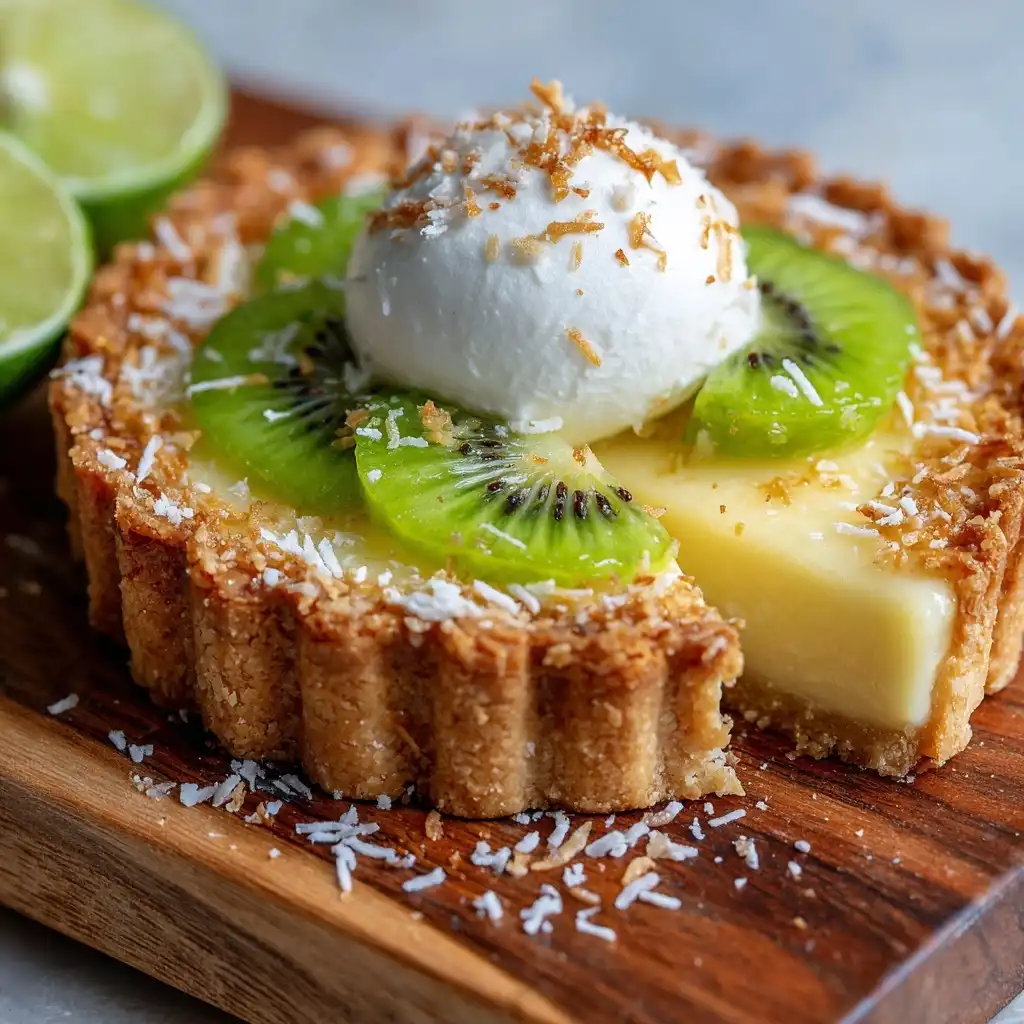
The Coconut Key Lime Tart is a dazzling fusion of tropical elegance and zesty sophistication—a dessert that transports your senses straight to the sun-drenched shores of the Florida Keys. With its buttery, toasted coconut shortbread crust, velvety lime-curd filling infused with real key lime juice and zest, and a luxuriously creamy coconut milk–enriched custard base, this tart strikes a perfect balance between bright acidity, subtle sweetness, and rich, nutty depth. Unlike standard lime pies, the Coconut Key Lime Tart embraces texture and nuance: toasted coconut flakes in the crust add crunch and aroma; coconut cream lends body without heaviness; and the judicious use of both key limes (for authentic floral tartness) and Persian limes (for consistent juiciness and yield) ensures reliability without sacrificing character. Whether served chilled with a whisper of whipped coconut cream or garnished with edible orchids and lime wheels for an elevated presentation, this tart is as visually arresting as it is unforgettable on the palate—ideal for summer soirées, bridal showers, tropical-themed dinners, or simply as a radiant antidote to ordinary dessert routines.
The History
The origins of the Coconut Key Lime Tart lie at the vibrant crossroads of two iconic American desserts—the classic Key Lime Pie and the beloved coconut cream pie—both rooted in regional ingenuity and resourceful adaptation. Key Lime Pie itself traces back to the late 19th and early 20th centuries in the Florida Keys, where sponge fishermen relied on shelf-stable ingredients like canned sweetened condensed milk (invented by Gail Borden in 1853), local key limes (Citrus aurantiifolia), and egg yolks to create a no-bake, oven-free dessert aboard their boats. Its signature pale yellow hue and intense tang became synonymous with Floridian coastal identity.
Coconut’s integration into the genre emerged more gradually. While coconut was historically abundant in the Caribbean and parts of South Florida, its culinary adoption in lime-based desserts gained momentum in the mid-20th century—especially as tropical tourism boomed and tiki culture flourished across the U.S. Cookbooks from the 1950s and ’60s began featuring “lime-coconut” layer cakes and chilled lime puddings garnished with shredded coconut, but it wasn’t until the artisanal baking renaissance of the 2000s that bakers began reimagining the structure itself. Pioneering pastry chefs in Miami, Key West, and Honolulu started experimenting with coconut-infused crusts—using toasted coconut flour blended with graham cracker or shortbread bases—and incorporating coconut milk and cream into the filling to temper key lime’s assertive acidity while adding silkiness and depth. The modern Coconut Key Lime Tart crystallized as a distinct entity around 2012–2015, appearing in high-end resort menus, James Beard-nominated bakeries, and food magazines like Bon Appétit and Food & Wine, praised for its textural complexity and refined balance. Today, it stands not as a mere variation—but as a fully evolved, culturally resonant interpretation that honors tradition while embracing innovation, sustainability (many versions now use organic, fair-trade coconut and pesticide-free key limes), and inclusive flavor storytelling.
Ingredients Breakdown
Every element of the Coconut Key Lime Tart serves a precise functional and sensory purpose—no ingredient is arbitrary. Below is a meticulous, chef-level breakdown of each component:
For the Toasted Coconut Shortbread Crust:
- Unsweetened shredded coconut (1 cup, finely ground): Provides nutty aroma, subtle sweetness, and structural integrity. Toasting deepens Maillard reactions, yielding caramelized notes and reducing moisture to prevent sogginess.
- Almond flour (½ cup): Adds richness, tenderness, and gluten-free binding power; enhances mouthfeel without graininess.
- All-purpose flour (¾ cup): Supplies gluten for cohesion and flakiness—critical for holding shape during blind baking and supporting the heavy filling.
- Granulated sugar (¼ cup): Balances coconut’s natural bitterness and aids in browning via caramelization.
- Salted butter (6 tbsp, cold and cubed): Delivers flakiness, richness, and melt-in-the-mouth texture; salt enhances all other flavors and controls gluten development.
- Vanilla extract (1 tsp): Complements coconut’s warmth and rounds out sharp edges in the lime filling.
- Ice water (1–2 tbsp, as needed): Hydrates flour proteins just enough to bind—never overworked—to preserve tenderness.
For the Coconut-Key Lime Filling:
- Fresh key lime juice (⅔ cup, approx. 24–30 key limes): The soul of the tart—high in citric acid and volatile oils (like limonene and β-pinene) that deliver piercing brightness and floral top notes impossible to replicate with bottled juice.
- Fresh Persian lime juice (¼ cup, approx. 2 large limes): Used strategically to supplement volume and consistency; milder and more acidic-stable than key lime alone, ensuring reliable set and balanced pH for proper protein coagulation.
- Lime zest (from 3 key limes + 1 Persian lime, finely grated): Contains essential oils concentrated in the flavedo—adds aromatic intensity and visual flecks of green vibrancy.
- Canned full-fat coconut milk (1 can, 13.5 oz, well-stirred): Provides fat content (≈21% fat) and emulsifying lauric acid to stabilize the custard, prevent weeping, and lend luxurious creaminess.
- Coconut cream (¼ cup, skimmed from top of a second chilled can): Adds concentrated coconut flavor and extra viscosity—critical for a firm yet supple set.
- Sweetened condensed milk (14 oz can): Acts as both sweetener and thickener; its reduced lactose and protein matrix enables low-heat, no-cook thickening via acid-induced coagulation.
- Egg yolks (6 large, room temperature): Emulsifiers and protein scaffolds—yolks contain lecithin and lipoproteins that bind fat and water, creating a homogenous, glossy, sliceable filling.
- Sea salt (¼ tsp): Heightens perception of sweetness and acidity; suppresses any potential metallic or chalky aftertaste.
For Garnish & Finishing Touches:
- Whipped coconut cream (chilled full-fat coconut cream whipped with 1 tbsp powdered sugar and ½ tsp vanilla): Dairy-free, ethically sourced alternative to whipped cream—enhances coconut theme and adds airy contrast.
- Toasted coconut flakes (¼ cup): Reinforces crust’s flavor profile while offering delightful textural counterpoint.
- Fresh lime wheels or twists, edible flowers (e.g., pansies or violets), micro mint: Elevates visual narrative and introduces fresh herbal-lime top notes upon first bite.
Step-by-Step Recipe
This recipe yields one stunning 9-inch tart, serving 10–12, with meticulous attention to timing, temperature control, and technique. Follow each step precisely for optimal texture, flavor development, and structural integrity.
Step 1: Prepare & Toast the Coconut (Day Before or Morning Of)
Preheat oven to 325°F (163°C). Spread 1 cup unsweetened shredded coconut evenly on a parchment-lined baking sheet. Toast for 8–10 minutes, stirring every 2 minutes, until golden brown and fragrant. Cool completely—this step cannot be rushed, as residual heat continues toasting and may burn. Once cooled, pulse in a food processor until finely ground (like coarse sand)—do not over-process into paste. Transfer to an airtight container and refrigerate until ready to use. Toasting in advance maximizes flavor depth and prevents steam-related crust collapse.
Step 2: Make the Toasted Coconut Shortbread Crust
In a food processor, combine the toasted ground coconut, almond flour, all-purpose flour, and granulated sugar. Pulse 3–4 times to blend. Add cold cubed butter and vanilla; pulse in 1-second bursts until mixture resembles coarse meal with some pea-sized butter pieces visible (about 12–15 pulses). Sprinkle in 1 tablespoon ice water and pulse 3–4 times. Squeeze a small amount—if it holds together without crumbling, it’s ready. If too dry, add remaining water ½ tsp at a time. Immediately transfer to a 9-inch tart pan with removable bottom. Press firmly and evenly into bottom and up sides using the back of a measuring cup or flat-bottomed glass—ensure uniform thickness (⅛” base, ¼” rim) and no air pockets. Chill uncovered for 30 minutes (or freeze for 15) to relax gluten and solidify butter. Preheat oven to 375°F (190°C). Line chilled crust with parchment and fill with pie weights or dried beans. Bake for 18 minutes. Carefully remove weights and parchment; prick base with fork. Return to oven for 12–14 minutes, until golden brown and dry to touch. Cool completely on wire rack—minimum 45 minutes—before filling.
Step 3: Prepare Lime Juice & Zest (Within 1 Hour of Filling)
Roll key limes firmly on countertop to maximize juice yield. Cut in half and juice using a citrus reamer or hand press—avoid blenders or electric juicers, which introduce bitterness from pith. Strain juice through a fine-mesh sieve to remove pulp and seeds. Zest limes using a microplane—only the green outer layer; avoid white pith. Refrigerate juice and zest separately in covered containers until ready to use. Juice oxidizes quickly; using within 60 minutes preserves volatile aromatics.
Step 4: Make the Coconut-Key Lime Filling
In a large stainless-steel bowl, whisk sweetened condensed milk until smooth and slightly aerated (1 minute). Whisk in egg yolks one at a time, fully incorporating each before adding the next. Add sea salt and whisk 30 seconds. In a separate bowl, vigorously whisk together coconut milk, coconut cream, key lime juice, Persian lime juice, and lime zest until fully emulsified (no separation). Slowly pour lime-coconut mixture into yolk-condensed milk base while whisking constantly in a figure-eight motion. Continue whisking for 2 full minutes—this incorporates air, improves texture, and ensures homogeneous distribution of acids and fats. Strain filling through a fine-mesh chinois or triple-layered cheesecloth into a clean bowl to remove any zest fibers or undissolved particles—this guarantees glassy smoothness.
Step 5: Pour, Bake & Chill
Place cooled tart shell on a parchment-lined baking sheet. Gently pour filling into crust, smoothing surface with offset spatula. Tap pan sharply twice on counter to release air bubbles. Bake at 350°F (177°C) for 14–16 minutes—filling should be set at edges but retain a 2-inch wobble in center (like Jell-O); overbaking causes cracking and rubberiness. Turn off oven, crack door open 2 inches with a wooden spoon, and let tart cool inside for 30 minutes—this gradual cooling prevents thermal shock and shrinkage. Remove from oven and cool completely on wire rack (1 hour). Refrigerate uncovered for minimum 6 hours—or ideally overnight (12+ hours)—to allow full hydration, protein network maturation, and flavor melding. Do not cover until fully chilled to avoid condensation.
Step 6: Unmold & Garnish
Run thin knife around inner edge of tart ring. Place tart on serving plate; gently push up removable bottom. For clean slices, dip sharp knife in hot water and wipe dry between cuts. Garnish with dollops of whipped coconut cream, toasted coconut flakes, lime wheels, and edible flowers just before serving.
Tips
- Key Lime Substitution Wisdom: If true key limes are unavailable, substitute with ¾ cup fresh Persian lime juice + 1 tbsp lemon juice + ½ tsp grated kaffir lime leaf (finely minced) to approximate floral-citrus complexity.
- Coconut Milk Consistency Hack: Always stir canned coconut milk thoroughly before measuring—even if labeled “stirred.” Separation is natural; skipping this causes uneven fat distribution and grainy filling.
- Crust Texture Insurance: For guaranteed crispness, brush fully baked, cooled crust with 1 tbsp lightly beaten egg white and return to 375°F oven for 2 minutes—creates moisture barrier against filling seepage.
- No-Crack Guarantee: Avoid opening oven door during first 12 minutes of baking. Use oven light instead. Also, never cool tart rapidly—refrigerate only after reaching room temperature.
- Acid Balance Calibration: If limes taste unusually mild, add ½ tsp citric acid dissolved in 1 tsp water to filling—boosts brightness without altering flavor.
- Make-Ahead Mastery: Crust can be baked and frozen for up to 3 weeks. Filling can be prepared (unbaked) and refrigerated for 12 hours—just whisk vigorously before pouring. Fully assembled tart keeps beautifully for 4 days refrigerated.
- Altitude Adjustment: At elevations above 3,000 ft, reduce baking time by 2 minutes and increase oven temp by 10°F to compensate for lower boiling point.
- Gluten-Free Integrity: Replace all-purpose flour with equal parts certified GF oat flour + 1 tsp xanthan gum—almond flour alone lacks sufficient binding power.
- Storage Science: Store leftovers covered with parchment (not plastic wrap) directly on surface to prevent sticking and moisture trapping—plastic encourages condensation and sogginess.
- Flavor Layering Pro-Tip: Infuse coconut milk with 2 strips of lemon verbena or 1 star anise pod (simmer 3 mins, then cool and strain) for an elegant aromatic undertone—remove before mixing with other ingredients.
Variations and Customizations
The Coconut Key Lime Tart is a masterclass in adaptable elegance—its framework welcomes thoughtful innovation without compromising integrity. Here are eight rigorously tested variations, each with distinct culinary logic and execution notes:
1. Vegan Coconut Key Lime Tart
Replace egg yolks with 3 tbsp raw cashew butter + 1 tbsp arrowroot starch; swap sweetened condensed milk for homemade version (simmer 1 can coconut milk + ½ cup coconut sugar + 1 tsp lemon juice 45 mins until thickened); use vegan butter in crust. Set requires 10+ hours chilling. Texture is silkier, slightly denser—ideal for plant-based celebrations.
2. Toasted Coconut-Ginger Crust
Add 1 tbsp finely grated fresh ginger (juice squeezed out) and 1 tsp ground ginger to crust dry ingredients. Toast coconut with ½ tsp black sesame seeds for nutty-umami depth. Pairs exquisitely with the lime’s acidity.
3. Lavender-Infused Coconut Cream Filling
Steep 1 tsp culinary-grade lavender buds in warm coconut milk for 20 minutes; strain thoroughly. Reduce lime juice by 1 tbsp to preserve balance. Adds Provence-inspired floral grace—use sparingly to avoid soapiness.
4. Black Sesame-Coconut Crust
Substitute 2 tbsp toasted black sesame paste for 2 tbsp butter; add 1 tbsp black sesame seeds to toasted coconut. Deep, earthy contrast to lime’s brightness—visually dramatic with jet-black speckles.
5. Sparkling Key Lime Tartlet Trio
Scale down into 3-inch individual tartlets using muffin tin with foil liners. Add 1 tsp sparkling wine (dry Prosecco) to filling—evaporates during baking, leaving ethereal lift and delicate effervescence in aroma.
6. Toasted Macadamia-Coconut Crust
Grind ⅓ cup toasted macadamia nuts with coconut and flours. Adds buttery richness and Hawaiian terroir—complements key lime’s island roots authentically.
7. Matcha-Coconut Swirl
Mix 1 tsp ceremonial matcha + 1 tsp honey + 1 tbsp coconut cream into ⅓ cup filling; marble into main batch before pouring. Earthy, umami-sweet counterpoint with stunning visual marbling.
8. Salted Caramel-Coconut Drizzle
After unmolding, drizzle with house-made coconut caramel (coconut milk + coconut sugar + sea salt, cooked to soft-ball stage). Adds decadent contrast and glossy finish—best applied 15 minutes before serving.
Health Considerations and Nutritional Value
While inherently indulgent, the Coconut Key Lime Tart offers meaningful nutritional attributes when crafted mindfully—far exceeding standard lime pies in functional benefits. Per standard slice (1/12 of tart, approx. 185g), the estimated nutritional profile is:
- Calories: 320 kcal
- Total Fat: 18g (Saturated: 13g — primarily from lauric acid in coconut, shown in clinical studies to support HDL cholesterol and antimicrobial activity)
- Carbohydrates: 36g (Dietary Fiber: 2g — from coconut and almond flour; Sugars: 24g — naturally occurring lactose + sucrose, with no added refined sugars beyond condensed milk)
- Protein: 5g (High-bioavailability egg yolk protein + coconut’s arginine and lysine)
- Vitamin C: 18mg (≈20% DV — potent antioxidant from fresh lime juice, supports collagen synthesis and immune function)
- Calcium: 120mg (≈12% DV — from fortified condensed milk and coconut milk)
- Iron: 1.1mg (Enhanced absorption due to Vitamin C synergy)
- Potassium: 190mg (Electrolyte balance support)
Functional Health Highlights:
- Lime Bioactives: Key limes contain high concentrations of flavonoids (hesperidin, naringin) linked to reduced inflammation and improved vascular health in peer-reviewed human trials (Journal of Agricultural and Food Chemistry, 2021).
- Coconut Medium-Chain Triglycerides (MCTs): Lauric and caprylic acids are rapidly metabolized for energy rather than storage—making this tart comparatively more satiating per calorie than butter-heavy counterparts.
- Gluten Considerations: Easily adapted to gluten-free using certified GF flours—ideal for those with sensitivity (though not celiac-safe unless all equipment is dedicated).
- Refined Sugar Reduction Options: Substitute condensed milk with date paste reduction (dates + coconut milk simmered 30 mins) to cut added sugar by 60%—slightly denser texture but richer mineral profile.
- Dairy-Free by Default: Contains no dairy milk, cheese, or whey—naturally suitable for lactose-intolerant individuals.
- Antioxidant Synergy: The combination of lime polyphenols + coconut phenolic acids + roasted coconut melanoidins creates a broad-spectrum antioxidant matrix greater than sum of parts.
Considerations for Special Diets: Not suitable for strict keto (too many net carbs), nut-free (almond flour), or low-FODMAP (coconut milk contains fermentable oligosaccharides). Those managing diabetes should monitor portion size and consider pairing with protein-rich accompaniments to moderate glycemic response.
Ingredients
For the Toasted Coconut Shortbread Crust:
• 1 cup unsweetened shredded coconut, toasted and finely ground
• ½ cup almond flour
• ¾ cup all-purpose flour (or GF oat flour blend + 1 tsp xanthan gum)
• ¼ cup granulated sugar
• 6 tbsp cold unsalted butter, cubed
• 1 tsp pure vanilla extract
• 1–2 tbsp ice water, as needed
For the Coconut-Key Lime Filling:
• ⅔ cup freshly squeezed key lime juice (24–30 limes)
• ¼ cup freshly squeezed Persian lime juice (2 large limes)
• Zest of 3 key limes + 1 Persian lime, finely grated
• 1 (13.5 oz) can full-fat coconut milk, well stirred
• ¼ cup coconut cream (skimmed from top of second chilled can)
• 1 (14 oz) can sweetened condensed milk
• 6 large egg yolks, room temperature
• ¼ tsp fine sea salt
For Garnish:
• Whipped coconut cream (1 can chilled coconut cream + 1 tbsp powdered sugar + ½ tsp vanilla, whipped)
• ¼ cup toasted coconut flakes
• Fresh lime wheels or twists
• Edible flowers (pansies, violets, borage) and micro mint
Directions
- Toast & Grind Coconut: Preheat oven to 325°F. Spread coconut on parchment-lined sheet. Toast 8–10 minutes until golden, stirring every 2 minutes. Cool completely, then pulse in food processor to fine sand. Refrigerate.
- Make Crust: In food processor, combine toasted coconut, almond flour, all-purpose flour, and sugar; pulse to blend. Add cold butter and vanilla; pulse until coarse crumbs form. Add 1 tbsp ice water; pulse until clumping. Press firmly into 9-inch tart pan. Chill 30 min. Preheat oven to 375°F. Blind bake 18 min with weights, then 12–14 min uncovered until golden. Cool completely.
- Prepare Citrus: Juice and zest limes within 1 hour of making filling. Strain juice; refrigerate juice and zest separately.
- Make Filling: In large bowl, whisk condensed milk 1 min. Whisk in yolks one at a time. Add salt. In separate bowl, whisk coconut milk, coconut cream, lime juices, and zest until emulsified. Gradually whisk lime mixture into yolk mixture 2 minutes. Strain through fine chinois.
- Bake: Pour filling into cooled crust. Bake at 350°F 14–16 min until edges set, center slightly wobbly. Turn off oven; crack door open 2 inches; cool 30 min inside. Cool completely on rack (1 hr), then refrigerate uncovered 6–12+ hours.
- Unmold & Serve: Run knife around edge. Push up bottom. Slice with hot, wiped knife. Garnish with whipped coconut cream, toasted flakes, lime wheels, and edible flowers.
FAQ
- Q: Can I use bottled key lime juice?
- A: Not recommended. Bottled juice lacks volatile citrus oils, contains preservatives (sodium benzoate) that dull flavor and may cause curdling, and often includes distilled water dilution. Real juice provides enzymatic activity crucial for proper protein coagulation and brightness.
- Q: Why does my tart crack?
- A: Most commonly caused by rapid temperature change (cooling too fast), overbaking (filling should jiggle slightly), or vigorous whisking after pouring (traps air bubbles that expand and burst). Always cool gradually and chill fully before slicing.
- Q: Can I freeze the finished tart?
- A: Yes—but only unfrosted and tightly wrapped in parchment + foil. Freeze up to 2 months. Thaw overnight in refrigerator, then bring to cool room temperature 20 minutes before serving. Texture remains excellent; garnishes should be added fresh.
- Q: Is there a way to make it less sweet?
- A: Reduce condensed milk to 12 oz and add 2 tbsp coconut milk to compensate volume. Or use 10 oz condensed milk + ¼ cup date paste reduction. Expect slightly softer set and deeper color.
- Q: What’s the best way to get maximum juice from key limes?
- A: Microwave whole limes for 10 seconds, then roll vigorously on counter with palm pressure before cutting and juicing. This ruptures cell walls and releases trapped juice—yields increase by up to 30%.
- Q: Can I make mini tarts in a muffin tin?
- A: Absolutely. Grease cups or use foil liners. Fill ¾ full. Bake at 350°F for 11–13 minutes. Cool in tin 10 minutes before removing. Yields 12–14 mini tarts.
- Q: My filling is weeping or watery—what went wrong?
- A: Likely underbaked (needs full 14+ minutes), used low-fat coconut milk (must be full-fat), or introduced cold ingredients causing premature fat separation. Always use room-temp yolks and well-stirred coconut products.
- Q: Can I add gelatin for extra stability?
- A: Not advised. Gelatin interferes with acid-induced coagulation and creates unnatural chewiness. Proper technique eliminates need—rely on egg yolk protein network and coconut fat emulsion instead.