Introduction
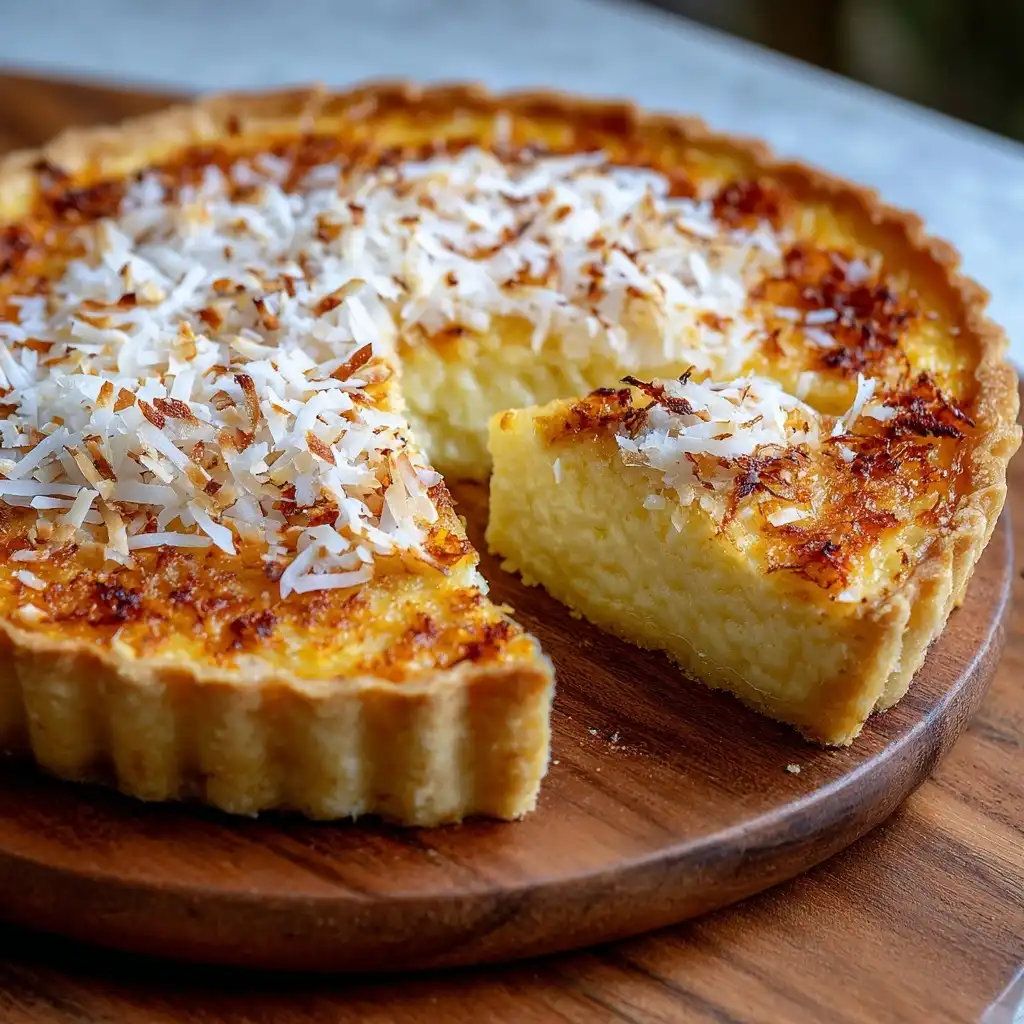
Toast Coconut Custard Tart is a luxurious, tropical-inspired dessert that marries the velvety richness of classic custard with the deep, nutty aroma and crunch of toasted coconut. With its buttery shortcrust base, silky-smooth coconut-infused filling, and a delicate golden-brown surface crowned with toasted flakes, this tart delivers an elegant balance of texture, temperature, and flavor. It’s more than just a dessert—it’s a sensory experience: the crisp snap of the shell, the lush creaminess of the custard, the subtle caramelized sweetness of toasted coconut, and the lingering warmth of vanilla and spice. Whether served at an intimate dinner party, a summer garden gathering, or as a weekend treat for loved ones, this tart evokes nostalgia and sophistication in equal measure—bridging traditional French pâtisserie techniques with vibrant Southeast Asian and Caribbean coconut traditions.
The History
The Toasted Coconut Custard Tart is a modern evolution born from centuries of global custard innovation and coconut-centric culinary heritage. Custard itself traces back to medieval Europe, where egg-thickened milk mixtures were used in savory dishes before evolving into sweet desserts like crème anglaise and flan by the 17th century. Meanwhile, coconut has been a staple across tropical regions—including the Philippines, Thailand, India, Jamaica, and Brazil—for over 3,000 years, revered for its versatility in both savory and sweet preparations. In colonial-era Southeast Asia and the Caribbean, European settlers adapted local ingredients into familiar formats: Spanish missionaries introduced baked custards to the Philippines (leading to *leche flan*), while British colonists in Jamaica fused coconut milk with English tart traditions, yielding early versions of coconut custard pies. The “toasted” element gained prominence in the late 20th century with the rise of artisanal baking and the “textural revolution” in pastry—chefs like Pierre Hermé and Dominique Ansel championed contrast, inspiring bakers to finish custards with torched or oven-toasted toppings. Today’s Toasted Coconut Custard Tart represents a harmonious convergence: a French-style pâte sucrée shell, a Thai- or Filipino-influenced coconut-milk-enriched custard (often using both coconut cream and whole milk for balance), and a finishing layer of deeply caramelized, hand-toasted desiccated coconut—elevating tradition through technique, terroir, and intention.
Ingredients Breakdown
Every component of this tart serves a precise functional and sensory role—understanding each ingredient unlocks mastery:
- Shortcrust Pastry (Pâte Sucrée): All-purpose flour provides structure; unsalted butter contributes flakiness, richness, and laminated tenderness when chilled and rolled correctly; confectioners’ sugar adds subtle sweetness and inhibits gluten development for tenderness; egg yolk binds and enriches color and mouthfeel; a pinch of salt balances sweetness and enhances butter flavor; cold water hydrates without activating excess gluten.
- Custard Base: Egg yolks act as the primary thickener and emulsifier, delivering unctuous silkiness; granulated sugar dissolves into the dairy to create a stable matrix and contribute to gentle caramelization during baking; whole milk offers balanced fat and protein for body without heaviness; full-fat coconut milk (preferably canned, not “light”) supplies intense coconut aroma, natural oils for richness, and lauric acid that enhances mouth-coating viscosity; heavy cream (36% fat) amplifies luxury, aids in browning, and prevents cracking; pure Madagascar bourbon vanilla extract and scraped seeds add floral depth and complexity; a small pinch of ground nutmeg or cardamom (optional but recommended) complements coconut without overpowering.
- Toasted Coconut Topping: Unsweetened shredded or flaked coconut ensures control over sweetness and allows even, deep toasting; clarified butter or neutral oil (like refined coconut oil) promotes uniform browning and prevents scorching; flaky sea salt (e.g., Maldon) added post-toasting heightens savoriness and creates a delightful sweet-salt counterpoint.
- Finishing Touches (Optional but Recommended): A light brush of warmed coconut syrup (reduced coconut water + palm sugar) adds glossy sheen and subtle umami; edible dried coconut chips or toasted coconut “caviar” (tiny toasted pearls) provide visual drama and textural surprise; micro mint or kaffir lime leaf ribbons offer aromatic freshness and chromatic contrast.
Step-by-Step Recipe
- Prepare the Pâte Sucrée Dough (Minimum 2 hours ahead, ideally overnight): In a food processor, pulse 1¾ cups (220g) all-purpose flour, ¼ cup (30g) confectioners’ sugar, and ¼ tsp fine sea salt until combined. Add 10 tbsp (140g) cold, cubed unsalted butter and pulse 8–10 times until pea-sized crumbs form. Add 1 large egg yolk and 2–3 tbsp ice-cold water, pulsing just until dough begins to clump. Turn onto parchment, gather into a disc, wrap tightly, and refrigerate for at least 2 hours (or freeze for up to 1 month). This chilling relaxes gluten, solidifies butter, and prevents shrinkage.
- Roll & Blind-Bake the Tart Shell: Preheat oven to 375°F (190°C). On a lightly floured surface, roll chilled dough to ⅛” thickness. Gently transfer to a 10-inch (25cm) fluted tart pan with removable bottom. Trim excess, press dough firmly into corners and up sides, then prick base with fork. Freeze for 15 minutes. Line with parchment and fill with pie weights or dried beans. Bake 20 minutes. Carefully remove weights and parchment; bake 12–15 more minutes until golden and dry. Cool completely on wire rack—do not skip cooling, or custard will weep.
- Prepare the Coconut Custard Filling: In a medium saucepan, combine 1 cup (240ml) full-fat coconut milk, 1 cup (240ml) whole milk, ½ cup (120ml) heavy cream, 1 vanilla bean (split and scraped) or 2 tsp pure extract, and a pinch of freshly grated nutmeg. Warm over medium-low heat until steaming (do not boil). Meanwhile, whisk 5 large egg yolks and ¾ cup (150g) granulated sugar in a bowl until pale and slightly thickened (~2 min). Slowly pour 1 cup of hot dairy mixture into yolks while whisking constantly (tempering). Pour tempered mixture back into saucepan. Cook over low heat, stirring constantly with a silicone spatula in figure-eights, until mixture thickens enough to coat the back of the spoon (170–175°F / 77–80°C)—about 8–10 minutes. Do not let boil or curdle. Strain immediately through a fine-mesh sieve into a clean bowl. Stir in 1 tbsp (14g) unsalted butter for extra gloss and smoothness. Cool to lukewarm (~95°F / 35°C) before pouring into cooled shell.
- Bake the Custard: Place filled tart on center oven rack. Reduce oven temperature to 325°F (165°C). Bake 35–45 minutes—until edges are set but center jiggles slightly like Jell-O (it will fully set while cooling). Rotate halfway for even baking. Avoid opening oven door before 30 minutes to prevent collapse.
- Toasting the Coconut Topping: While tart bakes, toast coconut: Heat 1 tbsp clarified butter in a nonstick skillet over medium-low heat. Add 1 cup (80g) unsweetened shredded coconut. Stir constantly for 4–7 minutes until evenly golden brown—not just tan, but rich amber with nutty fragrance. Immediately transfer to parchment-lined plate; sprinkle with ¼ tsp flaky sea salt. Cool completely.
- Chill & Finish: Let tart cool on wire rack for 1 hour at room temperature, then refrigerate uncovered for at least 4 hours (ideally overnight) to fully set and deepen flavors. Just before serving, evenly scatter cooled toasted coconut over surface. Optional: lightly torch for extra caramelization, or drizzle with warm coconut syrup and garnish with mint.
Tips
- Dough Perfection: Always use cold butter and cold water—warm butter melts prematurely, causing greasiness and shrinkage. If dough feels sticky while rolling, dust surface with rice flour instead of all-purpose—it absorbs less moisture and prevents toughness.
- No-Crack Custard Secret: Bake in a water bath (bain-marie) for ultra-even, gentle heat—place tart pan inside a larger roasting pan, then pour hot water halfway up sides. This reduces thermal shock and virtually eliminates cracks.
- Coconut Milk Wisdom: Shake the can vigorously before opening—separation is natural, but thorough emulsification ensures consistent flavor and texture. For richer tarts, substitute ¼ cup of milk with coconut cream (the thick top layer).
- Tempering Precision: Never pour all hot dairy into yolks at once—this causes scrambling. Add gradually while whisking furiously. If accidental lumps form, strain immediately—don’t try to whisk them out.
- Toasting Mastery: Toast coconut in a stainless steel or cast iron skillet—not nonstick if using high heat. Watch like a hawk: coconut goes from perfect to burnt in under 30 seconds. Remove from heat 30 seconds before desired color—it continues cooking on the hot pan.
- Serving Temperature: Serve chilled but not icy—remove from fridge 15 minutes before slicing. Use a hot, thin-bladed knife dipped in hot water and wiped clean between cuts for pristine slices.
- Storage Intelligence: Store covered in fridge up to 4 days. Do not freeze assembled tart—the custard weeps upon thawing. However, unbaked dough and baked shells freeze beautifully for 3 months.
- Texture Troubleshooting: Grainy custard? Likely overheated or under-strained. Watery edges? Underbaked or insufficient chilling. Soggy bottom? Shell wasn’t fully blind-baked or cooled before filling.
Variations and Customizations
This tart is a canvas for creativity—here are globally inspired, seasonally attuned, and dietary-conscious adaptations:
- Tropical Fusion: Swirl in 2 tbsp passionfruit purée or mango coulis before baking; top with toasted macadamia nuts and candied ginger.
- Spiced Chai Version: Infuse dairy with 1 cinnamon stick, 4 green cardamom pods, 3 black peppercorns, and 1 star anise for 20 minutes; strain before tempering. Garnish with crystallized ginger and chai-spiced coconut.
- Matcha-Coconut: Whisk 1½ tsp ceremonial-grade matcha into cooled custard base before pouring. Dust with matcha powder and toasted black sesame after baking.
- Vegan Adaptation: Use almond-oil-based shortcrust (with aquafaba as binder); replace eggs with silken tofu + cornstarch slurry (¾ cup tofu + 2 tbsp cornstarch); use full-fat coconut milk + cashew cream blend; toast coconut in coconut oil. Set with agar (0.75g per cup liquid) for firmness.
- Gluten-Free Option: Substitute pâte sucrée with GF all-purpose blend (with xanthan gum) + 1 tbsp almond flour for binding. Ensure certified GF oats if using oat-based variations.
- Low-Sugar/Keto-Friendly: Replace granulated sugar with erythritol + monk fruit blend (1:1 ratio); use unsweetened coconut milk and heavy cream only—no added milk; top with toasted coconut sweetened with a touch of coconut nectar.
- Mini-Tartlets: Press dough into 12 standard muffin tin cups lined with parchment. Blind-bake 12–14 minutes. Fill and bake 22–28 minutes. Perfect for parties or portion control.
- Smoked Coconut Variation: Cold-smoke unsweetened coconut flakes for 15 minutes over coconut husk chips before toasting—adds haunting, complex depth ideal for fall/winter service.
Health Considerations and Nutritional Value
A single generous slice (1/12 of a standard 10-inch tart) contains approximately 385–420 calories, with nuanced nutritional attributes rooted in its whole-food ingredients:
- Coconut Benefits: Rich in medium-chain triglycerides (MCTs), particularly lauric acid—shown in studies to support metabolic function, promote satiety, and possess antimicrobial properties. Contains electrolytes (potassium, magnesium) and fiber (especially in toasted flakes).
- Egg Yolk Nutrition: Provides highly bioavailable choline (critical for brain and liver health), lutein and zeaxanthin (eye-protective carotenoids), and vitamin D—especially when hens are pasture-raised.
- Butter & Cream Context: While high in saturated fat, recent meta-analyses (e.g., The Lancet Global Health, 2017) indicate no significant association between moderate dairy fat intake and cardiovascular disease—especially when part of a balanced diet low in refined carbs and industrial seed oils.
- Considerations: Naturally high in calories and sugars (even without added sweeteners, coconut milk contains ~6g natural sugar per ½ cup). Not suitable for strict low-FODMAP diets (coconut milk is moderate-FODMAP in ½-cup servings). Those with egg allergies must use appropriate binders (e.g., flax or chia gel, though texture shifts significantly).
- Mindful Enjoyment: This tart is best viewed as a nutrient-dense indulgence—not “health food,” but nourishing food. Pair with antioxidant-rich berries or a green salad to round the meal. Portion awareness (1 small slice) supports metabolic harmony without deprivation.
Ingredients
For the Pâte Sucrée Tart Shell:
- 1¾ cups (220g) all-purpose flour, plus extra for dusting
- ¼ cup (30g) confectioners’ sugar
- ¼ teaspoon fine sea salt
- 10 tablespoons (140g) unsalted butter, very cold and cubed
- 1 large egg yolk
- 2–3 tablespoons ice-cold water
For the Coconut Custard Filling:
- 1 cup (240ml) full-fat canned coconut milk (well shaken)
- 1 cup (240ml) whole milk
- ½ cup (120ml) heavy cream (36% fat)
- 1 vanilla bean (split and scraped) OR 2 teaspoons pure Madagascar bourbon vanilla extract
- Pinch of freshly grated nutmeg or ground cardamom (optional but recommended)
- 5 large egg yolks
- ¾ cup (150g) granulated sugar
- 1 tablespoon (14g) unsalted butter, at room temperature
For the Toasted Coconut Topping:
- 1 cup (80g) unsweetened shredded or flaked coconut
- 1 tablespoon clarified butter or refined coconut oil
- ¼ teaspoon flaky sea salt (e.g., Maldon)
Optional Finishing Touches:
- Coconut syrup (¼ cup coconut water + 2 tbsp palm sugar, simmered 5 min, cooled)
- Fresh kaffir lime leaves, thinly julienned
- Micro mint or Thai basil leaves
- Edible dried coconut chips
Directions
- Make the dough: In a food processor, combine flour, confectioners’ sugar, and salt. Pulse 3 times. Add cold butter; pulse 8–10 times until coarse crumbs form. Add egg yolk and 2 tbsp ice water; pulse just until dough begins to clump. If too dry, add remaining water, ½ tsp at a time. Turn onto parchment, gather into disc, wrap, and chill ≥2 hours or overnight.
- Blind-bake the shell: Preheat oven to 375°F (190°C). Roll dough to ⅛” thickness. Fit into 10-inch fluted tart pan; trim and crimp. Prick base. Freeze 15 min. Line with parchment, fill with weights. Bake 20 min. Remove weights/parchment; bake 12–15 min more until golden. Cool completely on rack.
- Infuse dairy: In saucepan, combine coconut milk, whole milk, heavy cream, vanilla pod/seeds (or extract), and nutmeg. Warm over medium-low heat until steaming (180°F / 82°C). Remove from heat; cover and steep 15 min if using pod.
- Temper & cook custard: Whisk egg yolks and sugar until pale (~2 min). Slowly whisk in 1 cup hot dairy. Return mixture to saucepan. Cook over low heat, stirring constantly, until thickened and coating spoon (170–175°F). Strain immediately. Stir in butter. Cool to lukewarm (~95°F).
- Fill & bake: Pour custard into cooled shell. Place on center rack. Reduce oven to 325°F (165°C). Bake 35–45 min until edges set and center jiggles slightly. Rotate at 25 min. Cool 1 hour at room temp.
- Toast coconut: While tart bakes, melt clarified butter in skillet. Add coconut; stir constantly over medium-low heat 4–7 min until deep golden. Transfer to parchment; sprinkle with salt. Cool completely.
- Chill & serve: Refrigerate uncovered ≥4 hours (overnight preferred). Before serving, scatter toasted coconut evenly over surface. Optional: torch lightly, drizzle with coconut syrup, and garnish.
FAQ
- Can I make the crust ahead?
- Absolutely. Dough keeps refrigerated for 3 days or frozen for 3 months. Baked shells stay crisp in airtight container at room temp for 2 days or frozen for 1 month.
- Why did my custard crack?
- Most common causes: oven too hot, rapid temperature change (opening door too soon), or overbaking. Water bath and gradual cooling prevent this. If cracked, gently press coconut topping into fissures—it’ll camouflage beautifully.
- Can I use sweetened coconut?
- Not recommended for the topping—it burns easily due to added sugars. For the filling, always use unsweetened coconut milk to control sweetness precisely.
- Is there a shortcut for the custard?
- You can use pasteurized egg yolks (found refrigerated in grocery stores) to reduce risk—but do not skip tempering. No true “instant” substitute preserves the silkiness; cornstarch or arrowroot thickeners yield a different, glossier, less delicate texture.
- My coconut didn’t toast evenly—what went wrong?
- Inconsistent heat or overcrowding the pan. Use medium-low flame, stir constantly with a wooden spoon, and spread in single layer. If clumping occurs, break apart with fingers while still warm.
- Can I add fruit?
- Yes—but add fresh fruit (mango, pineapple, guava) only as a garnish *after* baking. Baking fruit releases water and dilutes custard. Roasted or caramelized fruits (e.g., roasted figs, grilled peaches) make stunning elegant accents.
- How do I know when it’s done?
- Look for visual cues: edges should be puffed and set, surface matte (not shiny), and center should have a gentle, slow jiggle—not slosh or ripple. Inserting a knife near center should come out mostly clean with slight custard film.
- Can I use coconut cream only?
- You may substitute up to half the dairy with coconut cream for intensified flavor—but full coconut cream alone makes the custard overly dense and greasy. Balance with milk and cream for ideal mouthfeel.
- Why strain the custard?
- Straining removes any potential cooked-yolk bits, vanilla pod fragments, or undissolved sugar crystals—ensuring absolute silkiness. Don’t skip this step for professional results.
- What if I don’t have a tart pan?
- A 9-inch pie dish works, but expect slightly thinner filling and longer bake time. Or use a springform pan lined with parchment—just grease well and chill shell thoroughly before filling.
Summary
Toast Coconut Custard Tart is a masterclass in balance—where buttery French pastry meets lush Southeast Asian coconut tradition, elevated by the deep, resonant flavor of carefully toasted coconut.
With meticulous attention to temperature, texture, and timing, this dessert delivers sophisticated elegance, nostalgic comfort, and unforgettable tropical richness in every impeccably layered bite.