Introduction
There’s something profoundly comforting—and undeniably elegant—about a Brown Butter Peach Pie. It marries the rustic charm of summer’s juiciest fruit with the deep, nutty sophistication of browned butter, transforming a classic American dessert into a multi-sensory experience. Unlike standard fruit pies that rely solely on sugar and spice for depth, this version begins with a foundational technique—browning butter until it develops toasted milk solids and an amber-gold hue—infusing every bite with warm, caramelized complexity. The peaches shine not just as sweet fruit, but as tender, fragrant vessels that absorb and reflect the richness of the brown butter in the filling, crust, and even the glaze. Whether served warm with a scoop of vanilla bean ice cream or chilled with a dollop of crème fraîche, this pie is equal parts celebration and solace—a dessert that feels both nostalgic and refreshingly modern.
The History
The lineage of peach pie stretches back centuries—to colonial America, where early settlers adapted English fruit tart traditions using native and orchard-grown stone fruits. Peaches, originally from China and later cultivated across Persia, the Mediterranean, and Spain, arrived in North America via Spanish explorers in the 16th century and flourished in the Southeastern U.S., particularly Georgia and South Carolina. By the 1800s, peach pie appeared regularly in regional cookbooks like The Virginia House-Wife (1824) by Mary Randolph, often baked in open-faced “pies” or deep-dish “tarts” with lard-based crusts and minimal sweetening.
Browned butter, meanwhile, has roots in French culinary tradition (beurre noisette)—a technique perfected in the 17th and 18th centuries to elevate sauces, pastries, and sabayons. Its migration into American baking was gradual: early 20th-century home economists cautioned against browning butter for pie crusts due to perceived instability, but mid-century chefs and food writers began experimenting with its flavor potential. The fusion of brown butter and peach pie is a relatively recent innovation—gaining traction in the 2010s through influential baking blogs, James Beard Award–winning cookbooks (e.g., Sarah Kieffer’s The Vintage Baker), and viral social media moments highlighting its aromatic allure. Today, it stands as a hallmark of contemporary artisanal baking: honoring heritage while embracing bold, layered flavor development.
Ingredients Breakdown
Every element of this pie is intentionally chosen—not just for function, but for synergy. Here’s why each ingredient matters:
- Peaches: Freestone varieties (like Elberta, O’Henry, or Red Haven) are ideal—they release cleanly from the pit and hold shape during baking. Ripe but firm fruit (with slight give near the stem and rich floral aroma) ensures optimal texture; overripe peaches turn mushy, while underripe ones lack sweetness and depth.
- Brown Butter: Made from unsalted butter slowly cooked until water evaporates and milk solids toast to a golden-brown hue, releasing diacetyl (butter’s signature nutty compound) and volatile aromatics like furans and pyrazines. In this recipe, it’s used in three places: infused into the filling, folded into the crust dough, and brushed atop the lattice for glossy, savory-sweet finish.
- Demerara Sugar: Coarse, lightly molasses-infused cane sugar adds subtle caramel notes and textural contrast—especially important in the topping, where crystals resist full melting and create delicate crunch.
- Instant ClearJel (not cornstarch): A modified cornstarch designed specifically for fruit pies, ClearJel remains stable under prolonged heat and freezing, preventing weeping, gumminess, or breakdown. It thickens at lower temperatures and tolerates acidic fruit better than flour or tapioca—ensuring a lush, cohesive, non-stringy filling that slices cleanly.
- Apple Cider Vinegar: A tiny amount (¼ tsp) brightens the entire profile, balancing brown butter’s richness and enhancing peach’s natural acidity without detectable tang—similar to how lemon juice functions, but with softer, orchard-like resonance.
- Vanilla Bean Paste (not extract): Contains real scraped seeds suspended in a thick, honey-like base—delivering visual flecks and concentrated, creamy, floral-vanilla essence that stands up to robust brown butter without fading.
- Flaky Sea Salt (Maldon or Fleur de Sel): Sprinkled just before baking, it amplifies sweetness, tempers fat, and provides a delicate mineral pop—especially effective when paired with browned butter’s umami depth.
Step-by-Step Recipe
- Prepare the Brown Butter (2 hours ahead): Cut 1 cup (2 sticks / 227g) unsalted butter into tablespoon pieces. Melt in a light-colored heavy-bottomed saucepan over medium-low heat, swirling occasionally. Once foaming subsides and butter turns golden with amber-speckled solids (~6–9 minutes), immediately pour into a heatproof bowl. Scrape every bit of toasted milk solids—these are flavor gold. Cool completely to room temperature (do not refrigerate; it must remain soft but not liquid).
- Make the Flaky Brown Butter Crust: In a food processor, pulse 2¾ cups (345g) all-purpose flour, 1 tsp fine sea salt, and 1 tbsp granulated sugar. Add ½ cup (1 stick / 113g) cold cubed butter and ¼ cup (57g) cold lard; pulse until pea-sized crumbs form. Drizzle in 6–8 tbsp ice water mixed with 1 tsp apple cider vinegar, pulsing just until shaggy clumps form. Transfer to counter, gather into two discs (one 60% larger for bottom crust), wrap tightly, and chill ≥2 hours (or overnight).
- Prep the Peaches: Peel 2.5 lbs (about 8–10 medium) ripe freestone peaches using a quick blanch (30 sec in boiling water → ice bath → slip skins off). Halve, pit, and slice ½-inch thick. Toss gently in a large bowl with ¾ cup (150g) granulated sugar, ⅓ cup (65g) Demerara sugar, ¼ tsp ground cinnamon, ⅛ tsp ground cardamom, ¼ tsp apple cider vinegar, 1 tbsp vanilla bean paste, and 3 tbsp cooled brown butter. Let macerate 30 minutes at room temperature.
- Thicken & Finish Filling: Drain peaches *lightly* (reserve ¼ cup syrup). Whisk ¼ cup (30g) Instant ClearJel with reserved syrup until smooth. Gently fold syrup-ClearJel mixture and drained peaches together. Stir in 1 tbsp fresh lemon juice and 1 tsp flaky sea salt. Refrigerate filling 15 minutes (chilling stabilizes starch).
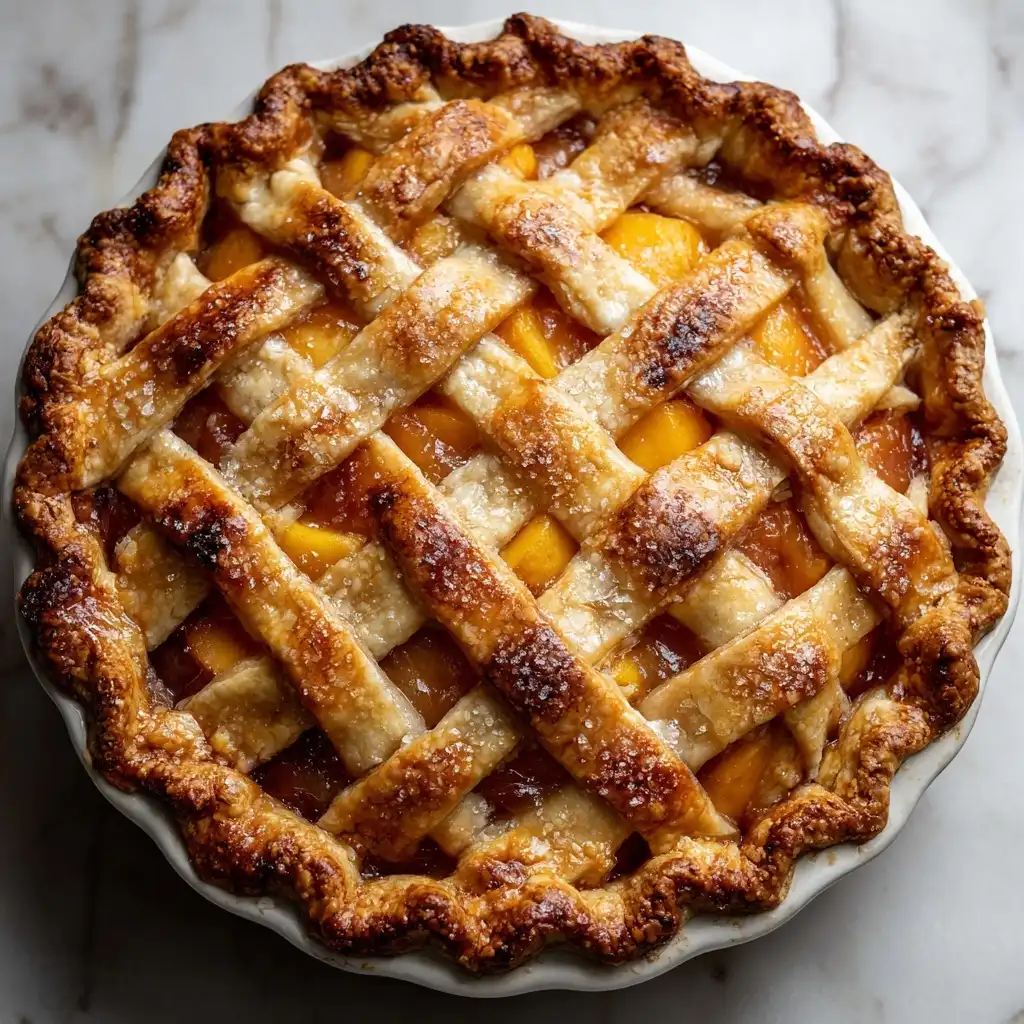
- Roll & Assemble: On parchment-lined surface, roll larger dough disc to 12-inch circle, ~⅛-inch thick. Fit into 9-inch deep-dish pie plate, trimming overhang to 1 inch. Chill 20 minutes. Roll second disc to 11-inch circle; cut into ¾-inch strips for lattice. Fill chilled crust with cold peach mixture, mounding slightly in center. Weave lattice, crimp edges decoratively, and brush lattice with 1 tbsp brown butter. Sprinkle generously with Demerara sugar and flaky salt.
- Bake Strategically: Place pie on preheated baking stone or inverted sheet tray in lowest oven rack. Bake at 425°F (220°C) for 20 minutes. Reduce heat to 375°F (190°C); rotate pie; bake 40–50 more minutes until crust is deeply golden, filling bubbles thickly at center, and internal temperature reaches 205–210°F (96–99°C) on instant-read thermometer.
- Cool Completely: Rest pie on wire rack ≥4 hours (ideally overnight). This allows starches to fully set—critical for clean slicing and preventing soupy filling.
Tips
- Butter Temperature Is Non-Negotiable: For flaky crust, butter and lard must stay cold (<55°F/13°C) until baking. If dough feels warm while rolling, return to fridge 10 minutes. Warm fat melts prematurely, yielding tough, greasy crust.
- Blanch Peaches Like a Pro: Use a slotted spoon—not tongs—to avoid bruising. After ice bath, dry thoroughly with clean towels; excess water dilutes filling and inhibits browning.
- ClearJel Must Be Whisked Into Cold Syrup: Adding dry ClearJel directly to fruit causes clumping. Always dissolve in cold liquid first—even if using reserved peach syrup.
- Prevent Soggy Bottoms: Preheat your baking stone or heavy-duty sheet pan for 45+ minutes. The intense bottom heat sets the crust before juices seep in.
- Lattice Luster Secret: Brush lattice with brown butter *after* weaving but *before* sprinkling sugar—it helps crystals adhere and enhances sheen. For extra gloss, brush again with melted brown butter 5 minutes before end of bake.
- Don’t Skip the Overnight Rest: Cutting into a warm pie releases steam trapped in the gel network, causing collapse and leakage. Patience = structural integrity.
- Freeze for Later: Unbaked assembled pie freezes beautifully for up to 3 months. Bake frozen—add 15–20 minutes to total time and tent foil over edges after 30 minutes to prevent over-browning.
Variations and Customizations
- Peach-Blackberry Swirl: Fold in 1 cup fresh blackberries (tossed with 1 tsp cornstarch) during final filling assembly for tart contrast and jewel-toned speckles.
- Bourbon-Brown Butter: Add 1½ tbsp aged bourbon to brown butter while still warm—let cool completely before using. Deepens caramel notes and adds subtle oak warmth.
- Oat-Maple Crumb Top: Replace lattice with oat crumble: combine ¾ cup rolled oats, ¼ cup maple sugar, ¼ cup brown butter, 2 tbsp flour, ¼ tsp cinnamon, pinch salt. Sprinkle thickly over filling before baking.
- Vegan Adaptation: Use cultured vegan butter (e.g., Miyoko’s) for browning (simmer gently—lower smoke point), swap lard for refined coconut oil, and replace ClearJel with kudzu root starch (1:1 ratio). Ensure peaches are organic (no wax coating interferes with browning).
- Gluten-Free Option: Substitute 1:1 gluten-free flour blend (with xanthan gum) in crust and filling. Add 1 tsp psyllium husk powder to dough for elasticity. Chill GF dough 30+ minutes longer before rolling.
- Herbal Infusion: Steep 2 tbsp fresh thyme leaves or 1 tbsp lavender buds in warm brown butter for 10 minutes before straining—imparts haunting, aromatic sophistication.
- Mini Hand Pies: Roll dough thinner (⅛-inch), cut circles with 4-inch cutter, fill with 2 tbsp cold filling, seal with fork, vent tops, brush with brown butter + sugar. Bake at 400°F for 18–22 minutes.
Health Considerations and Nutritional Value
A single generous slice (1/8 of 9-inch pie) contains approximately 420–460 calories, with nuanced nutritional contributions beyond simple calorie count:
- Peaches: Excellent source of vitamin C (15% DV), potassium (6% DV), and dietary fiber (2g/slice)—particularly soluble pectin, which supports gut health and gentle cholesterol modulation. Their polyphenols (chlorogenic acid, anthocyanins in red-blushed skin) exhibit antioxidant and anti-inflammatory activity.
- Brown Butter: While still a fat source (24g total fat/slice, ~14g saturated), browning triggers Maillard reactions that generate antioxidant compounds like tocopherols and butyric acid derivatives—shown in emerging research to support intestinal barrier integrity. Using grass-fed butter increases conjugated linoleic acid (CLA), linked to metabolic benefits in clinical models.
- Sugar Mindfully Managed: Total added sugar per slice hovers around 28–32g—lower than many commercial desserts (e.g., store-bought peach cobbler averages 45g). Demerara’s trace minerals (iron, calcium, potassium) offer marginal micronutrient uplift versus refined white sugar.
- ClearJel Advantage: Unlike flour thickeners, ClearJel contributes negligible calories or carbs (<0.5g/slice) and avoids gluten cross-reactivity concerns for sensitive individuals.
- Considerations: Naturally high in sodium (320mg/slice, mostly from butter and salt), so those on sodium-restricted diets may reduce added salt by half. For reduced-fat versions, substitute 2 tbsp of butter with unsweetened applesauce in filling—but note: this sacrifices brown butter’s signature depth and may soften crust texture.
This pie isn’t “health food”—but it’s a consciously crafted indulgence: whole-food ingredients, minimal processing, no artificial preservatives or colors, and intentional balance between pleasure and nourishment.
Ingredients
For the Brown Butter Crust
- 2¾ cups (345g) all-purpose flour, plus extra for dusting
- 1 tsp fine sea salt
- 1 tbsp granulated sugar
- ½ cup (1 stick / 113g) unsalted butter, very cold, cubed
- ¼ cup (57g) leaf lard, very cold, cubed
- 6–8 tbsp ice water
- 1 tsp apple cider vinegar
For the Brown Butter Peach Filling
- 2.5 lbs (about 8–10 medium) ripe freestone peaches, peeled, pitted, sliced ½-inch thick
- ¾ cup (150g) granulated sugar
- ⅓ cup (65g) Demerara sugar
- ¼ tsp ground cinnamon
- ⅛ tsp ground cardamom
- ¼ tsp apple cider vinegar
- 1 tbsp vanilla bean paste
- 3 tbsp cooled brown butter (from below)
- ¼ cup (30g) Instant ClearJel
- ¼ cup reserved peach syrup (from maceration)
- 1 tbsp fresh lemon juice
- 1 tsp flaky sea salt (e.g., Maldon)
For Browning the Butter (makes ~1 cup)
- 1 cup (2 sticks / 227g) unsalted butter, cut into tablespoon pieces
For Assembly & Finishing
- 1 tbsp cooled brown butter (for brushing lattice)
- 2 tbsp Demerara sugar (for sprinkling)
- ¼ tsp flaky sea salt (for finishing)
Directions
- Make the Brown Butter: In a light-colored heavy-bottomed saucepan over medium-low heat, melt butter, swirling occasionally. Once melted, continue cooking until foam subsides and butter turns golden with amber-brown specks (~6–9 minutes). Immediately pour into a heatproof bowl, scraping in all toasted solids. Cool completely to room temperature (≈2 hours). Do not refrigerate.
- Make the Crust Dough: In a food processor, pulse flour, salt, and sugar. Add cold butter and lard; pulse until mixture resembles coarse crumbs with some pea-sized pieces. In a small bowl, mix ice water and vinegar. Drizzle 6 tbsp over mixture while pulsing; add more water 1 tsp at a time until dough begins to clump. Turn onto counter; divide into two uneven discs (larger = 60% of dough). Wrap tightly in plastic; chill ≥2 hours (or up to 3 days).
- Prepare Peaches: Blanch peaches: boil water, submerge fruit 30 seconds, transfer to ice bath. Slip off skins. Halve, pit, slice. Toss gently in large bowl with granulated sugar, Demerara sugar, cinnamon, cardamom, vinegar, vanilla paste, and 3 tbsp cooled brown butter. Let sit 30 minutes at room temperature.
- Thicken Filling: Drain peaches, reserving exactly ¼ cup syrup. Whisk ClearJel into syrup until smooth, no lumps. Gently fold syrup mixture into drained peaches. Stir in lemon juice and flaky salt. Refrigerate 15 minutes.
- Assemble Pie: Preheat oven to 425°F (220°C) with baking stone or inverted heavy sheet pan on lowest rack. Roll larger dough disc on parchment to 12-inch circle, ⅛-inch thick. Fit into 9-inch deep-dish pie plate; trim overhang to 1 inch. Chill 20 minutes. Roll smaller disc to 11-inch circle; cut into ¾-inch strips. Fill chilled crust with cold peach mixture. Weave lattice, crimp edges, brush lattice with 1 tbsp brown butter, sprinkle with Demerara sugar and flaky salt.
- Bake: Place pie on preheated stone/sheet. Bake 425°F for 20 minutes. Reduce heat to 375°F (190°C); rotate pie. Bake 40–50 minutes more until crust is deep golden brown, filling bubbles vigorously at center, and internal temp reads 205–210°F (96–99°C).
- Cool & Serve: Cool completely on wire rack ≥4 hours (preferably overnight). Serve at room temperature or slightly warmed, with vanilla ice cream, crème fraîche, or lightly sweetened whipped cream.
FAQ
- Can I use frozen peaches?
- Yes—but thaw completely, drain *very* well (press gently in cheesecloth), and increase ClearJel to 5 tbsp. Frozen peaches release more water and may yield softer texture. Avoid canned peaches (syrup alters balance and adds unwanted gums).
- Why not cornstarch or tapioca?
- Cornstarch breaks down under prolonged heat and acidity, causing weeping and thin filling. Tapioca creates undesirable stringiness and cloudiness. Instant ClearJel is engineered for high-heat, high-acid fruit applications—providing clear, stable, glossy set without graininess.
- My crust shrank while baking. What went wrong?
- Overworking dough (developing too much gluten), insufficient chilling before baking, or stretching dough to fit the pan (causing recoil). Always chill shaped crust 20+ minutes, and ease—not stretch—dough into place.
- Can I make this pie ahead for Thanksgiving?
- Absolutely. Assemble unbaked pie up to 2 days ahead; cover tightly and refrigerate. Or freeze unbaked pie up to 3 months. Bake from frozen—just extend time and tent edges.
- What if my brown butter burns?
- If solids turn dark brown/black and smell acrid, discard—it’s bitter and unusable. Start over with fresh butter. To prevent: use medium-low heat, swirl constantly near end, and remove from heat *as soon as* golden specks appear.
- Is there a dairy-free alternative to brown butter?
- Yes—high-quality cultured vegan butter (e.g., Miyoko’s European Style) can be browned carefully at lower heat (325°F max). Coconut oil cannot replicate brown butter’s flavor chemistry, but toasted coconut butter blended with roasted almond butter offers intriguing nutty parallels.
- Can I omit the cardamom?
- Yes—it’s optional but highly recommended. Cardamom’s citrusy-woody notes harmonize with peach and amplify brown butter’s complexity. Substitute with ⅛ tsp ground ginger if preferred.
- How do I store leftovers?
- Cover tightly with beeswax wrap or foil. Refrigerate up to 5 days. Reheat individual slices at 325°F for 12–15 minutes—or enjoy cold. Do not freeze sliced pie; texture suffers.
Summary
Brown Butter Peach Pie is a masterclass in layered flavor and thoughtful technique—where the deep, nutty resonance of carefully browned butter elevates sun-ripened peaches into a dessert of remarkable sophistication and soulful comfort. Every component, from the flaky, golden-brown crust to the glossy, jewel-toned filling and delicately crunchy, salt-kissed lattice, reflects reverence for seasonal abundance and time-honored craft.
It’s not merely a pie—it’s a slow ritual of patience, precision, and pleasure: browning butter until it sings, coaxing sweetness from summer’s finest fruit, and waiting, with quiet confidence, for the alchemy of heat and time to transform humble ingredients into pure, resonant joy.