Introduction
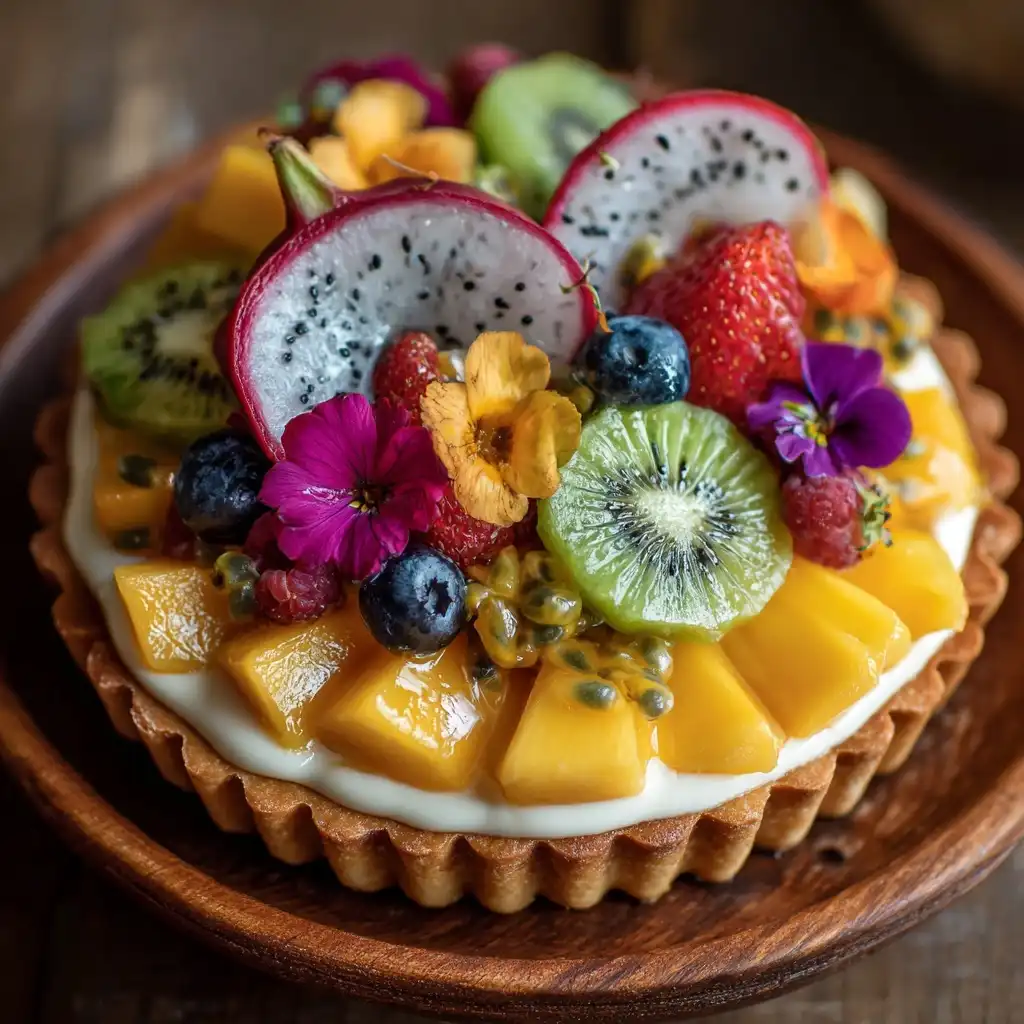
The Tropical Fruit Tart is a vibrant, sun-kissed dessert that transports your taste buds straight to a breezy island getaway. With its buttery, golden shortcrust base, luxuriously smooth vanilla or coconut-infused pastry cream, and a dazzling mosaic of ripe, juicy tropical fruits—think mango, pineapple, kiwi, passion fruit, starfruit, and dragon fruit—it’s as visually stunning as it is refreshingly flavorful. This tart strikes the perfect balance between elegance and approachability: sophisticated enough for dinner parties and special occasions, yet simple enough for weekend baking enthusiasts. Its bright acidity, natural sweetness, and creamy contrast make it a crowd-pleasing favorite across all ages—and a true celebration of summer, warmth, and botanical abundance.
The History
While tarts themselves trace their origins back to medieval Europe—where early versions were rustic, open-faced pastries filled with seasonal fruits—the Tropical Fruit Tart is a relatively modern evolution born from globalization, improved refrigeration, and the expanding availability of exotic produce in Western markets. In the mid-to-late 20th century, as air freight made fresh mangoes, pineapples, and papayas more accessible year-round, pastry chefs began experimenting beyond traditional apple, pear, and berry fillings. The rise of French pâtisserie techniques—especially the refinement of crème pâtissière (pastry cream) and blind-baking methods—merged seamlessly with tropical ingredients during the 1970s and ’80s in resorts across Hawaii, the Caribbean, and Southeast Asia. Chefs in Bali and Phuket started incorporating local coconut milk into custards; Hawaiian bakers paired lilikoi (passion fruit) curd with macadamia nut crusts; and Australian patisseries elevated the concept with native finger limes and Davidson plums. By the early 2000s, food media, culinary blogs, and televised baking competitions helped cement the Tropical Fruit Tart as a signature dessert—symbolizing freshness, vibrancy, and culinary fusion. Today, it stands not only as a dessert but as a cultural artifact reflecting our interconnected, ingredient-rich world.
Ingredients Breakdown
Every exceptional Tropical Fruit Tart rests on three foundational layers—each meticulously balanced for texture, flavor, and visual harmony:
- The Crust: A classic pâte sablée (sweet shortcrust pastry) made with all-purpose flour, confectioners’ sugar, fine sea salt, cold unsalted butter, and a touch of egg yolk or cold water. Some variations use toasted coconut flakes or crushed macadamia nuts blended into the flour for added aroma and crunch.
- The Filling: Traditionally a rich, velvety crème pâtissière, enriched with whole milk, heavy cream, egg yolks, granulated sugar, cornstarch or tapioca starch (for stability), and pure Madagascar vanilla bean paste or extract. Modern interpretations often infuse the milk with lemongrass, kaffir lime leaves, or dried hibiscus—or substitute part of the dairy with full-fat coconut milk for a subtle island nuance. For lighter options, stabilized whipped coconut cream or mango mousse may replace the pastry cream entirely.
- The Fruit Topping: A curated medley of *at-least-five* complementary tropical fruits—selected not just for flavor but for color contrast, ripeness, firmness, and enzymatic behavior. Key selections include:
- Mango (Ataulfo or Kent): Creamy, low-fiber, honey-sweet—ideal for clean slices.
- Pineapple (MD-2 or Smooth Cayenne): Bright acidity and floral notes; lightly drained to avoid sogginess.
- Kiwi (Hayward or Zespri SunGold): Vibrant green or golden flesh with tart-sweet zing; peeled and sliced just before assembly to prevent browning.
- Passion Fruit (Purple or Yellow): Used both as a glossy glaze (strained pulp + sugar + gelatin or agar-agar) and as aromatic bursts of seed-speckled jelly.
- Dragon Fruit (White or Pink): Mild, subtly sweet, with dramatic magenta or snowy-white flesh and black seeds—adds visual drama and textural intrigue.
- Bonus Stars: Starfruit (carambola) for crisp geometry; lychee (fresh or canned in syrup, well-drained) for rosewater-like perfume; guava (pink-fleshed) for dense, floral intensity; and even edible orchid petals or micro mint for garnish.
- The Glaze & Finish: A clear, shimmering, neutral-tasting glaze is essential—not only for food safety (sealing cut fruit surfaces) but for professional sheen and longevity. Options include apricot jam (simmered and strained), passion fruit coulis gelled with pectin, or a vegan-friendly agar-based syrup infused with lime zest. A final whisper of flaky Maldon salt or toasted coconut threads adds savory depth and textural contrast.
Step-by-Step Recipe
- Prepare the Crust (Day Before Recommended): In a food processor, pulse 1 ¼ cups (160g) all-purpose flour, ¼ cup (30g) confectioners’ sugar, and ¼ tsp fine sea salt until combined. Add ½ cup (115g) cold, cubed unsalted butter and pulse until pea-sized crumbs form. Add 1 large cold egg yolk and 1–2 tsp ice water; pulse just until dough begins to clump. Turn onto parchment, shape into a disc, wrap tightly, and chill for at least 2 hours (or up to 3 days). Preheat oven to 375°F (190°C). Roll dough to ⅛” thickness on a lightly floured surface; carefully transfer to a 9-inch (23cm) fluted tart pan with removable bottom. Trim edges, prick base with fork, line with parchment and pie weights, then blind-bake for 18 minutes. Remove weights and parchment; bake 10–12 more minutes until golden and dry. Cool completely on a wire rack.
- Make the Pastry Cream: In a heavy-bottomed saucepan, whisk together 2 cups (480ml) whole milk, ½ cup (120ml) full-fat coconut milk, and the scraped seeds of 1 vanilla bean (or 2 tsp paste). Heat over medium until steaming (do not boil). Meanwhile, in a bowl, whisk 6 large egg yolks, ⅔ cup (135g) granulated sugar, and ¼ cup (30g) cornstarch until pale and thick. Temper yolks by slowly pouring 1 cup hot milk mixture into them while whisking vigorously. Pour all back into saucepan. Cook over medium-low heat, whisking constantly, until thickened and bubbling gently at edges (~5–7 min). Strain through a fine-mesh sieve into a clean bowl. Press plastic wrap directly onto surface. Chill for at least 4 hours—or overnight—for maximum firmness and flavor development.
- Prepare the Fruits (2–3 Hours Before Serving): Wash, peel, and core all fruits. Slice mango and pineapple into uniform ¼-inch thick half-moons; kiwi and dragon fruit into similar rounds; starfruit into thin star-shaped slices. Pat all pieces *very gently* with paper towels to remove excess moisture—critical for preventing a soggy crust. Arrange fruits on a tray lined with parchment and refrigerate uncovered to chill and firm up.
- Assemble the Tart: Whip chilled pastry cream with a hand mixer on medium for 1–2 minutes until airy and spreadable (but not runny). Spread evenly into cooled tart shell using an offset spatula—smooth top thoroughly. Begin arranging fruits in concentric circles or a freeform mosaic pattern, starting from outer edge inward. Overlap slightly for coverage but avoid overcrowding. Use smaller fruits (passion fruit arils, lychee halves) to fill gaps.
- Glaze & Finish: In a small saucepan, warm ⅓ cup (80g) strained apricot jam with 1 tsp fresh lime juice and ½ tsp water until fluid. Strain through fine mesh. While still warm (not hot), gently brush over all exposed fruit surfaces using a soft pastry brush—work quickly and evenly to maintain clarity and shine. Optional: Drizzle with passion fruit coulis or dot with edible flowers. Refrigerate uncovered for 30 minutes to set glaze, then cover loosely and chill until serving (no longer than 6 hours for optimal texture).
Tips
- Ripeness is Non-Negotiable: Underripe tropical fruits lack sweetness and aroma; overripe ones turn mushy and ferment quickly. Mangoes should yield slightly to gentle pressure near the stem; pineapples should smell sweet at the base; kiwis should be fragrant and yield to palm-pressure—not fingertip pressure.
- Acid Is Your Ally: A light toss of fruit slices in a mixture of lime juice, a pinch of salt, and ½ tsp honey (just before glazing) enhances brightness and stabilizes color—especially for banana or apple-adjacent additions like plantain or green papaya.
- Crust Defense Strategy: To prevent sogginess, brush the *fully cooled* baked crust interior with a thin layer of melted white chocolate or tempered dark chocolate before adding pastry cream. This creates a moisture barrier that lasts up to 8 hours.
- Glaze Like a Pro: Never apply glaze to room-temperature fruit—it will weep. Always glaze chilled fruit, and ensure glaze is warm (120–130°F / 49–54°C), not hot. Too-hot glaze melts the cream; too-cool glaze clouds and sets unevenly.
- Knife Discipline: Use a sharp, non-serrated knife dipped in hot water and wiped dry between each slice for clean, photogenic cuts. Wipe blade after every 1–2 slices.
- Chill Timing Matters: Assemble no more than 4–6 hours before serving. Longer storage dulls fruit texture and causes condensation under the glaze. If prepping ahead, bake and cool crust + make pastry cream the day before—but hold fruit prep and assembly until same-day.
- Room-Temp Rest: Remove tart from refrigerator 15–20 minutes before serving. This allows flavors to bloom and cream to soften slightly—without sacrificing structural integrity.
Variations and Customizations
This recipe is a canvas—not a constraint. Here are inspired adaptations for every palate, season, and dietary need:
- Vegan Tropical Fruit Tart: Swap butter in crust for refined coconut oil or vegan block butter; use flax “eggs” (1 tbsp ground flax + 2.5 tbsp water per egg yolk); replace pastry cream with a silken tofu–coconut milk–vanilla–arrowroot blend, or a cashew-based lemon-coconut curd. Glaze with reduced passion fruit purée + agar (½ tsp per ½ cup liquid).
- Gluten-Free Version: Substitute crust flour with a 1:1 GF blend containing xanthan gum (e.g., King Arthur or Bob’s Red Mill); add 1 tbsp almond flour for richness. Ensure cornstarch in pastry cream is certified GF (most are, but verify).
- No-Bake Coconut Chia Tart: Skip the crust—blend 1 cup pitted dates, 1 cup toasted coconut, ¼ cup coconut oil, and pinch of salt; press into pan. Fill with chia pudding made from coconut milk, vanilla, maple syrup, and 3 tbsp chia seeds (soaked 4+ hours). Top with fruits and lime-coconut glaze.
- Grilled Tropical Tart: Lightly grill pineapple, mango, and peaches before slicing—they develop caramelized depth and concentrated sweetness that contrasts beautifully with cool cream.
- Savory-Sweet Twist: Infuse pastry cream with Thai basil or lemongrass; sprinkle finished tart with crushed roasted peanuts or sesame seeds; finish with a drizzle of chili-lime syrup.
- Mini Individual Tarts: Use 4-inch tartlet pans. Reduce bake time by 3–5 minutes. Perfect for buffets, weddings, or portion-controlled indulgence.
- Winter Tropical Fusion: When fresh tropicals are scarce, use high-quality frozen mango/pineapple (thawed and *thoroughly* drained), jarred guava paste (thinly sliced), and preserved kumquats or candied ginger for zing and chew.
- Boozy Upgrade: Fold 1 tbsp dark rum, coconut rum, or passion fruit liqueur into pastry cream before chilling—or brush fruits lightly with rum-lime syrup pre-glaze.
Health Considerations and Nutritional Value
A single generous slice (1/12 of a standard 9-inch tart) typically contains approximately 320–380 calories—depending on crust richness, cream fat content, and fruit selection. Let’s break down the nutritional landscape thoughtfully:
- Macronutrient Profile: Moderate in complex carbohydrates (from whole fruits and minimal added sugars), moderate in healthy fats (unsaturated fats from coconut milk, nuts, and butter), and low in protein (unless enhanced with Greek yogurt–infused cream or nut-based crusts). Fiber content is notably high—up to 5–7g per slice—thanks to mango, kiwi, dragon fruit, and passion fruit, supporting digestive health and satiety.
- Vitamin & Antioxidant Powerhouse: This tart delivers exceptional micronutrient density: Vitamin C (kiwi = 71mg/slice; pineapple = 25mg), Vitamin A (mango = ~1200 IU), folate (passion fruit), magnesium (dragon fruit), and polyphenols including mangiferin (mango), bromelain (pineapple—supporting digestion and inflammation modulation), and lycopene (pink dragon fruit). The vivid colors signal diverse phytonutrients—lutein (yellow fruits), betalains (red/pink fruits), and chlorophyll (green fruits).
- Sugar Awareness: Natural fruit sugars dominate—fructose and glucose—but total sugar can reach 25–35g/slice depending on added sweeteners in cream and glaze. To reduce: omit sugar from pastry cream (rely on ripe fruit sweetness), use unsweetened coconut milk, skip jam-based glaze (opt for agar-thickened passion fruit only), and select lower-glycemic fruits like green papaya or sour-sweet guava.
- Allergen Notes: Contains dairy (butter, milk, cream), eggs, and gluten (in standard crust). Easily adaptable for common allergens—as detailed in Variations—but cross-contamination vigilance is essential for severe allergies.
- Dietary Alignment: Naturally low in sodium (<100mg/slice), cholesterol-free if veganized, and suitable for Mediterranean, anti-inflammatory, and plant-forward diets. Not keto or low-FODMAP (due to fructose load), though a modified version using green banana flour crust and low-FODMAP fruits (small portions of pineapple, starfruit, ripe bananas) can be devised with dietitian guidance.
- Functional Benefits: Bromelain (pineapple) and papain (papaya, if used) support protein digestion; prebiotic fibers feed beneficial gut bacteria; antioxidants combat oxidative stress linked to chronic disease. Pairing with green tea or herbal infusions further amplifies polyphenol synergy.
Ingredients
For the Shortcrust Pastry:
- 1 ¼ cups (160g) all-purpose flour, plus extra for dusting
- ¼ cup (30g) confectioners’ sugar
- ¼ teaspoon fine sea salt
- ½ cup (115g) unsalted butter, very cold and cubed
- 1 large egg yolk, chilled
- 1–2 teaspoons ice water (only if needed)
For the Vanilla-Coconut Pastry Cream:
- 2 cups (480ml) whole milk
- ½ cup (120ml) full-fat canned coconut milk (well-stirred)
- 1 vanilla bean, split and scraped—or 2 teaspoons pure vanilla bean paste
- 6 large egg yolks
- ⅔ cup (135g) granulated sugar
- ¼ cup (30g) cornstarch
- Pinch of fine sea salt
- 2 tablespoons (28g) unsalted butter, cold and cubed (optional, for extra sheen)
For the Tropical Fruit Topping (choose at least 5):
- 1 large ripe Ataulfo or Kent mango, peeled, pitted, and sliced
- 1 cup fresh pineapple chunks (MD-2 variety preferred), well-drained
- 2 medium kiwis (Zespri SunGold recommended), peeled and sliced
- 1 small pink or white dragon fruit, peeled and sliced
- 1 cup fresh passion fruit pulp (about 8–10 fruits), strained
- ½ cup fresh lychees, peeled and pitted
- 2–3 thin slices starfruit (carambola), ends trimmed
- Optional: edible flowers (violets, pansies, borage), micro mint, or toasted coconut threads
For the Glaze:
- ⅓ cup (80g) apricot jam (seedless, no added pectin)
- 1 teaspoon fresh lime juice
- ½ teaspoon water
- Optional: ¼ teaspoon unflavored gelatin (bloomed in 1 tsp cold water) for extra durability
Directions
- Make the Crust: In a food processor, combine flour, confectioners’ sugar, and salt. Pulse 2–3 times to mix. Add cold butter cubes and pulse in 1-second bursts until mixture resembles coarse meal with some pea-sized butter pieces remaining (~10–12 pulses). Add chilled egg yolk and pulse just until dough begins to clump. If too dry, add ice water ½ tsp at a time—only until dough holds together when pinched. Turn dough onto a sheet of parchment paper, gather into a disc, flatten slightly, and wrap tightly. Refrigerate for at least 2 hours or up to 3 days.
- Roll & Blind-Bake: Preheat oven to 375°F (190°C). Lightly flour work surface and rolling pin. Unwrap dough and roll out to a 12-inch circle, ⅛-inch thick. Carefully lift and drape into a 9-inch fluted tart pan with removable bottom. Gently press into corners and up sides. Trim excess dough with a sharp knife. Prick base all over with a fork. Line with parchment paper and fill with ceramic pie weights or dried beans. Bake for 18 minutes. Carefully remove parchment and weights. Return crust to oven and bake 10–12 minutes more, until deep golden and dry-looking. Cool completely in pan on a wire rack—minimum 1 hour.
- Prepare Pastry Cream: In a heavy-bottomed saucepan, combine milk, coconut milk, and vanilla bean pod + seeds (or paste). Heat over medium until steaming and tiny bubbles form around edges—do not boil. Meanwhile, in a heatproof bowl, whisk egg yolks, sugar, cornstarch, and salt until thick, pale, and ribbony (~2 minutes). Slowly pour about 1 cup hot milk mixture into yolks while whisking constantly. Then pour yolk mixture back into saucepan. Cook over medium-low heat, whisking constantly and scraping bottom and corners, until mixture thickens dramatically and large bubbles break the surface steadily (~5–7 minutes). Remove from heat. Stir in cold butter (if using) until fully incorporated and glossy. Strain immediately through a fine-mesh sieve into a clean bowl. Press plastic wrap directly onto surface. Refrigerate for at least 4 hours or overnight.
- Prep Fruits: Wash, peel, and deseed all fruits. Slice mango, pineapple, kiwi, dragon fruit, and starfruit into uniform, attractive shapes—¼-inch thick is ideal. Place on triple-layered paper towels and gently pat dry—moisture is the enemy of crisp crust and shiny glaze. Refrigerate uncovered on a tray for 1–2 hours.
- Whip & Fill: Remove pastry cream from fridge. Using a hand mixer on medium speed, whip for 60–90 seconds until lightened and spreadable (do not over-whip or it may separate). Spoon into cooled tart shell. Using an offset spatula, spread evenly and smooth top with long, confident strokes. Chill filled tart for 15 minutes to set cream layer.
- Arrange Fruit: Begin at outer rim: place overlapping mango half-moons. Move inward with alternating pineapple and kiwi rounds. Use dragon fruit and starfruit for contrast in center. Nestle passion fruit arils and lychee halves into gaps. Work quickly but deliberately—keep fruits chilled throughout.
- Glaze: In a small saucepan, combine apricot jam, lime juice, and water (and bloomed gelatin, if using). Warm over low heat, stirring, until fully melted and smooth (~3–4 minutes). Remove from heat and strain. Let cool 2–3 minutes—glaze should be warm to the touch (120–130°F), not hot. Using a soft pastry brush, gently coat all exposed fruit surfaces in one direction, then the other—avoid pooling. Optional: drizzle with passion fruit coulis or dot with edible flowers.
- Final Chill & Serve: Refrigerate uncovered for 30 minutes to fully set glaze. Loosely cover with parchment or inverted cake dome (never plastic wrap directly on glaze). Serve within 4–6 hours for peak texture and vibrancy. Let sit at room temperature 15–20 minutes before slicing.
FAQ
- Can I make this tart ahead of time?
- Yes—with smart staging. Bake and cool the crust up to 3 days ahead; store airtight at room temperature. Make pastry cream up to 4 days ahead—refrigerated, surface-covered. Fruit must be prepped and assembled no more than 4–6 hours before serving for best quality. Do not glaze more than 2 hours ahead unless using agar-based glaze.
- Why does my fruit look dull or cloudy after glazing?
- Most commonly due to: (1) Glaze applied too hot (melts surface, causes cloudiness); (2) Fruit not cold enough (causes condensation); (3) Using low-quality or overly pectin-rich jam (clouds when cooled); (4) Not straining glaze. Solution: Cool glaze to 125°F, chill fruit thoroughly, strain glaze through fine mesh, and reheat gently if needed.
- Can I freeze a Tropical Fruit Tart?
- Not recommended. Freezing destroys fruit cell structure—leading to mushiness, water separation, and glaze breakdown. However, unbaked crust dough freezes beautifully for up to 3 months; baked crust can be frozen for up to 2 months (thaw at room temp before filling).
- What if I can’t find fresh passion fruit?
- Use high-quality frozen passion fruit purée (thawed and strained), or substitute with a combination of 2 tbsp fresh lime juice + 1 tbsp honey + 1 tsp grated lime zest for acidity and fragrance. For visual appeal, use black sesame seeds or poppy seeds to mimic arils.
- My pastry cream is lumpy—can I save it?
- Absolutely. Immediately strain while still warm through a fine-mesh sieve. For stubborn lumps, blend briefly with an immersion blender *before* straining. If already chilled, gently reheat over low heat with 1 tbsp milk, whisking until smooth, then re-chill.
- Is there a way to make this lower in sugar without sacrificing flavor?
- Yes. Omit sugar from pastry cream entirely—rely on ripe fruit sweetness. Use unsweetened coconut milk. Replace apricot jam glaze with reduced passion fruit purée (simmer ½ cup pulp + 1 tsp honey until thickened, then strain). Choose fruits higher in natural fructose (mango, pineapple) and lower in acid (banana, papaya) to enhance perceived sweetness.
- Can I use store-bought pastry cream?
- You can—but most commercial versions contain stabilizers, excessive sugar, and artificial flavors that mute tropical nuance. If using, choose organic, minimally processed brands and stir in 1 tsp coconut extract and seeds from ½ vanilla bean before chilling.
- How do I prevent the crust from shrinking during baking?
- Chill the shaped crust for 30 minutes before blind-baking; don’t stretch dough when fitting into pan—let gravity and gentle pressing do the work; avoid overworking dough during mixing; and use parchment + weights that fully cover the base and sides.
Summary
The Tropical Fruit Tart is a masterclass in balance—where buttery tradition meets exuberant, sun-drenched innovation, and every element, from the crisp crumb of the crust to the jewel-toned gleam of the glaze, serves both aesthetic grace and gustatory joy. It’s more than dessert: it’s a sensorial passport stamped with vanilla, kissed by coconut, and bursting with the vibrant, healing energy of the tropics.
Whether you’re honoring seasonal abundance, crafting a centerpiece for celebration, or simply seeking a moment of luminous calm on a busy day—this tart invites mindfulness, creativity, and the quiet luxury of perfectly ripe fruit, lovingly arranged and elegantly served.