Introduction
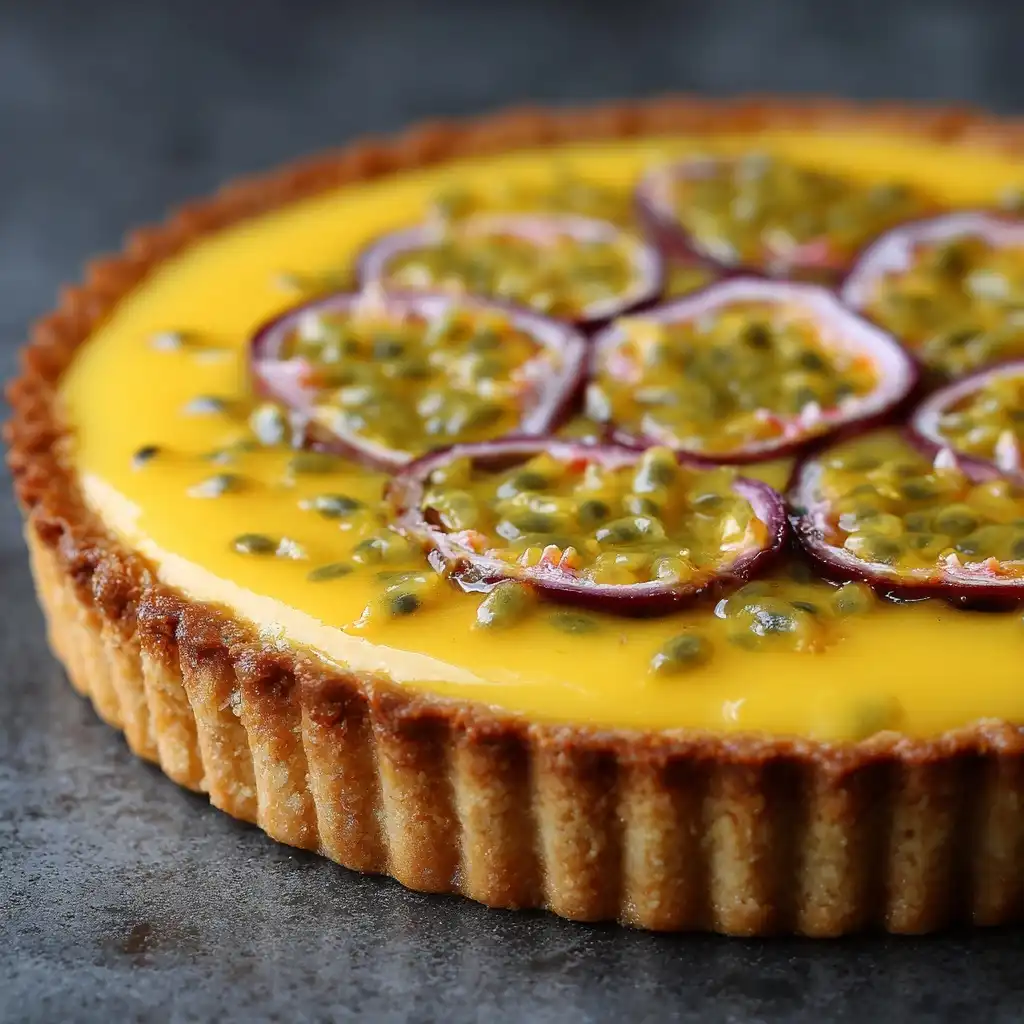
The Passion Fruit Curd Tart is a dazzling fusion of tropical exuberance and classic French patisserie elegance—a vibrant, sun-drenched dessert that awakens the senses with its intense floral-citrus aroma, velvety custard texture, and buttery shortcrust foundation. Unlike traditional lemon or lime tarts, this confection celebrates the uniquely complex profile of passion fruit: tart yet honeyed, musky yet bright, with subtle notes of guava, mango, and ripe berries—all concentrated into a luxuriously smooth, jewel-toned curd that glistens like liquid amber under soft light. Revered by chefs and home bakers alike for its showstopping visual appeal and sophisticated balance of acidity and sweetness, the Passion Fruit Curd Tart transcends seasonal boundaries—equally at home on a summer garden table, a holiday dessert buffet, or as an elegant finale to a fine-dining experience. Its growing popularity reflects a broader culinary shift toward bold, globally inspired flavors and the rising appreciation for underutilized, nutrient-dense superfruits—and few ingredients deliver more aromatic intensity per gram than the humble passion fruit.
The History
While curds themselves trace their origins to early 19th-century Britain—where lemon curd emerged as a clever way to preserve citrus in sugar and butter—the passion fruit curd tart is a distinctly modern evolution rooted in colonial botany, postwar ingredient globalization, and contemporary gastronomy. Passion fruit (Passiflora edulis) is native to South America, particularly Brazil, Paraguay, and northern Argentina, where Indigenous peoples consumed it for centuries. Spanish explorers introduced it to Europe in the 1600s, captivated by its intricate floral structure—which they associated with the Passion of Christ (hence its name). However, due to its delicate skin and short shelf life, passion fruit remained largely exotic and inaccessible outside tropical growing regions until the mid-20th century.
Commercial cultivation expanded significantly in Australia, New Zealand, South Africa, and Hawaii from the 1950s onward, and by the 1980s, frozen pulp and high-quality purees became widely available to professional kitchens. Pioneering pastry chefs—including London’s Sophie Mutter, Sydney’s Anna Polyviou, and San Francisco’s Chad Robertson—began experimenting with passion fruit as a curd base in the late 1990s, drawn to its natural pectin content (which aids thickening), vivid hue, and ability to cut through richness without cloying sweetness. The first documented “Passion Fruit Curd Tart” appeared in Modernist Cuisine’s 2011 dessert supplement, though artisanal versions had already gained cult status in Melbourne’s café scene and Parisian pâtisseries like Stohrer and Cyril Lignac’s boutiques. Today, it stands as a benchmark dessert in Michelin-starred establishments—from Copenhagen’s Noma (featured in their 2020 foraged fruit menu) to Tokyo’s Florilège—and has inspired countless reinterpretations across food media, cookbooks, and viral baking platforms.
Ingredients Breakdown
Every exceptional Passion Fruit Curd Tart begins not with technique alone—but with intentional, layered ingredient selection. Below is a granular analysis of each component, including functional roles, quality indicators, sourcing tips, and science-backed substitutions:
- Passion Fruit Pulp/Puree: The soul of the tart. Use unsweetened, strained, 100% pure passion fruit pulp—not juice blends or concentrates laden with added sugars or preservatives. Fresh, ripe yellow or purple passion fruits yield the most aromatic results when sieved at home (12–15 fruits ≈ 1 cup pulp). Frozen pulp (e.g., Iberia, Goya, or specialty brands like Tropical Pure) is often superior to “fresh” supermarket versions, which may be underripe or pasteurized at high heat, dulling volatile esters. Note: 1 cup pulp contains ~30g natural fructose, 120mg vitamin C, and over 200 aromatic compounds—including ethyl butanoate (pineapple), limonene (citrus zest), and beta-damascenone (honeyed florals).
- Eggs (Whole + Yolks): Provide emulsification, structure, and richness. Whole eggs contribute volume and stability; extra yolks deepen color and add fat-soluble flavor carriers. Pasture-raised or omega-3-enriched eggs yield deeper orange curds and enhanced mouthfeel. Avoid ultra-pasteurized eggs—they coagulate unevenly and can impart a faint “cooked” off-note.
- Granulated Sugar: Not just sweetener—it controls coagulation temperature, inhibits egg protein over-folding (preventing graininess), and enhances gloss via sucrose caramelization micro-reactions. Fine-grain caster sugar dissolves faster and yields silkier texture than standard granulated.
- Unsalted Butter (European-style, 82–84% fat): Critical for mouth-coating richness and sheen. High-fat butter (e.g., Plugrá, Kerrygold, or Échiré) contains less water, reducing risk of curdling and delivering superior flavor volatiles. Cold, cubed butter is folded in off-heat to preserve delicate aromatics—never boiled or microwaved.
- Sea Salt (Flaky or Fine): A mere ¼ tsp amplifies all other flavors via sodium ion modulation of taste receptors—especially enhancing sour perception while suppressing bitterness in passion fruit’s seeds and rind traces.
- Tart Shell (Pâte Sucrée): A classic sweet shortcrust made with all-purpose flour (or 50/50 blend with cake flour for tenderness), confectioners’ sugar (for fine crumb), cold butter, egg yolk, and vanilla. Blind-baked to golden crispness—no soggy bottoms allowed. Optional enhancements: 1 tsp toasted coconut flour (adds nuttiness), ½ tsp ground cardamom (complements tropical florals), or 1 tbsp freeze-dried passion fruit powder dusted inside pre-bake for intensified aroma.
- Finishing Touches: Edible flowers (violets, pansies, borage), micro mint, torched meringue peaks, coconut chantilly, or a shimmer of passion fruit seed “caviar” (seeds gently rinsed and lightly sugared) elevate both aesthetics and textural contrast.
Step-by-Step Recipe
This meticulously tested method prioritizes precision, sensory cues, and fail-safes—designed to produce flawless, restaurant-grade results even for intermediate bakers. Total active time: 45 minutes; inactive/chilling time: 4+ hours (including overnight shell chilling).
- Prepare the Pâte Sucrée Tart Shell (Yield: One 9-inch tart): In a food processor, pulse 1 ¼ cups (160g) all-purpose flour, ¼ cup (30g) confectioners’ sugar, and ¼ tsp flaky sea salt until combined. Add ½ cup (113g) very cold, cubed unsalted butter and 1 large egg yolk + 1 tsp cold water. Pulse 8–10 times until mixture resembles coarse breadcrumbs with pea-sized butter pieces. Transfer to a clean surface; gather into a shaggy mass using a bench scraper. Flatten into a 1-inch-thick disc, wrap tightly in parchment-lined plastic, and refrigerate minimum 2 hours (ideally overnight). This hydrates gluten evenly and firms butter for clean rolling.
- Roll & Blind-Bake: Preheat oven to 375°F (190°C) with rack in center. On a lightly floured surface, roll chilled dough into a 12-inch circle (~⅛-inch thick). Gently transfer to a 9-inch tart pan with removable bottom; press into corners and trim excess. Prick base 12x with fork. Freeze 20 minutes. Line with parchment and fill with ceramic pie weights or dried beans. Bake 20 minutes. Remove weights/parchment; bake 12–15 more minutes until deep golden and dry to touch. Cool completely on wire rack—do not skip cooling; residual heat causes curd weeping.
- Make the Passion Fruit Curd: In a heavy-bottomed, non-reactive stainless steel or enameled cast iron saucepan (avoid aluminum—it reacts with acid), whisk together 1 cup (240g) fresh or frozen-thawed passion fruit pulp, ¾ cup (150g) granulated sugar, 3 large eggs + 2 large egg yolks, and ¼ tsp fine sea salt until fully homogenized and frothy (≈1 min). Place over medium-low heat. Add 1 cup (227g) cold, cubed unsalted butter (cut into ½-inch pieces). Stir constantly with a silicone spatula in slow, figure-eight motions—scraping bottom and sides—to ensure even heating and prevent scrambling. As mixture warms (≈5–7 min), it will thicken gradually. Monitor closely: when it coats the back of the spatula and leaves a clear trail when you run your finger across it (≈170–175°F / 77–80°C on instant-read thermometer), immediately remove from heat. This is the critical window—overheating by even 5°F causes irreversible curdling.
- Strain & Set: Immediately pour hot curd through a fine-mesh chinois or triple-layered cheesecloth into a clean bowl. Press solids gently to extract maximum liquid; discard fibrous pulp residue. Stir in 1 tsp pure Madagascar bourbon vanilla extract (optional but recommended for depth). Let cool 10 minutes, stirring occasionally to release steam and prevent skin formation. Pour into cooled tart shell. Smooth surface with offset spatula. Refrigerate uncovered minimum 4 hours, preferably overnight. The curd continues to set via pectin-protein network maturation—resulting in firm-yet-giving texture and intensified flavor integration.
- Final Assembly: Just before serving, garnish with edible flowers, mint sprigs, or a quenelle of coconut-whipped cream. For dramatic presentation, torch a thin layer of Italian meringue piped around the rim (made with 2 egg whites, ½ cup sugar syrup cooked to 240°F, whipped to stiff peaks). Serve chilled—but never straight from freezer (texture becomes chalky) or room temp (curd weeps).
Tips
- Temperature Is Everything: Always bring eggs to room temperature before mixing—cold eggs cause butter to seize and create lumps. Conversely, butter for the crust must remain ice-cold (store cubes in freezer 15 min before use).
- Straining Is Non-Negotiable: Even “strained” commercial pulp contains microscopic fibers and seed fragments that compromise silkiness. Double-strain through a chinois lined with damp cheesecloth for glass-like clarity.
- The “Trail Test” Over Thermometers: While thermometers help, visual/tactile cues are more reliable. If the curd drips slowly off the spatula in thick ribbons and holds its shape for 2 seconds, it’s perfect. Bubbles breaking gently on surface = ideal; vigorous simmering = too hot.
- Avoid Steam Traps: Never cover curd while cooling—it forms a rubbery skin. Instead, place plastic wrap directly on the surface once slightly cooled to seal in moisture and shine.
- Prevent Tart Shell Sogginess: Brush baked shell interior with a thin layer of melted white chocolate or apricot jam (warmed and strained) before filling. This creates a moisture barrier that lasts 24+ hours.
- Rescue Curd If It Separates: If overheated and broken, immediately pour into blender with 1 tbsp cold butter and 1 tsp cold water. Blend on low 10 seconds—emulsion usually re-forms. Strain again.
- Freezing? Yes—with Caveats: Unfilled shells freeze beautifully for 3 months. Filled tarts freeze poorly (curd weeps upon thawing), but unbaked curd freezes well for 2 months—thaw overnight in fridge, then gently reheat to 140°F before pouring.
Variations and Customizations
Celebrate creativity while honoring the tart’s core identity with these chef-tested adaptations—each balancing innovation with structural integrity and flavor harmony:
- Tropical Fusion Curd: Replace ¼ cup passion fruit pulp with equal parts ripe mango purée + 1 tsp lime zest. Adds creamy sweetness and balances sharp acidity.
- Boozy Infusion: Steep 1 split vanilla bean in warm passion fruit pulp for 20 minutes before cooking. Or stir in 1 tbsp premium Cointreau or passion fruit liqueur (e.g., Bols Exotic) off-heat after straining for aromatic lift.
- Gluten-Free Shell: Substitute pâte sucrée with 1 ½ cups (180g) almond flour + ½ cup (60g) tapioca starch + ¼ cup (30g) coconut sugar + ½ cup cold butter + 1 egg yolk. Press into pan; bake same temp/time. Nutty depth complements fruit beautifully.
- Vegan Version: Curd: Replace eggs with ¼ cup silken tofu + 2 tbsp cornstarch + 1 tbsp agar-agar flakes (bloomed in 2 tbsp water). Use refined coconut oil instead of butter. Shell: GF oat flour + coconut oil + maple syrup. Requires precise timing but yields impressive texture.
- Deconstructed “Tartlettes”: Pipe curd into mini tart shells or phyllo cups. Top with coconut foam, candied ginger, and a single passion fruit seed. Ideal for buffets or tasting menus.
- Savory-Sweet Twist: Add 1 small finely minced kaffir lime leaf (stem removed) to pulp while heating. Or finish with flaky smoked sea salt and a drizzle of chili-infused honey.
- Chocolate-Passion Pairing: Layer 2mm dark chocolate ganache (70% cacao) beneath curd. The bitterness grounds the fruit’s brightness—like a grown-up Cadbury Creme Egg.
Health Considerations and Nutritional Value
While undeniably indulgent, the Passion Fruit Curd Tart offers surprising functional benefits when crafted mindfully—making it more than just a treat, but a thoughtfully composed culinary experience with measurable nutritional attributes. Per standard slice (1/12 of 9-inch tart, approx. 180g):
- Calories: ~295 kcal (moderate for a dessert—less than many fruit pies or cheesecakes due to lower flour/butter ratio)
- Vitamin C: ~45 mg (50% DV)—passion fruit pulp is one of the richest natural sources, supporting collagen synthesis and immune resilience
- Dietary Fiber: ~2.5g (10% DV)—primarily from passion fruit’s soluble fiber (pectin), shown in clinical trials to support healthy cholesterol metabolism and postprandial glucose regulation
- Polyphenols & Antioxidants: Contains potent flavonoids (vitexin, isovitexin) and carotenoids (beta-cryptoxanthin) linked to reduced oxidative stress and neuroprotective effects in peer-reviewed studies (e.g., Food Chemistry, 2022)
- Healthy Fats: Butter provides conjugated linoleic acid (CLA) and fat-soluble vitamins A/D/E/K—enhancing absorption of passion fruit’s carotenoids
- Lower Glycemic Impact: Natural fruit acids and fiber slow sugar absorption—GI estimated at ~48 (low-moderate), especially when paired with whole-grain or nut-based crusts
Considerations for Special Diets: Naturally gluten-free if using GF crust; easily adaptable for dairy-free (coconut oil, vegan butter); low-FODMAP in controlled portions (limit to 2 tbsp pulp per serving); keto-friendly with erythritol/stevia swaps and almond-flour shell (net carbs ~6g/slice). Always consult a registered dietitian for personalized guidance.
Ingredients
For the Pâte Sucrée Tart Shell:
• 1 ¼ cups (160g) all-purpose flour, plus extra for dusting
• ¼ cup (30g) confectioners’ sugar
• ¼ tsp fine sea salt
• ½ cup (113g) unsalted butter, very cold and cubed
• 1 large egg yolk
• 1 tsp ice-cold water
• Optional: 1 tsp pure vanilla extract or ½ tsp ground cardamom
For the Passion Fruit Curd:
• 1 cup (240g) fresh or frozen-thawed, unsweetened passion fruit pulp (strained)
• ¾ cup (150g) granulated sugar (caster preferred)
• 3 large eggs + 2 large egg yolks, room temperature
• ¼ tsp fine sea salt
• 1 cup (227g) unsalted butter, cold and cubed (82–84% fat recommended)
• 1 tsp pure Madagascar bourbon vanilla extract (optional but highly recommended)
For Garnish (Optional):
• Edible flowers (violets, pansies, borage)
• Fresh mint leaves
• Toasted coconut flakes
• Passion fruit seeds, rinsed and lightly sugared
• Coconut whipped cream or torched Italian meringue
Directions
Make the Tart Shell: In a food processor, combine flour, confectioners’ sugar, and salt; pulse to mix. Add cold butter and pulse until mixture resembles coarse crumbs with visible pea-sized butter bits (15–20 sec). Add egg yolk and cold water; pulse just until dough begins to clump. Turn onto floured surface; gather into disc, flatten to 1-inch thickness, wrap in parchment-lined plastic, and chill ≥2 hours (overnight best).
Blind-Bake: Preheat oven to 375°F (190°C). Roll dough to 12-inch circle; fit into 9-inch tart pan. Trim edges, prick base, freeze 20 min. Line with parchment, fill with weights. Bake 20 min. Remove weights/parchment; bake 12–15 min until deep golden. Cool completely on wire rack.
Make the Curd: In heavy saucepan, whisk pulp, sugar, eggs + yolks, and salt until frothy. Add cold butter pieces. Cook over medium-low heat, stirring constantly with silicone spatula in figure-eights, scraping bottom/sides, until thickened and coating spatula (≈170–175°F; 10–12 min). Remove from heat immediately when trail test passes.
Strain & Set: Strain curd through fine-mesh chinois into bowl. Stir in vanilla. Cool 10 min, stirring. Pour into cooled shell. Refrigerate uncovered ≥4 hours (overnight ideal).
Finish & Serve: Garnish just before serving. Slice with hot, dry knife dipped in hot water and wiped clean between cuts. Serve chilled.
FAQ
- Q: Can I use passion fruit juice instead of pulp?
- A: Not recommended. Juice lacks pectin, fiber, and volatile oils—resulting in thin, flat-tasting curd. If only juice is available, reduce 1 ½ cups juice to ½ cup syrup over low heat, then proceed—but expect diminished aroma and body.
- Q: Why did my curd curdle?
- A: Most commonly from overheating (>175°F) or inadequate stirring. Ensure constant motion and remove from heat at first sign of thickening. Also check for ultra-pasteurized eggs or acidic impurities (e.g., vinegar residue in pan).
- Q: How long does it keep?
- A: Refrigerated, covered, up to 5 days. Unfilled shells keep 3 days at room temp or 3 months frozen. Curd alone (unbaked) freezes 2 months.
- Q: Can I make it ahead for an event?
- A: Absolutely. Bake shell and make curd 2 days ahead. Assemble day-of. For best texture, fill no earlier than morning of service.
- Q: Is there a low-sugar version?
- A: Yes—substitute sugar with ½ cup erythritol + 2 tbsp monk fruit blend (to retain bulk and browning). Reduce butter by 1 tbsp to compensate for altered emulsion. Expect slight textural difference but excellent flavor retention.
- Q: What if I can’t find passion fruit?
- A: Guava or pineapple curd makes a stunning alternative. Adjust sugar down by 1–2 tbsp for guava; add ½ tsp grated ginger for pineapple complexity.
- Q: Can I use a store-bought crust?
- A: Yes—but par-bake it per package instructions and brush with white chocolate barrier. Quality varies widely; avoid overly sweet or greasy varieties.
Summary
The Passion Fruit Curd Tart is a masterclass in balance—where the electrifying acidity and floral depth of ripe passion fruit meet the sumptuous richness of slow-emulsified butter and the delicate crumbliness of a perfectly blind-baked pâte sucrée, resulting in a dessert that is simultaneously vibrant, refined, and deeply comforting. With its stunning visual appeal, sophisticated flavor architecture, and surprising nutritional virtues, it stands as a timeless yet thoroughly modern celebration of global ingredients and artisanal technique—proving that the most unforgettable desserts are born not from complication, but from reverence for exceptional, authentic flavor.