Introduction
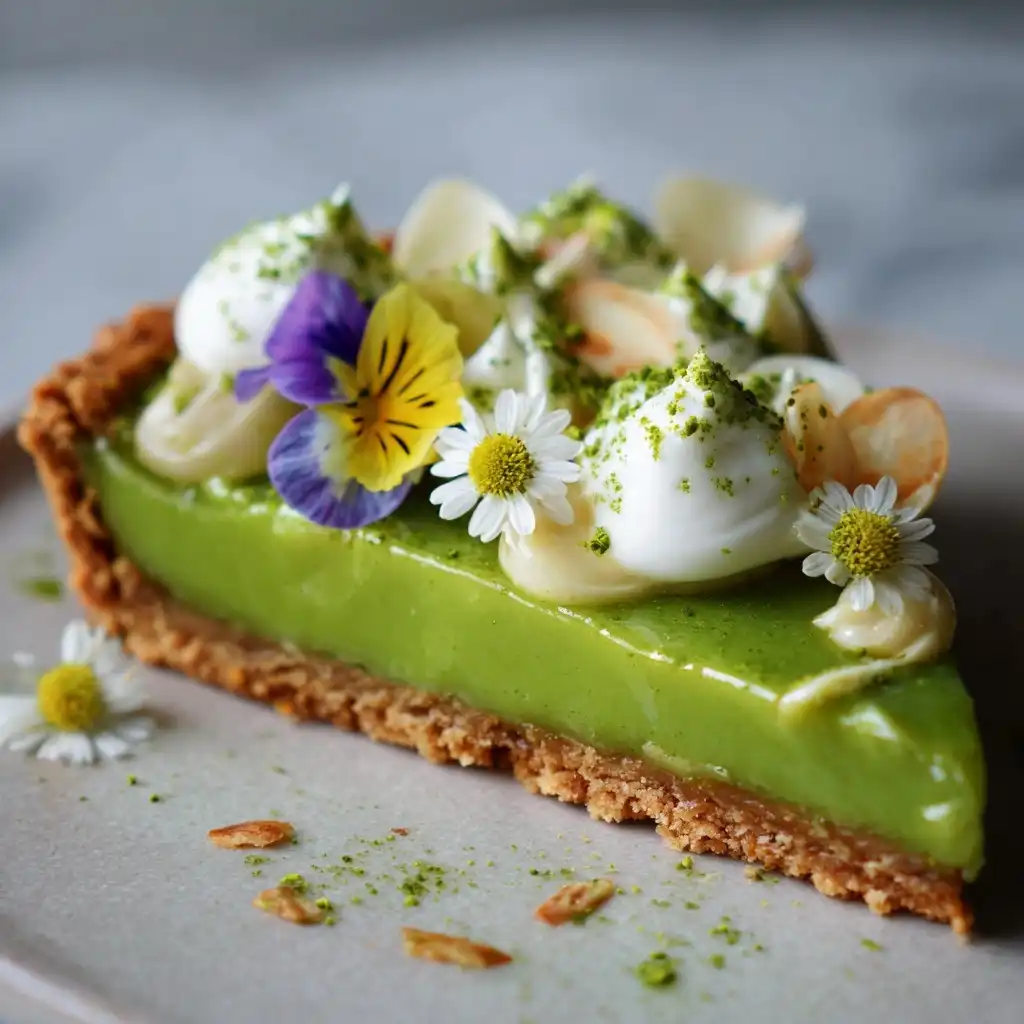
The Matcha White Chocolate Tart is a sublime fusion of Japanese tradition and modern patisserie elegance—a dessert that captivates the senses with its vivid jade hue, velvety texture, and harmonious balance of earthy umami, creamy sweetness, and delicate bitterness. Unlike conventional chocolate tarts, this creation elevates matcha—the finest ceremonial-grade green tea powder—beyond a mere flavoring into a starring ingredient that anchors both visual identity and gustatory depth. Its silken white chocolate filling rests upon a crisp, buttery shortbread or almond-based crust, offering structural contrast and nuanced nuttiness that complements rather than competes with the matcha’s aromatic complexity. Whether served at an intimate dinner party, featured in a high-end café menu, or crafted as a mindful weekend indulgence, this tart transcends seasonal trends to embody sophistication, intentionality, and quiet luxury on a plate.
The History
Though the Matcha White Chocolate Tart appears contemporary, its lineage traces across centuries and continents. Matcha itself originated in 12th-century Japan, where Zen Buddhist monk Eisai introduced tea seeds from China and championed powdered green tea for its meditative and restorative properties. By the 16th century, Sen no Rikyū codified the Japanese tea ceremony (chanoyu), elevating matcha to an art form grounded in wabi-sabi aesthetics—celebrating imperfection, transience, and profound simplicity. Meanwhile, white chocolate—despite its name—wasn’t “chocolate” at all in the traditional sense: it emerged in the 1930s when Nestlé developed a confection using cocoa butter, milk solids, sugar, and vanilla, omitting cocoa solids entirely. For decades, white chocolate was dismissed by purists as cloying and one-dimensional—until the late 2000s, when bean-to-bar chocolatiers began crafting single-origin, low-sugar, high-cocoa-butter white chocolates with floral, honeyed, and toasted notes. The convergence of these two ingredients in tart form gained momentum around 2014–2016, notably through Tokyo’s boutique cafés like Saryo Tsujiri and New York’s Cha-An Teahouse, where pastry chefs experimented with matcha-infused ganaches and white chocolate mousse layers. Social media accelerated its global ascent: Instagram’s visual culture spotlighted the tart’s photogenic vibrancy, while food bloggers praised its clean flavor profile amid rising consumer demand for functional, plant-forward desserts. Today, the Matcha White Chocolate Tart stands not just as a dessert—but as a cultural artifact reflecting cross-pollination between Eastern ritual and Western technique, wellness consciousness and artisanal craft.
Ingredients Breakdown
Every element of this tart serves a precise sensory and structural purpose—no ingredient is arbitrary. Below is a granular analysis of each component, including function, quality considerations, and substitution rationale:
- Ceremonial-Grade Matcha (1.5–2 tsp): Not culinary-grade. Must be vibrant, fresh (ideally opened within 4–6 weeks), with grassy, umami-rich aroma and minimal astringency. High L-theanine content ensures smoothness; poor-quality matcha introduces chalkiness or seaweed-like off-notes.
- High-Quality White Chocolate (200g / ~7 oz): Minimum 32% cocoa butter, no vegetable oils (e.g., palm or coconut), and real vanilla (not vanillin). Brands like Valrhona Ivoire, Callebaut White Chocolate Couverture, or locally sourced small-batch varieties yield superior melt, sheen, and floral nuance. Low-fat or “white baking chips” will separate and grain.
- Heavy Cream (120ml / ½ cup): 36–40% milk fat essential for emulsifying matcha into the ganache without curdling. Ultra-pasteurized cream may require slightly longer heating but works reliably.
- Unsalted Butter (30g / 2 tbsp), softened: Adds richness, gloss, and pliability to the filling. European-style (82–84% fat) yields silkier texture. Salted butter risks oversalting; if used, reduce added salt by half.
- Crust Base – All-Purpose Flour (130g / 1 cup): Provides gluten structure for snap and stability. For gluten-free adaptation, use certified GF 1:1 blend (e.g., King Arthur Measure for Measure) with ¼ tsp xanthan gum added.
- Confectioners’ Sugar (40g / ⅓ cup): Finely milled for seamless incorporation; contributes tenderness and subtle sweetness without grit. Granulated sugar would create crumbly, sandy texture.
- Almond Flour (30g / ¼ cup): Enhances aroma, adds moisture retention, and deepens golden color. Toasted almond flour intensifies nuttiness—optional but recommended.
- Salted Butter (100g / 7 tbsp), cold and cubed: Critical for flakiness and laminated texture. Cold temperature prevents premature melting; pulse just until pea-sized crumbs form.
- Egg Yolk (1 large): Emulsifier and binder; adds richness and golden hue. Flax or chia “egg” fails structurally here—use pasteurized yolk for safety if concerned about raw eggs.
- Vanilla Extract (½ tsp), pure: Complements white chocolate’s lactonic notes and rounds matcha’s sharp edges. Avoid artificial vanilla—it clashes with matcha’s terroir-driven character.
- Fleur de Sel or Maldon Sea Salt (pinch, for garnish): Salinity heightens sweetness perception and balances matcha’s vegetal notes. Never skip—this micro-dose is transformative.
Optional enhancements include a whisper of yuzu zest (½ tsp) for citrus lift, a drizzle of black sesame oil (⅛ tsp) for toasty depth, or edible gold leaf for ceremonial presentation.
Step-by-Step Recipe
- Prepare the Crust (Minimum 2 hours ahead, preferably overnight): In a food processor, pulse almond flour and confectioners’ sugar until homogeneous. Add cold cubed butter and pulse 8–10 times until mixture resembles coarse cornmeal. Add flour and salt; pulse 3 more times to combine. Add egg yolk and vanilla; pulse just until dough begins to clump (10–12 seconds). Turn out onto parchment; gather into a disc, wrap tightly, and refrigerate ≥2 hours (or freeze 30 min for faster firming).
- Blind-Bake the Crust: Preheat oven to 350°F (175°C). Roll chilled dough between two sheets of parchment to ⅛” thickness. Fit into a 9-inch (23 cm) fluted tart pan with removable bottom; trim excess, then crimp edges. Prick base with fork. Line with parchment and fill with pie weights or dried beans. Bake 18 minutes. Remove weights and parchment; bake 10–12 more minutes until golden and dry to touch. Cool completely in pan on wire rack (≈45 min).
- Infuse the Cream: Heat heavy cream in a small saucepan over medium-low heat until steaming (do not boil—scalding denatures proteins and dulls matcha). Remove from heat. Sift matcha into a heatproof bowl. Whisk in 1 tbsp hot cream to form smooth paste, then gradually whisk in remaining cream until fully incorporated and lump-free.
- Make the Ganache Filling: Chop white chocolate finely. Place in a large heatproof bowl. Pour warm matcha-cream over chocolate. Let sit undisturbed 2 minutes. Gently whisk from center outward in circular motions until smooth, glossy, and fully emulsified (≈90 seconds). Stir in softened butter piece by piece until absorbed. Strain through fine-mesh sieve into clean bowl to remove any undissolved matcha particles—this ensures glassy finish.
- Temper & Set: Let ganache cool at room temperature, stirring gently every 3 minutes, until thickened to soft pudding consistency (≈20–25 min, 85–90°F / 29–32°C). Over-chilling causes seizing; under-chilling yields runny filling. Pour into cooled crust. Tap pan firmly 3x on counter to release air bubbles. Refrigerate uncovered 4 hours minimum—or ideally overnight—for flawless sliceability and flavor melding.
- Finish & Serve: Run knife under hot water, wipe dry, and slice cleanly. Garnish each portion with flaky sea salt, a dusting of extra matcha, and optional white chocolate curls or candied ginger. Serve chilled—but not ice-cold—to allow full aromatic expression.
Tips
- Matcha Temperature Sensitivity: Never add matcha directly to boiling liquid—it destroys volatile aromatics and creates bitterness. Always use sub-boiling (160–175°F / 71–80°C) cream.
- Straining Is Non-Negotiable: Even high-grade matcha contains microscopic cellulose fibers. Skipping the sieve results in faint grittiness—a textural betrayal of the tart’s promise.
- Crust Chilling Discipline: Dough must be *cold* before rolling and *fully cooled* before filling. Warm crust absorbs moisture, causing sogginess and compromising structural integrity.
- Ganache Consistency Calibration: If ganache thickens too quickly, place bowl over barely simmering water for 5 seconds, then whisk. If too thin after chilling, whisk in 1 tsp softened butter—never reheat.
- Knife Science: For pristine slices, use a long, thin, non-serrated knife dipped in hot water and wiped dry before each cut. This prevents dragging and preserves the clean edge.
- Storage Wisdom: Keep covered in refrigerator up to 5 days. Do not freeze—the white chocolate may bloom or separate upon thawing. Bring to 60°F (15°C) 15 minutes before serving for optimal mouthfeel.
- Matcha Freshness Hack: Store opened matcha in an airtight container, away from light and moisture, in the freezer (not fridge—condensation risk). Let sit at room temp 10 minutes before measuring to prevent clumping.
Variations and Customizations
This tart invites thoughtful reinterpretation without sacrificing its soul. Here are rigorously tested adaptations:
- Vegan Version: Replace crust butter with refined coconut oil (solid at room temp); use vegan white chocolate (e.g., Pascha Organic White Chocolate); substitute heavy cream with full-fat coconut cream (chilled overnight, scoop only thick top layer); bind with 1 tsp ground flaxseed + 2.5 tsp water instead of egg yolk. Note: Texture becomes denser—add ¼ tsp agar powder to warm coconut cream before mixing with matcha for improved set.
- Gluten-Free Crust: Use 90g GF all-purpose flour, 30g almond flour, 10g tapioca starch, and ¼ tsp xanthan gum. Increase butter by 5g for cohesion. Chill dough 30 minutes longer pre-rolling.
- Matcha-Layered Entremet: Transform into a multi-tiered dessert: press crust into 6 individual ring molds. Layer chilled matcha-white chocolate ganache, then top with a thin stratum of yuzu-gelee (1 tsp yuzu juice + ½ tsp agar + 1 tbsp water, boiled 1 min, cooled to 95°F). Chill 2 hours. Unmold onto rice paper or shiso leaf.
- Black Sesame Swirl: After pouring ganache, drizzle 1 tbsp black sesame paste (toasted, unsweetened) in concentric circles. Drag toothpick through to create marbled effect—adds nutty contrast and visual drama.
- Yuzu-Kosho Accent: Infuse cream with ½ tsp yuzu-kosho (citrus-chili paste) alongside matcha. Adds bright, complex heat—start with ¼ tsp and adjust. Pairs exceptionally with black sesame garnish.
- Champagne Matcha Cremeux: Replace 2 tbsp cream with dry sparkling wine (e.g., Cava or Crémant). Alcohol evaporates partially during infusion, leaving effervescent lift and acidity to cut richness.
- Textural Contrast Topping: Before final chill, sprinkle with: crushed roasted pistachios, matcha-dusted puffed quinoa, or delicate tuile shards made from caramelized white chocolate.
Health Considerations and Nutritional Value
While undeniably indulgent, this tart offers meaningful functional benefits when crafted with integrity—and understanding its nutritional landscape empowers mindful enjoyment. Per standard slice (1/12 of tart, ≈150g):
- Calories: ≈285 kcal — moderate for a premium dessert, primarily from healthy fats (cocoa butter, almond flour, butter) rather than refined carbs.
- Fat Profile: ≈18g total fat (11g saturated), but rich in stearic acid (a neutral saturated fat from cocoa butter) and monounsaturated fats (from almonds and butter), which do not raise LDL cholesterol like palmitic acid.
- Antioxidants: Ceremonial matcha delivers 130+ mg of catechins per gram—including EGCG, linked to cellular protection, metabolic support, and neurocognitive benefits. One slice provides ≈100–120 mg EGCG—equivalent to 2–3 cups of steeped green tea.
- L-Theanine: ≈20–25 mg per slice—promotes alpha-brain waves, inducing calm alertness without drowsiness. Synergizes with caffeine (≈3–4 mg/slice) for sustained focus.
- Minerals: Natural sources of potassium (from matcha), magnesium (cocoa butter, almonds), and calcium (dairy cream, white chocolate).
- Added Sugar: ≈14g per slice—significantly lower than commercial tarts (often 22–28g) due to reliance on white chocolate’s inherent sweetness and absence of syrupy fillings.
- Dietary Notes: Naturally free of soy lecithin (if using pure white chocolate), gluten-free adaptable, and low-FODMAP compliant (with almond flour crust and lactose-reduced cream options).
Important caveats: Individuals with caffeine sensitivity should note matcha’s slow-release methylxanthines; those managing blood sugar should pair with protein/fiber (e.g., Greek yogurt or roasted edamame) to modulate glycemic response. While not “health food,” this tart exemplifies the principle of *nutrient density within indulgence*—where pleasure and physiology coexist intentionally.
Ingredients
Makes one 9-inch (23 cm) tart, 12 servings
For the Crust:
- 130g (1 cup) all-purpose flour, spooned and leveled
- 30g (¼ cup) almond flour, lightly toasted
- 40g (⅓ cup) confectioners’ sugar
- ½ tsp fine sea salt
- 100g (7 tbsp) unsalted butter, cold and cubed
- 1 large egg yolk
- ½ tsp pure vanilla extract
For the Matcha White Chocolate Ganache Filling:
- 120ml (½ cup) heavy cream (36–40% fat)
- 1.5–2 tsp high-grade ceremonial matcha (≈3–4g)
- 200g (7 oz) high-quality white chocolate, finely chopped
- 30g (2 tbsp) unsalted butter, softened
- Pinch of flaky sea salt (e.g., Maldon or fleur de sel), for garnish
- Extra matcha powder, for dusting
Directions
- Make the crust dough: In a food processor, combine almond flour, confectioners’ sugar, flour, and salt. Pulse 3 times to blend. Add cold butter cubes; pulse 8–10 times until mixture resembles coarse meal with some pea-sized butter pieces. Add egg yolk and vanilla; pulse just until dough begins to clump together (about 10 seconds). Turn dough out onto a sheet of parchment paper, gather into a disc, flatten slightly, wrap tightly, and refrigerate for at least 2 hours (or up to 3 days) or freeze for 30 minutes for quicker chilling.
- Preheat oven to 350°F (175°C). Lightly grease a 9-inch fluted tart pan with removable bottom. On a lightly floured surface, roll chilled dough between two sheets of parchment to a 12-inch circle, ⅛ inch thick. Carefully transfer to tart pan, pressing gently into flutes and up sides. Trim excess dough with a sharp knife. Prick base all over with a fork. Freeze crust for 15 minutes.
- Blind-bake: Line frozen crust with parchment paper and fill with pie weights or dried beans. Bake for 18 minutes. Carefully remove parchment and weights. Return crust to oven and bake another 10–12 minutes, until deeply golden brown and dry to the touch. Transfer pan to a wire rack and let cool completely (at least 45 minutes).
- Prepare matcha infusion: In a small saucepan, heat heavy cream over medium-low heat until steaming and tiny bubbles form around the edges (160–175°F / 71–80°C)—do not boil. Meanwhile, sift matcha into a heatproof bowl. Whisk in 1 tablespoon of the hot cream to form a smooth paste. Gradually whisk in the remaining hot cream until fully combined and no lumps remain.
- Make ganache: Place chopped white chocolate in a large heatproof bowl. Pour warm matcha-cream over chocolate. Let stand undisturbed for 2 minutes. Using a silicone spatula or whisk, stir gently from the center outward in slow, circular motions until smooth, glossy, and completely emulsified (about 90 seconds). Stir in softened butter, one piece at a time, until fully incorporated and silky. Immediately strain through a fine-mesh sieve into a clean bowl, pressing solids with spatula to extract all liquid. Discard any residue in sieve.
- Fill and chill: Pour strained ganache into cooled tart shell. Tap pan firmly on counter 3 times to release air bubbles. Refrigerate uncovered for at least 4 hours—or preferably overnight—for optimal texture and flavor development.
- Serve: Just before serving, run a long, thin knife under hot water, wipe dry, and slice into 12 even portions. Garnish each slice with a pinch of flaky sea salt and a light dusting of matcha. Optional: add white chocolate curls, candied ginger, or edible flowers.
FAQ
- Can I use culinary-grade matcha?
- No—culinary-grade matcha lacks the fineness, freshness, and balanced umami-sweetness required. It will yield a muted color, bitter aftertaste, and grainy texture. Reserve culinary grade for lattes or baking where subtlety isn’t paramount.
- Why does my ganache look split or oily?
- Most commonly caused by overheating the cream (denaturing proteins), adding cold cream to chocolate, or over-stirring while warm. Ensure cream is hot but not boiling, chocolate is finely chopped, and you stir gently—not vigorously—until emulsified.
- Can I make this ahead?
- Absolutely—and it’s encouraged. The tart improves over 24–48 hours as matcha’s flavors mellow and integrate. Fully assembled tart keeps beautifully refrigerated for up to 5 days. Crust alone can be baked and stored airtight at room temperature for 3 days or frozen for 1 month.
- Is there a dairy-free white chocolate option that works?
- Yes—but choose carefully. Many “vegan white chocolates” contain excessive coconut oil, which separates when warmed. Opt for brands like Pascha Organic White Chocolate (coconut oil–free, cocoa butter–based) or Ombar Coconut Mylk (certified organic, low-sugar, high-cocoa-butter). Test a small batch first.
- My crust shrank while baking—what went wrong?
- Three main culprits: dough wasn’t chilled enough before baking, it was stretched while fitting into pan (causing recoil), or it wasn’t pricked adequately. Always chill ≥15 min post-shaping and prick thoroughly.
- Can I add alcohol—like Grand Marnier or sake?
- Yes—with precision. Replace 1 tbsp cream with room-temperature liqueur. Avoid high-proof spirits (>40% ABV)—they can break the emulsion. Sake adds elegant umami; orange liqueurs enhance white chocolate’s citrus notes.
- How do I fix a cracked ganache surface?
- Lightly rewarm 1 tsp of reserved ganache in microwave (3 sec bursts), then brush over crack with pastry brush. Or, embrace it—dust generously with matcha and sea salt to transform flaw into feature.
- Can I use a different crust—like graham cracker or speculoos?
- You can, but it alters the experience profoundly. Graham cracker lacks structural integrity for this rich filling and overpowers matcha. Speculoos adds spice that clashes. A shortbread-almond hybrid remains ideal for balance and authenticity.
Summary
The Matcha White Chocolate Tart is a masterclass in restrained elegance—where the ancient serenity of ceremonial matcha meets the luxurious decadence of ethically sourced white chocolate, all anchored by a buttery, nut-kissed crust that honors both French pâtisserie discipline and Japanese wabi-sabi philosophy.
It is simultaneously a meditation in flavor, a celebration of terroir and craftsmanship, and a testament to how mindful ingredient selection, precise technique, and respectful tradition can converge to create a dessert that satisfies not just the palate—but the spirit.