Introduction
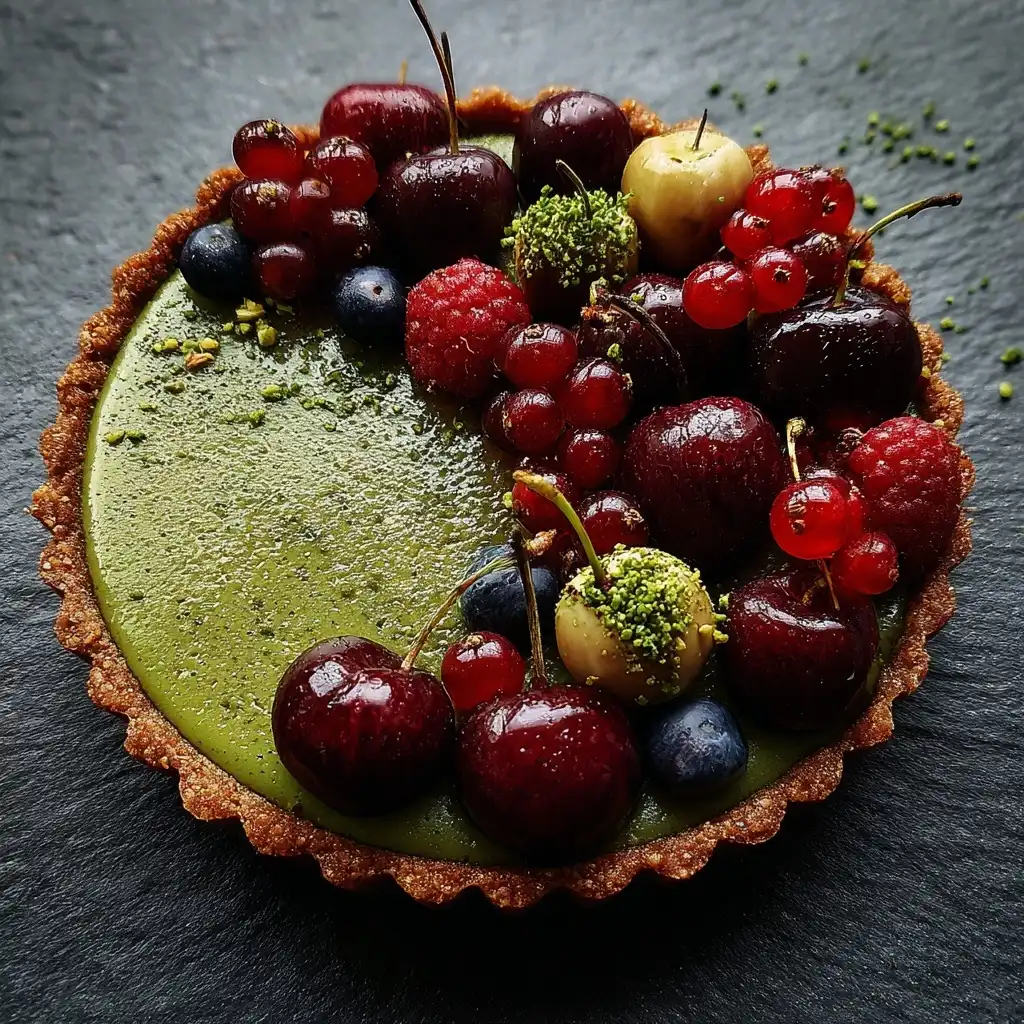
Indulge in the serene elegance and vibrant flavor of the Matcha Custard Tart with Berries — a harmonious fusion of Japanese tradition and French patisserie artistry. This dessert marries the earthy, umami-rich depth of premium ceremonial-grade matcha with the velvety smoothness of a silken custard, all cradled in a crisp, buttery shortcrust pastry shell. Crowned with a vibrant mosaic of seasonal fresh berries — think jewel-toned strawberries, tart raspberries, plump blueberries, and delicate blackberries — each bite delivers a sophisticated interplay of textures and flavors: creamy, flaky, bright, floral, and subtly bitter-sweet. More than just a treat, this tart embodies mindful indulgence — where wellness meets wonder, and every component is thoughtfully chosen to delight the senses while honoring balance and seasonality.
The History
The Matcha Custard Tart with Berries is a contemporary culinary evolution rooted in centuries-old traditions. Matcha, the finely ground stone-milled green tea powder, traces its origins to Tang Dynasty China (7th–10th century) before being perfected in Japan’s Zen monasteries during the 12th century. Its ceremonial use emphasized harmony, respect, purity, and tranquility — principles that continue to inform modern interpretations of matcha in food. Meanwhile, custard tarts have long been cherished across Europe: from medieval English “custard pies” (documented as early as the 14th century in *The Forme of Cury*) to Portugal’s iconic *pastéis de nata*, and France’s refined *tarte aux œufs*. The marriage of matcha and custard emerged prominently in the late 20th and early 21st centuries, first gaining traction in Tokyo’s avant-garde cafés and high-end wagashi shops seeking innovative ways to modernize traditional ingredients. As global interest in Japanese superfoods surged — fueled by scientific research on matcha’s antioxidants, L-theanine, and metabolic benefits — Western pastry chefs began integrating it into classic frameworks. The addition of fresh berries reflects both aesthetic sensibility (inspired by kaiseki plating philosophy) and functional nutrition, bridging Eastern botanical wisdom with Western fruit-forward dessert culture. Today, this tart stands as a cross-cultural icon — a testament to how reverence for ingredient integrity, technical precision, and seasonal awareness can yield something both timeless and refreshingly new.
Ingredients Breakdown
Every element of this tart serves a distinct purpose — structurally, texturally, and sensorially. Understanding the role of each ingredient empowers bakers to troubleshoot, adapt, and elevate their results:
- Shortcrust Pastry (Pâte Brisée): A blend of all-purpose flour (for structure), unsalted European-style butter (high fat, low water = superior flakiness and richness), powdered sugar (tenderness + subtle sweetness), fine sea salt (flavor enhancement), and cold egg yolk (emulsification + binding without toughness). No water is added — moisture comes solely from the yolk and butter’s natural content, minimizing gluten development.
- Matcha Custard Filling: Organic, ceremonial-grade matcha (not culinary grade — essential for nuanced aroma and vibrant color), full-fat dairy cream (36% fat minimum for luxurious mouthfeel and heat stability), whole milk (balances richness and aids smooth coagulation), granulated cane sugar (dissolves cleanly and supports caramelization), large egg yolks (richness, emulsification, and thickening power), cornstarch (prevents curdling and ensures spoonable set without rubberiness), and a whisper of Madagascar bourbon vanilla bean paste (adds aromatic complexity that complements, never competes with, matcha’s vegetal notes).
- Berry Garnish & Glaze: A rotating selection of impeccably fresh, peak-season berries — selected for firmness, acidity balance, and natural sheen. A light apricot glaze (simmered apricot jam + water + lemon juice, strained) adds gloss, cohesion, and a subtle fruity brightness that lifts the earthiness of matcha without masking it.
- Finishing Touches: Micro mint or shiso leaves (for aromatic lift and visual contrast), edible gold leaf flakes (optional, for ceremonial opulence), and a dusting of matcha-infused powdered sugar (sifted through a fine-mesh sieve for ethereal texture).
Step-by-Step Recipe
- Prepare the Shortcrust Dough (Day Before Recommended): In a food processor, pulse 1 ¼ cups (160g) chilled, cubed unsalted butter with 1 ¾ cups (220g) all-purpose flour, ¼ cup (30g) powdered sugar, and ½ tsp fine sea salt until mixture resembles coarse crumbs. Add 1 large cold egg yolk and 1 tsp ice-cold water; pulse just until dough begins to clump. Turn onto parchment, gather into a disc, wrap tightly, and refrigerate for at least 2 hours (or up to 3 days). For optimal flavor and ease, freeze for 30 minutes before rolling.
- Roll & Blind-Bake the Tart Shell: Preheat oven to 375°F (190°C) with rack in lower third. On a lightly floured surface, roll dough to ⅛-inch thickness. Gently transfer to a 9-inch (23cm) fluted tart pan with removable bottom. Trim excess, crimp edges, prick base with fork, and freeze 20 minutes. Line with parchment and fill with ceramic baking weights or dried beans. Bake 18 minutes. Remove weights and parchment; bake 12–15 minutes more until golden and dry. Cool completely on wire rack — do not skip cooling; residual heat will cause custard to weep.
- Infuse the Dairy Base: In a heavy-bottomed saucepan, combine 1 cup (240ml) heavy cream, ½ cup (120ml) whole milk, and seeds scraped from ½ vanilla bean pod (pod included). Warm over medium-low heat until steaming (do not boil), about 5 minutes. Remove from heat, cover, and steep 15 minutes for deep vanilla infusion. Strain out pod.
- Whisk Dry Ingredients: In a separate bowl, whisk together ¾ cup (150g) granulated sugar, 3 large egg yolks, 2 tbsp (16g) cornstarch, and 1 ½ tsp (3g) ceremonial-grade matcha until no lumps remain and color is uniformly pale jade-green. Sift twice for absolute smoothness — crucial for silkiness.
- Temper & Cook the Custard: Reheat infused dairy to just below simmer. Slowly pour ⅓ of hot liquid into yolk mixture while whisking vigorously. Pour mixture back into saucepan. Cook over medium-low heat, stirring constantly with a silicone spatula in figure-eight motions, scraping bottom and corners. At 170–175°F (77–80°C), mixture will thicken to napé consistency — coats the back of a spoon and holds a clear line when finger is drawn across. Do NOT boil — eggs will scramble. Immediately remove from heat.
- Strain & Chill: Pour custard through a fine-mesh chinois into a clean bowl. Press plastic wrap directly onto surface to prevent skin formation. Refrigerate uncovered for 30 minutes, then covered for at least 4 hours (preferably overnight) — essential for full setting and flavor melding.
- Fill & Finish: Spoon chilled custard into cooled tart shell, smoothing top with offset spatula. Arrange berries in concentric circles or organic clusters. Warm 2 tbsp apricot jam with 1 tsp water and ¼ tsp lemon juice; strain and brush gently over berries. Chill 30 minutes to set glaze. Just before serving, dust with matcha sugar and garnish.
Tips
- Matcha Quality is Non-Negotiable: Use only ceremonial-grade matcha — vibrant green, fine as talcum powder, with sweet, grassy, umami notes. Culinary grade will taste bitter, dull, and muddy. Store in an airtight container in the freezer; exposure to light, air, and heat rapidly degrades flavor and color.
- Temperature Discipline Saves Custards: All dairy must be warm (not hot) when tempering; eggs must be at room temperature. Overheating post-tempering causes curdling. Invest in an instant-read thermometer — 175°F is your custard’s safe harbor.
- Chill Time Is Active Time: Don’t rush the custard chill. Overnight refrigeration allows starches to fully hydrate and set, yielding a luxuriously stable, sliceable texture — not runny or grainy.
- Blind-Baking Mastery: Freezing the shaped shell before baking prevents shrinkage. Docking (pricking) and weights ensure a flat, crisp base. If edges brown too fast, shield with foil or a pie crust shield.
- Berries Are Seasonal Stars: Never wash berries until seconds before assembly — moisture accelerates spoilage. Pat dry meticulously. Choose berries at peak ripeness: strawberries should be fragrant and firm; raspberries deeply colored and plump (not mushy); blueberries taut and dusty-blue. Avoid frozen berries — thawed ones release excess water and dull the custard’s finish.
- Texture Contrast is Key: For maximum sensory impact, serve slightly chilled (not icy cold) — around 50°F (10°C) — so the custard is cool and lush, the crust crisp, and the berries refreshingly bright.
- Prevent Soggy Bottoms: Ensure tart shell is *completely* cool before filling. A warm shell creates steam that softens the base. If humidity is high, store unfilled shells in an airtight container with a desiccant packet.
Variations and Customizations
This tart is a canvas for creativity — adaptable to dietary needs, seasonal shifts, and personal flair — without compromising its soul:
- Vegan Adaptation: Replace shortcrust with almond-flour-oat crust (using coconut oil + maple syrup). Substitute custard with coconut milk–cashew base (soaked raw cashews, full-fat coconut milk, matcha, cornstarch, and agar-agar), blended ultra-smooth and cooked to 185°F. Top with macerated berries and coconut yogurt drizzle.
- Gluten-Free Version: Use a 1:1 GF flour blend with xanthan gum (like Bob’s Red Mill) in the crust. Ensure matcha and cornstarch are certified GF. Add 1 tbsp psyllium husk to dough for elasticity.
- Decadent Upgrade: Infuse custard with white chocolate (¼ cup melted and cooled) for added richness. Swirl in black sesame paste before baking. Top with candied ginger pieces and toasted white sesame seeds.
- Seasonal Fruit Rotations: Spring: Rhubarb compote + strawberry; Summer: Peach slices + blackberry; Autumn: Poached pear + fig; Winter: Blood orange segments + pomegranate arils. Always pair acidity with sweetness to balance matcha’s bitterness.
- Flavor Infusions: Steep dried cherry blossoms (sakura) in the dairy for delicate floral notes. Add a pinch of saffron threads for golden hue and honeyed complexity. Stir in yuzu zest for citrus lift.
- Textural Twists: Layer a thin ribbon of salted caramel or blackberry coulis beneath the custard. Sprinkle crushed roasted pistachios or matcha shortbread crumble over the finished tart.
- Miniature Format: Bake in 3-inch tartlet pans. Reduce blind-bake time by 3–4 minutes and custard chill time to 2 hours. Perfect for elegant buffets or wedding favors.
- Savory-Sweet Fusion: Add a whisper of freshly grated wasabi (¼ tsp) to custard for intriguing heat — best paired with mango and lime zest.
Health Considerations and Nutritional Value
While undeniably a dessert, the Matcha Custard Tart with Berries offers meaningful nutritional layers when crafted mindfully — transforming indulgence into intentional nourishment:
- Matcha Powerhouse: One teaspoon (1g) of ceremonial matcha delivers ~35mg caffeine (gentle, sustained energy) and ~100mg EGCG — a potent catechin shown in clinical studies to support antioxidant defense, metabolic rate, and neuroprotective pathways. Its L-theanine promotes alpha-brain waves, inducing calm alertness — a unique synergy rare in nature.
- Berries’ Bioactive Bounty: Strawberries provide 149% DV vitamin C per cup; blueberries boast anthocyanins linked to improved vascular function and cognitive resilience; raspberries offer 8g fiber per cup (32% DV), supporting gut microbiome diversity and satiety.
- Smart Fat Choices: Grass-fed butter contributes butyrate (anti-inflammatory short-chain fatty acid) and fat-soluble vitamins A, D, E, and K2. Heavy cream provides conjugated linoleic acid (CLA), associated in research with healthy body composition.
- Nutrient Density vs. Calorie Count: A standard 9-inch tart yields 12 servings (~280 kcal/serving). Macronutrient profile: ~16g fat (mostly unsaturated), ~30g carbs (18g naturally occurring sugars from berries/milk, minimal added), ~4g protein. Micronutrients include calcium (15% DV), potassium (10% DV), and manganese (25% DV from matcha).
- Considerations for Sensitivity: Those with caffeine sensitivity may prefer a half-dose of matcha (¾ tsp) or opt for decaf matcha (processed via water extraction). Individuals managing blood sugar should note the glycemic load is moderate — pairing with a protein-rich meal (e.g., Greek yogurt) slows absorption. Gluten-free and vegan versions maintain core phytonutrient benefits while accommodating dietary restrictions.
- Portion Wisdom: This tart shines brightest as a mindful, shared experience — savoring one generous slice slowly, appreciating aroma, texture, and balance, rather than consuming multiple servings. Its richness naturally encourages moderation.
Ingredients
For the Shortcrust Pastry
- 1 ¼ cups (160g) unsalted butter, very cold, cubed
- 1 ¾ cups (220g) all-purpose flour, plus extra for dusting
- ¼ cup (30g) powdered sugar
- ½ teaspoon fine sea salt
- 1 large egg yolk, cold
- 1 teaspoon ice-cold water
For the Matcha Custard Filling
- 1 cup (240ml) heavy cream (36% fat)
- ½ cup (120ml) whole milk
- ½ vanilla bean pod, split and seeds scraped (reserve pod)
- ¾ cup (150g) granulated cane sugar
- 3 large egg yolks, room temperature
- 2 tablespoons (16g) cornstarch
- 1 ½ teaspoons (3g) ceremonial-grade matcha powder
For the Berry Garnish & Glaze
- 2 cups mixed fresh berries (strawberries, raspberries, blueberries, blackberries), hulled and halved if large
- 2 tablespoons apricot jam
- 1 teaspoon water
- ¼ teaspoon fresh lemon juice
- Optional: Matcha-infused powdered sugar, micro mint or shiso leaves, edible gold leaf
Directions
- Make the Pastry: Pulse butter, flour, powdered sugar, and salt in a food processor until pea-sized crumbs form. Add egg yolk and water; pulse until dough just begins to clump. Turn onto parchment, shape into disc, wrap, and refrigerate 2+ hours.
- Blind-Bake the Shell: Roll dough to ⅛-inch thickness. Fit into 9-inch fluted tart pan. Freeze 20 minutes. Preheat oven to 375°F (190°C). Line with parchment and weights; bake 18 minutes. Remove weights; bake 12–15 minutes until golden. Cool completely.
- Infuse Dairy: Combine cream, milk, and vanilla seeds + pod in saucepan. Heat to steaming (180°F), cover, and steep 15 minutes. Strain, discarding pod.
- Whisk Dry Mix: Whisk sugar, egg yolks, cornstarch, and matcha until smooth and lump-free. Sift twice.
- Cook Custard: Reheat dairy to 180°F. Temper yolk mixture. Return to pan. Cook over medium-low, stirring constantly, until thickened (170–175°F). Strain immediately.
- Chill Thoroughly: Press plastic directly on surface. Refrigerate covered for min. 4 hours (overnight ideal).
- Assemble: Fill cooled shell with custard. Arrange berries. Warm jam + water + lemon juice; strain and glaze berries. Chill 30 minutes. Dust with matcha sugar and garnish before serving.
FAQ
- Can I use culinary-grade matcha?
- No — culinary grade lacks the delicate flavor, vibrant color, and solubility needed. It will yield a harsh, astringent, dull-green custard. Ceremonial grade is essential for authenticity and quality.
- Why did my custard curdle?
- Most commonly: overheating past 175°F, insufficient whisking during cooking, or adding hot dairy too quickly to yolks. Always use a thermometer and temper slowly.
- Can I make this ahead?
- Absolutely. Bake shell up to 3 days ahead (store airtight at room temp). Make custard up to 2 days ahead. Assemble no more than 4 hours before serving for optimal berry freshness and glaze sheen.
- My tart shell shrank while baking. Why?
- Inadequate chilling before baking, overworking dough (developing gluten), or stretching dough instead of gently pressing it into the pan. Always freeze shaped shell before baking.
- Is there a substitute for cornstarch?
- Arrowroot powder works 1:1 and yields similar clarity. Tapioca starch is acceptable but may add slight chewiness. Do not use flour — it clouds the custard and requires longer cooking, risking curdling.
- Can I freeze the finished tart?
- Not recommended — berries become watery and mushy upon thawing, and custard may separate. Freeze unbaked dough or baked, unfilled shells instead.
- What’s the best way to store leftovers?
- Cover tightly with beeswax wrap or lid. Refrigerate up to 3 days. Serve chilled — do not reheat. If glaze dulls, refresh with a light brush of warmed jam.
- Why does my matcha taste bitter?
- Overheating the custard, using low-quality matcha, or excessive matcha quantity. Stick to 1 ½ tsp ceremonial grade, cook to 175°F max, and whisk vigorously to aerate.
- Can I omit the vanilla?
- You can, but it’s highly discouraged. Vanilla’s warm, floral notes round out matcha’s vegetal edge and deepen overall complexity. Use real bean paste — extract lacks the same nuance.
- How do I achieve a perfectly smooth custard?
- Three keys: 1) Sift matcha + cornstarch + sugar *before* adding yolks, 2) Strain custard immediately after cooking, 3) Press plastic wrap directly on surface while chilling.
Summary
A sublime synthesis of Japanese tea ceremony reverence and French pastry precision, the Matcha Custard Tart with Berries delivers an unforgettable sensory journey — where velvety, umami-kissed custard meets flaky, buttery crust and bursts of sun-ripened, antioxidant-rich fruit.
Thoughtfully crafted with ceremonial-grade matcha, seasonal berries, and time-honored technique, it’s not merely dessert — it’s a mindful ritual of balance, beauty, and nourishing joy, designed to be savored slowly and shared generously.