Introduction
Mini Chocolate Tartlets are the epitome of elegant indulgence—bite-sized, velvety, and irresistibly rich. These petite desserts combine the crisp, buttery texture of a shortcrust pastry shell with a luxuriously smooth chocolate filling that melts on the tongue. Perfect for dinner parties, bridal showers, holiday buffets, or even as a sophisticated after-dinner treat, mini chocolate tartlets offer portion control without sacrificing decadence. Their compact size allows for creative plating, diverse flavor layering, and effortless serving—no slicing, no mess, just pure chocolate delight in every miniature vessel. Whether you’re a seasoned pastry chef or a home baker eager to level up your dessert game, mastering these delicate confections is both rewarding and surprisingly accessible.
The History
The lineage of the chocolate tart traces back to 19th-century European patisseries, where advancements in cocoa processing—especially the invention of the cocoa press by Coenraad van Houten in 1828—made high-quality cocoa powder widely available. Early versions appeared as rustic “chocolate flans” in French provincial kitchens and evolved into refined tarte au chocolat in Parisian salons by the 1880s. The shift toward miniature formats began in earnest during the mid-20th century, influenced by post-war culinary trends emphasizing presentation, portion discipline, and versatility. Haute cuisine pioneers like Gaston Lenôtre championed petits fours and miniature tarts as essential components of multi-course tasting menus, recognizing their ability to deliver intense flavor in restrained, artful packages. By the 1990s, American food media and celebrity chefs—including Julia Child (who featured a scaled-down version in her “Baking with Julia” series) and later Dominique Ansel—elevated mini chocolate tartlets to iconic status, pairing them with modern garnishes like sea salt flakes, edible gold leaf, and micro mint. Today, they appear on Michelin-starred menus, artisanal bakery counters, and viral baking reels alike—a timeless confection continually reinvented across cultures and generations.
Ingredients Breakdown
Every exceptional mini chocolate tartlet rests on three foundational components: the shell, the filling, and the finish. Understanding the science and function of each ingredient ensures consistency, texture integrity, and layered flavor development.
- For the Shortcrust Tart Shell: All-purpose flour provides structure; confectioners’ sugar adds tenderness and subtle sweetness while inhibiting gluten formation; unsalted butter (cold, high-fat, preferably European-style) delivers richness and flakiness upon baking; egg yolk binds and enriches; a pinch of fine sea salt balances sweetness and enhances butter flavor; and ice water hydrates the dough without activating excess gluten. Optional additions include toasted almond flour (for nutty depth), vanilla bean paste (for aromatic complexity), or a whisper of ground espresso (to intensify chocolate notes).
- For the Chocolate Ganache Filling: High-quality bittersweet or semisweet chocolate (60–70% cacao) forms the core—its cocoa butter content dictates silkiness and snap; heavy cream (36–40% fat) emulsifies smoothly and carries flavor; a small amount of light corn syrup or glucose syrup prevents sugar crystallization and adds gloss; a touch of fleur de sel or Maldon salt amplifies umami; and optional enhancements include Madagascar bourbon vanilla extract, a splash of Grand Marnier or dark rum, or a few drops of orange blossom water for floral lift.
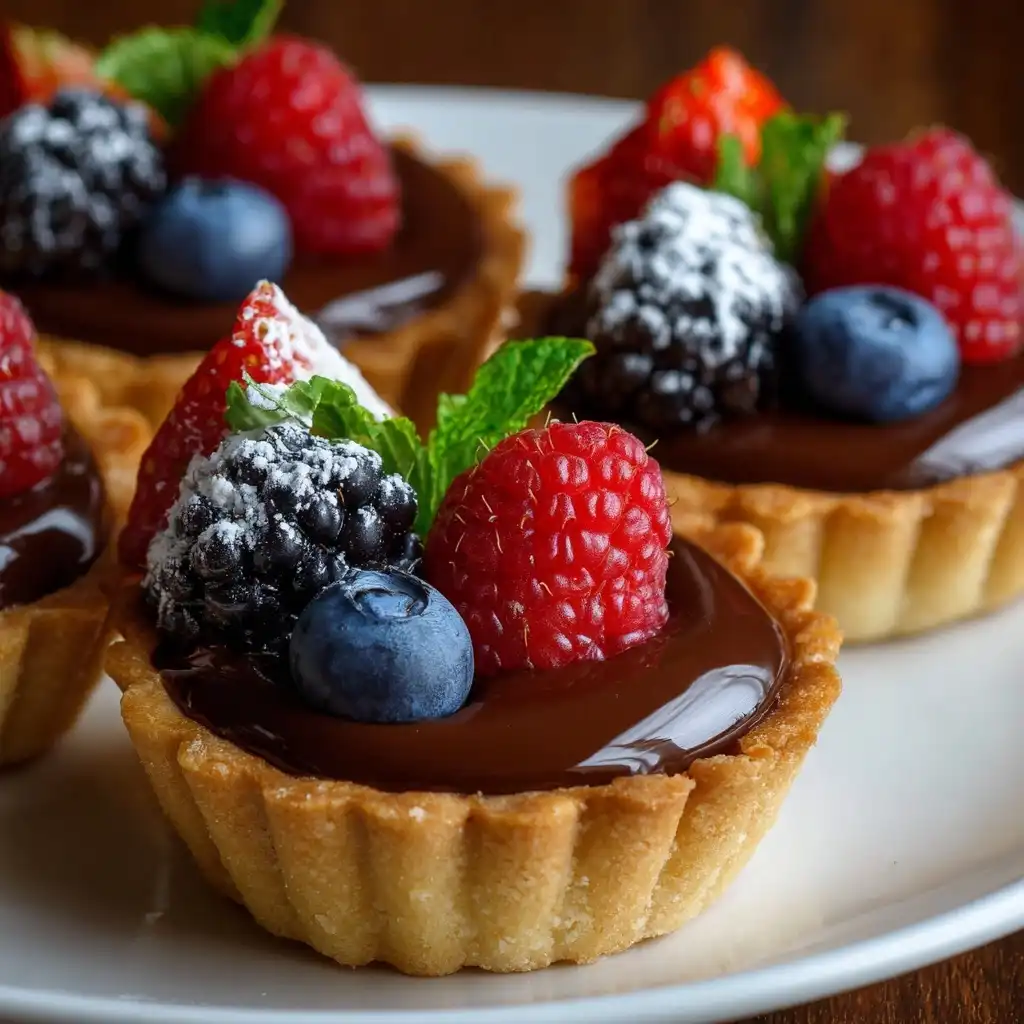
- For Garnish & Finish: Fresh seasonal berries (raspberries, blackberries, or hulled strawberries) add acidity and visual contrast; crème fraîche or mascarpone quenelles lend tangy creaminess; edible flowers (violets, pansies, borage) elevate aesthetics; tempered chocolate curls or shards provide textural drama; flaky sea salt crystals deliver finishing minerality; and a dusting of Dutch-process cocoa or matcha powder offers nuanced color and flavor accents.
Crucially, ingredient temperature matters: cold butter ensures a tender, non-shrinking crust; warm (not boiling) cream prevents seizing when poured over chocolate; and fully cooled shells prevent ganache from sliding or sweating.
Step-by-Step Recipe
- Prepare the Pâte Sucrée Dough: In a food processor, pulse 1¼ cups (160g) all-purpose flour, ¼ cup (30g) confectioners’ sugar, and ¼ tsp fine sea salt until combined. Add ½ cup (115g) very cold unsalted butter, cut into ½-inch cubes, and pulse 8–10 times until mixture resembles coarse meal with pea-sized butter bits. Add 1 large cold egg yolk and 1 tsp ice water; pulse just until dough begins to clump. Turn onto parchment, flatten into a 1-inch-thick disc, wrap tightly, and chill for at least 2 hours (or up to 3 days).
- Roll & Line Tartlet Molds: Preheat oven to 350°F (175°C). Lightly butter and flour 12 standard (3.5-inch) fluted tartlet molds (or use non-stick mini muffin tins with removable bottoms). On a lightly floured surface, roll chilled dough to ⅛-inch thickness. Cut circles using a 4-inch round cutter, gently press into molds, trim excess, and prick bases with a fork. Freeze filled molds for 20 minutes.
- Bake Blind: Line frozen shells with parchment and fill with pie weights or dried beans. Bake for 18 minutes. Carefully remove weights and parchment; bake 8–10 minutes more until golden and dry to the touch. Cool completely in molds on a wire rack (minimum 45 minutes).
- Make the Dark Chocolate Ganache: Finely chop 8 oz (225g) 65% dark chocolate and place in a heatproof bowl. Heat 1 cup (240ml) heavy cream, 1 tbsp light corn syrup, and ¼ tsp flaky sea salt in a saucepan until steaming (180°F / 82°C)—do not boil. Pour hot cream over chocolate; let sit 2 minutes. Gently whisk from center outward until smooth, glossy, and fully emulsified. Stir in 1 tsp pure vanilla extract. Strain through a fine-mesh sieve into a clean bowl.
- Fill & Set: Spoon 1½ tbsp warm ganache into each cooled shell. Tap mold gently to release air bubbles. Refrigerate uncovered for 2 hours, or until ganache is firm but not brittle (ideal temp: 50–55°F).
- Garnish & Serve: Unmold tartlets by gently pushing up from bottom. Top each with a fresh raspberry, a tiny quenelle of crème fraîche, a single flaky salt crystal, and a delicate dark chocolate curl. Serve chilled—but allow 5 minutes at room temperature for optimal mouthfeel and flavor bloom.
Tips
- Dough Handling Wisdom: Never overwork the dough—warm hands melt butter prematurely. If dough becomes sticky, return to fridge for 10 minutes before rolling. For ultra-crisp shells, brush baked crusts lightly with egg white and return to oven for 2 minutes to seal pores.
- Ganache Perfection: Use a digital thermometer: cream must be between 175–185°F for ideal emulsification. Stir slowly—aggressive whisking incorporates air and causes dullness. Let ganache rest at room temperature for 15 minutes before filling to reduce condensation risk.
- Mold Mastery: Silicone tartlet molds yield flawless release but require freezing before baking to hold shape. Metal tins give superior browning—line with parchment collars if removing while warm. Always cool shells completely before filling; residual warmth causes ganache to pool or weep.
- Storage Savvy: Store unfilled baked shells airtight at room temperature up to 5 days; freeze up to 3 months. Filled tartlets keep refrigerated (covered loosely with parchment, not plastic) for up to 48 hours. Never freeze filled tartlets—they suffer texture degradation and surface sweating upon thawing.
- Visual Flair: For mirror-like ganache tops, use a small offset spatula dipped in hot water and wiped dry to smooth surface before chilling. Dust with cocoa *after* setting to avoid smudging. Use tweezers for precise placement of edible flowers or gold leaf.
- Timing Tip: Prepare dough one day, bake shells next morning, fill and garnish same afternoon—this staggered approach minimizes stress and maximizes freshness.
Variations and Customizations
The versatility of mini chocolate tartlets invites endless creativity—each variation honors the classic structure while introducing bold new dimensions of flavor, texture, and cultural inspiration.
- White Chocolate & Passionfruit: Substitute white chocolate for dark; infuse cream with passionfruit purée (2 tbsp per 1 cup cream); top with torched meringue peaks and fresh passionfruit seeds.
- Espresso-Dark Fusion: Add 1 tsp instant espresso powder to ganache; finish with candied orange peel and a dusting of cocoa nibs.
- Spiced Mexican-Inspired: Infuse cream with cinnamon stick, star anise, and chipotle powder; stir in ¼ tsp ground ancho chili and 1 tbsp piloncillo syrup; garnish with crumbled pepitas and cacao nibs.
- Matcha-Black Sesame: Replace 2 tbsp chocolate with ceremonial-grade matcha; swirl in black sesame paste (1 tbsp) before setting; top with toasted black sesame seeds and yuzu zest.
- Vegan & Refined Sugar-Free: Use almond flour + oat flour crust (bound with cold coconut oil + maple syrup); ganache made from full-fat coconut milk + dairy-free dark chocolate + date syrup; set with agar-agar infusion for stability.
- Boozy Luxe Edition: Add 1 tbsp aged bourbon or Armagnac to warm ganache; pipe a ribbon of salted caramel inside shell before ganache; crown with bourbon-candied pecans.
- Savory-Sweet Umami Boost: Incorporate 1 tsp white miso paste into ganache for deep savoriness; pair with caramelized shallot confit and pickled red onion ribbons.
- Gluten-Free Adaptation: Blend ¾ cup (90g) GF all-purpose flour, ¼ cup (25g) almond flour, and 2 tbsp tapioca starch; add ½ tsp xanthan gum to mimic gluten elasticity.
- Kid-Friendly Fun: Use milk chocolate ganache; pipe colorful buttercream rosettes; decorate with rainbow sprinkles, mini marshmallows, and chocolate-dipped pretzel sticks.
- Seasonal Spotlight: Spring—lavender-infused ganache + violet sugar; Summer—strawberry-balsamic reduction drizzle + basil oil; Autumn—roasted pear compote + brown butter crumble; Winter—spiced cranberry gel + candied ginger.
Health Considerations and Nutritional Value
While inherently indulgent, mini chocolate tartlets can be thoughtfully adapted to accommodate dietary needs and enhance nutritional profile—without compromising pleasure. A standard mini tartlet (approx. 2.5 inches diameter, 1.5 oz total weight) contains roughly 185–220 calories, 12–15g fat (7–9g saturated), 18–22g carbohydrates (12–15g sugars), and 2–3g protein. Key considerations include:
- Cocoa Benefits: Dark chocolate (70%+) contributes flavanols—antioxidants linked to improved endothelial function, reduced blood pressure, and enhanced cognitive circulation. Opt for minimally processed, stone-ground chocolate with no alkalizing (Dutch processing), which preserves up to 80% more flavanols.
- Butter vs. Alternatives: Grass-fed butter supplies vitamin K2 (supporting arterial and bone health) and butyrate (anti-inflammatory). For lower-saturated-fat options, consider clarified butter (ghee) or cold-pressed avocado oil in dough—though texture and browning differ.
- Sugar Awareness: Traditional recipes rely on refined sucrose. Substitutes like coconut sugar (lower glycemic index), monk fruit blend (zero-calorie, heat-stable), or date paste (fiber-rich) alter moisture and browning—adjust liquid accordingly.
- Allergen Notes: Naturally nut-free and soy-free (if chocolate is certified), but always verify labels. For egg-free crusts, replace yolk with 1 tbsp aquafaba + ½ tsp apple cider vinegar. Gluten-free versions require careful cross-contamination prevention.
- Portion Psychology: The miniature format supports mindful eating—studies show smaller vessels reduce consumption by 20–30% versus larger servings, helping maintain satiety cues and reducing postprandial glucose spikes.
- Nutrient Enhancement: Boost fiber with whole-grain or oat-based crusts; add omega-3s via ground chia or flaxseed in dough; incorporate probiotic-rich toppings like cultured coconut cream or kefir-based glazes.
- Medical Considerations: Those managing diabetes should prioritize high-cocoa, low-sugar versions and pair with protein/fat (e.g., almond butter garnish) to slow absorption. Individuals with GERD may prefer lower-acid chocolates (avoid citrus-infused varieties). Always consult a registered dietitian for personalized adaptations.
Ingredients
Makes 12 mini tartlets
For the Pâte Sucrée Tart Shells:
- 1¼ cups (160g) all-purpose flour, plus extra for dusting
- ¼ cup (30g) confectioners’ sugar
- ¼ teaspoon fine sea salt
- ½ cup (115g) unsalted butter, very cold, cut into ½-inch cubes
- 1 large egg yolk, chilled
- 1–2 teaspoons ice water (as needed)
For the Dark Chocolate Ganache Filling:
- 8 ounces (225g) high-quality dark chocolate (65–70% cacao), finely chopped
- 1 cup (240ml) heavy cream (36–40% fat)
- 1 tablespoon (15g) light corn syrup or glucose syrup
- ¼ teaspoon flaky sea salt (such as Maldon)
- 1 teaspoon pure Madagascar bourbon vanilla extract
For Garnish (per tartlet):
- 1 fresh raspberry or blackberry
- ½ teaspoon crème fraîche or mascarpone
- 1 delicate dark chocolate curl (tempered)
- 1 tiny flake of sea salt
- Optional: edible flower petal or micro mint leaf
Directions
- Make the dough: In a food processor, combine flour, confectioners’ sugar, and salt. Pulse 3 times to aerate. Add cold butter cubes and pulse 8–10 times, until mixture resembles coarse cornmeal with visible butter pieces no larger than peas. In a small bowl, whisk together egg yolk and 1 tsp ice water. With machine running, drizzle yolk mixture through feed tube. Pulse only until dough begins to gather into clumps—about 6–8 pulses. Do not overmix. Squeeze a small amount—if it holds together without crumbling, it’s ready.
- Chill the dough: Turn dough onto a sheet of parchment paper. Press into a 1-inch-thick disc. Wrap tightly in plastic wrap and refrigerate for at least 2 hours, or up to 3 days. For longer storage, double-wrap and freeze up to 3 months—thaw overnight in fridge before rolling.
- Preheat & prepare molds: Position oven rack in center. Preheat oven to 350°F (175°C). Lightly butter and flour twelve 3.5-inch fluted tartlet molds (with removable bottoms preferred). Alternatively, use non-stick silicone mini tart molds—no greasing needed.
- Roll and line: On a lightly floured surface, roll chilled dough to ⅛-inch thickness (about 12 inches in diameter). Using a 4-inch round cutter, stamp out 12 circles. Gently lift each circle and press into prepared molds, easing dough into flutes without stretching. Trim excess dough flush with rim using a paring knife or bench scraper. Prick base of each shell 5–6 times with fork tines. Place molds on a baking sheet and freeze for 20 minutes.
- Bake blind: Line frozen shells with parchment paper and fill evenly with ceramic pie weights or dried beans. Bake 18 minutes. Carefully lift parchment with weights and discard. Return shells to oven and bake 8–10 minutes more, until edges are golden brown and centers look dry and matte—not shiny or wet. Remove from oven and cool in molds on a wire rack for at least 45 minutes—do not rush this step.
- Prepare ganache: Place chopped chocolate in a medium heatproof bowl. In a small saucepan, combine cream, corn syrup, and salt. Heat over medium-low heat, stirring occasionally, until mixture reaches 180°F (82°C) on an instant-read thermometer—small bubbles will form around edges, but do not let boil. Immediately pour hot cream over chocolate. Let stand undisturbed for 2 minutes. Beginning at center, gently whisk in slow concentric circles until completely smooth and glossy—about 45 seconds. Whisk in vanilla extract. Strain ganache through a fine-mesh sieve into a clean bowl to remove any unmelted particles or air bubbles.
- Fill tartlets: Spoon 1½ tablespoons (about 25g) warm ganache into each cooled shell. Tap baking sheet firmly on counter once to settle and eliminate air pockets. Refrigerate uncovered for exactly 2 hours—no more, no less—for ideal set: firm enough to hold shape, soft enough to yield luxuriously on the tongue.
- Unmold and garnish: Gently push up on removable bottoms to release tartlets. Transfer to a serving platter. Top each with a fresh berry, a quenelle of crème fraîche (use a melon baller or teaspoon), a single chocolate curl, and one delicate salt flake. For best texture and flavor, serve within 30 minutes of garnishing—or store refrigerated and bring to cool room temperature (55°F) 5 minutes before serving.
FAQ
- Can I make the dough ahead of time?
- Absolutely. Dough keeps refrigerated for up to 3 days or frozen for 3 months. Thaw overnight in fridge before rolling. Baked, unfilled shells stay crisp for 5 days airtight at room temperature—or freeze for 3 months (thaw uncovered at room temp 30 minutes before filling).
- Why did my ganache seize or become grainy?
- Seizing usually occurs from overheating chocolate (above 120°F/49°C), adding cold cream, or introducing even a trace of water. Always use dry utensils and bowls. If grainy, gently re-warm over double boiler while whisking in 1 tsp warm cream—stop before boiling. Prevention is key: use accurate thermometer, steam-not-boil cream, and chop chocolate finely.
- Can I use milk or white chocolate instead?
- Yes—with adjustments. Milk chocolate has more milk solids and sugar—reduce cream by 2 tbsp and omit corn syrup. White chocolate is highly sensitive—heat cream only to 110°F (43°C) and stir constantly. Both set softer; refrigerate filled tartlets minimum 3 hours.
- My tart shells shrank or slid down the sides—what went wrong?
- Overworking dough, insufficient chilling, or stretching dough while pressing into molds causes shrinkage. Always freeze lined shells before baking, handle gently, and avoid pulling dough upward. Also ensure molds are well-chilled before lining.
- How do I get a perfectly smooth, glossy ganache surface?
- After pouring, tap mold sharply on counter to pop bubbles. Let sit 1 minute, then use a small offset spatula dipped in hot water and wiped *completely dry* to sweep surface smoothly. Chill immediately. For mirror finish, apply thin layer of neutral glaze (gelatin + simple syrup + water) after initial set.
- Can I make these gluten-free or vegan?
- Yes—see Variations section for tested GF crust blends and dairy-free ganache formulas. Note: vegan versions may require agar-agar stabilization and benefit from overnight chilling for full set.
- What’s the best way to transport these to a party?
- Use a rigid, lidded container lined with parchment. Place tartlets upright in snug-fitting slots (egg cartons work well). Chill fully before packing. Keep in cooler with ice packs until 15 minutes before serving. Never stack or cover with plastic wrap—it traps condensation.
- Why does my ganache have a dull, matte finish instead of shine?
- Lack of cocoa butter emulsion. Ensure cream is hot enough (but not boiling), stir gently—not vigorously—and strain. Adding corn syrup or glucose improves sheen. Tempering chocolate beforehand also enhances reflectivity.
- Can I add liqueur to the ganache?
- Yes—up to 1 tbsp per batch. Add *after* emulsifying, when ganache is slightly cooled (100–110°F). Too much alcohol prevents proper set; balance with extra chocolate if needed.
- How do I fix cracked ganache surfaces?
- Minor cracks often disappear upon garnishing. For severe cases, gently rewarm surface with kitchen torch (1 second max) or steam wand, then smooth with warm spatula. Prevent by avoiding temperature shock—don’t refrigerate warm ganache.
Summary
Mini Chocolate Tartlets are exquisitely balanced confections—featuring buttery, flaky pâte sucrée shells enrobing a silken, deeply flavorful dark chocolate ganache, finished with artful, contrasting garnishes that elevate both taste and presentation.
Rooted in centuries-old French pastry tradition yet endlessly adaptable to dietary needs, global flavors, and modern aesthetics, these petite desserts prove that profound luxury resides not in size—but in intention, quality, and the quiet joy of a perfect bite.