Introduction
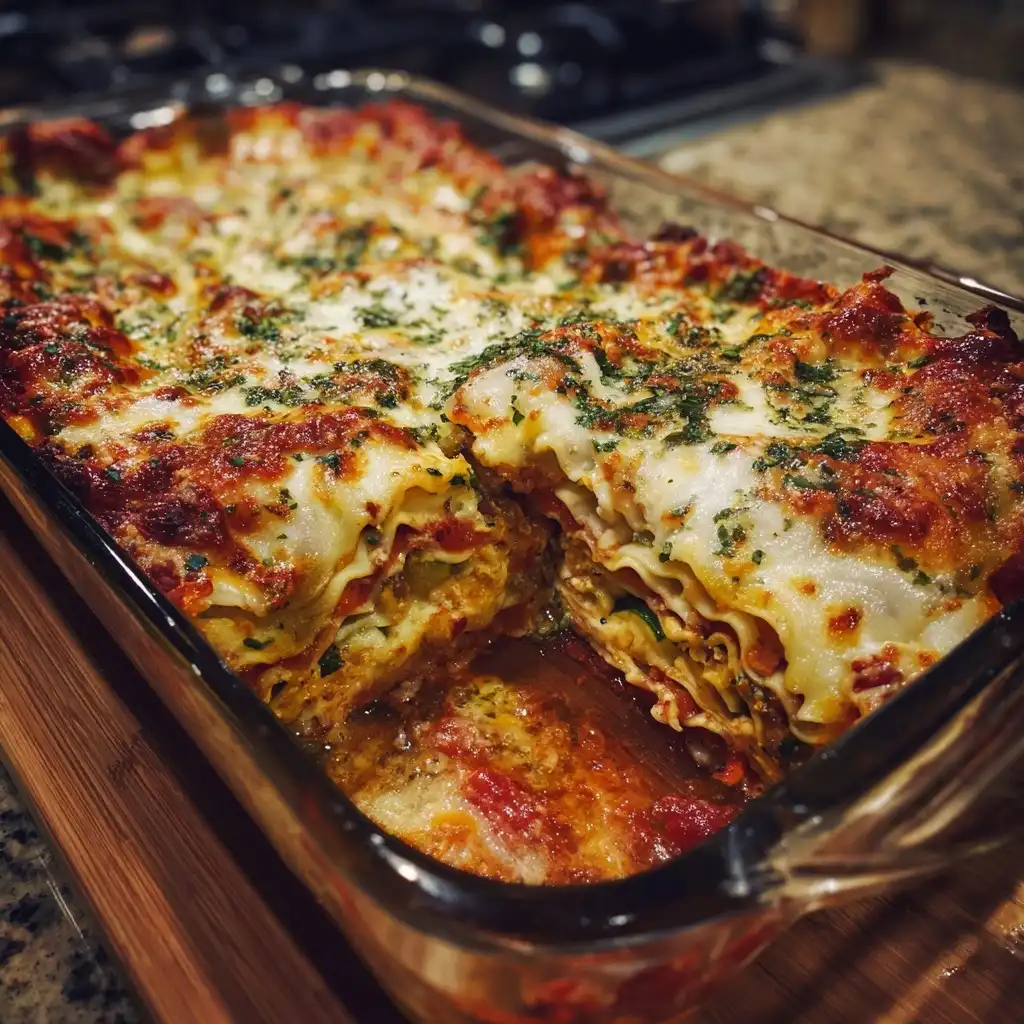
Loaded Veggie Supreme Lasagna is a vibrant, nutrient-dense reimagining of the classic Italian-American comfort dish — transformed into a celebration of seasonal produce, plant-powered protein, and rich, layered flavor. Far from being a mere “meatless alternative,” this lasagna stands proudly on its own as a centerpiece entrée: hearty enough to satisfy even the most devoted traditionalists, yet light, colorful, and deeply nourishing thanks to an abundance of roasted, sautéed, and fresh vegetables. Each bite delivers a symphony of textures — tender-crisp zucchini ribbons, caramelized sweet peppers, earthy mushrooms, creamy spinach-ricotta swirls, and chewy whole-grain noodles — all bound together by a luscious, herb-infused tomato sauce and crowned with golden, bubbling mozzarella and Parmesan. Whether you’re cooking for a weeknight family dinner, hosting a vegetarian gathering, meal prepping for the week, or simply seeking a wholesome, satisfying way to increase your daily vegetable intake, this lasagna delivers joy, depth, and undeniable comfort — without compromise.
The History
Lasagna’s origins trace back over 700 years to medieval Italy, where early versions featured sheets of dough layered with spices, cheese, and sometimes minced meats — though notably, not tomatoes (which only arrived in Europe after the Columbian Exchange in the late 15th century). The modern American-style lasagna — with ricotta, mozzarella, ground beef, and robust tomato sauce — solidified in the mid-20th century, fueled by postwar Italian immigration and the rise of accessible grocery staples like canned tomatoes and shredded cheese. As dietary awareness evolved in the 1980s and ’90s, vegetarian adaptations emerged, often substituting lentils or tofu for meat. However, the true “Veggie Supreme” iteration — intentionally abundant, unapologetically diverse, and built around vegetable *as* the star rather than a filler — gained momentum in the 2010s alongside farm-to-table movements, rainbow nutrition science, and social media–driven culinary creativity. This Loaded Veggie Supreme Lasagna honors that legacy while pushing boundaries: it embraces global vegetable preparations (roasting, charring, marinating), incorporates ancient grains (like kamut or spelt noodles), integrates fermented elements (a splash of nutritional yeast for umami depth), and reflects contemporary values — sustainability, seasonality, and inclusivity. It is both homage and evolution — a dish rooted in centuries of layered pasta tradition, yet vibrantly, unmistakably of today.
Ingredients Breakdown
Every component in this lasagna serves a distinct sensory and nutritional role — nothing is arbitrary. Let’s explore the purpose and synergy behind each major category:
- Base Pasta Layers: Oven-ready whole-wheat or legume-based (lentil/chickpea) lasagna noodles provide complex carbohydrates, fiber, and plant protein — offering structure and chew while supporting digestive health and sustained energy release. No-boil varieties reduce prep time and eliminate soggy edges.
- The Roasted Veggie Medley: A triumvirate of zucchini, eggplant, and red bell peppers — roasted at high heat — develops deep sweetness, smoky notes, and concentrated texture. Roasting evaporates excess moisture (critical for preventing a watery lasagna), enhances natural sugars, and activates antioxidant compounds like lycopene (in peppers) and nasunin (in eggplant skin).
- The Sautéed Aromatics & Umami Builders: Onions, garlic, cremini mushrooms, and spinach form the savory backbone. Mushrooms contribute meaty texture and glutamates for natural savoriness; onions and garlic build foundational aroma; wilted spinach adds iron, folate, and volume without diluting flavor.
- The Creamy Ricotta-Cheese Blend: Whole-milk ricotta (not low-fat) ensures richness and proper binding; combined with grated Parmigiano-Reggiano (aged for nuttiness and salt complexity), a touch of lemon zest (brightens fat), fresh basil (herbal freshness), black pepper (piperine boosts nutrient absorption), and a whisper of nutmeg (traditional warmth), this filling is luxuriously textured and deeply balanced.
- The Signature Tomato-Basil Sauce: Simmered from San Marzano-style crushed tomatoes, extra-virgin olive oil, slow-sautéed shallots, dried oregano and basil, a splash of balsamic vinegar (for acidity and depth), and a bay leaf — this isn’t just “marinara.” It’s a slow-developed, herbaceous, lightly sweet-tart foundation that cuts through richness and ties every layer together.
- The Golden Topping: A dual-layer finish — first, a generous blanket of low-moisture part-skim mozzarella for melt and stretch, then a final dusting of sharp, aged Parmigiano-Reggiano and freshly chopped parsley — yields visual appeal, textural contrast (crisp-edged cheese vs. creamy interior), and aromatic lift upon serving.
Step-by-Step Recipe
- Prep & Pre-Roast Vegetables (45 min ahead): Preheat oven to 425°F (220°C). Slice 2 medium zucchinis lengthwise into ¼-inch planks; peel and cube 1 small eggplant (½-inch cubes); deseed and slice 2 large red bell peppers into ½-inch strips. Toss each veggie separately with 1 tbsp extra-virgin olive oil, kosher salt, and black pepper. Spread on parchment-lined baking sheets (do not overcrowd). Roast zucchini 18–20 min (flip halfway), eggplant 25–28 min (stir once), peppers 22–25 min — until tender, slightly caramelized, and moisture visibly reduced. Cool slightly, then pat dry with paper towels to remove residual steam.
- Build the Savory Sauté Base: In a large Dutch oven or heavy-bottomed skillet, heat 2 tbsp olive oil over medium heat. Add 1 large diced yellow onion and 4 minced garlic cloves; sauté 5 min until translucent. Add 8 oz sliced cremini mushrooms; cook 8–10 min until deeply browned and liquid evaporates. Stir in 5 oz fresh baby spinach (or 10 oz thawed frozen, squeezed bone-dry); wilt 2 min. Season with 1 tsp dried oregano, ½ tsp red pepper flakes, salt, and pepper. Remove from heat; cool 10 min.
- Prepare the Ricotta Filling: In a large bowl, combine 3 cups whole-milk ricotta, 1 cup finely grated Parmigiano-Reggiano, ¼ cup chopped fresh basil, zest of 1 lemon, ½ tsp freshly grated nutmeg, 1 tsp black pepper, and 1 tsp sea salt. Fold gently until uniform — avoid overmixing to preserve lightness. Gently fold in the cooled spinach-mushroom mixture until evenly distributed.
- Simmer the Sauce: In the same skillet (wiped clean), heat 1 tbsp olive oil. Sauté 2 finely diced shallots 3 min until soft. Add 28 oz crushed San Marzano tomatoes, 1 tbsp balsamic vinegar, 1 tsp dried basil, 1 bay leaf, and ½ tsp sugar (optional, if tomatoes are acidic). Simmer uncovered 15–20 min, stirring occasionally, until thickened to a spoon-coating consistency. Discard bay leaf. Taste and adjust salt, acidity (more balsamic), or sweetness.
- Assemble with Precision: Preheat oven to 375°F (190°C). Lightly grease a 9×13-inch deep ceramic or glass baking dish. Spread 1 cup sauce on bottom. Layer 4 oven-ready noodles (slightly overlapping if needed). Top with ⅓ of ricotta mixture (spread evenly), ½ of roasted zucchini, ⅓ of roasted eggplant, ½ of roasted peppers. Repeat: sauce → noodles → ricotta → zucchini → eggplant → peppers. Third layer: sauce → noodles → remaining ricotta → remaining eggplant & peppers. Finish with 1½ cups sauce, spreading smoothly to cover all noodles. Cover tightly with greased foil.
- Bake & Rest (Non-Negotiable Step): Bake covered 40 min. Carefully remove foil. Sprinkle evenly with 2 cups shredded low-moisture mozzarella and ½ cup grated Parmigiano-Reggiano. Return uncovered to oven 15–18 min, until cheese is golden, bubbly, and edges are deeply caramelized. Turn broiler to low for final 60–90 seconds if top needs extra color (watch closely!). Remove and rest full 35 minutes — this allows starches to set, layers to fuse, and steam to redistribute, preventing a soupy collapse when sliced.
Tips
- Moisture Is the Enemy — Combat It Relentlessly: Pat roasted veggies DRY. Squeeze thawed frozen spinach in a clean kitchen towel until no water remains. Let sautéed base cool completely before folding into ricotta. Excess water = broken sauce, sliding layers, and gummy noodles.
- Noodle Choice Matters Profoundly: Use certified oven-ready (no-boil) noodles — they absorb liquid predictably. If using regular noodles, boil until *al dente*, rinse in cold water, and lay flat on oiled parchment to prevent sticking. Legume-based noodles hold up best to long bake times and add protein.
- Ricotta Texture Secret: For ultra-smooth filling, pulse ricotta in a food processor for 15 seconds before mixing. Or strain it in cheesecloth over a bowl for 30 minutes to remove whey — especially crucial if using store-bought ricotta that tends to be watery.
- Sauce Consistency Check: Your sauce should mound on a spoon and hold its shape for 3 seconds. Too thin? Simmer longer. Too thick? Stir in 1–2 tbsp vegetable broth or reserved tomato liquid.
- Resting Is Not Optional — It’s Alchemy: Cutting too soon releases trapped steam and destabilizes the delicate emulsion between cheese, sauce, and noodle. 35 minutes minimum allows gluten networks to relax and starches to gel — yielding clean, defined layers and maximum structural integrity.
- Layering Order Logic: Always start and end with sauce (prevents sticking and drying). Place delicate roasted veggies (zucchini, peppers) directly against ricotta — their moisture helps hydrate the cheese layer. Heavier eggplant goes mid-layer where it benefits from surrounding moisture and heat conduction.
- Make-Ahead Magic: Assemble entirely up to 24 hours ahead; refrigerate covered. Add 10–15 minutes to covered bake time. Or freeze unbaked lasagna for up to 3 months — thaw overnight in fridge before baking.
Variations and Customizations
This recipe is a canvas — adaptable to seasons, pantries, dietary needs, and cravings. Here’s how to make it uniquely yours:
- Seasonal Swaps: Spring: substitute asparagus tips and fava beans (blanched); Summer: add cherry tomatoes (halved & roasted), corn kernels, and fresh basil ribbons; Fall: use roasted butternut squash, caramelized onions, and sage; Winter: swap in roasted turnips, kale (massaged with lemon), and pomegranate arils for garnish.
- Protein Boosters: Stir 1 cup cooked lentils, crumbled tempeh bacon, or white beans into the ricotta. For vegan: replace ricotta with blended silken tofu + lemon + nutritional yeast; use cashew mozzarella and vegan Parmesan.
- Gluten-Free Adaptation: Use certified GF oven-ready lasagna noodles (brown rice or quinoa-based). Ensure all sauces and cheeses are GF-certified (some Parmesan contains wheat starch).
- Low-Carb/Keto Version: Replace noodles with thinly sliced zucchini or eggplant “noodles” (salted, drained, and patted dry). Increase cheese ratio slightly to compensate for lost binding. Reduce tomato sauce volume by ⅓ and add 1 tbsp tomato paste for intensity.
- Spice & Heat Profiles: Smoky: Add ½ tsp smoked paprika to sauce and roasted veggies. Mediterranean: Stir ¼ cup chopped Kalamata olives and 2 tbsp capers into ricotta. Thai-Inspired: Infuse sauce with lemongrass, ginger, and lime juice; top with cilantro and crushed peanuts.
- Herb & Aroma Twists: Swap basil for fresh oregano or marjoram in sauce; add 1 tsp toasted fennel seeds to ricotta; finish with microgreens, edible flowers, or a drizzle of high-quality basil oil.
- Sheet Pan Shortcut: For faster weeknight assembly: roast all veggies on one large sheet pan; layer everything in a rimmed baking sheet lined with parchment — bake same method, but reduce covered time by 5 min due to shallower depth.
Health Considerations and Nutritional Value
A single 1-cup serving (approx. 1/12th of the full recipe) delivers an exceptional micronutrient profile while balancing macronutrients intelligently:
- Fiber Powerhouse: ~12g dietary fiber (45% DV) — primarily from whole-grain noodles, eggplant, zucchini, peppers, and spinach — supports gut microbiome diversity, stabilizes blood sugar, and promotes satiety and healthy digestion.
- Antioxidant Density: Rich in vitamins A (beta-carotene in peppers), C (bell peppers, tomatoes), K (spinach, basil), and polyphenols (nasunin in eggplant, lycopene in tomatoes, quercetin in onions). These combat oxidative stress and chronic inflammation.
- Plant-Based Protein Synergy: ~18g protein per serving — from ricotta (whey/casein), Parmesan (complete protein), whole-wheat noodles (lysine + methionine), and mushrooms (ergothioneine + selenium). Combining sources ensures all essential amino acids.
- Heart-Healthy Fats: Monounsaturated fats from olive oil and nuts (if added) support HDL cholesterol and vascular function. Minimal saturated fat (only from cheese — easily reduced by using part-skim mozzarella).
- Low Sodium Potential: By controlling added salt and using no-salt-added tomatoes, sodium can stay under 450mg/serving — ideal for hypertension management. Rely on herbs, acids (lemon, vinegar), and umami (mushrooms, Parmesan) for flavor instead of salt.
- Considerations & Modifications: For dairy sensitivity: use lactose-free ricotta and aged Parmesan (naturally low-lactose). For histamine concerns: omit spinach and mushrooms, use fresh mozzarella (lower histamine than aged), and skip fermented elements. For FODMAP tolerance: replace onion/shallot with garlic-infused oil and green onion tops; use lactose-free ricotta and hard cheeses in moderation.
Ingredients
- For Roasting: 2 medium zucchinis, sliced lengthwise into ¼-inch planks • 1 small eggplant (about 12 oz), peeled and cubed • 2 large red bell peppers, deseeded and sliced • 3 tbsp extra-virgin olive oil • 1½ tsp kosher salt • 1 tsp freshly ground black pepper
- For Sauté Base: 2 tbsp extra-virgin olive oil • 1 large yellow onion, finely diced • 4 garlic cloves, minced • 8 oz cremini mushrooms, sliced • 5 oz fresh baby spinach (or 10 oz frozen, thawed & squeezed dry) • 1 tsp dried oregano • ½ tsp red pepper flakes • Sea salt and black pepper to taste
- For Ricotta Filling: 3 cups whole-milk ricotta (well-drained) • 1 cup finely grated Parmigiano-Reggiano • ¼ cup fresh basil leaves, finely chopped • Zest of 1 organic lemon • ½ tsp freshly grated nutmeg • 1 tsp black pepper • 1 tsp sea salt • Optional: 2 tbsp nutritional yeast (for extra umami and B12)
- For Tomato-Basil Sauce: 1 tbsp extra-virgin olive oil • 2 shallots, finely diced • 28 oz high-quality crushed San Marzano tomatoes (preferably in glass) • 1 tbsp balsamic vinegar • 1 tsp dried basil • 1 bay leaf • ½ tsp organic cane sugar (optional) • Salt and black pepper to taste
- For Assembly & Topping: 12 oven-ready whole-wheat or legume-based lasagna noodles • 2 cups low-moisture part-skim mozzarella, shredded • ½ cup finely grated Parmigiano-Reggiano • 2 tbsp fresh parsley, chopped (for garnish)
Directions
- Roast Vegetables: Preheat oven to 425°F (220°C). Prepare zucchini, eggplant, and peppers as directed. Toss each separately with oil, salt, and pepper. Roast on separate parchment-lined sheets: zucchini 18–20 min, eggplant 25–28 min, peppers 22–25 min. Cool slightly, then thoroughly pat dry with paper towels. Reduce oven to 375°F (190°C).
- Sauté Base: Heat oil in Dutch oven over medium. Sauté onion and garlic 5 min. Add mushrooms; cook 8–10 min until browned and dry. Stir in spinach, oregano, red pepper flakes, salt, and pepper. Cook 2 min. Cool completely (10+ min).
- Make Ricotta Filling: In large bowl, whisk ricotta, 1 cup Parmesan, basil, lemon zest, nutmeg, pepper, and salt until smooth. Fold in cooled mushroom-spinach mixture until fully incorporated.
- Simmer Sauce: In same skillet, heat oil. Sauté shallots 3 min. Add tomatoes, balsamic, dried basil, bay leaf, and sugar (if using). Simmer uncovered 15–20 min until thick. Discard bay leaf. Adjust seasoning.
- Assemble: Grease 9×13-inch baking dish. Spread 1 cup sauce. Layer 4 noodles. Spread ⅓ ricotta mix. Top with ½ zucchini, ⅓ eggplant, ½ peppers. Repeat layers twice more (sauce → noodles → ricotta → veggies), ending with noodles. Top with remaining 1½ cups sauce, smoothing evenly.
- Bake: Cover tightly with greased foil. Bake 40 min. Remove foil. Top with mozzarella and remaining ½ cup Parmesan. Bake uncovered 15–18 min until golden and bubbling. Optional: broil 60–90 sec for deeper browning.
- Rest & Serve: Let stand undisturbed for 35 minutes. Cut into 12 squares with a sharp chef’s knife. Garnish with parsley. Serve warm.
FAQ
- Can I make this lasagna ahead of time?
- Absolutely. Assemble up to 24 hours in advance, cover tightly, and refrigerate. Add 10–15 minutes to the initial covered bake time. For longer storage, assemble, wrap tightly in plastic + foil, and freeze up to 3 months. Thaw overnight in the fridge before baking — no need to adjust time significantly.
- Why do my lasagna noodles bubble up or become mushy?
- This almost always stems from excess moisture. Ensure roasted veggies are patted *completely* dry, spinach is squeezed bone-dry, and sauce is thick enough to coat a spoon. Also verify your “oven-ready” noodles are truly no-boil — some generic brands require brief boiling. Overbaking uncovered can also cause edge breakdown.
- Can I use fresh lasagna noodles instead of no-boil?
- Yes — but they must be parboiled first. Cook in salted water until *al dente* (1–2 min less than package says), drain, rinse under cold water, and lay flat on oiled parchment to prevent sticking. Layer immediately while still pliable.
- Is this lasagna freezer-friendly?
- Yes — it freezes exceptionally well. Assemble unbaked, wrap tightly in plastic wrap, then double-wrap in heavy-duty foil. Label with date. Freeze up to 3 months. To bake: thaw overnight in fridge, then bake as directed (may need +5 min covered).
- My ricotta filling is watery — what went wrong?
- Store-bought ricotta often contains excess whey. Either strain it in cheesecloth for 30 minutes before mixing, or pulse briefly in a food processor to homogenize and release water. Also ensure the sautéed base is fully cooled — residual heat causes ricotta to weep.
- What’s the best way to reheat leftovers?
- For best texture, reheat individual portions in a covered toaster oven or conventional oven at 350°F (175°C) for 15–20 minutes until hot throughout. Microwaving makes cheese rubbery and noodles gummy. If using microwave, cover with damp paper towel and heat in 30-second bursts.
- Can I make this vegan?
- Yes! Replace ricotta with blended silken tofu (14 oz) + 3 tbsp lemon juice + 3 tbsp nutritional yeast + 1 tsp garlic powder + ½ tsp salt. Use vegan mozzarella shreds and GF vegan Parmesan. Ensure noodles are egg-free. Sauce remains unchanged.
- How do I know when it’s done baking?
- Look for visual cues: sauce should be bubbling vigorously around the edges, cheese top deeply golden and slightly blistered, and a toothpick inserted into center should meet gentle resistance (not raw noodle, not mush). Internal temperature should read 165°F (74°C) at the thickest point.
Summary
Loaded Veggie Supreme Lasagna is a masterclass in plant-forward comfort food — where layers of roasted seasonal vegetables, herb-kissed ricotta, slow-simmered tomato sauce, and golden cheese unite in a harmonious, nutrient-rich, and deeply satisfying casserole that redefines expectations of vegetarian cooking.
With meticulous attention to moisture control, smart ingredient pairings, and flexible customization options, it delivers restaurant-quality depth and texture while supporting wellness goals — proving that abundance, flavor, and nourishment belong at the very heart of every meal.