Introduction
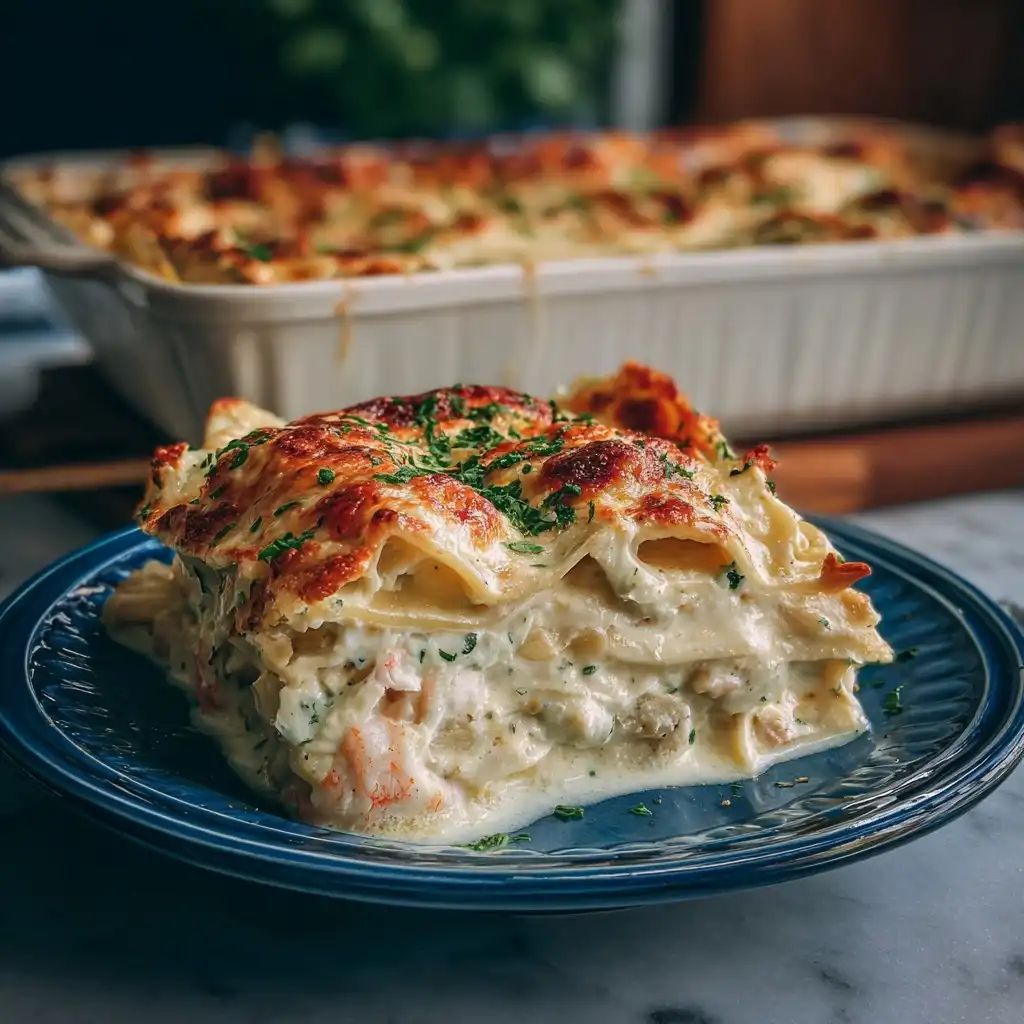
Creamy White Seafood Lasagna is a luxurious, restaurant-worthy twist on the beloved Italian classic—elevated with the delicate sweetness of premium seafood, velvety béchamel, and layers of tender pasta. Unlike traditional meat- or vegetable-based lasagnas, this version celebrates the ocean’s bounty with a harmonious blend of shrimp, scallops, and flaky white fish, all enveloped in a rich, garlic-kissed white sauce infused with subtle herbs and a whisper of nutmeg. Elegant yet approachable, it bridges coastal Mediterranean flair with comforting Italian technique—perfect for special occasions, holiday dinners, or when you simply crave something sumptuous, creamy, and deeply satisfying without the heaviness of tomato-based sauces.
The History
While lasagna traces its roots to 13th-century Italy—first documented in the medieval cookbook De honesta voluptate et valetudine by Bartolomeo Sacchi (Platina)—the concept of “white lasagna” (lasagna bianca) evolved more gradually. Traditional Emilian lasagna features ragù, béchamel, and Parmigiano-Reggiano, but coastal regions like Liguria, Campania, and Sicily long incorporated seafood into pasta dishes, especially during feast days honoring patron saints of fishermen. The fusion of these traditions—rich northern béchamel techniques meeting southern Mediterranean seafood sensibilities—gained momentum in the mid-to-late 20th century as refrigeration improved seafood distribution and home cooks embraced global flavors. Chefs like Marcella Hazan championed simplified, ingredient-driven Italian cooking in America, paving the way for refined interpretations like Creamy White Seafood Lasagna. Today, it stands as a testament to culinary cross-pollination: an homage to heritage, yet boldly contemporary in its balance of delicacy, creaminess, and umami depth.
Ingredients Breakdown
Every element in this lasagna plays a precise role—no filler, no afterthoughts. Let’s explore the purpose and nuance behind each component:
- Fresh Seafood Trio: Shrimp (peeled, deveined, tail-off), bay scallops (small, sweet, tender), and skinless, boneless white fish fillets (such as haddock, cod, or halibut) provide layered texture and flavor. Shrimp contributes briny brightness, scallops add buttery succulence, and the white fish lends mild, flaky richness—ensuring no single variety dominates.
- No-Boil Lasagna Noodles: Engineered to absorb moisture directly from the sauce during baking, these eliminate pre-cooking while delivering consistent al dente tenderness. Look for high-quality, bronze-die extruded noodles for superior sauce adhesion and structural integrity.
- Béchamel Foundation: Made with whole milk, unsalted butter, and all-purpose flour, this classic French white sauce forms the creamy backbone. Its smoothness is elevated with grated nutmeg (freshly ground for aromatic warmth), a touch of white pepper, and slow incorporation to prevent lumps—never boiled aggressively, which can cause separation.
- Aromatics & Flavor Builders: Shallots (finely minced) offer sweeter, more nuanced allium depth than onions; garlic (pressed, not powdered) delivers pungent freshness; dry white wine (e.g., Pinot Grigio or Verdicchio) deglazes the pan and lifts the seafood’s natural sweetness without acidity overpowering the cream.
- Herb Ensemble: Fresh parsley (flat-leaf, finely chopped) adds grassy brightness; a small amount of fresh dill (optional but recommended) imparts a subtle anise-like lift that complements seafood beautifully; dried oregano is omitted entirely—its robustness clashes with delicate ocean flavors.
- Cheese Matrix: A triple-layered cheese system ensures complexity and melt: freshly grated Parmigiano-Reggiano (aged 24+ months for crystalline umami), whole-milk ricotta (drained overnight for silkiness), and mozzarella di bufala (or high-moisture fior di latte) for stretch and milky sweetness—no pre-shredded cheeses (anti-caking agents inhibit melting).
- Finishing Touches: Lemon zest (microplaned, not juiced) adds aromatic citrus oil—not sourness—while a final dusting of lemon zest and parsley before serving awakens the palate. A drizzle of high-quality extra-virgin olive oil post-bake adds fruitiness and sheen.
Step-by-Step Recipe
This method prioritizes control, timing, and layer integrity—ensuring each bite delivers balanced creaminess, tender seafood, and perfectly cooked noodles.
- Prep & Dry Seafood: Pat shrimp, scallops, and fish cubes *thoroughly* dry with paper towels. Excess moisture is the #1 cause of watery lasagna. Refrigerate uncovered for 15 minutes to further dehydrate surface water.
- Make the Béchamel: In a heavy-bottomed saucepan, melt 6 tbsp unsalted butter over medium-low heat. Whisk in 6 tbsp all-purpose flour; cook, stirring constantly, for 2–3 minutes until golden and fragrant (do not brown). Gradually whisk in 3 cups warm whole milk (heated separately to prevent lumps), ¼ tsp freshly grated nutmeg, ½ tsp white pepper, and 1 tsp fine sea salt. Cook, whisking continuously, until thickened to a ribbon consistency (about 8–10 minutes). Remove from heat; stir in 1 cup grated Parmigiano-Reggiano. Cool to lukewarm (≈90°F/32°C) before proceeding—warm béchamel will curdle ricotta.
- Sauté Aromatics & Seafood: In a large nonstick skillet, heat 2 tbsp olive oil over medium heat. Sauté 1 cup finely minced shallots until translucent (3 min). Add 4 cloves pressed garlic; cook 30 seconds until fragrant. Add seafood in batches: first fish cubes (2 min per side), then scallops (1.5 min per side), then shrimp (1 min per side)—remove each batch immediately to a bowl as done. Deglaze pan with ½ cup dry white wine; simmer 2 minutes to reduce and concentrate flavor. Cool completely.
- Combine Fillings: In a large bowl, gently fold cooled seafood mixture into cooled béchamel. Separately, combine 2 cups well-drained whole-milk ricotta, ¼ cup chopped fresh parsley, 1 tbsp fresh dill (if using), ½ tsp lemon zest, and ½ tsp salt. Fold together just until uniform—do not overmix.
- Layer with Precision: In a 9×13-inch deep ceramic or stainless-steel baking dish (avoid reactive aluminum), spread ¾ cup béchamel-seafood mixture to coat bottom. Place 4 no-boil noodles (slightly overlapping if needed). Spread ⅓ of ricotta mixture (≈1 cup) evenly. Top with ⅓ of remaining seafood-béchamel (≈1¼ cups). Sprinkle with ⅓ of remaining Parmigiano (¼ cup). Repeat layers twice more (noodles → ricotta → seafood-béchamel → cheese), ending with a final noodle layer. Pour remaining béchamel (≈1 cup) evenly over top. Cover tightly with parchment-lined foil (prevents sticking and steam-locking).
- Bake with Rest: Bake at 375°F (190°C) for 45 minutes covered. Remove foil; sprinkle with 1 cup shredded mozzarella and ¼ cup additional Parmigiano. Return uncovered for 15–20 minutes until top is golden, edges bubble vigorously, and center reaches 165°F (74°C) on an instant-read thermometer. Crucially: Let rest, uncovered, for 35 minutes before cutting—this allows starches to set, prevents collapse, and lets residual heat finish cooking the noodles.
Tips
- Seafood Quality is Non-Negotiable: Use sustainably sourced, day-boat-caught or flash-frozen-at-sea seafood. Avoid “previously frozen” thawed shrimp with ice crystals or opaque, mushy scallops—these release excess water and compromise texture.
- Ricotta Drainage Matters: Line a fine-mesh strainer with cheesecloth; place ricotta inside; refrigerate uncovered for 8–12 hours. Discard whey. This prevents a soupy layer and yields luxuriously dense, cloud-like pockets.
- Wine Selection Wisdom: Choose a crisp, unoaked white with bright acidity and low alcohol (11–12.5%). Avoid Chardonnay aged in oak (vanilla overwhelms seafood) or overly floral Gewürztraminer (cloying). A dry Riesling or Albariño works beautifully.
- Noodle Alignment Prevents Slippage: Soak no-boil noodles in warm water for 30 seconds *only* if your brand consistently under-hydrates. Test one first—if it bends without snapping, skip soaking. Always align noodles parallel to the dish’s long sides for clean cuts.
- Thermometer Over Timing: Ovens vary wildly. Insert an instant-read thermometer into the center—it must read 165°F (74°C) for food safety and optimal starch gelatinization. If under, return covered for 5-minute increments.
- Cooling is Cooking: That 35-minute rest isn’t passive—it’s active setting. Cutting too soon releases trapped steam, causing layers to slide and sauce to pool. Use this time to prepare a simple arugula-lemon salad or warm garlic bread.
- Reheat Gently: Leftovers? Cover with damp parchment + foil; warm at 325°F (163°C) for 25 minutes. Never microwave—ricotta separates and seafood toughens.
Variations and Customizations
This recipe is a canvas—respect the core technique, but adapt thoughtfully to preferences, seasons, or pantry constraints:
- Shellfish-Forward: Replace white fish with lump crabmeat (jumbo lump, hand-picked) and add ¼ cup finely chopped clams (canned, rinsed, or fresh steamed and minced). Boost with 1 tsp Old Bay seasoning in the béchamel.
- Mediterranean Herb Garden: Stir 2 tbsp chopped sun-dried tomatoes (oil-packed, patted dry) and 2 tbsp crumbled feta into the ricotta layer. Garnish with kalamata olives and oregano.
- Low-Carb/Keto Adaptation: Substitute no-boil noodles with thinly sliced zucchini ribbons (salted, drained 20 min, patted dry) or blanched eggplant planks. Increase Parmigiano to 1½ cups for binding; reduce béchamel by ½ cup.
- Dairy-Free Luxury: Use cashew béchamel (soaked raw cashews blended with nutritional yeast, garlic, lemon juice, and almond milk), coconut milk ricotta (blended silken tofu + lemon + herbs), and vegan mozzarella shreds. Ensure seafood is ethically sourced—dairy-free doesn’t mean compromise.
- Spice Infusion: For subtle heat, infuse the béchamel with ¼ tsp crushed red pepper flakes while cooking the roux—or stir in 1 tsp harissa paste into the seafood mixture.
- Vegetarian Seafood Mimic: Replace seafood with king oyster mushroom “scallops” (sliced thick, seared until golden) and hearts of palm “crab” (shredded, marinated in nori powder, lemon, and seaweed oil). Umami-rich, ocean-evocative, and wholly plant-based.
- Make-Ahead Mastery: Assemble up to 24 hours ahead; cover tightly and refrigerate unbaked. Add 5–10 minutes to covered bake time. Or freeze assembled (unbaked) for up to 3 months—thaw overnight in fridge before baking.
Health Considerations and Nutritional Value
Creamy White Seafood Lasagna is inherently nutrient-dense—when prepared mindfully, it delivers exceptional wellness benefits without sacrificing indulgence:
- High-Quality Protein Powerhouse: Seafood provides complete proteins with all 9 essential amino acids. Shrimp offers selenium (a potent antioxidant); scallops supply magnesium for muscle function; white fish delivers lean protein and heart-healthy omega-3s (EPA/DHA), supporting cognitive health and reducing inflammation.
- Smart Fat Profile: Using whole milk and real butter contributes conjugated linoleic acid (CLA) and fat-soluble vitamins (A, D, K2). Opting for grass-fed butter and organic dairy increases omega-3s and reduces pesticide exposure. Olive oil adds monounsaturated fats linked to cardiovascular protection.
- Calcium & Bone Health: Parmigiano-Reggiano is one of nature’s most concentrated calcium sources (≈330mg per ¼ cup), plus bioavailable vitamin K2, which directs calcium to bones—not arteries.
- Low Glycemic Impact: No-boil noodles have lower glycemic load than pre-boiled versions due to slower starch hydration. Pairing with high-fiber vegetables (e.g., sautéed spinach in ricotta layer) further stabilizes blood sugar.
- Considerations & Mitigations: Sodium content can rise with cheese and seafood—control by using low-sodium broth (if deglazing) and omitting added salt in ricotta. For those watching saturated fat, substitute half the butter in béchamel with avocado oil and use part-skim ricotta (though full-fat yields superior texture). Gluten-free? Use certified GF no-boil noodles (rice/corn blend) and verify all sauces are GF-certified.
- Nutrition Snapshot (Per Serving, 12 Servings): Approx. 425 kcal | 28g protein | 22g fat (11g sat) | 26g carbs (2g fiber) | 780mg calcium | 1,100mg omega-3s | 35mcg selenium | 180mcg folate. Values assume full-fat dairy, wild-caught seafood, and no substitutions.
Ingredients
- 1 lb (450g) large shrimp, peeled, deveined, tails removed
- 1 lb (450g) fresh bay scallops, patted dry
- 1 lb (450g) skinless, boneless white fish fillets (cod, haddock, or halibut), cut into ¾-inch cubes
- 12 no-boil lasagna noodles (oven-ready, high-quality)
- 6 tbsp (85g) unsalted butter, divided
- 6 tbsp (45g) all-purpose flour
- 3 cups (720ml) whole milk, warmed
- 1 cup (100g) freshly grated Parmigiano-Reggiano, plus extra for garnish
- 1 cup (120g) well-drained whole-milk ricotta (see Tips for draining method)
- 1 cup (120g) fresh mozzarella di bufala or fior di latte, shredded
- 1 cup (150g) finely minced shallots (≈3 large)
- 4 cloves garlic, pressed
- ½ cup (120ml) dry white wine (Pinot Grigio, Verdicchio, or Albariño)
- ¼ cup (15g) finely chopped fresh flat-leaf parsley
- 1 tbsp (4g) fresh dill, finely chopped (optional but recommended)
- 1 tsp (2g) finely grated lemon zest (from 1 organic lemon)
- ¼ tsp freshly grated nutmeg
- 1 tsp fine sea salt, plus more to taste
- ½ tsp freshly ground white pepper
- 2 tbsp (30ml) extra-virgin olive oil
- Extra-virgin olive oil and additional lemon zest for garnish
Directions
- Prepare seafood: Pat shrimp, scallops, and fish cubes extremely dry with paper towels. Place on a wire rack over a tray; refrigerate uncovered for 15 minutes.
- Make béchamel: In a heavy-bottomed saucepan, melt 4 tbsp butter over medium-low heat. Whisk in flour; cook 2–3 minutes until golden and fragrant. Gradually whisk in warm milk, nutmeg, white pepper, and 1 tsp salt. Cook, whisking constantly, until thickened to a ribbon consistency (8–10 min). Remove from heat; stir in 1 cup Parmigiano. Transfer to a bowl; cool to lukewarm (≈90°F/32°C). Cover surface with plastic wrap to prevent skin.
- Sauté aromatics: Heat olive oil in a large nonstick skillet over medium heat. Sauté shallots until translucent (3 min). Add garlic; cook 30 sec. Add fish cubes; cook 2 min per side until opaque. Remove to a bowl. Add scallops; cook 1.5 min per side until just firm. Remove. Add shrimp; cook 1 min per side until pink. Remove. Deglaze pan with wine; simmer 2 min. Cool completely.
- Combine fillings: Gently fold cooled seafood mixture into cooled béchamel. In another bowl, combine ricotta, parsley, dill (if using), lemon zest, and ½ tsp salt. Fold together until uniform.
- Layer lasagna: Preheat oven to 375°F (190°C). In a 9×13-inch baking dish, spread ¾ cup seafood-béchamel. Layer 4 noodles. Spread ⅓ ricotta mixture (≈1 cup). Top with ⅓ seafood-béchamel (≈1¼ cups). Sprinkle with ¼ cup Parmigiano. Repeat twice more. Top with final 4 noodles. Pour remaining béchamel (≈1 cup) evenly over top. Cover tightly with parchment-lined foil.
- Bake: Covered, 45 min. Remove foil; sprinkle with mozzarella and remaining ¼ cup Parmigiano. Uncovered, bake 15–20 min until golden and bubbling. Insert thermometer—center must read 165°F (74°C).
- Rest & serve: Let stand uncovered for 35 minutes. Cut into 12 squares. Garnish with lemon zest, parsley, and a drizzle of extra-virgin olive oil.
FAQ
- Can I use frozen seafood?
- Yes—but only high-quality, individually quick-frozen (IQF) seafood. Thaw overnight in the refrigerator, then pat *extremely* dry. Never thaw at room temperature or in water, as it leaches flavor and adds moisture.
- Why no tomato sauce?
- Tomatoes’ acidity and bold flavor compete with delicate seafood, causing curdling in dairy and masking subtle ocean notes. White sauce preserves purity, sweetness, and textural harmony.
- My lasagna turned out watery—what went wrong?
- Most commonly: insufficient drying of seafood, under-drained ricotta, or skipping the cooling step for béchamel (causing ricotta to break). Also, covering with foil *without* parchment causes condensation to drip back in—always line foil with parchment.
- Can I prep this the day before?
- Absolutely. Assemble fully (through step 5), cover tightly, and refrigerate up to 24 hours. Add 5–10 minutes to the initial covered bake time. Do not add cheese topping until ready to bake.
- What wine pairs best with this dish?
- A chilled, mineral-driven white—think Chablis (unoaked Chardonnay), Vermentino from Sardinia, or a crisp Assyrtiko from Santorini. Serve at 48°F (9°C) to complement the creaminess without overwhelming the seafood.
- Is there a shortcut for the béchamel?
- Not without sacrifice. Pre-made béchamel often contains stabilizers that separate when baked. However, you *can* make it 2 days ahead and refrigerate—reheat gently with a splash of milk, whisking until smooth.
- Can I add vegetables?
- Yes—thoughtfully. Sauté 2 cups baby spinach with garlic until wilted and *thoroughly* squeezed dry; fold into ricotta. Or add 1 cup roasted, diced fennel bulb to the seafood mixture for anise brightness.
- How do I know when it’s done baking?
- Visual cues: Golden, blistered top; vigorous bubbling at edges. But the definitive test is internal temperature: 165°F (74°C) at the center. Under-baking risks gummy noodles; over-baking dries seafood.
Summary
Creamy White Seafood Lasagna is a masterful fusion of Italian tradition and coastal elegance—featuring tender shrimp, scallops, and white fish suspended in a luxuriously smooth, nutmeg-kissed béchamel, layered with silky ricotta and golden Parmigiano-Reggiano between no-boil noodles.
With meticulous attention to seafood preparation, precise sauce technique, and a non-negotiable 35-minute rest, it delivers restaurant-caliber depth, creamy richness, and ocean-fresh brightness in every forkful—proving that decadence and delicacy can coexist seamlessly.