Introduction
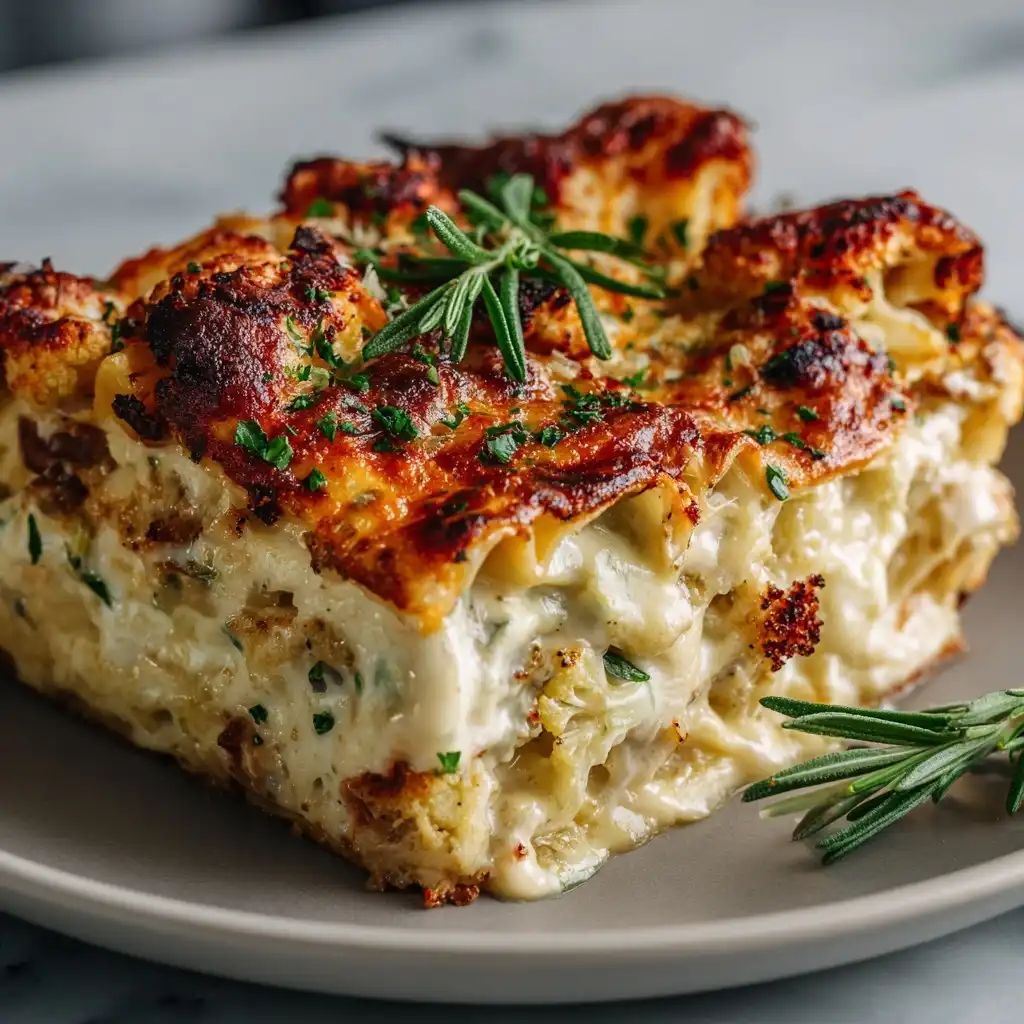
Roasted Cauliflower Alfredo Lasagna is a revolutionary, nutrient-dense twist on the beloved Italian-American classic—reimagined for modern palates and wellness-focused lifestyles. This dish masterfully bridges indulgence and nourishment by replacing traditional pasta sheets with tender, golden-roasted cauliflower “noodles,” while preserving the creamy, velvety soul of classic Alfredo through a luscious, dairy-rich (yet optionally lighter) sauce. Far from a mere substitution meal, it’s a culinary celebration: deeply savory, aromatically rich, and texturally dynamic—with caramelized cauliflower edges offering subtle nuttiness, layered ricotta and mozzarella lending luxurious melt, and fresh herbs adding brightness that cuts through the richness. Whether you’re following a low-carb, gluten-free, keto, vegetarian, or simply plant-forward diet—or just seeking a more vibrant, vegetable-forward version of comfort food—this lasagna delivers soul-satisfying depth without compromise. It’s hearty enough for Sunday suppers, elegant enough for dinner parties, and adaptable enough to become a cherished family staple.
The History
The evolution of Roasted Cauliflower Alfredo Lasagna is a fascinating convergence of culinary tradition, dietary innovation, and ingredient-driven creativity. While lasagna itself traces its roots to medieval Italy—where layered pasta, cheese, and ragù were baked in wood-fired ovens—the modern American interpretation emerged in the early 20th century with the rise of Italian immigration and the popularization of ricotta- and mozzarella-laden versions. Alfredo sauce, though often attributed to Roman restaurateur Alfredo di Lelio (who famously served fettuccine with butter and Parmigiano-Reggiano in the 1920s), was dramatically reinterpreted in the U.S. into a richer, cream-and-cheese–based emulsion—eventually becoming synonymous with decadent pasta dishes. The integration of roasted cauliflower as a pasta alternative began gaining traction in the late 2000s and early 2010s, propelled by the paleo, Whole30, and low-carb movements, which sought grain-free, high-fiber, nutrient-dense foundations. Chefs and home cooks alike discovered that thick-cut, well-seasoned, and properly roasted cauliflower slices—not only hold structural integrity when layered but also develop complex umami and sweet-caramelized notes that harmonize beautifully with rich dairy sauces. Over time, this fusion evolved beyond simple substitution into an intentional, flavor-forward composition: roasting became non-negotiable (not just for texture, but for depth), the Alfredo sauce was refined to balance richness with brightness (often incorporating garlic-infused cream, aged Parmigiano, and a whisper of nutmeg), and layering techniques were optimized to prevent sogginess—culminating in what is now widely regarded as a benchmark dish in contemporary vegetable-forward Italian cuisine.
Ingredients Breakdown
Every component in Roasted Cauliflower Alfredo Lasagna serves a distinct functional and sensory purpose—no ingredient is incidental. Let’s explore each in detail:
- Cauliflower: A large, dense head (2–2.5 lbs) is essential—not only for yield but for consistency. Mature, tightly packed florets with creamy-white curds and green, crisp stems indicate peak freshness and optimal roasting behavior. When sliced into ¼-inch planks (not florets), the cauliflower develops a sturdy, slightly chewy-yet-tender bite after roasting—mimicking the al dente quality of pasta while contributing glucosinolates (anti-inflammatory compounds), fiber (7g per cup, cooked), and vitamin C (77% DV). Its mild, subtly sweet, earthy base acts as the perfect canvas for bold dairy flavors.
- Olive Oil: Extra-virgin olive oil (EVOO) is used both for roasting and finishing. Its polyphenols enhance browning via the Maillard reaction, while its fruity, peppery notes lend aromatic complexity. For roasting, heat stability matters—EVOO’s smoke point (~375°F) aligns perfectly with the ideal roasting temp (425°F), especially when applied judiciously and evenly.
- Fresh Garlic: Minced (not powdered) garlic is sautéed gently in butter to unlock allicin—the compound responsible for garlic’s signature aroma and cardiovascular benefits—without bitterness. Roasting later further mellows its pungency into sweet, caramelized depth.
- Unsalted Butter: Provides foundational richness, mouthfeel, and emulsification power for the Alfredo sauce. Unsalted ensures precise sodium control, critical when pairing with salty cheeses like Parmigiano-Reggiano.
- Heavy Cream (or Full-Fat Coconut Milk for Dairy-Free): With 36–40% milk fat, heavy cream delivers unparalleled silkiness and stabilizes the sauce against curdling. Its high-fat content also carries fat-soluble vitamins (A, D, E, K) from the cheeses. For vegan adaptations, canned full-fat coconut milk—chilled overnight, with only the solid cream portion used—offers comparable viscosity and subtle sweetness.
- Parmigiano-Reggiano: Aged minimum 24 months, this DOP-certified Italian cheese contributes intense umami, crystalline crunch, and natural glutamates that amplify savoriness. Its saltiness and nutty, caramelized notes anchor the entire dish. Freshly grated is mandatory—pre-grated versions contain anti-caking agents that impede melting and create graininess.
- Ricotta Cheese: Whole-milk, small-curd ricotta (preferably from sheep’s or cow’s milk, not whey-based imitations) offers delicate sweetness, airy texture, and high protein (14g/cup). Its moisture content helps keep layers supple, while its mild tang balances the richness of Alfredo and mozzarella.
- Mozzarella: Low-moisture, whole-milk mozzarella (shredded fresh, not pre-shredded) melts uniformly, creating stretchy, golden-brown strata. Its mild lactic flavor allows other ingredients to shine, while its calcium content supports structural cohesion during baking.
- Nutmeg: Freshly grated (not ground) nutmeg adds a warm, floral-spicy nuance that enhances dairy flavors without overpowering—a classic pairing dating back to Renaissance Italian cooking.
- Fresh Herbs: Flat-leaf parsley and basil are added post-bake for vibrancy and phytonutrient diversity (apigenin, luteolin). Their volatile oils provide aromatic lift that counters heaviness.
- Sea Salt & Black Pepper: Maldon or flaky sea salt enhances surface texture and controlled salinity; freshly cracked Tellicherry black pepper contributes terpenes (like limonene and pinene) that add bright, citrusy heat—complementing the earthiness of cauliflower.
Step-by-Step Recipe
- Preheat & Prep: Position oven racks in upper-middle and lower-middle positions. Preheat oven to 425°F (220°C). Line two large, heavy-duty rimmed baking sheets with parchment paper—do not use foil, as it impedes even browning. Wash and thoroughly dry one large head of cauliflower (approx. 2.2 lbs). Using a sharp chef’s knife, remove outer leaves and trim stem flush with the base. Place cauliflower stem-side down on cutting board. Slice vertically into ¼-inch thick slabs—starting from the center outward. Aim for 12–14 uniform planks (some will be curved or irregular—reserve smaller pieces for layering edges). Discard core scraps or save for stock.
- Season & Roast Cauliflower: In a large bowl, whisk together ¼ cup extra-virgin olive oil, 2 tsp kosher salt, 1½ tsp freshly cracked black pepper, and ½ tsp smoked paprika (optional, for depth). Gently toss cauliflower planks in oil mixture—use hands to ensure full coverage, especially along cut edges. Arrange in a single layer on prepared sheets, leaving space between pieces. Roast for 22–26 minutes, rotating pans top-to-bottom and front-to-back at 12 minutes, until edges are deeply golden, undersides are crisp, and centers are tender-crisp when pierced with a fork. Remove and cool 10 minutes—this prevents steam buildup in final bake.
- Prepare Alfredo Sauce: In a heavy-bottomed, medium saucepan over medium-low heat, melt 6 tbsp unsalted butter. Add 4 minced garlic cloves; sauté 60–90 seconds until fragrant but not browned. Whisk in 2 tbsp all-purpose flour (or gluten-free 1:1 blend); cook 1 minute to eliminate raw taste. Gradually whisk in 2 cups cold heavy cream (never hot—prevents splattering and curdling). Bring to gentle simmer, whisking constantly. Reduce heat to low and simmer 5–7 minutes until slightly thickened (coats back of spoon). Remove from heat. Whisk in 1½ cups freshly grated Parmigiano-Reggiano, ¼ tsp freshly grated nutmeg, 1 tsp lemon zest, and ½ tsp white pepper. Taste and adjust salt—remember cheeses are salty. Sauce should be velvety, pourable, but coat spoon thickly. Set aside, covered.
- Prepare Ricotta Layer: In a medium bowl, combine 2 cups whole-milk ricotta, ½ cup grated Parmigiano, 1 large egg (binds layers), ¼ cup chopped fresh flat-leaf parsley, 1 tbsp lemon juice, ½ tsp salt, and ¼ tsp black pepper. Stir until smooth and homogenous—avoid overmixing, which can make ricotta grainy.
- Assemble Lasagna: Lightly grease a 9×13-inch ceramic or glass baking dish (avoid metal for even heating). Spread ¾ cup Alfredo sauce evenly across bottom. Layer 6–7 roasted cauliflower planks overlapping slightly to cover base completely—even small gaps are fine. Spoon ⅓ of ricotta mixture over cauliflower; spread gently with offset spatula. Drizzle with ½ cup Alfredo. Sprinkle with ½ cup shredded low-moisture mozzarella. Repeat layers twice: cauliflower → ricotta → Alfredo → mozzarella. Top final layer with remaining cauliflower planks, remaining Alfredo sauce (about ½ cup), and remaining 1 cup mozzarella. Finish with ¼ cup grated Parmigiano-Reggiano.
- Bake & Rest: Cover dish tightly with aluminum foil (tent slightly to prevent cheese sticking). Bake at 375°F (190°C) for 35 minutes. Remove foil; bake uncovered 12–15 minutes until top is bubbling vigorously at edges and mozzarella is deeply golden with blistered spots. Turn broiler to HIGH; broil 2–3 minutes until crown is crisp and speckled—watch closely! Remove and rest 25 minutes undisturbed—this allows starches to set, prevents sliding layers, and lets residual heat finish cooking centers.
- Finish & Serve: Just before serving, scatter ¼ cup torn fresh basil and 2 tbsp additional parsley over top. Drizzle lightly with high-quality EVOO and a pinch of flaky sea salt. Slice with a sharp, non-serrated knife dipped in hot water between cuts for clean edges.
Tips
- Roasting is Non-Negotiable: Do not steam, boil, or pan-sear cauliflower for this recipe—it lacks structural integrity and introduces excess moisture. Roasting dehydrates edges just enough to create “bite” while concentrating flavor. If your oven runs hot, reduce temp to 415°F—but never below 400°F.
- Uniform Slicing = Even Cooking: Use a mandoline with guard (set to ¼”) for absolute consistency—or practice steady hand-slicing. Irregular thickness causes some planks to overcook (bitter) while others stay watery.
- Cool Before Assembling: Warm cauliflower releases steam into the sauce, causing separation. Let roasted planks cool 10 minutes on wire racks—not on paper towels, which trap moisture.
- Sauce Temperature Matters: Always add cold cream to the roux—adding hot cream causes immediate clumping. And always remove sauce from heat before adding cheese—residual heat is sufficient to melt without greasiness.
- Layer Order is Strategic: Bottom sauce layer prevents sticking. Ricotta goes *under* mozzarella—not over—to avoid drying out. Mozzarella on top provides visual appeal and textural contrast.
- Resting is as Important as Baking: Cutting too soon yields soupy, collapsed layers. The 25-minute rest allows proteins in ricotta and eggs to fully coagulate and starches in cauliflower to retrograde—creating sliceable structure.
- Make-Ahead Friendly: Roast cauliflower up to 3 days ahead; store airtight refrigerated. Sauce keeps 4 days refrigerated or 3 months frozen (thaw overnight, rewhisk). Fully assembled (unbaked) lasagna freezes up to 3 months—thaw overnight in fridge before baking (add 10 min covered time).
- Golden-Brown Secret: For ultra-crisp, restaurant-worthy top, brush exposed mozzarella edges with melted butter mixed with ½ tsp garlic powder before broiling.
Variations and Customizations
This recipe is a dynamic foundation—easily adapted for dietary needs, seasonal produce, or flavor adventures:
- Keto/Low-Carb: Replace ricotta with a blend of 1 cup mascarpone + ½ cup crème fraîche + 1 egg (lower carb, higher fat). Omit lemon juice; add 1 tsp xanthan gum to sauce if freezing.
- Dairy-Free/Vegan: Use cultured coconut yogurt (unsweetened) instead of ricotta; cashew-based Alfredo (soaked raw cashews, nutritional yeast, garlic, lemon, and reserved cauliflower cooking liquid); and vegan mozzarella shreds (Miyoko’s or Daiya Cutting Board). Roast cauliflower with avocado oil.
- Protein-Boosted: Add 1½ cups cooked, crumbled Italian sausage (fennel-forward) or shredded rotisserie chicken between ricotta and mozzarella layers. Sauté with 1 tsp fennel seed first for authenticity.
- Vegetable-Packed: Layer in thin ribbons of roasted zucchini, sautéed spinach (squeezed dry), or caramelized onions. For autumnal depth, add ½ cup roasted butternut squash purée swirled into ricotta.
- Herb-Infused: Steep 2 tbsp fresh thyme sprigs or rosemary in warm cream for 10 minutes before making Alfredo—strain before adding to roux.
- Spice-Forward: Add ¼ tsp cayenne to Alfredo, or layer with pickled jalapeños and cotija cheese. Finish with chipotle crema drizzle.
- Gourmet Upgrade: Substitute truffle-infused olive oil for finishing; use burrata instead of mozzarella on top; garnish with edible flowers and microgreens.
- Mini Individual Servings: Use 8 oz ramekins—layer 2–3 cauliflower slices per ramekin. Reduce bake time to 25 minutes covered, 8 uncovered.
Health Considerations and Nutritional Value
A single 1-cup serving (approx. 1/12th of full recipe) delivers remarkable nutritional density without sacrificing satisfaction:
- Calories & Macros: ~385 kcal | 22g fat (12g sat), 18g protein, 12g total carbs (4g fiber, 3g natural sugars). Net carbs: 8g—ideal for moderate low-carb plans.
- Phytonutrient Powerhouse: Cauliflower provides sulforaphane (linked to detoxification enzyme activation), indole-3-carbinol (supports healthy estrogen metabolism), and quercetin (antioxidant flavonoid). Roasting preserves >85% of these compounds vs. boiling.
- Dairy Benefits, Thoughtfully Sourced: Grass-fed butter and cheeses contribute CLA (conjugated linoleic acid—studied for metabolic support), vitamin K2 (critical for calcium utilization and arterial health), and bioavailable calcium. Opting for organic reduces exposure to synthetic hormones and antibiotics.
- Digestive Wellness: The combination of prebiotic fiber (cauliflower) and probiotic potential (raw, unpasteurized cheeses—if used) supports gut microbiome diversity. Ricotta’s whey protein is highly digestible and rich in branched-chain amino acids.
- Low Glycemic Impact: With minimal added sugars and high fiber/fat/protein, this dish elicits a gentle, sustained glucose response—making it suitable for prediabetic or insulin-resistant individuals.
- Considerations: Those with lactose intolerance may tolerate aged cheeses (Parmigiano has <0.1g lactose/serving) and low-moisture mozzarella (<1g), but can substitute lactose-free ricotta and cream. For histamine sensitivity, omit aged cheeses and use fresh mozzarella and goat cheese instead. Always consult a registered dietitian for personalized guidance.
Ingredients
- 1 large head cauliflower (2.2–2.5 lbs), cored and sliced into twelve to fourteen ¼-inch thick planks
- ¼ cup extra-virgin olive oil, plus more for finishing
- 2 tsp kosher salt, divided
- 1½ tsp freshly cracked black pepper, divided
- ½ tsp smoked paprika (optional, for depth)
- 6 tbsp unsalted butter
- 4 garlic cloves, finely minced
- 2 tbsp all-purpose flour (or gluten-free 1:1 blend)
- 2 cups cold heavy cream (or full-fat canned coconut milk, chilled, solids only, for dairy-free)
- 1½ cups freshly grated Parmigiano-Reggiano cheese, divided
- ¼ tsp freshly grated nutmeg
- 1 tsp lemon zest
- ½ tsp white pepper
- 2 cups whole-milk ricotta cheese
- 1 large egg
- ¼ cup finely chopped fresh flat-leaf parsley, plus more for garnish
- 1 tbsp fresh lemon juice
- ½ cup shredded low-moisture mozzarella cheese, divided (about 4 oz)
- ¼ cup torn fresh basil leaves, for garnish
- Flaky sea salt, for finishing
Directions
- Preheat oven to 425°F (220°C). Line two large rimmed baking sheets with parchment paper.
- Prepare cauliflower: Remove outer leaves and trim stem flush. Slice vertically into ¼-inch planks. Discard tough core; reserve usable pieces.
- In a large bowl, whisk ¼ cup olive oil, 1½ tsp salt, 1 tsp pepper, and optional smoked paprika. Toss cauliflower planks to coat evenly.
- Arrange planks in single layer on prepared sheets. Roast 22–26 minutes, rotating pans halfway, until golden-edged and tender-crisp. Cool 10 minutes on wire racks.
- Reduce oven to 375°F (190°C). Grease a 9×13-inch baking dish.
- Make Alfredo: In saucepan, melt butter over medium-low. Sauté garlic 60–90 sec. Whisk in flour; cook 1 min. Gradually whisk in cold cream. Simmer 5–7 min until thickened. Off heat, whisk in 1½ cups Parmigiano, nutmeg, lemon zest, and white pepper. Set aside.
- Make ricotta layer: In bowl, combine ricotta, ½ cup Parmigiano, egg, ¼ cup parsley, lemon juice, ½ tsp salt, and ¼ tsp pepper. Stir until smooth.
- Assemble: Spread ¾ cup Alfredo in dish. Layer 6–7 cauliflower planks. Spread ⅓ ricotta mixture. Drizzle ½ cup Alfredo. Sprinkle ½ cup mozzarella. Repeat twice. Top with remaining cauliflower, remaining Alfredo, remaining mozzarella, and remaining ¼ cup Parmigiano.
- Cover tightly with foil. Bake 35 minutes. Uncover; bake 12–15 min until bubbling and golden. Broil 2–3 min until blistered and crisp.
- Rest 25 minutes. Garnish with basil, parsley, flaky salt, and olive oil. Slice and serve.
FAQ
- Can I use frozen cauliflower?
- No—frozen cauliflower is waterlogged and disintegrates when roasted, resulting in mushy, unlayerable slices. Always use fresh, firm heads.
- Why does my Alfredo sauce break or look greasy?
- This occurs when cheese is added to hot sauce (causing fat separation) or when low-fat dairy is substituted (lacking stabilizing fat). Always remove sauce from heat before adding cheese, and use full-fat cream and freshly grated cheese.
- Can I make this ahead and reheat?
- Absolutely. Fully baked and cooled lasagna stores refrigerated up to 4 days. Reheat covered at 325°F for 25–30 minutes, then uncover for 5 minutes. For best texture, refresh under broiler 1–2 minutes before serving.
- What if my cauliflower planks stick to the pan?
- Ensure parchment is certified non-stick (not just “natural” parchment), and avoid overcrowding. A light spray of oil on parchment before placing cauliflower helps immensely. Never use wax paper—it melts.
- Is this gluten-free?
- Yes—provided you use certified gluten-free flour (or skip the roux entirely and thicken Alfredo with 1 tbsp cornstarch slurry added at the end) and verify all cheese labels (some shredded cheeses contain gluten-containing anti-caking agents).
- Can I air-fry the cauliflower instead of roasting?
- You can—but results differ. Air-fry at 400°F for 14–18 minutes, flipping halfway. Expect less caramelization and more steamed edges. Oven roasting remains superior for depth and structure.
- How do I prevent watery lasagna?
- Three keys: (1) Roast cauliflower until edges are crisp-golden (not just tender), (2) Cool roasted planks fully before assembling, (3) Rest baked lasagna minimum 25 minutes before slicing—this allows gelatinization of natural cauliflower pectins and ricotta proteins.
- Can I freeze this lasagna?
- Yes—both unbaked (wrap tightly in foil + freezer bag) and baked (cool completely, wrap in double foil). Freeze up to 3 months. Thaw overnight in fridge. Add 10–15 minutes to covered bake time if starting cold.
Summary
Roasted Cauliflower Alfredo Lasagna redefines comfort food by uniting the deep, caramelized sweetness of oven-roasted cauliflower “noodles” with a luxuriously smooth, garlicky Parmigiano-Reggiano Alfredo sauce and creamy, herb-flecked ricotta—all crowned with golden, blistered mozzarella.
It’s a nutritionally robust, endlessly customizable, and restaurant-worthy dish that satisfies cravings while honoring whole-food integrity—proving that wellness and indulgence don’t just coexist, they elevate each other.