Introduction
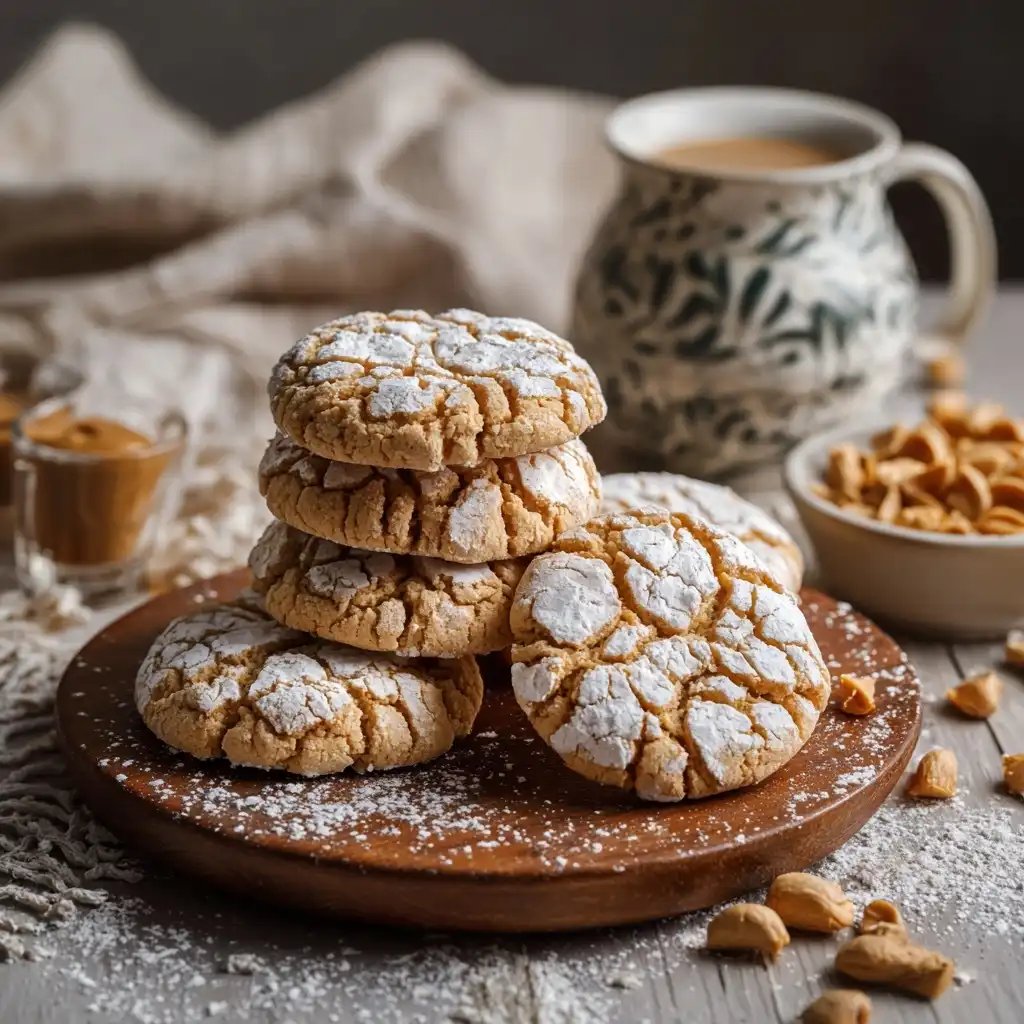
Peanut Butter Crinkle Cookies are a beloved classic—soft, chewy, richly nutty, and irresistibly festive with their signature cracked, sugar-dusted surface. These cookies strike the perfect balance between deep peanut butter flavor and delicate sweetness, with a tender crumb that gives way to a slightly crisp edge and a melt-in-your-mouth center. Whether served at holiday cookie exchanges, packed in lunchboxes, or enjoyed with a tall glass of cold milk on a quiet afternoon, Peanut Butter Crinkle Cookies evoke nostalgia, comfort, and pure indulgence. Their dramatic visual appeal—the snowy powdered sugar coating contrasted against deep amber cracks—makes them as photogenic as they are delicious, cementing their status as a staple in American home baking.
The History
The origins of the crinkle cookie trace back to mid-20th-century America, when home bakers began experimenting with dense, high-fat doughs that expanded dramatically during baking—creating the iconic “cracked” appearance as the surface dried and split under heat. While chocolate crinkles (often made with cocoa and rolled in powdered sugar) gained early popularity in the 1940s and ’50s, peanut butter versions emerged shortly thereafter, riding the wave of peanut butter’s meteoric rise as an affordable, protein-rich pantry staple during and after World War II. Recipes appeared in community cookbooks, women’s magazines like Good Housekeeping and Ladies’ Home Journal, and notably in the 1963 edition of the Betty Crocker Picture Cookbook, which helped standardize technique and ingredient ratios. The crinkle’s structural magic lies in its high ratio of sugar and fat to flour, minimal leavening, and the critical step of rolling chilled dough balls in confectioners’ sugar before baking—creating a dry, brittle shell that fractures as the interior rises and sets. Over decades, regional adaptations surfaced—from Southern versions enriched with molasses or bourbon to Midwestern takes featuring local honey-roasted peanuts—and today, the peanut butter crinkle remains a proudly unpretentious, time-tested favorite passed down through generations, often bearing handwritten notes, stained recipe cards, and stories of childhood kitchens filled with warm, nutty aromas.
Ingredients Breakdown
Every ingredient in Peanut Butter Crinkle Cookies plays a precise functional and flavor role—no component is merely filler. Understanding these roles empowers bakers to troubleshoot, substitute thoughtfully, and elevate results:
- Peanut Butter (1 cup, smooth & creamy): The soul of the cookie. Must be 100% natural (just peanuts + salt) or a trusted shelf-stable brand with no added hydrogenated oils or excessive sugars. Natural peanut butter yields superior depth and oil separation that enhances chewiness—but requires thorough stirring prior to measuring. Avoid “no-stir” varieties with stabilizers, as they produce drier, denser cookies with less spread and diminished crack formation.
- Granulated Sugar (1 cup): Provides sweetness, tenderness, and structure. Its fine crystals dissolve easily into the batter, aiding in creaming and contributing to crisp edges and caramelized notes during baking.
- Brown Sugar (½ cup, firmly packed light or dark): Adds moisture, chewiness, and nuanced molasses-inspired complexity. Dark brown sugar intensifies richness and imparts a subtle toffee-like aroma; light brown offers milder warmth. The molasses content also boosts acidity, helping activate baking soda for optimal lift.
- Large Eggs (2, room temperature): Act as emulsifiers and binders while adding moisture and structure. Room-temperature eggs incorporate more evenly, preventing curdling and ensuring a homogenous, velvety dough. One egg provides richness; the second ensures proper volume and resilience during baking.
- Vanilla Extract (2 tsp, pure): Enhances and rounds out peanut butter’s earthy notes without overpowering. Imitation vanilla lacks aromatic complexity and can leave a flat, chemical aftertaste—especially critical in a minimally spiced cookie where flavor purity matters.
- All-Purpose Flour (1¼ cups, spooned & leveled): The structural backbone. Too much flour leads to tough, cakey cookies that resist cracking; too little causes excessive spreading and loss of shape. Always measure by spooning flour into the measuring cup and leveling with a knife—never scoop directly from the bag, which compacts flour and adds up to 25% excess.
- Baking Soda (1 tsp, fresh & clump-free): The primary leavener. Reacts with the acid in brown sugar and natural peanut butter to generate carbon dioxide bubbles—essential for the gentle rise that creates tension in the sugar shell, resulting in those signature fissures. Replace every 6 months for peak potency.
- Ground Cinnamon (½ tsp, optional but highly recommended): A quiet powerhouse. Complements peanut butter’s warmth, adds aromatic dimension, and subtly balances sweetness without tasting “spicy.” Freshly ground cinnamon offers far more volatile oils and brightness than pre-ground supermarket varieties.
- Salt (½ tsp, fine sea or kosher): Not just for seasoning—salt sharpens flavor perception, suppresses bitterness, and strengthens gluten development just enough to support the cookie’s tender-yet-cohesive texture.
- Confectioners’ Sugar (1½ cups, for rolling): Non-negotiable for authentic crinkles. Its ultra-fine particles adhere smoothly to damp dough, forming a delicate, hygroscopic crust that dries rapidly in the oven’s heat—then cracks as the interior expands. Never substitute granulated or superfine sugar; they won’t create the same brittle shell or snowy finish. Sift before use to eliminate lumps that cause uneven coating.
Optional enhancements include a pinch of cayenne (for sweet-heat contrast), ¼ tsp almond extract (to accentuate nuttiness), or ½ cup chopped roasted peanuts (for textural crunch—add after mixing wet and dry ingredients).
Step-by-Step Recipe
- Prep & Chill Equipment: Place your mixing bowls, whisk, spatula, and baking sheets in the refrigerator for 15 minutes. Cold tools prevent premature softening of the butter-rich dough and support uniform chilling later.
- Whisk Dry Ingredients: In a medium bowl, thoroughly whisk together flour, baking soda, cinnamon, and salt. Sift if any lumps remain. Set aside.
- Cream Wet Ingredients: In a large bowl, beat peanut butter, granulated sugar, and brown sugar with an electric mixer on medium speed for 2–3 minutes until fluffy and pale—scraping the bowl twice. Add eggs one at a time, beating 30 seconds after each, then stir in vanilla until fully incorporated. Mixture should be glossy and homogeneous—not grainy or separated.
- Combine Gradually: Reduce mixer to low. Add dry ingredients in three equal additions, mixing only until *just* combined after each. Overmixing develops gluten and causes toughness. Use a flexible spatula for final folds to ensure no flour pockets remain at the bottom.
- Chill Dough (Non-Negotiable Step): Cover bowl tightly with plastic wrap and refrigerate for *minimum 2 hours*, ideally 4–6 hours or overnight. Chilling solidifies fats, prevents overspreading, allows flavors to meld, and crucially—enables the dough to hold its shape when rolled and develop maximum surface tension for cracking.
- Preheat & Prep: Position oven racks in upper and lower thirds. Preheat to 350°F (177°C). Line two heavy-duty baking sheets with parchment paper—*not* silicone mats (they inhibit crack formation) or greased surfaces (causes sticking and uneven browning).
- Portion & Roll: Scoop chilled dough using a 1.5-tablespoon cookie scoop (≈20g per ball). Roll *gently* between palms into smooth spheres—do not overwork. Pour confectioners’ sugar into a shallow dish. Roll each ball thoroughly until fully coated and opaque white. Shake off excess gently—don’t pat.
- Arrange Strategically: Place coated dough balls 3 inches apart on prepared sheets. They will spread significantly. For even baking, stagger placement rather than aligning in rows.
- Bake with Precision: Bake 10–12 minutes—set timer for 10 and check. Cookies are done when edges are lightly golden and set, centers look *slightly underbaked* (soft and puffed), and the surface displays a network of deep, irregular cracks radiating from the center. Rotate sheets top-to-bottom and front-to-back halfway through for even heat distribution.
- Cool Completely: Let cookies rest on baking sheets for 5 minutes—this allows structure to set. Then carefully transfer with a thin spatula to wire racks. Cool *fully* (at least 30 minutes) before storing or serving. Warm cookies are fragile and lack their signature chew.
Tips
- Temperature Is Everything: All ingredients—especially peanut butter and eggs—must be at true room temperature (68–72°F) before mixing. Cold ingredients cause seizing, poor emulsification, and dense texture. If rushed, warm eggs in warm water for 5 minutes; let natural peanut butter sit out 30+ minutes and stir vigorously before measuring.
- Chill Twice for Perfection: After initial chilling, roll dough balls, place on parchment-lined sheet, and freeze for 15 minutes before coating in powdered sugar. This extra firmness prevents smudging and ensures clean, sharp cracks.
- Measure Peanut Butter Correctly: Use the “water displacement” method: fill a liquid measuring cup with ½ cup water, add peanut butter until water level reaches 1 cup mark, then pour off water. Or pack firmly into a dry measuring cup and level.
- Don’t Skip the Sift: Confectioners’ sugar clumps easily. Sifting *after* measuring ensures flawless coating and prevents gritty patches or bare spots on baked cookies.
- Oven Thermometer Required: Most home ovens run hot or cold. An inexpensive oven thermometer verifies true temperature—critical since even 25°F variance alters spread, set time, and crack development.
- Rotate & Monitor Relentlessly: Ovens have hot spots. Rotating sheets ensures uniform browning. Watch closely during final 2 minutes—cookies go from perfect to overbaked in 60 seconds.
- Cooling Surface Matters: Wire racks allow airflow underneath, preventing steam buildup that makes bottoms soggy. Never cool on towels or plates.
- Revive Stale Cookies: Place hardened cookies on a parchment-lined sheet and bake at 300°F for 3–4 minutes—they’ll regain softness and aroma.
- Freeze Like a Pro: Portion, roll in powdered sugar, and freeze unbaked dough balls on a tray for 2 hours. Transfer to freezer bags for up to 3 months. Bake straight from frozen—add 1–2 minutes to bake time.
- Consistency Check: Ideal dough should be slightly tacky but hold its shape when rolled—like cold playdough. If too sticky, chill longer. If crumbly, add ½ tsp milk or beaten egg white.
Variations and Customizations
While classic peanut butter crinkles are sublime, creative adaptations keep them exciting across seasons and dietary needs:
- Chocolate-Peanut Butter Swirl: After rolling in powdered sugar, press a small disc of dark chocolate (70%) or a Hershey’s Kiss into the center of each ball before baking. Melts into a gooey core.
- Honey-Roasted Crunch: Fold in ⅔ cup roughly chopped honey-roasted peanuts *after* mixing wet and dry ingredients. Adds caramelized notes and irresistible texture contrast.
- Flourless Vegan Version: Replace flour with ¾ cup oat flour + ¼ cup almond flour; use flax eggs (2 tbsp ground flax + 6 tbsp water, rested 10 min); choose certified vegan peanut butter (no honey or dairy derivatives); and ensure powdered sugar is bone-char free. Chill 8+ hours for best cohesion.
- Gluten-Free Adaptation: Substitute 1:1 gluten-free all-purpose flour blend (with xanthan gum included, e.g., King Arthur or Bob’s Red Mill). Add ¼ tsp xanthan gum if blend doesn’t contain it. Increase chill time to 6 hours.
- Protein-Packed Boost: Add 2 scoops (¼ cup) unflavored or vanilla whey or plant-based protein powder. Reduce flour by 2 tbsp to compensate. Expect slightly drier texture—add 1 tbsp milk if needed.
- Spiced Chai Crinkles: Replace cinnamon with 1 tsp chai spice blend (cinnamon, ginger, cardamom, cloves, black pepper) and add 1 tbsp strong brewed chai tea, cooled, to wet ingredients.
- Maple-Bacon Crunch: Stir in ½ cup finely chopped, cooked, and cooled maple-glazed bacon. Use maple extract instead of vanilla and reduce brown sugar by 1 tbsp.
- Mini Crinkles: Use a 1-teaspoon scoop. Bake 7–8 minutes. Perfect for parties, gift tins, or portion control.
- Stuffed Surprise: Flatten dough balls, place ¼ tsp jam (raspberry or apple butter) or Nutella in center, seal, and roll. Coat generously in powdered sugar.
- Sea Salt Finish: Immediately after removing from oven, sprinkle each cookie with a tiny flake of Maldon sea salt for gourmet contrast.
Health Considerations and Nutritional Value
A single standard Peanut Butter Crinkle Cookie (approx. 28g, based on a 24-cookie yield) contains roughly:
- Calories: 135–150 kcal
- Total Fat: 7–8g (mostly unsaturated from peanuts; 1.5g saturated)
- Carbohydrates: 16–18g (including 10–12g sugars—primarily from added granulated and brown sugars)
- Protein: 3–4g (a meaningful plant-based contribution from peanuts)
- Fiber: 0.8–1.2g (modest, but increases with whole wheat or oat flour substitutions)
- Sodium: 95–120mg (largely from peanut butter and added salt)
Nutritional Highlights: Peanut butter delivers heart-healthy monounsaturated fats, vitamin E (a potent antioxidant), magnesium (supports muscle and nerve function), and resveratrol (linked to anti-inflammatory benefits). The moderate protein content promotes satiety, making these cookies more sustaining than many refined-sugar counterparts.
Considerations for Balanced Enjoyment:
- Sugar Awareness: The double sugar presence (granulated + brown) and powdered sugar coating contribute significantly to total sugar. For reduced-sugar versions, replace half the granulated sugar with coconut sugar (lower glycemic index) or use a monk fruit–erythritol blend (1:1 substitute), though texture may be slightly drier.
- Fat Quality: Choose natural peanut butter with zero added oils or sugars to avoid unnecessary saturated fats and empty calories. Avoid palm oil–based brands, which add environmentally problematic saturated fat.
- Portion Mindfulness: Their rich density means satisfaction comes quickly—savor one or two slowly rather than eating multiple. Pair with Greek yogurt or a piece of fruit to balance macros.
- Dietary Modifications: Gluten-free, vegan, and lower-sugar options make crinkles accessible to many. However, those managing diabetes should monitor portions and consider fiber-boosting tweaks (e.g., adding ground flaxseed or oat bran).
- Allergen Note: Peanuts are a top-8 allergen. Always label clearly when sharing, and avoid cross-contact in kitchens serving allergic individuals.
Ultimately, Peanut Butter Crinkle Cookies belong to the category of mindful indulgence—nutrient-enhanced treats best enjoyed intentionally, in moderation, and with appreciation for real-food ingredients.
Ingredients
- 1 cup (250g) smooth, natural peanut butter (no added sugar or hydrogenated oils)
- 1 cup (200g) granulated sugar
- ½ cup (100g) packed light or dark brown sugar
- 2 large eggs, room temperature
- 2 teaspoons pure vanilla extract
- 1¼ cups (160g) all-purpose flour, spooned & leveled
- 1 teaspoon baking soda
- ½ teaspoon ground cinnamon
- ½ teaspoon fine sea salt
- 1½ cups (180g) confectioners’ sugar, sifted (for rolling)
Directions
- In a medium bowl, whisk together flour, baking soda, cinnamon, and salt. Set aside.
- In a large bowl, using an electric mixer on medium speed, beat peanut butter, granulated sugar, and brown sugar until light, fluffy, and pale—about 2–3 minutes, scraping bowl twice. Add eggs one at a time, beating 30 seconds after each addition. Beat in vanilla until smooth and well combined.
- Reduce mixer to low speed. Gradually add dry ingredients in three additions, mixing only until no streaks of flour remain—do not overmix. Finish with a spatula to ensure uniformity.
- Cover bowl tightly with plastic wrap and refrigerate for at least 2 hours, or up to 72 hours.
- When ready to bake, preheat oven to 350°F (177°C). Line two large baking sheets with parchment paper.
- Scoop chilled dough using a 1.5-tablespoon cookie scoop (≈20g). Roll gently into smooth balls. Place sifted confectioners’ sugar in a shallow dish. Roll each ball thoroughly until completely coated in sugar, shaking off excess.
- Place coated balls 3 inches apart on prepared sheets. Bake 10–12 minutes, rotating sheets halfway through, until edges are set and golden and tops are deeply cracked.
- Let cookies cool on baking sheets for 5 minutes, then transfer to wire racks to cool completely—minimum 30 minutes—before serving or storing.
FAQ
- Why didn’t my cookies crack?
- Most common causes: dough wasn’t chilled long enough (needs ≥2 hrs), confectioners’ sugar wasn’t sifted (lumps prevent even coating), oven too cool (preheat fully and verify temp), or dough balls were under-rolled (incomplete sugar coverage). Also ensure you’re using baking soda—not powder—and that it’s fresh.
- Can I use crunchy peanut butter?
- Yes—but expect less uniform cracks and a grittier texture. Stir well to distribute nuts evenly, and chill dough an extra 30 minutes to prevent chunk migration during rolling.
- My cookies spread too much and turned into puddles.
- Over-creaming (incorporated too much air), insufficient chilling, warm baking sheets, or too much granulated sugar relative to flour. Next time, chill dough longer, use cool sheets, and double-check flour measurement.
- Can I make these ahead for holidays?
- Absolutely. Baked cookies stay fresh in an airtight container at room temperature for 1 week, or freeze for up to 3 months. Unbaked, powdered-sugar-coated dough balls freeze beautifully for 3 months—bake from frozen, adding 1–2 minutes.
- Why do my cookies puff up then collapse?
- This signals over-leavening—likely expired baking soda or too much used. Also occurs if dough is too warm entering the oven. Always use exact 1 tsp and verify freshness.
- Can I substitute oil or butter for peanut butter?
- No—peanut butter is irreplaceable here. Its unique fat-protein-starch matrix provides structure, flavor, and moisture that oils or butter cannot replicate. Substitutions will result in greasy, flat, or cakey failures.
- How do I get whiter cracks?
- Use extra confectioners’ sugar—roll twice: first coat, wait 30 seconds for slight tack, then roll again. Also, avoid opening the oven door before 9 minutes—steam release disrupts surface setting.
- Are these safe for peanut-allergic individuals?
- No. These contain concentrated peanut protein and pose severe risk. Do not attempt substitutions with other nut butters unless verified safe for the individual’s specific allergy profile.
- Can I add chocolate chips?
- Yes—but limit to ½ cup mini chips to avoid weighing down dough and inhibiting crack formation. Fold in gently at the end, after combining wet and dry.
- What’s the best way to store to keep them soft?
- Store cooled cookies in an airtight container with a slice of plain white bread. The cookies will absorb moisture from the bread, staying soft for days. Replace bread slice every 2 days.
Summary
Peanut Butter Crinkle Cookies are a masterclass in simple, science-backed baking—where natural peanut butter, precise sugar ratios, strategic chilling, and powdered sugar’s transformative crust converge to create soft, deeply flavorful cookies crowned with elegant, rustic cracks. They honor tradition while inviting endless creativity, offering both nostalgic comfort and modern adaptability for diverse dietary needs and tastes.
Beyond the kitchen, they represent generosity, warmth, and the quiet joy of shared sweetness—whether gifted in hand-decorated tins, served alongside steaming coffee on a snowy morning, or baked side-by-side with a child whose hands are dusted just as white as the cookies themselves.