Introduction
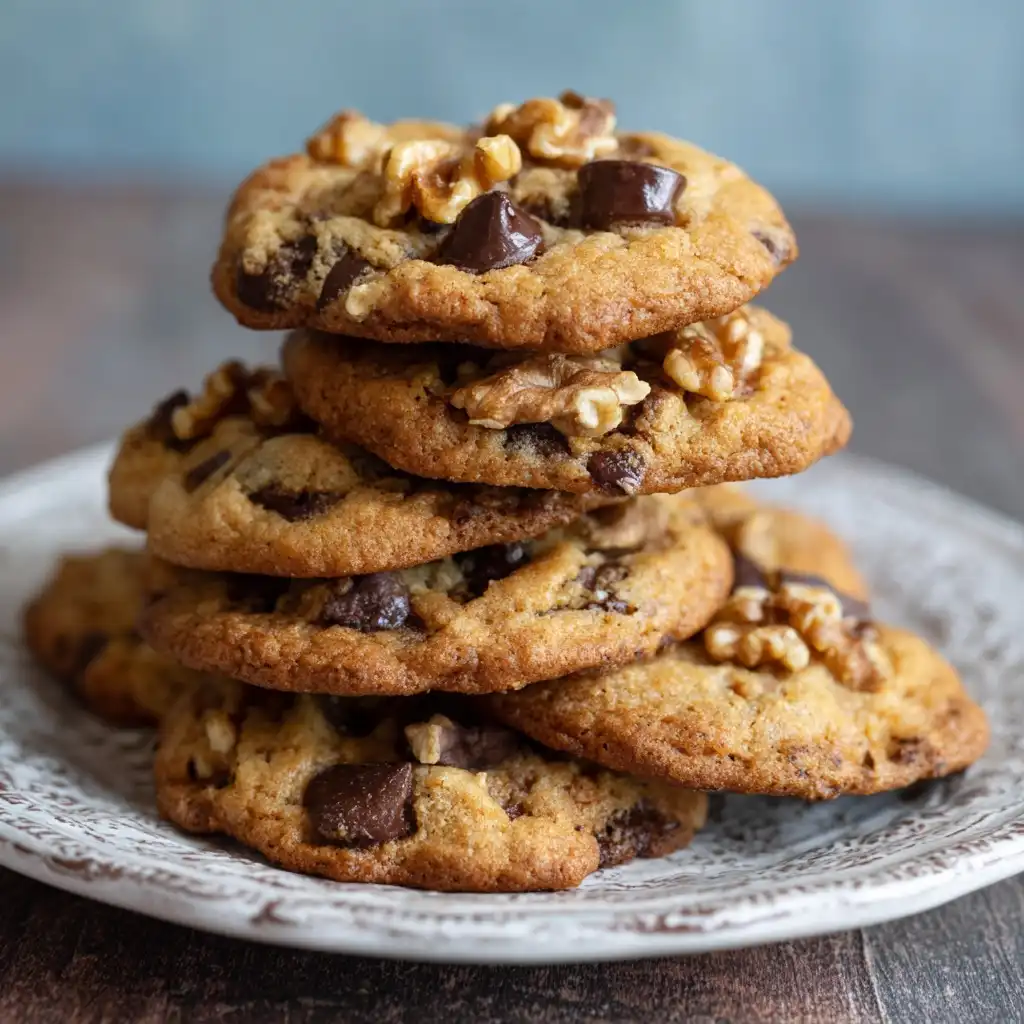
Chocolate Chip Walnut Cookies are the quintessential American comfort treat—warm, chewy, richly textured, and irresistibly nostalgic. More than just a dessert, they represent home-baked warmth, childhood afternoons, and the simple joy of combining pantry staples into something extraordinary. Unlike standard chocolate chip cookies, the addition of toasted walnuts introduces a deeply earthy, slightly bitter contrast that balances the sweetness of brown sugar and the creamy richness of melted chocolate—creating a multidimensional flavor profile that satisfies both texture and taste cravings. Whether served alongside a glass of cold milk, packed in lunchboxes, gifted in festive tins, or enjoyed straight from the cooling rack with fingers dusted in flour, these cookies evoke timeless tradition while remaining endlessly adaptable to modern tastes, dietary preferences, and seasonal creativity.
The History
The origins of the chocolate chip cookie trace back to 1938, when Ruth Wakefield—chef, innkeeper, and visionary—accidentally invented the now-iconic Toll House Cookie at the Toll House Inn in Whitman, Massachusetts. While preparing her popular Butter Drop Do cookies, Wakefield substituted broken pieces of Nestlé’s semi-sweet chocolate bar for baker’s chocolate, expecting the morsels to melt and disperse evenly. To her surprise—and the delight of generations to come—the chips held their shape, creating pockets of molten, bittersweet luxury within a tender, golden-brown cookie. The recipe was published in her 1938 cookbook Toll House Tried and True Recipes, and Nestlé soon struck a landmark deal: printing the recipe on its chocolate bar wrappers in exchange for exclusive rights to promote the “Toll House Chocolate Crunch Cookie.”
Walnuts entered the classic formula shortly thereafter—not as an afterthought, but as a deliberate enhancement. In the 1940s and ’50s, walnuts were widely available, affordable, and prized for their nutritional density and robust flavor. Home bakers began folding them in to add crunch, depth, and a subtle tannic nuance that cut through sweetness. By the 1960s, walnut-studded chocolate chip cookies appeared in regional cookbooks, church fundraisers, and women’s magazines across the Midwest and Pacific Northwest—regions where English walnuts were commercially cultivated. Over time, the Chocolate Chip Walnut variation evolved beyond mere substitution; it became a benchmark for “gourmet” home baking—signaling care, intentionality, and culinary confidence. Today, it remains one of the most frequently requested cookies in bakeries, cafes, and food blogs worldwide—a testament to its enduring balance of simplicity and sophistication.
Ingredients Breakdown
Every exceptional Chocolate Chip Walnut Cookie begins with purposeful, high-quality ingredients—each playing a precise functional and sensory role:
- All-Purpose Flour (2 ¼ cups): Provides essential gluten structure. Not too strong (like bread flour) nor too weak (like cake flour), it delivers the ideal blend of chew and tenderness. Sifting or whisking before measuring prevents compaction and ensures accurate volume.
- Baking Soda (1 tsp): A fast-acting leavening agent that reacts immediately with acidic components (brown sugar’s molasses, yogurt if used, or even natural cocoa notes)—promoting spread, lift, and golden-brown caramelization via the Maillard reaction.
- Unsalted Butter (1 cup / 2 sticks, room temperature): Room-temp butter creams smoothly with sugars, trapping air for lightness. Its water content turns to steam during baking, aiding rise, while its fat coats flour proteins to limit gluten formation—ensuring softness. Unsalted allows full control over sodium levels.
- Granulated Sugar (¾ cup): Adds sweetness, aids in crispness at the edges, and contributes to structural stability by inhibiting gluten development. Its fine crystals dissolve easily during creaming.
- Packed Light Brown Sugar (1 cup): The soul of the cookie’s moisture and chew. Molasses lends acidity (activating baking soda), deep caramel notes, hygroscopic properties (retaining moisture for days), and a rich amber hue. Dark brown sugar intensifies flavor but may darken cookies excessively.
- Large Eggs (2, room temperature): Bind ingredients, add richness and emulsification, and contribute to structure via coagulation. Room-temp eggs incorporate more uniformly and reduce batter separation.
- Pure Vanilla Extract (2 tsp): Not optional—it amplifies all other flavors and adds aromatic complexity. Imitation vanilla lacks depth and can taste medicinal under heat.
- Semi-Sweet Chocolate Chips (2 cups): Preferably high-cocoa (52–60%) chips or chopped chocolate bars with stable temper. Avoid “baking chips” loaded with waxes—they resist melting and yield dull texture. Guittard, Ghirardelli, Callebaut, or Valrhona are excellent choices.
- Toasted Walnuts (1 ½ cups, coarsely chopped): Toasting is non-negotiable: 350°F for 8–10 minutes until fragrant and lightly golden unlocks oils, deepens nuttiness, and eliminates raw bitterness. Cool completely before folding in to prevent melting chocolate. English walnuts are traditional; black walnuts offer bold terroir but are polarizing; pecans make a seamless swap.
- Flaky Sea Salt (½ tsp, plus extra for finishing): Balances sweetness, enhances chocolate’s fruitiness, and elevates walnut’s earthiness. Maldon or Jacobsen salt dissolves gently on the surface without grittiness.
Note on Additions: A pinch of cinnamon (¼ tsp) or espresso powder (1 tsp) can deepen complexity without altering identity. A tablespoon of corn syrup or honey boosts chew and shelf life—but adjust liquids accordingly.
Step-by-Step Recipe
- Prep & Toast: Preheat oven to 375°F (190°C). Line two large baking sheets with parchment paper or silicone baking mats. Spread walnuts evenly on a dry baking sheet and toast for 8–10 minutes, stirring once halfway, until fragrant and lightly golden. Let cool completely on a wire rack—this prevents premature chocolate melting and oil bleeding.
- Whisk Dry Ingredients: In a medium bowl, whisk together flour, baking soda, and flaky sea salt. Set aside.
- Cream Butter & Sugars: In a large stand mixer fitted with the paddle attachment (or using a hand mixer), beat room-temperature butter, granulated sugar, and brown sugar on medium-high speed for 3–4 minutes—until pale, fluffy, and nearly doubled in volume. Scrape down the bowl thoroughly.
- Add Eggs & Vanilla: Add eggs one at a time, beating well after each (about 30 seconds per egg) until fully incorporated and glossy. Add vanilla and mix for another 15 seconds. Batter should be smooth, not curdled.
- Incorporate Dry Mixture: Reduce mixer speed to low. Gradually add the flour mixture in three additions, mixing only until *just* combined after each. Overmixing develops gluten → tough cookies. Use a flexible spatula for final folds to ensure no dry pockets remain.
- Fold in Mix-Ins: Gently fold in cooled walnuts and chocolate chips using a wide spatula—about 15–20 strokes. Stop when evenly distributed but still visibly chunky. Do not overfold.
- Chill the Dough (Critical Step): Cover dough tightly and refrigerate for *at least 1 hour*, preferably 2–3 hours or up to 72 hours. Chilling solidifies butter, slows spread, concentrates flavors, improves texture (chewier centers, crisper edges), and deepens caramel notes. For best results, portion dough *before* chilling: scoop ~3 tbsp (45g) balls onto parchment, then chill.
- Bake Strategically: Arrange chilled dough balls 3 inches apart on prepared sheets (no more than 12 per standard half-sheet). Bake one sheet at a time in center rack for 11–13 minutes—until edges are deeply golden and set, centers look soft and slightly puffed, and surface appears faintly crackled. Rotate sheet halfway through for even browning.
- Cool with Patience: Remove from oven and let cookies rest on baking sheet for 5 minutes—this allows structure to set. Then, carefully transfer to wire racks to cool completely (15–20 minutes). They’ll continue to firm up as they cool. Resist biting early—they’re molten inside!
Tips
- Measure Flour Correctly: Use the “spoon-and-level” method—fluff flour in bag, spoon into measuring cup, then level with a straight edge. Scooping directly packs flour and yields dense, dry cookies.
- Butter Temperature Matters: Too cold → won’t cream properly. Too warm → greasy, flat cookies. Ideal temp: 65–68°F—slightly cool to touch, leaves clean indentation when pressed.
- Toast Nuts in Bulk: Make double batches of toasted walnuts and store airtight in freezer for up to 3 months—ready for instant baking.
- Chill Dough Overnight: Extended chilling (12–24 hrs) produces deeper flavor, better browning, and superior texture. Dough freezes beautifully for up to 3 months—bake frozen, adding 1–2 minutes.
- Rotate & Position Sheets: Always bake one sheet at a time in center rack. Convection ovens? Reduce temp by 25°F and check 1–2 minutes earlier.
- Underbake Slightly: Pull cookies out when centers look soft and underdone—they’ll finish cooking on the hot sheet. Overbaking = crunchy, brittle, flavorless discs.
- Use an Ice Cream Scoop: A #20 or #24 spring-loaded scoop ensures uniform size, even baking, and professional appearance.
- Rest Dough Between Batches: If baking multiple sheets, return dough to fridge for 10 minutes between batches to maintain chill.
- Don’t Skip the Salt Finish: A tiny flake of sea salt on each warm cookie right after baking creates a stunning sweet-salty contrast and elevates every bite.
- Cool on Racks, Not Towels: Wire racks allow airflow underneath—preventing steam buildup and soggy bottoms.
Variations and Customizations
These cookies are a canvas—not a constraint. Here’s how to reimagine them thoughtfully:
Dietary Adaptations
- Gluten-Free: Substitute 1:1 gluten-free flour blend (Bob’s Red Mill or King Arthur) + ½ tsp xanthan gum. Add 1 tbsp ground flaxseed + 2 tbsp water per egg to boost binding.
- Vegan: Replace butter with vegan stick butter (Miyoko’s or Earth Balance); eggs with flax eggs (2 tbsp ground flax + 5 tbsp water, rested 10 min); use dairy-free chocolate and certified vegan walnuts.
- Lower-Sugar: Reduce granulated sugar to ½ cup and brown sugar to ¾ cup; add 2 tbsp unsweetened applesauce for moisture. Consider monk fruit–erythritol blend (½ cup) + ¼ cup brown sugar for bulk and flavor.
Flavor & Texture Twists
- Espresso-Dark Chocolate: Add 1 tsp instant espresso powder to dry ingredients; swap semi-sweet chips for 70% dark chocolate chunks and add ¼ tsp cinnamon.
- Honey-Oat Walnut: Replace ¼ cup brown sugar with local raw honey; stir in 1 cup old-fashioned oats with dry ingredients for hearty chew.
- Bourbon-Caramel Swirl: Fold in ½ cup thick homemade bourbon caramel sauce (cooled) along with chips and nuts for gooey ribbons.
- Maple-Pecan: Substitute pure maple syrup for ¼ cup brown sugar; use toasted pecans instead of walnuts; add ¼ tsp maple extract.
- Orange-Zested White Chocolate: Add 1 tbsp finely grated orange zest + 1 tsp orange extract; replace semi-sweet with high-quality white chocolate chips and toasted walnuts.
Seasonal & Festive Editions
- Pumpkin Spice Walnut: Add 1 tsp pumpkin pie spice + 2 tbsp canned pumpkin purée (reduce butter by 1 tbsp); top with candied walnuts.
- Peppermint Crunch: Fold in ½ cup crushed candy canes + 1 tsp peppermint extract; use dark chocolate and walnuts.
- Cherry-Almond: Swap walnuts for toasted sliced almonds; fold in ½ cup dried tart cherries (soaked in kirsch); add ¼ tsp almond extract.
- Gingerbread Spice: Add 1 tsp ginger, ½ tsp cloves, ½ tsp allspice; use dark chocolate and walnuts; press whole walnuts on top pre-bake.
Textural Upgrades
- Double-Chocolate: Replace ¼ cup flour with unsweetened cocoa powder; use dark chocolate and walnuts.
- Stuffed Cookies: Flatten dough balls, place 1 square of chocolate + 1 walnut half in center, seal tightly, then chill before baking.
- Crunchy-Edge, Fudgy-Center: Bake at 325°F for 16–18 minutes—low and slow yields dramatic contrast.
Health Considerations and Nutritional Value
A single standard Chocolate Chip Walnut Cookie (approx. 38g, ~1 cookie from this recipe) contains approximately:
- Calories: 195–210 kcal
- Total Fat: 11–13 g (mostly unsaturated from walnuts and butter)
- Saturated Fat: 5–6 g
- Cholesterol: 30–35 mg
- Sodium: 120–145 mg
- Total Carbohydrates: 22–24 g
- Dietary Fiber: 1.2–1.5 g (walnuts and whole grain options boost this)
- Sugars: 13–15 g (naturally occurring + added)
- Protein: 2.5–3 g
Nutritional Highlights:
Walnuts are among the richest plant sources of alpha-linolenic acid (ALA), an essential omega-3 fatty acid linked to cardiovascular and cognitive health. They also provide magnesium, copper, manganese, and polyphenolic antioxidants like ellagic acid. Dark chocolate contributes flavanols shown to support endothelial function and blood flow. Brown sugar offers trace minerals (calcium, potassium, iron) from molasses. While cookies are inherently energy-dense, mindful ingredient choices—reduced sugar, increased walnut ratio, whole grain flour substitutions, and portion control—can align them with balanced eating patterns.
Considerations: Those managing diabetes should monitor portion size and pair cookies with protein/fiber (e.g., Greek yogurt or apple slices) to moderate glucose response. Individuals with tree nut allergies must avoid walnuts entirely and substitute seeds (pumpkin, sunflower) with caution due to cross-reactivity risks. For lower saturated fat, consider replacing half the butter with avocado oil or walnut oil—but expect texture shifts.
Ultimately, these cookies belong in the category of *intentional indulgence*: nutrient-enhanced, made with real food, and enjoyed mindfully—not as daily staples, but as meaningful, joyful nourishment.
Ingredients
- 2 ¼ cups (280g) all-purpose flour, spooned & leveled
- 1 teaspoon baking soda
- ½ teaspoon flaky sea salt (plus extra for finishing)
- 1 cup (227g / 2 sticks) unsalted butter, room temperature
- ¾ cup (150g) granulated sugar
- 1 cup (200g) packed light brown sugar
- 2 large eggs, room temperature
- 2 teaspoons pure vanilla extract
- 2 cups (340g) semi-sweet chocolate chips or chopped chocolate (52–60% cocoa)
- 1 ½ cups (165g) toasted English walnuts, coarsely chopped
Directions
- Preheat oven to 375°F (190°C). Line two large baking sheets with parchment paper or silicone baking mats.
- Toast walnuts: Spread walnuts on a dry baking sheet. Bake for 8–10 minutes, stirring once, until fragrant and lightly golden. Cool completely on a wire rack—minimum 20 minutes.
- In a medium bowl, whisk together flour, baking soda, and ½ tsp sea salt. Set aside.
- In the bowl of a stand mixer fitted with paddle attachment, beat butter, granulated sugar, and brown sugar on medium-high for 3–4 minutes until pale, fluffy, and creamy. Scrape bowl thoroughly.
- Add eggs one at a time, beating 30 seconds after each until fully incorporated. Add vanilla; mix 15 seconds more.
- Reduce speed to low. Gradually add flour mixture in three parts, mixing only until no dry streaks remain—do not overmix. Use spatula for final fold.
- Gently fold in cooled walnuts and chocolate chips until evenly distributed—about 15–20 strokes.
- Cover dough tightly and refrigerate for minimum 1 hour, ideally 2–3 hours (or up to 72 hours). For efficiency, scoop 3-tbsp portions onto parchment before chilling.
- Arrange chilled dough balls 3 inches apart on prepared sheets (max 12 per sheet). Bake one sheet at a time in center rack for 11–13 minutes—until edges are golden and set, centers appear soft and puffed, and surface shows delicate cracks.
- Let cookies rest on baking sheet for 5 minutes. Transfer carefully to wire racks to cool completely (15–20 min). Sprinkle lightly with flaky sea salt while still warm.
- Store cooled cookies in airtight container at room temperature for up to 5 days, or freeze baked cookies for up to 3 months.
FAQ
- Can I use salted butter?
- Yes—but omit the added salt in the dry ingredients and reduce sea salt finish. Unsalted is preferred for precision.
- Why did my cookies spread too much?
- Likely causes: butter too warm, insufficient chilling, expired baking soda, or too little flour. Always chill dough ≥1 hour and verify leavener freshness.
- Can I make dough ahead and freeze it?
- Absolutely. Portion dough balls, freeze on parchment until solid (2 hrs), then transfer to freezer bag for up to 3 months. Bake frozen—add 1–2 minutes.
- What’s the best way to store baked cookies?
- In an airtight container at room temperature with a slice of plain white bread—its moisture keeps cookies soft for 4–5 days. Replace bread every 2 days.
- Can I substitute walnuts with other nuts?
- Yes! Pecans, almonds, hazelnuts, or macadamias all work beautifully. Toast them first. For nut-free, try roasted sunflower or pumpkin seeds.
- My cookies turned out cakey—what went wrong?
- Overcreaming butter/sugar, too much leavener, or excess flour (scooped vs. spooned). Also, using cake flour or adding too much egg.
- Can I make these dairy-free?
- Yes—with high-fat vegan butter (not margarine), flax eggs, and dairy-free chocolate. Ensure walnuts are processed in nut-only facilities if allergy-sensitive.
- How do I get that perfect chewy-center/crispy-edge texture?
- Chill dough thoroughly, underbake slightly (they’ll set on the sheet), and use more brown sugar than white. Also, avoid overmixing after adding flour.
- Can I add oats or coconut?
- Yes—add 1 cup old-fashioned oats with dry ingredients, or ½ cup unsweetened shredded coconut with walnuts. Adjust chill time if adding wet ingredients.
- Why do some recipes use melted butter and others use softened?
- Softened butter (this recipe) yields chewier, thicker cookies with better aeration. Melted butter creates thinner, crisper, more toffee-like cookies—choose based on desired outcome.
Summary
Chocolate Chip Walnut Cookies are a masterclass in balance—where the deep, toasted earthiness of walnuts harmonizes with the bittersweet melt of premium chocolate and the caramelized richness of brown sugar, all wrapped in a tender-yet-chewy, golden-edged base.
Rooted in mid-century ingenuity and elevated by intentional technique—proper toasting, precise creaming, strategic chilling, and mindful baking—these cookies transcend nostalgia to become a versatile, nourishing, and deeply satisfying expression of thoughtful home baking.