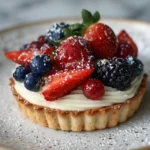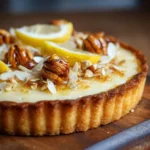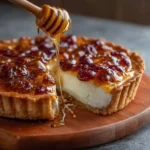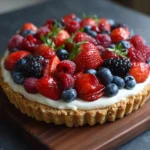
Introduction
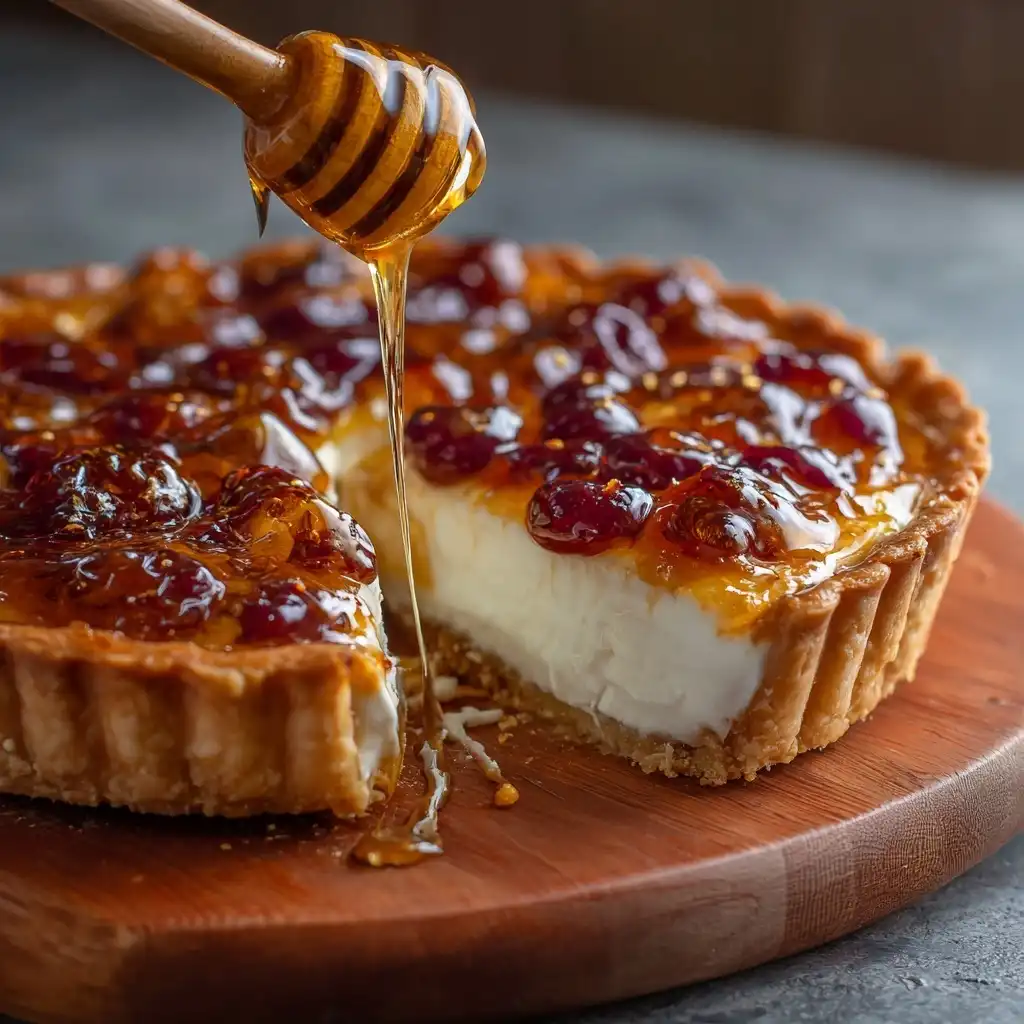
The Greek Yogurt Honey Tart is a modern, elegant dessert that masterfully bridges the richness of traditional European tarts with the clean, vibrant appeal of Mediterranean-inspired wellness cuisine. Unlike heavy custard-based tarts or overly sweet pastries, this creation celebrates simplicity, balance, and natural flavor—highlighting the creamy tang of strained yogurt, the floral depth of raw honey, and the buttery crispness of a delicate shortcrust. It’s as much a celebration of mindful indulgence as it is a showcase of culinary restraint: no artificial flavors, no refined sugar overload, no unnecessary complexity—just thoughtfully layered textures and harmonious contrasts. Whether served at a sun-drenched brunch, an intimate dinner party, or as a nourishing afternoon treat, this tart embodies the philosophy that desserts can be both deeply satisfying and inherently wholesome.
The History
While not rooted in ancient Greek manuscripts or Ottoman palace kitchens, the Greek Yogurt Honey Tart is a delicious product of 21st-century gastronomic evolution—a natural descendant of several culinary traditions converging over time. Its lineage traces back to classic French flan and Italian crostata, where dairy-based fillings meet tender pastry. However, its defining character emerges from the global rise of Greek yogurt beginning in the early 2000s, particularly after major U.S. and European brands popularized its thick, protein-rich profile as a health-conscious alternative to sour cream and cream cheese. Simultaneously, artisanal honey appreciation surged—driven by beekeeping revival movements, terroir-focused apiculture, and renewed interest in monofloral varietals like thyme, orange blossom, and wildflower honeys native to Greece and the broader Eastern Mediterranean. Chefs and home bakers alike began experimenting with yogurt’s versatility beyond breakfast bowls and marinades; its ability to mimic the body of crème fraîche while offering greater acidity and stability made it ideal for no-bake and low-heat set fillings. The first documented iterations appeared in food blogs around 2012–2014, often labeled “Honey-Yogurt Galette” or “No-Bake Yogurt Tart,” but it wasn’t until influential pastry chefs like Stéphanie Le Quellec (Paris) and Nikos Doulas (Athens) elevated the format—with laminated crusts, torched honey glazes, and edible flower garnishes—that the dessert coalesced into its current refined identity: a composed, restaurant-worthy tart that honors tradition without being bound by it.
Ingredients Breakdown
Every component of the Greek Yogurt Honey Tart serves both functional and sensory purpose—nothing is included merely for volume or convenience. Below is an in-depth exploration of each ingredient’s role, origin considerations, and substitution logic:
- Full-Fat Greek Yogurt (3 cups / 750g): The structural and flavor backbone. Must be strained, high-protein (minimum 10g per 170g serving), and unsweetened. Brands like Fage Total 5% or Chobani Whole Milk are ideal due to their dense curd structure and balanced lactic tang. Low-fat or non-fat versions lack sufficient fat to emulsify properly and often contain stabilizers (e.g., corn starch, gelatin) that interfere with texture. For authenticity, seek Greek-produced yogurts such as Granny’s Greek Yogurt (Lesvos) or Olympos (Thessaly), traditionally made from sheep or goat milk—offering deeper, gamier notes and superior mouthfeel.
- Raw, Unfiltered Honey (¾ cup / 255g): Not merely a sweetener—but the aromatic heart. Opt for single-origin, lightly warmed (never pasteurized above 40°C/104°F) honey. Thyme honey from Crete delivers earthy, herbal complexity; pine honey from the Peloponnese adds resinous depth and subtle bitterness that cuts through richness; acacia offers clean, mild sweetness ideal for beginners. Avoid clover or generic “wildflower” blends unless traceable—many commercial honeys are ultra-filtered, stripped of pollen and enzymes, and sometimes adulterated with corn syrup. Always taste your honey before using: it should bloom on the palate, not just hit the tongue with one-dimensional sweetness.
- Unsalted European-Style Butter (12 tbsp / 170g, cold): Used in both crust and filling enrichment. Choose high-fat (82–84% butterfat), cultured varieties like Échiré, Plugrá, or Kerrygold Pure Irish Butter. Their superior fat content yields flakier pastry and richer mouth-coating in the filling. Salted butter is discouraged—not only for sodium control, but because residual salt crystals can encourage gluten development in dough and destabilize yogurt emulsions.
- All-Purpose Flour (1¾ cups / 220g): Preferably organic, stone-ground, and unbleached. Bleached flour contains chlorine gas residues that dull flavor and weaken gluten network consistency. For enhanced nuttiness and fiber, substitute up to ¼ cup with toasted oat flour or spelt flour—but never exceed 30% whole-grain replacement, or the crust will harden upon chilling.
- Egg Yolks (4 large, room temperature): Act as dual-purpose emulsifiers and thermal thickeners. They bind water and fat molecules in the yogurt-honey mixture while providing gentle, silk-textured set during brief baking (or optional no-bake chilling). Using whole eggs introduces excess water and albumin proteins that may cause syneresis (weeping) or graininess. Always separate eggs carefully—any trace of white compromises emulsification.
- Vanilla Bean Paste (1½ tsp) or Seeds from 1 Whole Pod: Far superior to extract. The tiny black seeds provide visual elegance and vanillin compounds that synergize with honey’s floral esters. Madagascar Bourbon beans offer creamy, rum-like warmth; Tahitian beans lend cherry-anise top notes—ideal for summer variations with stone fruit.
- Fine Sea Salt (1 tsp + pinch for crust): Enhances all other flavors, suppresses bitterness, and balances acidity. Use flaky Maldon or moist Celtic grey salt—avoid iodized table salt, whose metallic aftertaste lingers.
- Heavy Cream (¼ cup / 60ml, cold): Added last to adjust viscosity and enrich without diluting tang. Must be 36–40% milk fat; lower-fat creams introduce excess water and destabilize the filling’s colloidal matrix.
- Optional Garnishes: Crushed toasted pistachios (for crunch and chlorophyll contrast), edible lavender buds (use sparingly—½ tsp max), lemon zest (microplaned, non-pithy), pomegranate arils (for jewel-toned acidity), or a drizzle of aged balsamic reduction (20-year Modena, reduced 5:1).
Step-by-Step Recipe
- Prepare the Sweet Shortcrust Pastry (Pâte Sucrée): In a food processor, pulse 1¼ cups (155g) flour, ¼ tsp salt, and ¼ cup (55g) confectioners’ sugar until combined. Add ½ cup (115g) cold cubed butter and pulse 12–15 times until mixture resembles coarse meal with pea-sized butter pieces. Add 1 large egg yolk and 2 tsp ice water; pulse just until dough begins to clump. Transfer to parchment, flatten into a 1-inch disc, wrap tightly, and chill ≥2 hours (preferably overnight). *Why?* Resting relaxes gluten, firms butter, and prevents shrinkage during blind baking.
- Roll & Blind-Bake the Crust: Preheat oven to 375°F (190°C) with rack in lower third. On lightly floured surface, roll dough to 12-inch circle, ⅛-inch thick. Fit gently into 10-inch fluted tart pan with removable bottom; trim excess, crimp edges. Prick base with fork. Line with parchment and pie weights (or dried beans). Bake 18 minutes. Remove weights/parchment; bake 10–12 more minutes until golden and dry. Cool completely on wire rack—minimum 45 minutes. *Critical step:* A fully cooled, crisp crust prevents sogginess and provides textural counterpoint.
- Make the Yogurt-Honey Filling: In stand mixer fitted with paddle attachment, beat remaining ½ cup (115g) cold butter on medium until creamy (~1 min). Reduce speed to low; gradually add honey in thin stream—do not rush, or mixture may “break.” Once fully incorporated, increase speed to medium-high and beat 3–4 minutes until pale, fluffy, and nearly doubled in volume. Scrape bowl. Add yogurt in three additions, beating 30 seconds after each—mixture will loosen slightly but remain cohesive. Beat in vanilla paste, salt, and egg yolks one at a time, fully incorporating each before next addition. Finally, drizzle in cold heavy cream while mixing on low—just until uniform. Do not overmix. *Science note:* This method creates a stable foam-emulsion—honey’s invert sugars and yogurt’s casein micelles trap air bubbles, yielding ethereal lightness despite density.
- Fill & Finish: Pour filling into cooled crust. Smooth surface with offset spatula. Optional: Gently tap pan on counter 3x to release air bubbles. For baked version: Reduce oven to 325°F (165°C); bake tart 22–25 minutes until edges are set but center jiggles slightly like Jell-O. For no-bake version: Refrigerate uncovered ≥8 hours (ideally overnight) until firm to touch and cleanly releases from pan sides. *Pro tip:* If surface develops slight skin during chilling, gently rewarm 1 tsp honey in microwave 5 sec, then brush thinly for glossy finish.
- Chill & Serve: Let baked tart cool on rack 1 hour, then refrigerate ≥4 hours before slicing. No-bake version must chill ≥8 hours. Run thin knife under hot water, wipe dry, and slice cleanly. Serve chilled—not cold—so flavors bloom. Garnish just before serving to preserve texture.
Tips
- Yogurt Temperature Matters: Always use yogurt straight from the fridge—even if butter is cold, yogurt must not be room temp. Warmed yogurt separates faster and loses its binding capacity.
- Honey Consistency Check: If honey is crystallized, gently warm jar in warm water bath (max 110°F / 43°C) for 10 minutes—never microwave, which degrades volatile aromatics and caramelizes fructose prematurely.
- Crust Protection Trick: Brush cooled, baked crust interior with melted white chocolate (1 oz) before adding filling. Creates impermeable barrier against moisture migration—especially crucial in humid climates or long-service settings.
- No-Weep Guarantee: Strain yogurt through cheesecloth-lined fine-mesh sieve over bowl for 30 minutes before using. Removes excess whey that causes puddling.
- Slicing Precision: Use a hot, thin-bladed knife (dip in near-boiling water, wipe dry between cuts) for flawless layers and minimal drag.
- Storage Wisdom: Keep covered with parchment (not plastic wrap, which traps condensation) in fridge up to 4 days. Freezing is not recommended—yogurt weeps severely upon thawing, and crust turns leathery.
- Altitude Adjustment: Above 3,000 ft: Reduce honey by 1 tbsp and add 1 tsp cornstarch to filling—prevents over-spreading and collapse.
Variations and Customizations
This tart is a canvas—not a dogma. Here are rigorously tested, chef-approved adaptations that preserve integrity while expanding expression:
- Lemon-Olive Oil Variation: Replace 2 tbsp honey with 2 tbsp high-quality arbequina olive oil and add 2 tsp finely grated Meyer lemon zest + 1 tbsp lemon juice. Swirl oil into filling at final stage for marbled effect. Pairs exquisitely with rosemary shortcrust.
- Roasted Fig & Black Pepper: Top chilled tart with 8–10 halved, roasted fresh figs (tossed in 1 tsp honey + cracked Tellicherry pepper). Adds jammy sweetness and spicy warmth.
- Matcha-Sesame: Whisk 1½ tsp ceremonial-grade matcha + 1 tbsp toasted white sesame paste into filling after egg yolks. Dust finished tart with black sesame seeds and yuzu zest.
- Vegan Adaptation: Use house-made cashew yogurt (soaked 8 hrs, blended with probiotic capsule, fermented 12 hrs), date paste + brown rice syrup (1:1 ratio) instead of honey, coconut oil (refined, for neutral taste) in crust, and flax “egg” (1 tbsp ground flax + 2.5 tbsp water). Requires 12-hour chill and benefits from ½ tsp agar powder bloomed in cream.
- Decadent Chocolate Ripple: Melt 3 oz 70% dark chocolate (cooled to 90°F); fold gently into ⅓ of filling. Layer marbled in crust for dramatic veining. Sprinkle with flaky sea salt pre-chill.
- Herbal Garden Tart: Infuse honey for 48 hrs with 2 tsp fresh thyme leaves or 1 tsp dried lavender (strain before use). Add 1 tbsp crumbled feta to crust dough for savory counterpoint.
- Breakfast Tart Format: Reduce honey to ⅓ cup, add 1 tsp ground cardamom + 2 tbsp granola to crust. Serve with fresh berries and dollop of labneh.
Health Considerations and Nutritional Value
A single generous slice (1/10 of tart) delivers approximately 320–360 calories, with nuanced nutritional advantages over conventional desserts:
- Protein Powerhouse: ~12–14g high-biological-value protein from Greek yogurt supports muscle synthesis and satiety—nearly triple that of standard custard tarts. Contains all nine essential amino acids, especially leucine for metabolic signaling.
- Prebiotic-Prebiotic Synergy: Raw honey contains oligosaccharides that feed beneficial gut bacteria (Bifidobacteria, Lactobacilli), while yogurt contributes live cultures (L. acidophilus, S. thermophilus)—creating a synbiotic effect unmatched in most bakery desserts.
- Low Glycemic Impact: With glycemic load of ~8 (vs. 22 for apple pie), this tart avoids blood sugar spikes thanks to yogurt’s protein/fat matrix slowing glucose absorption and honey’s balanced fructose-glucose ratio (≈40:60).
- Phytonutrient Density: Unfiltered honey offers polyphenols (quercetin, caffeic acid), enzymatic antioxidants (glucose oxidase), and trace minerals (zinc, selenium). Pairing with lemon zest or pistachios boosts vitamin C and gamma-tocopherol (vitamin E).
- Reduced Inflammatory Load: Absence of refined flour (using moderate AP + optional whole-grain), zero trans fats, no artificial emulsifiers, and inclusion of anti-inflammatory compounds (oleocanthal in olive oil variation, EGCG in matcha) make this dessert metabolically kinder than alternatives.
- Considerations: Not suitable for infants under 12 months (botulism risk from honey), strict vegans (due to honey and dairy), or those with lactose intolerance (though Greek yogurt contains <3g lactose per cup—most tolerate well). Those monitoring sodium should omit added salt in crust and rely on honey’s mineral profile alone.
Ingredients
- For the Sweet Shortcrust Pastry:
– 1¼ cups (155g) all-purpose flour, plus extra for dusting
– ¼ cup (30g) confectioners’ sugar
– ¼ tsp fine sea salt
– ½ cup (115g) cold unsalted European-style butter, cubed
– 1 large egg yolk
– 2 tsp ice water - For the Greek Yogurt-Honey Filling:
– 3 cups (750g) full-fat plain Greek yogurt, cold
– ¾ cup (255g) raw, unfiltered honey (thyme, pine, or orange blossom preferred)
– ½ cup (115g) cold unsalted European-style butter, cubed
– 4 large egg yolks, room temperature
– 1½ tsp vanilla bean paste or seeds from 1 whole pod
– 1 tsp fine sea salt
– ¼ cup (60ml) cold heavy cream (36–40% fat) - For Garnish (optional):
– ¼ cup shelled, unsalted pistachios, toasted and roughly chopped
– Edible flowers (violas, pansies, borage)
– Lemon or orange zest
– Drizzle of aged balsamic reduction
Directions
- In a food processor, combine 1¼ cups flour, confectioners’ sugar, and ¼ tsp salt. Pulse to blend. Add cold butter cubes and pulse 12–15 times until mixture resembles coarse crumbs with visible pea-sized butter pieces.
- Add egg yolk and ice water. Pulse just until dough begins to clump together when pinched. Turn out onto parchment paper, gather into a disc, wrap tightly, and refrigerate ≥2 hours or overnight.
- Preheat oven to 375°F (190°C). Roll chilled dough on floured surface to 12-inch circle, ⅛-inch thick. Carefully transfer to 10-inch fluted tart pan with removable bottom. Press in gently, trim excess, and crimp edges. Prick base with fork.
- Line crust with parchment and fill with pie weights or dried beans. Bake 18 minutes. Remove weights and parchment; bake 10–12 minutes more until golden and dry. Cool completely on wire rack—minimum 45 minutes.
- Reduce oven to 325°F (165°C) if baking filling. In stand mixer with paddle attachment, beat ½ cup cold butter on medium until creamy (~1 min).
- Reduce speed to low. Gradually add honey in thin, steady stream—do not rush. Once fully incorporated, increase speed to medium-high and beat 3–4 minutes until pale, fluffy, and nearly doubled.
- Reduce speed to low. Add yogurt in three additions, beating 30 seconds after each. Scrape bowl thoroughly.
- Beat in vanilla paste and 1 tsp salt. Add egg yolks one at a time, fully incorporating each before adding the next.
- With mixer on low, slowly drizzle in cold heavy cream. Mix only until uniform—do not overbeat.
- Pour filling into cooled crust. Smooth surface. Tap pan gently on counter 3 times.
- For baked version: Bake 22–25 minutes until edges are set and center jiggles slightly. Cool on rack 1 hour, then refrigerate ≥4 hours before serving.
- For no-bake version: Refrigerate uncovered ≥8 hours (overnight preferred) until firm to touch and cleanly releases from pan sides.
- Run thin knife under hot water, wipe dry, and slice cleanly. Garnish just before serving.
FAQ
- Can I use regular yogurt instead of Greek yogurt?
- No—regular yogurt contains too much whey and insufficient protein to hold structure. It will weep, split, and yield a runny, unstable filling. If Greek yogurt is unavailable, strain regular whole-milk yogurt through cheesecloth for 8–12 hours until thickened to Greek consistency (approx. 1 cup yields ½ cup strained).
- Why does my filling look curdled during mixing?
- Curdling usually results from temperature shock (warm honey + cold yogurt), overmixing after adding cream, or using low-fat yogurt with stabilizers. Always keep all dairy cold, add liquids gradually, and stop mixing once uniform. If minor separation occurs, gently fold with silicone spatula—do not re-beat.
- Can I make the crust gluten-free?
- Yes—with caveats. Use certified GF 1:1 blend containing xanthan gum (e.g., Bob’s Red Mill). Increase butter by 1 tbsp and chill dough 30 minutes longer. Pre-bake with weights 22 minutes—GF crust browns faster and dries quicker. Expect slightly more crumbly texture.
- My crust shrank dramatically—what went wrong?
- Most common causes: dough not chilled sufficiently before rolling/baking, overworking during rolling (develops gluten), stretching dough while fitting into pan (creates tension that contracts), or skipping the crimping step. Always chill dough ≥2 hours, roll gently from center outward, lift and settle—not pull—and crimp firmly.
- Can I prepare components ahead?
- Absolutely. Crust dough keeps refrigerated 3 days or frozen 3 months. Baked crust stays crisp 2 days at room temp in airtight container. Filling can be mixed and refrigerated (unbaked) up to 12 hours before pouring—stir gently before using. Fully assembled tart holds beautifully refrigerated 4 days.
- Is there a way to make it dairy-free without compromising texture?
- The closest approximation uses house-fermented cashew yogurt (blanched cashews + probiotic + 12-hr fermentation), coconut oil–based shortcrust, and date-sweetened honey alternative. Texture will be denser and less airy, but still luxuriously creamy when executed precisely. See Vegan Variation section for full method.
- Why does the recipe emphasize “European-style” butter?
- European butters have higher fat content (82–84% vs. 80% standard), lower moisture, and often undergo culturing—yielding richer flavor, better melting behavior, and superior lamination in crusts. Standard American butter may produce a greasier crust and less stable emulsion in filling.
Summary
The Greek Yogurt Honey Tart is a masterclass in minimalist luxury—where centuries-old techniques meet contemporary wellness sensibilities, and every ingredient is chosen for both its intrinsic excellence and its collaborative harmony with the others.
It rewards patience with profound flavor, honors seasonality through honey terroir and garnish choices, and proves that restraint, respect for quality, and understanding of food science are the true foundations of unforgettable dessert-making.