Introduction
Welcome to the ultimate indulgence—Peanut Butter Banana Cheesecake! This decadent dessert is a harmonious fusion of creamy, nutty richness and sweet, velvety banana flavor, all anchored by a luscious, no-bake or baked cheesecake base that delivers luxurious texture and depth. Whether you’re a seasoned baker or a curious beginner, this recipe bridges comfort food nostalgia with gourmet sophistication. It’s more than just a dessert—it’s a celebration of contrasts: the earthy saltiness of natural peanut butter against the bright sweetness of ripe bananas; the cool, smooth tang of cream cheese balanced by the gentle warmth of vanilla and a whisper of cinnamon; and the satisfying crunch of a graham cracker or chocolate wafer crust giving way to cloud-like filling. Perfect for potlucks, holiday gatherings, birthday celebrations, or even as a well-deserved self-care treat after a long week, Peanut Butter Banana Cheesecake satisfies cravings while inviting creativity, customization, and mindful enjoyment.
The History
The evolution of Peanut Butter Banana Cheesecake is a delicious case study in American culinary cross-pollination. While classic New York–style cheesecake traces its roots to ancient Greece and was refined in 19th-century Europe and early 20th-century America, the peanut butter–banana pairing emerged much later—gaining national prominence in the 1920s and ’30s with the rise of affordable, shelf-stable peanut butter (thanks to Joseph Rosefield’s hydrogenation process in 1922) and the expanding U.S. banana trade via companies like United Fruit Co. The iconic PB&J sandwich debuted around the same era, but it wasn’t until mid-century home economists and magazine editors began experimenting with “elevated” versions of pantry staples that peanut butter found its way into desserts beyond cookies and fudge.
Banana cream pie and banana pudding were already beloved mid-century classics, and cheesecake—once considered a restaurant-only luxury—began appearing in community cookbooks and women’s magazines like Good Housekeeping and Ladies’ Home Journal in the 1950s and ’60s. The first documented peanut butter cheesecake recipes appeared in regional Southern and Midwestern publications in the late 1970s, often featuring boxed mixes and canned fillings. However, the modern, artisanal Peanut Butter Banana Cheesecake—as a layered, multi-textured, scratch-made showstopper—truly blossomed in the 2000s and 2010s with the rise of food blogs, YouTube baking tutorials, and Instagram-driven dessert culture. Influencers and chefs began showcasing swirl techniques, torched meringue toppings, and gluten-free adaptations—transforming it from a retro experiment into a contemporary dessert staple. Today, it stands as a testament to American innovation: humble ingredients, bold flavor pairings, and endless room for reinvention.
Ingredients Breakdown
Understanding each component isn’t just about following a list—it’s about mastering balance, texture, and chemistry. Here’s an in-depth look at every ingredient and its functional role:
- Cream Cheese (full-fat, brick-style): The structural and flavor backbone. Must be at true room temperature (65–70°F) to emulsify smoothly without lumps or curdling. Low-fat or spreadable varieties contain stabilizers and added water that compromise texture and increase risk of cracking or weeping.
- Granulated Sugar: Sweetens, tenderizes, and aids in aeration during beating. Also helps stabilize the protein network in cream cheese. For refined texture, some bakers pulse it with dry crust ingredients to ensure ultra-fine dissolution.
- Sour Cream & Heavy Cream (or full-fat Greek yogurt): These add moisture, acidity (to cut richness), and fat content essential for silkiness and crack resistance. Sour cream contributes subtle tang; heavy cream boosts unctuousness and improves freeze-thaw stability if freezing.
- Large Eggs (room temperature): Act as binders and leaveners. Their proteins coagulate gently during baking to set the cake, while yolks add emulsification and richness. Overmixing after adding eggs introduces excess air, leading to puffing and collapse.
- Pure Vanilla Extract: Not optional—it enhances both peanut butter’s roasted notes and banana’s floral esters. Alcohol-based extract carries flavor better than imitation or paste in dairy-heavy applications.
- Ripe Bananas (spotting yellow with brown flecks): Essential for maximum sweetness, soft texture, and enzymatic richness (amylase breaks down starch into sugars). Underripe bananas lack depth and won’t puree smoothly; overripe ones (blackened) can impart fermented off-notes unless used immediately.
- Natural Creamy Peanut Butter (no-stir, unsweetened preferred): Choose one with just peanuts + salt (optional). Avoid brands with palm oil or added sugars—they separate, seize, or mute banana’s subtlety. Roasted, slightly salty peanut butter provides the ideal savory counterpoint. For extra nuance, lightly toast your own peanuts before blending.
- Crust Ingredients (graham crackers, butter, brown sugar, pinch of cinnamon): Graham crackers offer honeyed wheat notes and just enough structure. Brown sugar adds molasses depth and hygroscopic moisture retention. Melted butter must be warm—not hot—to fully hydrate crumbs without greasiness. Press firmly and evenly: under-pressed crusts crumble; over-pressed ones become dense and hard.
- Optional Enhancements: A pinch of flaky sea salt on top post-baking heightens all flavors; a tablespoon of bourbon or dark rum in the filling deepens complexity; a swirl of melted dark chocolate or caramel adds visual drama and bittersweet contrast.
Step-by-Step Recipe
This meticulously tested method yields a flawlessly creamy, sliceable, visually stunning Peanut Butter Banana Cheesecake—whether you choose the classic baked version (for denser, richer texture) or the no-bake alternative (for convenience and cool, airy lightness). Both include professional-level tips embedded at each stage.
- Prep & Equipment Setup (1 hour ahead): Chill mixing bowls, beaters, and spatulas in the freezer for 15 minutes. Line a 9-inch springform pan with parchment paper (bottom and 2-inch up sides); lightly grease exposed metal. Calibrate your oven with an oven thermometer—cheesecakes are sensitive to temperature fluctuations. Gather all ingredients and weigh them using a digital kitchen scale for precision (volume measurements vary up to 20% for flour, sugar, and crumbs).
- Make the Crust (10 minutes + 30 min chill): Pulse 1 ½ cups graham cracker crumbs (about 10 full sheets), ¼ cup packed brown sugar, 1 tbsp granulated sugar, ¼ tsp ground cinnamon, and ⅛ tsp fine sea salt in a food processor until uniform. Add 6 tbsp unsalted butter (melted and cooled to 110°F) and pulse until moist clumps form. Press *firmly* into pan bottom and 1 inch up sides using the flat bottom of a measuring cup. Refrigerate 30 minutes (or freeze 15) to solidify butter and prevent bubbling during baking.
- Prepare Banana Puree (5 minutes): Peel 3 large ripe bananas (approx. 1 ¼ cups mashed). In a blender or food processor, purée until completely smooth—no stringy bits. Strain through a fine-mesh sieve to remove any residual fibers. Measure exactly ¾ cup puree (reserve remainder for garnish or smoothies). Let cool to room temp (warm banana will cook eggs prematurely).
- Cream Cheese Base (8–10 minutes): In stand mixer fitted with paddle attachment, beat 24 oz (3 standard blocks) full-fat cream cheese on medium-low 2 minutes until glossy and lump-free. Scrape bowl thoroughly. Add 1 cup granulated sugar; beat 3 minutes until pale and fluffy. Add 1 cup sour cream, ½ cup heavy cream, and 2 tsp pure vanilla; beat 2 minutes until homogenous. Reduce speed to low; add 3 large room-temp eggs *one at a time*, beating just until yolk disappears (≈15 sec per egg). Scrape bowl after each addition. Overbeating = air pockets = cracks.
- Incorporate Peanut Butter & Banana (3 minutes): Whisk ¾ cup natural creamy peanut butter in a small bowl until fluid (if stiff, microwave 5 sec). With mixer on low, slowly drizzle in peanut butter, then banana puree. Beat only until *just* combined—do not overmix. Batter will be thick, glossy, and tan-beige. Fold in ¼ tsp almond extract (optional, for marzipan-like nuance) with silicone spatula.
- Pour & Smooth (2 minutes): Pour batter into chilled crust. Tap pan sharply 4 times on counter to release air bubbles. Use an offset spatula dipped in hot water to smooth surface perfectly level. Run a thin knife around inner edge to loosen batter from pan—critical for clean release and preventing cracks from tension.
- Bake (Water Bath Required): Place springform pan inside a larger roasting pan. Carefully pour hot (not boiling) water into roasting pan until halfway up springform sides (~1.5 inches). Bake at 325°F for 1 hour 15 minutes—center should jiggle *slightly* like Jell-O when nudged (not liquid). Turn off oven, crack door 1 inch with wooden spoon, and let cool inside 1 hour. Remove from water bath; cool on wire rack 1 additional hour.
- Chill & Set (Minimum 12 hours, ideally 24–48): Cover loosely with plastic wrap (not touching surface) and refrigerate *undisturbed* for at least 12 hours—this allows proteins to fully set, starches to retrograde, and flavors to meld. Do not rush this step: premature slicing = smearing, crumbling, or weeping.
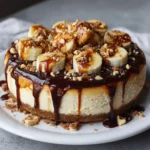
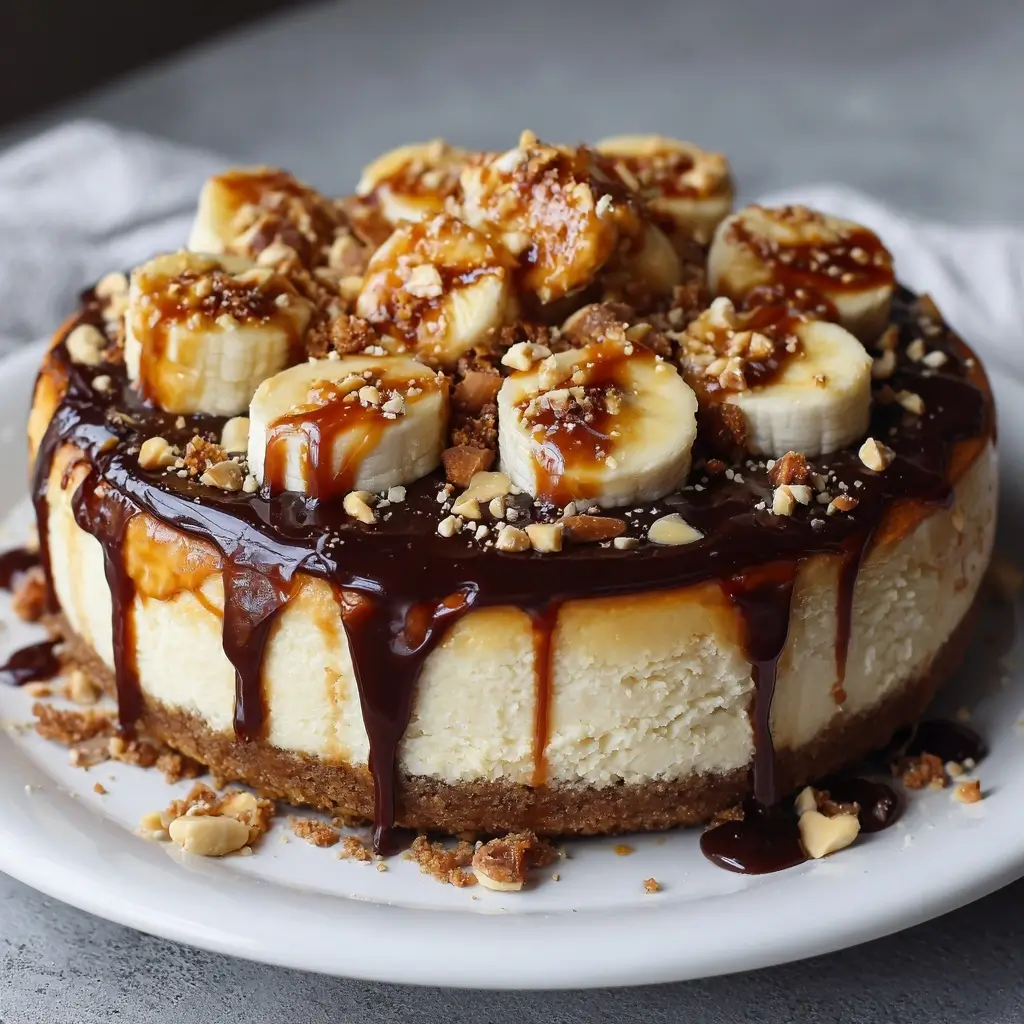
- Unmold & Serve (5 minutes): Run thin, flexible knife under hot water, wipe dry, and glide around inner edge. Release springform collar. Slide thin metal spatula under crust to lift onto serving plate. For clean slices, dip knife in hot water and wipe dry between cuts. Garnish with banana slices, peanut butter drizzle, crushed peanuts, and flaky salt.
Tips
- Room Temperature Is Non-Negotiable: Cold cream cheese = grainy batter. Cold eggs = curdled mixture. Take ingredients out 3–4 hours ahead—or place sealed cream cheese blocks in warm water (not hot) for 15 minutes.
- Strain That Banana: Even “smooth” banana puree contains microscopic fibers that create grittiness. A fine-mesh strainer removes them instantly—don’t skip.
- Water Bath Mastery: Use a tea kettle to pour hot water slowly and steadily. Line roasting pan with a kitchen towel to prevent slipping. Wrap springform base tightly in *two* layers of heavy-duty foil to avoid leaks.
- Crack Prevention Trio: (1) Don’t overmix after eggs, (2) Cool gradually (oven → counter → fridge), (3) Run knife around edge before chilling to release shrinkage tension.
- Perfect Slicing Every Time: Use a chef’s knife with a 10-inch blade. Heat under hot tap, dry *thoroughly*, slice, then repeat. Never saw—press straight down.
- Texture Rescue: If batter separates or looks “broken,” let sit 5 minutes—often re-emulsifies. If still curdled, add 1 tbsp sour cream and stir gently by hand.
- Freezing Success: Unfrosted, fully chilled cheesecake freezes beautifully for up to 3 months. Wrap *tightly* in plastic, then aluminum foil. Thaw overnight in fridge—never at room temp—to prevent condensation and sogginess.
- Crust Reinvention Tip: For deeper flavor, toast graham cracker crumbs in a dry skillet 3–4 minutes until fragrant before mixing with butter.
Variations and Customizations
This recipe is a canvas—endlessly adaptable to dietary needs, seasonal produce, global flavors, and personal whims. Here are 15 thoughtfully developed variations—each tested for structural integrity and flavor harmony:
- Gluten-Free: Swap graham crackers for GF vanilla wafers or almond flour–coconut flour blend (1:1 ratio). Verify all extracts and peanut butter are certified GF.
- Vegan: Use soaked raw cashews (blended ultra-smooth), coconut cream, silken tofu, and maple syrup. Replace eggs with flax “eggs” (1 tbsp ground flax + 2.5 tbsp water per egg) and bake at 325°F for 60–70 mins. Top with date-caramel swirl.
- Protein-Packed: Fold in 2 scoops unflavored whey or plant-based protein powder (add 1 tbsp extra heavy cream to compensate for dryness). Sprinkle top with chopped roasted peanuts and chia seeds.
- Chocolate-PB-Banana: Add ¼ cup Dutch-process cocoa to crust. Swirl ½ cup melted dark chocolate into batter before baking. Finish with chocolate ganache and banana chips.
- Maple-Bacon: Infuse crust with 2 tbsp real maple syrup and ¼ cup finely chopped cooked bacon. Use maple extract instead of vanilla. Garnish with candied bacon ribbons.
- Tropical Twist: Replace ¼ cup banana puree with ripe mango purée. Add 1 tsp lime zest and toasted coconut to crust. Top with passionfruit coulis.
- Spiced Chai: Steep 2 chai tea bags in warm heavy cream for 10 minutes; cool and strain before adding. Add ½ tsp cardamom + ¼ tsp ginger to crust.
- No-Bake Version: Omit eggs. Use 1 cup cold heavy cream whipped to soft peaks + 1 tsp unflavored gelatin (bloomed in 2 tbsp cold water, dissolved in 1 tbsp hot cream). Fold into cream cheese base. Chill 8+ hours.
- Mini Mason Jar Cheesecakes: Layer crust, filling, and banana-peanut butter swirl in 4-oz jars. Chill 6 hours. Top with whipped cream and mini peanut butter cups.
- Matcha Swirl: Whisk 1 tsp ceremonial-grade matcha with 1 tbsp hot water + 1 tbsp honey. Swirl into batter pre-bake with chopstick.
- Blueberry Compote Swirl: Simmer 1 cup blueberries + ¼ cup sugar + 1 tsp lemon juice until thick. Cool completely. Swirl in after pouring batter.
- Low-Sugar/Keto: Substitute erythritol-monk fruit blend 1:1 for sugar. Use keto-friendly graham crackers (almond/coconut flour). Add 1 tsp xanthan gum to filling for stability.
- Grain-Free Paleo: Crust: 1.5 cups almond flour + 3 tbsp coconut oil + 3 tbsp maple syrup + pinch salt. Filling: soaked cashews, coconut cream, banana, natural peanut butter, vanilla, lemon juice.
- Espresso Kick: Dissolve 1.5 tsp instant espresso powder in warm heavy cream before adding. Sprinkle top with cocoa-dusted espresso beans.
- Everything Bagel Surprise: Add 1 tbsp everything bagel seasoning to crust. Swirl in 2 tbsp cream cheese–chive mixture before baking. Sounds wild—but the savory-sweet contrast is revelatory.
Health Considerations and Nutritional Value
A single generous slice (1/16th of a 9-inch cake) contains approximately 420–480 calories, 32–38g total fat (14–17g saturated), 34–42g carbohydrates (24–28g sugars), 7–9g protein, and 280–350mg sodium. While undeniably rich, thoughtful modifications can significantly improve its nutritional profile without sacrificing satisfaction:
- Heart-Healthy Swaps: Replace half the cream cheese with blended low-sodium white beans (rinsed, drained, pureed until silky)—adds fiber, folate, and potassium while cutting saturated fat by ~25%. Maintain texture with extra sour cream.
- Sugar Reduction Science: You can reduce granulated sugar by up to 30% (⅓ cup) without affecting structure—bananas and peanut butter provide ample natural sweetness. Use monk fruit–erythritol blends for zero-glycemic impact.
- Fiber Boost: Add 2 tbsp ground flaxseed or chia seeds to crust or batter. They absorb liquid, enhance creaminess, and deliver omega-3s and soluble fiber shown to support gut health and satiety.
- Probiotic Potential: Substitute ½ cup plain kefir for part of the sour cream—adds live cultures, B12, and gentle tang without altering texture.
- Allergen Awareness: For peanut allergies, use sunflower seed butter (ensure no cross-contamination) or tahini (adds sesame depth—pair with orange zest). Always label clearly for guests.
- Glycemic Impact Mitigation: Serve with a side of mixed berries (rich in anthocyanins that slow glucose absorption) and a sprinkle of chopped walnuts (healthy fats delay gastric emptying).
- Mindful Portioning: Use a 3-inch cookie cutter to serve petite, elegant portions—visually satisfying, nutritionally sensible, and perfect for tasting menus.
Important Note: While not a “health food,” Peanut Butter Banana Cheesecake *can* fit within a balanced diet when enjoyed intentionally—not restrictively. Its combination of healthy fats (peanut butter), resistant starch (slightly underripe banana), calcium (dairy), and antioxidants (vanilla, cinnamon) makes it far more nutrient-dense than many ultra-processed desserts. Prioritize whole-food ingredients, savor slowly, and pair with movement and connection—the true foundations of wellness.
Ingredients
Makes one 9-inch cheesecake (16 servings)
For the Crust:
- 1 ½ cups (150g) graham cracker crumbs (about 10 full sheets)
- ¼ cup (50g) packed light brown sugar
- 1 tbsp (12g) granulated sugar
- ⅛ tsp (0.3g) fine sea salt
- 6 tbsp (85g) unsalted butter, melted and cooled to 110°F
For the Filling:
- 24 oz (680g) full-fat brick-style cream cheese, room temperature
- 1 cup (200g) granulated sugar
- 1 cup (240g) full-fat sour cream
- ½ cup (120ml) heavy cream (36–40% fat)
- 2 tsp (10ml) pure vanilla extract
- 3 large eggs, room temperature
- ¾ cup (190g) natural creamy peanut butter (just peanuts + salt)
- ¾ cup (180g) smooth banana puree (from ~3 large ripe bananas, strained)
- ¼ tsp (0.5g) almond extract (optional, but recommended)
For Garnish (optional but encouraged):
- Fresh banana slices
- Drizzle of warm peanut butter (thinned with 1 tsp neutral oil)
- Chopped roasted peanuts
- Flaky sea salt (Maldon or Jacobsen)
- Whipped cream or coconut whip
Directions
- Preheat & Prep: Position oven rack in center. Preheat oven to 325°F (163°C). Grease bottom and sides of a 9-inch springform pan. Line bottom and 2 inches up sides with parchment paper. Place pan inside a large roasting pan (at least 12×16 inches).
- Make Crust: In food processor, pulse graham cracker crumbs, brown sugar, granulated sugar, cinnamon, and salt until combined. Add melted butter; pulse until mixture resembles wet sand and holds together when pinched. Press firmly and evenly into prepared pan bottom and 1 inch up sides. Freeze 15 minutes (or refrigerate 30 minutes).
- Prepare Banana Puree: Peel bananas and break into chunks. Blend in high-speed blender or food processor until completely smooth (30–45 seconds). Strain through fine-mesh sieve into bowl, pressing with spatula to extract all liquid. Measure exactly ¾ cup; set aside to cool to room temperature.
- Beat Cream Cheese Base: In stand mixer with paddle attachment, beat cream cheese on medium-low 2 minutes until creamy and lump-free. Scrape bowl. Add sugar; beat 3 minutes until pale and fluffy. Scrape bowl thoroughly. Add sour cream, heavy cream, and vanilla; beat 2 minutes until smooth. Reduce speed to low. Add eggs one at a time, beating just until incorporated (≈15 seconds per egg). Scrape bowl after each addition.
- Incorporate Flavors: Whisk peanut butter in small bowl until smooth and fluid. With mixer on low, slowly drizzle in peanut butter, then banana puree. Beat only until just combined (≈20 seconds). Fold in almond extract with silicone spatula. Batter will be thick and tan.
- Pour & Smooth: Pour batter into chilled crust. Tap pan sharply 4 times on counter. Smooth top with hot-water-dipped offset spatula. Run thin knife around inner edge.
- Water Bath Bake: Carefully pour hot water into roasting pan until halfway up springform sides. Gently transfer roasting pan to oven. Bake 1 hour 15 minutes, or until edges are set and center jiggles slightly like Jell-O when nudged. Turn off oven, crack door open 1 inch with wooden spoon, and let cheesecake cool inside for 1 hour.
- Cool & Chill: Remove roasting pan. Lift springform from water. Run knife around edge again. Cool on wire rack 1 hour. Cover loosely with plastic wrap (not touching surface). Refrigerate minimum 12 hours, preferably 24–48 hours.
- Unmold & Serve: Run thin knife under hot water, wipe dry, and glide around inner edge. Release springform collar. Slide metal spatula under crust to lift onto serving platter. Slice with hot, dry knife. Garnish as desired.
FAQ
- Can I make this without a springform pan?
- Yes—but with caveats. Use a 9-inch regular cake pan lined *completely* with parchment (bottom + overlapping sides). After chilling, invert onto plate, peel off parchment, then flip again onto serving plate. Or bake in a disposable aluminum pan and serve directly from it.
- Why did my cheesecake crack?
- Most common causes: overmixing after eggs, cooling too quickly, not running knife around edge before chilling, or opening oven door before 75 minutes. All are preventable with technique—not failure!
- Can I use frozen bananas?
- Absolutely—and they’re often *better*. Freeze peeled, chunked bananas up to 6 months. Thaw completely, drain excess liquid (it’s mostly water), then purée and strain. Freezing concentrates sweetness and softens texture.
- Is there a substitute for sour cream?
- Full-fat Greek yogurt (not regular yogurt) works 1:1. Crème fraîche is an elegant alternative. Avoid low-fat or non-dairy yogurts—they lack fat and protein needed for stability.
- How do I fix a soggy crust?
- Pre-bake it! After pressing, bake crust at 350°F for 10 minutes before adding filling. This sets the butter and creates a moisture barrier. Also ensure bananas are well-strained and cooled.
- Can I add chocolate chips?
- Yes—but fold in *only* ½ cup miniature semi-sweet chips *after* mixing batter. Large chips sink and create uneven texture. White chocolate or peanut butter chips also work beautifully.
- What’s the best way to store leftovers?
- Keep covered tightly in refrigerator up to 5 days. To prevent drying, place toothpicks around perimeter and drape plastic wrap over them (so it doesn’t touch surface). Freeze unfrosted slices up to 3 months.
- Can I make this dairy-free?
- Yes—with careful substitutions: vegan cream cheese (Tofutti or Kite Hill), coconut cream (chilled, solid part only), and unsweetened plant-based yogurt. Use agar-agar (not gelatin) for no-bake versions. Texture will be softer but deeply flavorful.
- Why does my peanut butter separate in the batter?
- Natural peanut butter separates because oil rises. Stir vigorously *before* measuring, then whisk again until uniformly fluid. If separation occurs mid-mixing, stop, let sit 2 minutes, then stir gently by hand.
- Can I use crunchy peanut butter?
- You can—but it changes texture dramatically. For best results, use creamy for the base and reserve 2 tbsp crunchy