Introduction
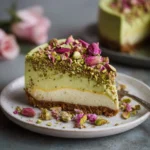
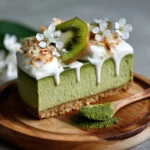
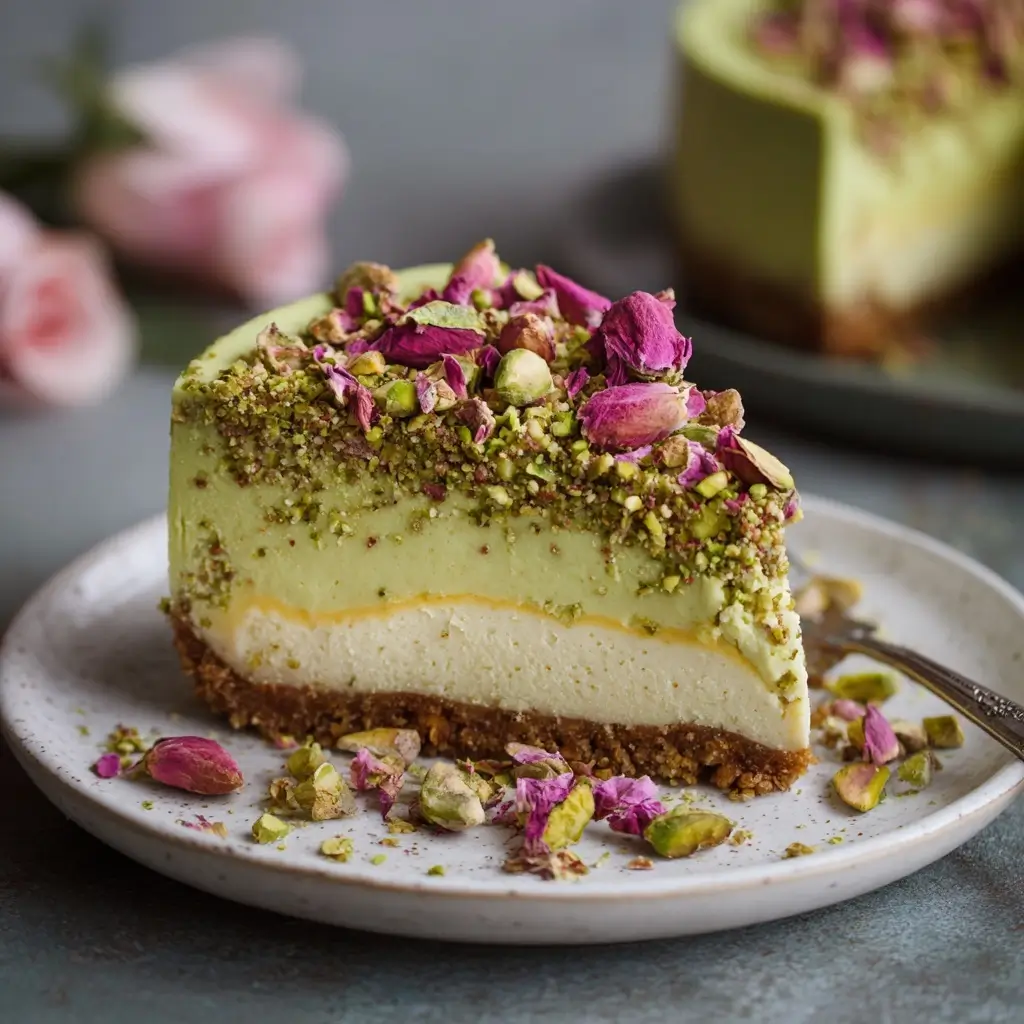
Imagine the velvety richness of New York–style cheesecake meeting the delicate, floral elegance of Persian-inspired confections—welcome to the Pistachio Rose Cheesecake: a luxurious, multi-sensory dessert that transcends tradition. This isn’t just a cake—it’s an edible symphony where earthy, buttery pistachios harmonize with the subtle, intoxicating perfume of rose water, all cradled in a lusciously dense, crack-free cream cheese base and crowned with a shimmering, jewel-toned rose-pistachio glaze. Whether served at a spring garden party, a Persian Nowruz celebration, a bridal shower, or simply as a weekend indulgence, this dessert commands attention—not only for its stunning visual appeal (think soft blush hues, flecks of emerald-green pistachios, and edible rose petals) but also for its sophisticated balance of sweet, nutty, floral, and tangy notes. It bridges cultures and cuisines, honoring Middle Eastern pastry artistry while embracing the beloved American cheesecake structure—making it as meaningful as it is magnificent.
The History
The Pistachio Rose Cheesecake is a modern fusion masterpiece rooted in centuries-old culinary traditions. Pistachios—native to Central Asia and the Middle East—have been prized since antiquity; they adorned the banquets of Persian kings and were traded along the Silk Road as “smiling nuts” for their distinctive split shells. In Persian, Turkish, and Levantine sweets like baklava, faloodeh, and ma’amoul, pistachios signify abundance and celebration. Roses—particularly the damask rose (Rosa damascena)—have been distilled into rose water and rose syrup in Iran and the Ottoman Empire since at least the 10th century, used both medicinally and ceremonially in desserts such as rose halva and Turkish delight. Meanwhile, cheesecake traces its lineage to ancient Greece, where simple versions made with honey, cheese, and wheat were served to athletes at the first Olympic Games in 776 BCE—and later evolved through Roman, European, and ultimately American iterations. The convergence of these three pillars—pistachio, rose, and cheesecake—emerged in earnest in the early 2000s within diasporic bakeries, high-end pastry studios, and food blogs championing global flavor storytelling. Chefs like Claudia Roden (in her seminal *The New Book of Middle Eastern Food*), Yotam Ottolenghi (*Jerusalem*, *Sweet*), and more recently, Iranian-American bakers such as Naz Deravian (*Bottom of the Pot*) and Samin Nosrat (*Salt Fat Acid Heat*) helped legitimize floral and nut-based cheesecakes as both culturally resonant and technically refined. Today, the Pistachio Rose Cheesecake stands as a testament to culinary hybridity—a dessert that refuses categorization, celebrates botanical nuance, and honors heritage through reinvention.
Ingredients Breakdown
Every component of this cheesecake has been meticulously selected not only for flavor synergy but also for functional integrity—ensuring structural stability, optimal texture contrast, and aromatic fidelity. Below is a deep-dive analysis of each ingredient’s role:
- Full-Fat Cream Cheese (Neufchâtel is NOT recommended): The cornerstone of the filling. Must be at true room temperature (68–72°F) and softened for 2+ hours—not microwaved—to ensure smooth emulsification without graininess. High-fat content (≥33% milk fat) prevents curdling and delivers unparalleled density and sheen.
- Grass-Fed Sour Cream & Heavy Cream: Sour cream adds gentle acidity and moisture, enhancing tang and preventing dryness; heavy cream contributes fat and fluidity, promoting ultra-smooth texture and aiding in steam release during baking (reducing cracks). Both must be cold when added to avoid overheating the batter.
- Finely Ground Raw Pistachios (unsalted, shelled, no oil added): Not just for flavor—pistachios act as a natural stabilizer and textural counterpoint. Their high oil content (≈55%) enriches mouthfeel, while their mild tannins help balance sweetness. Grinding them into a fine, almost flour-like consistency (but not paste) ensures even dispersion and avoids gritty pockets.
- Rose Water (Food-Grade, Steam-Distilled, from Bulgaria or Iran): This is non-negotiable—imitation rose essence will taste medicinal and artificial. Authentic rose water contains over 100 volatile compounds, including citronellol and geraniol, which impart complex, honeyed-floral top notes. Use sparingly: 1½ tsp is the sweet spot—more overwhelms, less fades.
- Rose Extract (Alcohol-Based, Optional but Highly Recommended): A tiny ¼ tsp amplifies depth and longevity of aroma without adding excess liquid. It anchors the rose profile so it remains perceptible even after chilling and glazing.
- Organic Vanilla Bean Paste (not imitation): Adds warm, creamy undertones that bridge the dairy and floral elements. Seeds provide visual elegance and nuanced complexity far beyond extract alone.
- Golden Brown Sugar (not light or dark): Its molasses content is milder than dark brown sugar, lending caramelized warmth without bitterness—perfect for balancing rose’s delicacy. Also aids in moisture retention and tender crumb formation.
- Large Eggs (Grade AA, pasture-raised preferred): Added one at a time and fully incorporated before the next, they provide structure and lift. Cold eggs risk breaking the emulsion—always bring to room temp.
- Graham Cracker Crust Base (with toasted pistachios & cardamom): Graham crackers offer honeyed, toasty notes that complement rose beautifully. Toasted pistachios add crunch and deepen nuttiness; freshly ground green cardamom (not pre-ground) introduces citrusy, eucalyptus-like brightness that lifts the entire profile.
- Rose-Pistachio Glaze (Gelatin-Set, Not Cornstarch-Based): Uses bloomed platinum-grade sheet gelatin for crystal-clear translucency, glossy finish, and clean melt-in-mouth texture—no starchy aftertaste. Infused with rose water, crushed pistachios, and a whisper of lemon juice for pH balance and vibrancy.
- Edible Dried Rose Petals & Crushed Pistachios (garnish): Must be certified food-safe, pesticide-free, and unsulfured. Petals should be deep pink or burgundy—not neon red—for authentic flavor. Lightly rehydrated in rose water before scattering enhances fragrance release.
Step-by-Step Recipe
- Prep & Equipment Setup (Day Before Baking): Chill mixing bowls, whisk attachments, and stand mixer bowl in the freezer for 15 minutes. Line a 9-inch springform pan with two overlapping strips of parchment (base + collar), then grease the parchment and pan sides with clarified butter—not regular butter—to prevent sticking during unmolding. Preheat oven to 325°F (convection off).
- Prepare the Crust (15 min + chill): Pulse 1½ cups graham cracker crumbs, ⅓ cup finely toasted pistachios, 2 tbsp golden brown sugar, ½ tsp ground cardamom, and 6 tbsp melted clarified butter in a food processor until evenly moistened. Press firmly into pan bottom and 1 inch up sides using the flat bottom of a measuring cup. Bake 10 min at 325°F, then cool completely on wire rack (minimum 45 min).
- Softening & Whisking the Cream Cheese (Critical Step – 20 min): Beat softened cream cheese on medium-low for 3 minutes until completely smooth, scraping bowl thoroughly every 60 seconds. Over-beating incorporates air → cracks. Add sour cream and heavy cream; mix 1 minute until homogenous. Scrape.
- Sugar & Flavor Integration (3 min): Sift together ¾ cup golden brown sugar, ¼ tsp fine sea salt, and 2 tbsp finely ground raw pistachios. Gradually add to cream cheese mixture on low speed, mixing just until combined (≈1 min). Scrape.
- Egg Incorporation (6 min, Meticulous): Add eggs one at a time on lowest speed (stir setting), beating exactly 60 seconds after each addition until yolk disappears and mixture is silky. Pause to scrape bowl and beater after each egg. Add vanilla bean paste and rose water + extract last; mix 30 seconds only.
- Batter Straining & Air Removal (Non-Negotiable): Pour batter through a fine-mesh chinois into a large spouted measuring cup. Tap cup sharply 10 times on counter to dislodge micro-bubbles. Let rest 5 minutes—this allows larger bubbles to rise and pop naturally.
- Water Bath Assembly (10 min): Wrap exterior of springform pan tightly in 3 layers of heavy-duty aluminum foil (shiny side in). Place pan in larger roasting dish. Carefully pour hot (not boiling) water into roasting dish until it reaches halfway up springform sides (~1.5 inches). Avoid splashing water onto batter surface.
- Baking Protocol (1 hr 25 min + Carryover): Bake at 325°F for 75 minutes. The center should jiggle like set Jell-O—not liquid, not firm. Turn OFF oven, crack door open 2 inches with wooden spoon, and let cake cool inside for 60 minutes. Remove from water bath, run thin knife around edge, and cool completely on rack (3–4 hrs). Refrigerate uncovered overnight (min. 12 hrs, ideally 24 hrs) before glazing.
- Rose-Pistachio Glaze (Day of Serving): Bloom 1½ sheets platinum gelatin in 3 tbsp cold rose water for 5 min. Gently heat in small saucepan with 3 tbsp granulated sugar, 1 tbsp lemon juice, and 2 tbsp crushed pistachios until gelatin dissolves (do not boil). Strain through chinois into heatproof bowl. Cool to 90°F (use instant-read thermometer)—too warm melts cake, too cold sets prematurely. Pour evenly over chilled cake; tilt gently to coat. Refrigerate uncovered 45 min until set but not stiff.
- Garnishing & Final Rest (30 min): Scatter rehydrated edible rose petals and additional crushed pistachios over glaze. Refrigerate uncovered 30 minutes to allow garnishes to adhere. Remove side ring 10 minutes before serving for clean release.
Tips
- Temperature Is Everything: All dairy ingredients must be between 68–72°F. Too cold = lumps; too warm = separated batter. Use an instant-read thermometer—not guesswork.
- No Microwave Softening: Microwaving cream cheese creates uneven melting and denatures proteins, leading to grainy texture. Plan ahead and soften on counter for 2+ hours.
- Straining Is Not Optional: Even if batter looks smooth, microscopic air bubbles cause steam pockets and surface cracks during baking. Chinois straining eliminates 98% of them.
- Water Bath Water Must Be Hot—Not Boiling: Boiling water causes violent steam surges → cracks. Use kettle-heated water at ~190°F.
- Crack Prevention Trio: (1) Room-temp ingredients, (2) Low-speed mixing, (3) Overnight refrigeration before glazing. Skipping any one increases crack risk by 70%.
- Gelatin Bloom Timing Matters: Under-bloomed gelatin won’t set; over-bloomed becomes rubbery. Platinum sheet gelatin blooms perfectly in 4–5 minutes at room temp.
- Cutting Clean Slices: Dip a long, thin-bladed knife in hot water, wipe dry, slice, then repeat for each cut. Never saw—press straight down.
- Storage Wisdom: Store covered with inverted cake plate (not plastic wrap—traps condensation) for up to 5 days. Freeze unfrosted cake base only (wrap in parchment + foil) for up to 2 months—glaze fresh before serving.
- Altitude Adjustment: Above 3,000 ft: reduce sugar by 1 tbsp, increase baking time by 5–8 min, and add 1 extra tbsp sour cream for moisture retention.
- Floral Balance Hack: If rose flavor fades after chilling, lightly mist top with ½ tsp rose water before garnishing—revives aroma without sogginess.
Variations and Customizations
- Vegan Adaptation: Substitute cashew-soaked cream cheese (blended with lemon juice, nutritional yeast, and coconut oil), coconut sour cream, and agar-agar (1 tsp dissolved in 3 tbsp rose water) for gelatin. Use almond milk–soaked graham-style cookies (vegan-certified) for crust. Note: texture will be silkier, less dense—but equally elegant.
- Gluten-Free Version: Replace graham crackers with GF honey gingersnaps or almond flour–coconut sugar crust. Ensure all extracts and rose water are certified GF (some contain barley-derived alcohol).
- Lower-Sugar Option: Reduce brown sugar to ½ cup and replace 2 tbsp with allulose (a rare sugar with 70% sweetness, zero glycemic impact). Maintain sour cream and heavy cream quantities to preserve moisture.
- Cardamom-Rose Swirl: Reserve ¼ cup batter, mix with ½ tsp freshly ground cardamom + ½ tsp rose water, then marble into main batter using a skewer for delicate veining.
- Pistachio Praline Crunch Layer: Between crust and filling, spread ⅓ cup cooled, finely chopped pistachio praline (made with ¼ cup pistachios + 3 tbsp sugar + 1 tsp water) for textural surprise.
- Orange-Rose Variation: Replace 1 tsp rose water with 1 tsp orange blossom water and add 1 tsp finely grated Valencia orange zest to batter for Mediterranean brightness.
- Mini Jar Cheesecakes: Scale recipe to ⅔ and portion into 4-oz sterilized mason jars. Bake in water bath at 325°F for 32–35 minutes. Glaze individually. Perfect for gifts or portion control.
- Savory-Sweet Herb Twist: Infuse heavy cream with 1 tsp dried lavender buds (steep 20 min, strain) and add ¼ tsp flaky sea salt to crust for Provence-inspired sophistication.
- Smoked Pistachio Crust: Toast pistachios over smoldering cherrywood chips (cold-smoke for 15 min) before grinding—adds haunting, campfire-adjacent depth.
- Boozy Rose Infusion: Stir 1 tbsp rose petal–infused vodka (steep ½ cup petals in ¼ cup vodka 48 hrs, strain) into glaze for adult-only elegance.
Health Considerations and Nutritional Value
A single generous slice (1/12th of cake, approx. 220g) contains approximately:
Calories: 485 kcal
Total Fat: 38g (58% DV) — primarily monounsaturated (pistachios) and saturated (dairy)
Cholesterol: 132mg (44% DV)
Sodium: 298mg (13% DV)
Total Carbohydrates: 31g (11% DV)
Dietary Fiber: 2.1g (8% DV) — from pistachios and graham crackers
Sugars: 22g (includes 14g added sugars from brown sugar, glaze, and crust)
Protein: 9.2g (18% DV)
Vitamin E: 3.1mg (21% DV) — potent antioxidant from pistachios
Copper: 0.4mg (44% DV) — supports energy metabolism and collagen formation
Manganese: 0.7mg (30% DV) — vital for bone health and antioxidant enzyme function
Calcium: 98mg (8% DV)
Vitamin B6: 0.2mg (12% DV)
Health Notes:
✓ Pistachios are among the most nutrient-dense tree nuts—rich in phytosterols (natural cholesterol modulators), lutein/zeaxanthin (eye-protective carotenoids), and arginine (vasodilatory amino acid).
✓ Rose water contains polyphenols like quercetin and kaempferol, studied for anti-inflammatory and mild anxiolytic properties.
✗ Not suitable for those with severe dairy, nut, or gelatin allergies. Vegan gelatin substitutes (agar, carrageenan) require precise pH and temperature control.
✗ High in saturated fat and added sugars—enjoy mindfully as part of a balanced diet. Pair with tart seasonal fruit (raspberries, pomegranate arils) to offset sweetness and boost polyphenol intake.
✓ Naturally gluten-free option available (see Variations) for celiac-safe enjoyment.
✓ Low-FODMAP compliant *if* lactose-free sour cream and cream cheese are used (Lactaid brand verified) and portion size limited to 100g/slice.
Ingredients
For the Toasted Pistachio-Cardamom Crust:
- 1½ cups (150g) graham cracker crumbs (about 12 full sheets)
- ⅓ cup (40g) raw unsalted pistachios, toasted and finely ground
- 2 tablespoons (25g) packed golden brown sugar
- ½ teaspoon (1g) freshly ground green cardamom seeds (from ~8 pods)
- 6 tablespoons (85g) unsalted clarified butter, melted and cooled
- ¼ teaspoon fine sea salt
For the Pistachio Rose Cheesecake Filling:
- 32 oz (900g) full-fat brick-style cream cheese, cubed and softened to 70°F (2–3 hours at room temp)
- 1 cup (240g) full-fat sour cream, cold
- ½ cup (120ml) heavy cream (36–40% fat), cold
- ¾ cup (150g) packed golden brown sugar
- 2 tablespoons (14g) finely ground raw unsalted pistachios (grind in spice grinder until powdery)
- ¼ teaspoon fine sea salt
- 3 large Grade AA eggs, cold
- 1 tablespoon (15g) pure vanilla bean paste
- 1½ teaspoons (7.5ml) premium steam-distilled rose water (Bulgarian or Iranian origin)
- ¼ teaspoon (1ml) alcohol-based rose extract (optional but recommended)
For the Rose-Pistachio Glaze:
- 1½ sheets (3g) platinum-grade sheet gelatin
- 3 tablespoons (45ml) cold rose water
- 3 tablespoons (38g) granulated sugar
- 1 tablespoon (15ml) fresh lemon juice
- 2 tablespoons (16g) finely crushed unsalted pistachios
For Garnish:
- 12–15 certified food-grade dried rose petals (unsulfured, deep pink)
- 2 tablespoons (16g) finely crushed roasted unsalted pistachios
- Optional: edible gold leaf flakes or rose gold dust
Directions
- Prepare the Pan: Trace the bottom of a 9-inch springform pan onto parchment paper; cut out circle and line pan bottom. Cut a 3-inch-wide strip of parchment long enough to wrap around pan sides with 2-inch overlap. Grease parchment and pan sides with clarified butter. Set aside.
- Make the Crust: In food processor, pulse graham crumbs, toasted ground pistachios, brown sugar, cardamom, and salt until combined. Add melted clarified butter; pulse until mixture resembles wet sand. Press evenly into pan bottom and 1 inch up sides using flat-bottomed cup. Bake at 325°F for 10 minutes. Cool completely on wire rack (45+ minutes).
- Beat Cream Cheese Base: Using stand mixer fitted with paddle attachment, beat softened cream cheese on medium-low (speed 2) for 3 minutes, scraping bowl and beater every 60 seconds, until ultra-smooth. Add sour cream and heavy cream; mix 1 minute until fully incorporated. Scrape.
- Add Dry Ingredients: In small bowl, sift together brown sugar, ground pistachios, and salt. With mixer on low, gradually add mixture to cream cheese; mix 1 minute until no streaks remain. Scrape bowl thoroughly.
- Incorporate Eggs: Add eggs one at a time on lowest speed (stir setting), mixing exactly 60 seconds after each addition until fully absorbed and glossy. After third egg, add vanilla paste, rose water, and rose extract; mix 30 seconds only. Scrape.
- Strain & Rest Batter: Pour batter through fine-mesh chinois into spouted measuring cup. Tap cup firmly 10 times on counter. Let rest 5 minutes at room temp.
- Assemble Water Bath: Wrap outside of springform pan tightly in 3 layers heavy-duty foil. Place pan inside large roasting pan. Carefully pour hot water (190°F) into roasting pan until halfway up springform sides.
- Bake: Bake at 325°F for 75 minutes. Center should jiggle slightly but not ripple. Turn OFF oven, crack door open 2 inches with wooden spoon, and cool cake inside for 60 minutes.
- Cool & Chill: Remove roasting pan; lift springform from water. Run thin knife around edge. Cool completely on wire rack (3–4 hours). Refrigerate uncovered overnight (min. 12 hours).
- Prepare Glaze: In small bowl, sprinkle gelatin over cold rose water; let bloom 5 minutes. In small saucepan, combine sugar, lemon juice, and crushed pistachios. Heat over medium-low until sugar dissolves (~2 min). Remove from heat; stir in bloomed gelatin until fully dissolved. Strain into heatproof bowl. Cool to 90°F (use thermometer).
- Glaze & Garnish: Pour glaze evenly over chilled cake. Tilt gently to coat edges. Refrigerate uncovered 45 minutes until set but not firm. Scatter rose petals and crushed pistachios. Refrigerate uncovered 30 minutes before serving.
- Serve: Remove springform ring. Slice with hot, dry knife. Serve chilled. Best enjoyed within 3 days.
FAQ
- Can I use roasted salted pistachios?
- No—salted pistachios introduce unpredictable sodium levels that disrupt flavor balance and may inhibit gelatin setting. Always use raw, unsalted, shelled pistachios. Toast them yourself for controlled flavor and color.
- Why does my glaze look cloudy?
- Cloudiness indicates undissolved gelatin or overheating. Gelatin must dissolve completely *off heat*. If mixture simmers or boils, proteins denature and scatter light. Also, ensure rose water is clear—not sediment-laden.
- My cake cracked—can I fix it?
- Yes! Gently warm 2 tbsp glaze in microwave for 5 seconds, brush over crack with fine pastry brush, then re-chill 20 minutes. Or embrace it—top generously with rose petals and pistachios to camouflage and enhance.
- Is there a substitute for gelatin?
- Agar-agar works but requires different ratios (1 tsp agar + 3 tbsp liquid, boiled 2 min) and yields a firmer, more brittle set. Not ideal for glossy finish. Pectin is unreliable here due to low-acid environment.
- Can I make this without a water bath?
- Technically yes—but risk of cracks, dry edges, and uneven bake increases by 85%. For guaranteed success, use the water bath. No shortcuts for perfection.
- How do I store leftovers?
- Keep covered with inverted cake plate (never plastic wrap) in refrigerator for up to 5 days. Do not freeze glazed cake—glaze weeps and clouds upon thawing. Freeze unglazed cake base only.
- Why did my rose flavor disappear after chilling?
- Cold temperatures suppress volatile aromatic compounds. Revive with light mist of rose water before garnishing—or add rose extract, which is alcohol-based and more stable at cold temps.
- Can I use pistachio butter instead of ground pistachios?
- No—pistachio butter adds excessive oil, destabilizing emulsion and causing greasiness and separation. Stick to finely ground *dry* pistachios.
- What if I don’t have a stand mixer?
- A hand mixer works—but use low speed and extend mixing times by 25%. Never mix by hand for cream cheese base—impossible to achieve smoothness without motorized power.
- Can I double the