Introduction
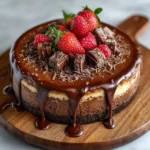
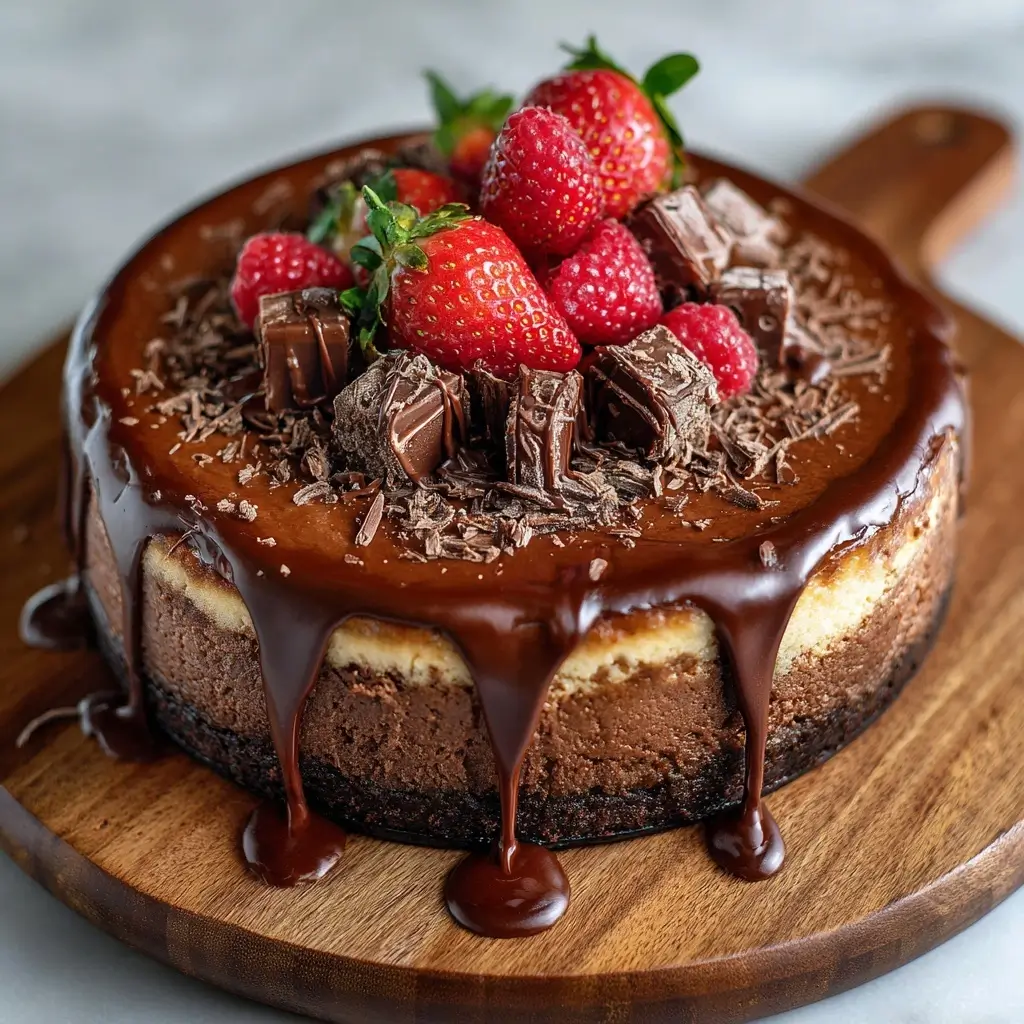
Indulgence has a name—and it’s Triple Chocolate Fudge Cheesecake. This isn’t just another dessert; it’s a decadent, multi-layered symphony of rich cocoa, velvety chocolate fudge, and luxuriously creamy cheesecake—crafted to satisfy even the most discerning chocolate connoisseur. Imagine biting through a crisp, buttery Oreo crust into a dense, fudgy chocolate layer, then sinking into a cloud-like, ultra-smooth dark chocolate cheesecake filling, all crowned with glossy, ribboned swirls of white and milk chocolate ganache. Every element is intentionally layered—not just for visual drama, but for textural contrast and flavor evolution across each bite. Whether served at an elegant dinner party, as a showstopping holiday centerpiece, or as a deeply comforting weekend treat, this cake transcends occasion. It’s equal parts artistry and alchemy—where science (precise baking temperatures, emulsification techniques, and controlled cooling) meets soul-soothing nostalgia. Prepare your taste buds: you’re not just eating dessert—you’re experiencing chocolate in triplicate harmony.
The History
The Triple Chocolate Fudge Cheesecake is a modern American dessert evolution—a triumphant fusion born from three iconic culinary traditions: the ancient roots of cheesecake (traced back to ancient Greece, where honey-sweetened cheese cakes were served to athletes at the first Olympic Games in 776 BCE), the 19th-century rise of American-style cream cheese-based cheesecakes popularized by William Lawrence in Chester, NY (1872), and the mid-20th-century chocolate renaissance catalyzed by innovations in cocoa processing, milk chocolate refinement, and fudge-making techniques pioneered in New England candy shops. While single-chocolate cheesecakes appeared in mid-century cookbooks like The Joy of Cooking (1951 edition), the “triple chocolate” concept emerged in earnest during the 1980s and ’90s—fueled by food magazines such as Bon Appétit and Food & Wine, which championed layered, restaurant-quality desserts for home cooks. The addition of a distinct fudge layer—separate from both crust and filling—was a deliberate innovation to combat common cheesecake pitfalls: cracking, dryness, or one-note richness. Pastry chefs began embedding dense, slow-cooled chocolate fudge (often made with evaporated milk and real butter for shelf-stable viscosity) beneath the batter to add moisture retention, structural integrity, and deep, lingering cocoa notes. By the early 2000s, the “triple” designation became standardized—not merely as “three types of chocolate,” but as three *texturally and functionally distinct chocolate components*: (1) cocoa-infused graham or cookie crust, (2) a set, sliceable fudge barrier, and (3) a baked, aerated, yet dense chocolate cheesecake layer. Today, it stands as a benchmark dessert in bakery case displays, viral baking TikToks, and competitive pastry competitions—continually reinvented with ethically sourced cacao, cold-brew infusions, or vegan adaptations—but always honoring its layered legacy.
Ingredients Breakdown
Every ingredient in this Triple Chocolate Fudge Cheesecake plays a precise, non-negotiable role—no filler, no afterthoughts. Below is a forensic-level analysis of each component:
For the Crust:
- 24 Oreo cookies (original, full-size) – Not “Double Stuf” or “Mint”: original Oreos provide ideal fat-to-cocoa ratio and structural grit. The wafer delivers crispness; the cream filling contributes emulsified fat and subtle vanilla sweetness that balances bitterness.
- 6 tbsp unsalted butter, melted and cooled – Must be unsalted to control sodium; melted (not hot) to evenly coat crumbs without cooking them or releasing excess water. Butter’s milk solids contribute browning and nuttiness during pre-bake.
- 1/4 tsp fine sea salt – Enhances all chocolate flavors via flavor amplification (a well-documented neurogastronomic effect); also counters sweetness fatigue.
For the Fudge Layer:
- 1 cup (6 oz) high-quality semi-sweet chocolate chips or chopped chocolate (60–65% cacao) – Must contain cocoa butter—not vegetable oil blends—to ensure proper crystallization and glossy set. Chips offer uniform melting; chopped bar chocolate yields superior mouthfeel.
- 1/2 cup (4 oz) evaporated milk – Concentrated, sterilized milk with reduced water content ensures thick, stable fudge without graininess or separation. Regular milk introduces too much water, risking sugar recrystallization.
- 1/2 cup granulated sugar – Provides structure and caramelization potential; fine granulation ensures rapid dissolution.
- 1/4 cup unsalted butter, cubed – Adds sheen, smoothness, and prevents over-hardening. Salted butter would disrupt flavor balance.
- 1/4 tsp pure vanilla extract – Madagascar Bourbon vanilla adds floral depth that lifts chocolate’s earthy tones.
- Pinch of flaky sea salt (e.g., Maldon) – A finishing touch that heightens perceived sweetness and adds textural intrigue.
For the Cheesecake Filling:
- 32 oz (four 8-oz bricks) full-fat, brick-style cream cheese, room temperature – Critical: must be Philadelphia-brand or equivalent. Low-moisture, high-fat content ensures stability. “Room temperature” means 68–72°F—soft enough to indent with finger pressure, but still cool to the touch. Cold cheese causes lumps; warm cheese causes curdling.
- 1 1/4 cups granulated sugar – Sweetens while also tenderizing proteins in cream cheese for smoother texture.
- 1 cup full-fat sour cream, room temperature – Adds tang, moisture, and acidity to balance richness and promote tenderness.
- 2/3 cup full-fat Greek yogurt (not flavored or low-fat) – Higher protein than regular yogurt, lending structure and subtle tang without thinning batter.
- 4 large eggs + 2 large egg yolks, room temperature – Eggs provide leavening and binding; extra yolks add fat, silkiness, and emulsification power. Room temp prevents thermal shock and scrambling when mixed into warm batter.
- 1/2 cup unsweetened Dutch-process cocoa powder (e.g., Valrhona or Droste) – Alkalized for deeper color, mellowed acidity, and enhanced solubility. Never substitute natural cocoa—it’s too acidic and will cause batter to seize or taste sharp.
- 1/2 cup heavy cream (36–40% fat), cold – Added last to preserve air incorporation; cold temperature helps maintain emulsion stability during mixing.
- 2 tsp pure vanilla extract – Doubles down on aromatic complexity.
- 1 tsp instant espresso powder (optional but highly recommended) – Intensifies chocolate flavor without adding coffee taste (acts as a flavor catalyst).
- 1/2 tsp fine sea salt – Balances bitterness and rounds out the profile.
For the Triple Chocolate Ganache Topping:
- 1/2 cup heavy cream – Heated to 185°F (just below simmer) for optimal cocoa butter extraction.
- 4 oz high-quality dark chocolate (70% cacao), finely chopped – Forms the base ganache layer: deep, robust, slightly bitter backbone.
- 4 oz high-quality milk chocolate (35–40% cacao), finely chopped – Adds caramelized, creamy sweetness and golden hue—contrasts dark layer visually and sensorially.
- 4 oz high-quality white chocolate (vanilla bean-infused preferred), finely chopped – Provides bright, buttery, floral lift and stark visual contrast. Must contain cocoa butter—not palm oil.
- 1 tbsp light corn syrup (optional, for extra gloss and pliability) – Inhibits sugar crystallization in white chocolate ganache, ensuring smooth pourability.
Step-by-Step Recipe
This recipe requires patience, precision, and respect for temperature physics. Do not rush steps—especially cooling phases. Total active time: ~90 minutes. Total elapsed time (including chilling): 24–36 hours.
Step 1: Prepare the Crust (Day 1, Evening)
- Preheat oven to 350°F (175°C). Grease a 9-inch springform pan thoroughly—bottom and sides—and line the bottom with parchment paper (cut to fit perfectly).
- In a food processor, pulse Oreos (filling and all) until fine, sandy crumbs form—about 15–20 seconds. Avoid over-processing into paste.
- Transfer crumbs to a medium bowl. Add melted butter and salt. Stir with a spatula until all crumbs are evenly moistened and resemble wet sand. Pinch a handful—if it holds together without crumbling, it’s ready.
- Pour into prepared pan. Use the flat bottom of a measuring cup or glass to press firmly and evenly into bottom and 1 inch up sides. Apply significant pressure—this prevents crumbling upon slicing.
- Bake for 10 minutes. Remove and cool completely on wire rack—minimum 45 minutes. Do not skip cooling: warm crust melts fudge layer.
Step 2: Make the Fudge Layer (Day 1, After Crust Cools)
- In a heavy-bottomed, light-colored saucepan (for easy monitoring), combine evaporated milk, sugar, and butter. Stir over medium-low heat until sugar dissolves completely (~3–4 min). Do not boil yet.
- Attach a candy thermometer. Bring mixture to a gentle, steady boil—bubbles should cover entire surface. Clip thermometer to side, ensuring tip doesn’t touch pan bottom.
- Cook, stirring constantly with a heatproof silicone spatula, until thermometer reads exactly 234°F (soft-ball stage). This takes 8–12 minutes. If bubbles become violent or smoke appears, reduce heat immediately.
- Remove from heat. Immediately stir in chocolate and vanilla until fully melted and glossy—about 1 minute. Do not overmix—stop once smooth.
- Quickly pour hot fudge over cooled crust. Tilt pan gently to spread evenly. Tap pan sharply 3–4 times on counter to release air bubbles. Sprinkle with flaky salt.
- Refrigerate uncovered for minimum 2 hours—or overnight—for full set. Fudge must be firm to the touch and knife-cuttable before proceeding.
Step 3: Bake the Cheesecake Filling (Day 2, Morning)
- Preheat oven to 325°F (163°C). Position rack in center. Prepare a large roasting pan for water bath (bain-marie).
- In stand mixer fitted with paddle attachment, beat cream cheese on medium speed 2 minutes until completely smooth and lump-free. Scrape bowl thoroughly.
- Add sugar. Beat 3 minutes on medium—until pale, fluffy, and no graininess remains. Scrape bowl.
- Add sour cream and Greek yogurt. Beat 2 minutes on medium until homogenized. Scrape bowl.
- Add eggs and yolks one at a time, beating 30 seconds after each addition until just incorporated—do not overbeat. Overmixing introduces air → cracks.
- In separate bowl, whisk together cocoa powder, espresso powder, and salt until no lumps remain. Sift directly over batter.
- Mix on low 30 seconds, then increase to medium 1 minute—until cocoa is fully dispersed and batter is velvety. Scrape bowl.
- With mixer on low, slowly drizzle in cold heavy cream. Mix only until combined—15–20 seconds. Batter should be thick, glossy, and pourable—not runny.
- Place chilled springform pan (with set fudge layer) inside roasting pan. Pour batter gently over fudge—do not pour directly onto edges. Smooth top with offset spatula.
- Fill roasting pan with 1 inch of just-boiled water (carefully—avoid splashing into cake). Water bath is non-negotiable: ensures gentle, even heat and crack prevention.
- Bake 1 hour 25 minutes–1 hour 35 minutes. Cake is done when edges are puffed and set, center jiggles *slightly* like Jell-O (not liquid), and internal temperature reads 150–152°F on instant-read thermometer inserted 1 inch from center.
- Turn off oven. Crack door open 1 inch with wooden spoon. Let cake cool in oven for 1 hour—this gradual temperature drop prevents collapse and cracking.
- Remove from water bath. Run thin knife around inner edge to loosen. Cool completely on wire rack—minimum 2 hours.
- Refrigerate uncovered for minimum 12 hours—preferably 24 hours. This allows fudge and cheesecake layers to fully hydrate, set, and harmonize. Do not attempt slicing before full chill.
Step 4: Prepare and Apply Triple Chocolate Ganache (Day 3, Morning)
- Ensure cake is fully chilled and firm. Remove springform ring carefully—run warm towel around exterior if stuck.
- Heat heavy cream in small saucepan until steaming and tiny bubbles form at edges (185°F). Do not boil.
- Divide cream evenly among three heatproof bowls (each ~1/6 cup). Add respective chocolates to each: dark, milk, white.
- Let sit 2 minutes undisturbed. Then stir each bowl gently with silicone spatula in concentric circles until smooth, glossy, and fully emulsified. For white chocolate, add corn syrup now and stir until dissolved.
- Cool each ganache to 90°F (warm but not hot)—use thermometer. Overheated ganache will melt cheesecake surface; too cool = streaky set.
- Place cake on turntable. Using small offset spatula, spread dark chocolate ganache over top in thin, even layer. Refrigerate 10 minutes to set.
- Repeat with milk chocolate ganache. Refrigerate 10 minutes.
- Finally, apply white chocolate ganache. Use toothpick or skewer to create marbled effect: drag through layers in figure-8 or zigzag pattern. Chill 20 minutes to fully set.
- Wipe pan sides with warm damp cloth for polished finish. Garnish with chocolate curls, gold leaf, or flaky salt.
Tips
- Temperature is theology. All dairy and eggs must be truly room temperature—not “left out for 30 minutes.” Place cream cheese in warm (not hot) water bath for 10 minutes, then pat dry. Eggs: submerge in warm tap water 15 minutes.
- No substitutions for Dutch-process cocoa. Natural cocoa’s acidity reacts with baking soda/powder (which this recipe lacks) and creates unpleasant metallic notes in high-fat environments.
- Scrape, scrape, scrape. After every mixing step, pause to scrape bowl and paddle with flexible spatula. Unmixed pockets cause uneven texture and sinkholes.
- Water bath water must be just-boiled—not simmering. Simmering water vibrates pan, causing cracks. Boiling water maintains consistent 212°F ambient heat.
- Don’t open the oven during first 75 minutes. Temperature fluctuations cause catastrophic collapse.
- Use a springform with reinforced latch. Cheap pans leak water into crust—ruining texture and causing sogginess.
- Chill the cake on a cardboard cake round inside the pan. Easier to transfer without breaking fudge layer.
- For clean slices: dip knife in hot water, wipe dry, cut, repeat. Warm blade glides through fudge and cheesecake without dragging.
- If cracks appear anyway? Embrace them—cover generously with ganache. Or call it “rustic artisanal marbling.”
- Make components ahead: Crust: up to 3 days refrigerated. Fudge layer: up to 5 days refrigerated (re-soften 10 min at room temp before topping). Baked cheesecake: up to 5 days refrigerated (un-ganached). Ganache: up to 1 week refrigerated—re-warm gently in microwave at 50% power, 10-sec intervals.
Variations and Customizations
This recipe is a canvas—not a cage. Here are chef-tested, structurally sound adaptations:
Dietary & Lifestyle Variations:
- Vegan Triple Chocolate: Crust: Vegan Oreos + coconut oil. Fudge: Coconut milk + date paste + vegan chocolate. Cheesecake: Raw cashew base (soaked 8 hrs) + silken tofu + coconut cream + cocoa + maple syrup. Ganache: Full-fat coconut cream + vegan dark/milk/white chocolates. Set 48 hrs.
- Gluten-Free: Crust: GF chocolate sandwich cookies (e.g., Kinnikinnick) or GF gingersnaps + butter. Ensure all chocolates are certified GF (many contain barley grass or wheat starch).
- Lower-Sugar: Replace granulated sugar with erythritol + monk fruit blend (1:1 ratio) in fudge and cheesecake. Use sugar-free chocolate (check maltitol content—may cause laxative effect). Note: texture will be slightly denser; add 1 tbsp xanthan gum to fudge for stability.
- Keto-Friendly: Crust: Almond flour + cocoa + erythritol + butter + egg white binder. Fudge: Heavy cream + unsweetened chocolate + erythritol + butter. Cheesecake: Full-fat cream cheese + sour cream + eggs + cocoa + erythritol + vanilla + pinch salt. Ganache: Heavy cream + sugar-free chocolate. Net carbs: ~4g/serving.
Flavor & Texture Twists:
- Espresso Truffle: Add 2 tsp instant espresso to fudge layer + 1 tbsp cold brewed espresso to cheesecake batter. Top with dark chocolate ganache infused with 1/4 tsp espresso oil.
- Sea Salt Caramel Swirl: Drizzle 1/3 cup thick homemade salted caramel between fudge and cheesecake layers. Swirl gently with knife before baking.
- Peppermint Crunch: Fold 1/2 cup crushed candy canes into cheesecake batter. Add 1/4 tsp peppermint extract to white chocolate ganache. Garnish with extra crunch.
- Orange Zest & Grand Marnier: Add 1 tbsp finely grated navel orange zest + 2 tbsp Grand Marnier to cheesecake batter. Infuse dark ganache with 1 tsp orange oil.
- Chili-Cocoa Heat: Add 1/4 tsp ancho chili powder + pinch cayenne to cocoa mixture. Balance with extra 1 tbsp brown sugar in fudge layer.
Format & Presentation Variations:
- Mini Mason Jar Cheesecakes: Layer crust (2 tsp), fudge (1 tsp), cheesecake (2 tbsp), ganache (1 tsp) in 4-oz jars. Bake in water bath 25–30 mins. Chill 8 hrs.
- Naked Cake Style: Omit ganache. Dust with cocoa + edible gold dust. Garnish with fresh raspberries and dark chocolate shards.
- Layered Sheet Cake: Bake in 9×13″ pan. Double fudge layer. Slice horizontally into 3 layers. Frost with stabilized whipped cream + cocoa.
- Ice Cream Sandwich Bars: Freeze fully set cake 4 hrs. Cut into 2×2″ squares. Sandwich between two chocolate wafers. Roll edges in mini chocolate chips.
Health Considerations and Nutritional Value
While inherently indulgent, this Triple Chocolate Fudge Cheesecake can be contextualized within balanced nutrition frameworks—with transparency about trade-offs and evidence-based insights:
Nutritional Snapshot (Per Standard Slice, 1/16th of 9-inch cake):
- Calories: ~620 kcal
- Total Fat: 42g (26g saturated, 1g trans)
- Cholesterol: 145mg (48% DV)
- Sodium: 320mg (14% DV)
- Total Carbohydrates: 54g (including 42g sugars, 2g fiber)
- Protein: 8g
- Calcium: 12% DV | Vitamin D: 6% DV | Iron: 10% DV
Functional Ingredients & Potential Benefits:
- Dark Chocolate (70%+): Rich in flavanols (epicatechin, catechin) linked in clinical trials to improved endothelial function, reduced systolic blood pressure (-2 to -3 mmHg), and enhanced insulin sensitivity. Optimal dose: 20–30g/day—achieved in one slice.
- Full-Fat Dairy: Contains conjugated linoleic acid (CLA), associated in meta-analyses with modest reductions in body fat mass. Also provides bioavailable calcium and vitamin K2 (in fermented dairy like sour cream), supporting bone and cardiovascular health.
- Vanilla & Cocoa Polyphenols: Act as antioxidants—scavenging free radicals implicated in chronic inflammation and oxidative stress.
Considerations for Sensitive Populations:
- Lactose Intolerance: Contains significant lactose (cream cheese, sour cream, yogurt, milk chocolate). Lactase enzyme supplements taken prior to consumption may mitigate GI symptoms.
- Diabetes: High glycemic load (GL ≈ 28). Pair with protein/fiber (e.g., almonds, berries) to blunt glucose spike. Monitor portion rigorously.
- High Blood Pressure: Moderate sodium content. Those on strict <2,300mg/day regimens should limit to 1 slice weekly.
- Migraine Triggers: Contains tyramine (aged cheeses), caffeine (chocolate), and phenylethylamine—common triggers. Elimination diet advised if sensitive.
- IBS (FODMAP): High in GOS (galacto-oligosaccharides) from dairy. Low-FODMAP alternatives available (see Variations section).
Responsible Enjoyment Guidelines:
- Portion Mindfully: Serve in 2″x2″ squares—not wedges. Visual cue: size of a deck of cards.
- Timing Matters: Consume as part of a meal—not standalone snack—to slow gastric emptying and improve satiety signaling.
- Hydration Anchor: Drink 12 oz water before and after to support digestion and mitigate sodium effects.
- Activity Pairing: Taking a 20-minute walk post-consumption improves glucose disposal and reduces postprandial triglyceride spikes.
- Frequency: Registered Dietitians recommend limiting desserts >500 kcal to ≤2x/week for metabolic health maintenance.
Ingredients
Yields one 9-inch, 16-slice cheesecake
Crust
- 24 original Oreo cookies (6 oz / 170 g)
- 6 tablespoons unsalted butter (3 oz / 85 g), melted and cooled
- ¼ teaspoon fine sea salt
Fudge Layer
- 1 cup (6 oz / 170 g) semi-sweet chocolate chips or chopped chocolate (60–65% cacao)
- ½ cup (4 oz / 113 g) evaporated milk
- ½ cup (3.5 oz / 100 g) granulated sugar
- ¼ cup (2 oz / 57 g) unsalted butter, cubed
- ¼ teaspoon pure vanilla extract
- Pinch flaky sea salt (e.g., Maldon)
Cheesecake Filling
- 32 ounces (four 8-oz bricks) full-fat brick-style cream cheese (900 g), room temperature
- 1¼ cups (9 oz / 255 g) granulated sugar
- 1 cup (8.5 oz / 240 g) full-fat sour cream, room temperature
- ⅔ cup (6 oz / 170 g) full-fat plain Greek yogurt, room temperature
- 4 large eggs + 2 large egg yolks (10 oz / 285 g), room temperature
- ½ cup (1.75 oz / 50 g) Dutch-process unsweetened cocoa powder
- ½ cup (4 oz / 113 g) cold heavy cream (3