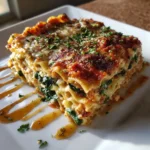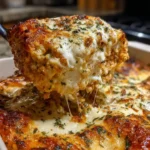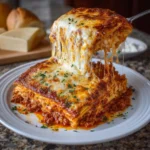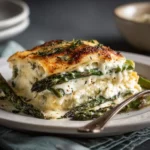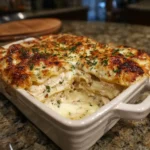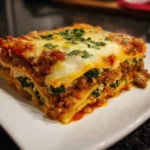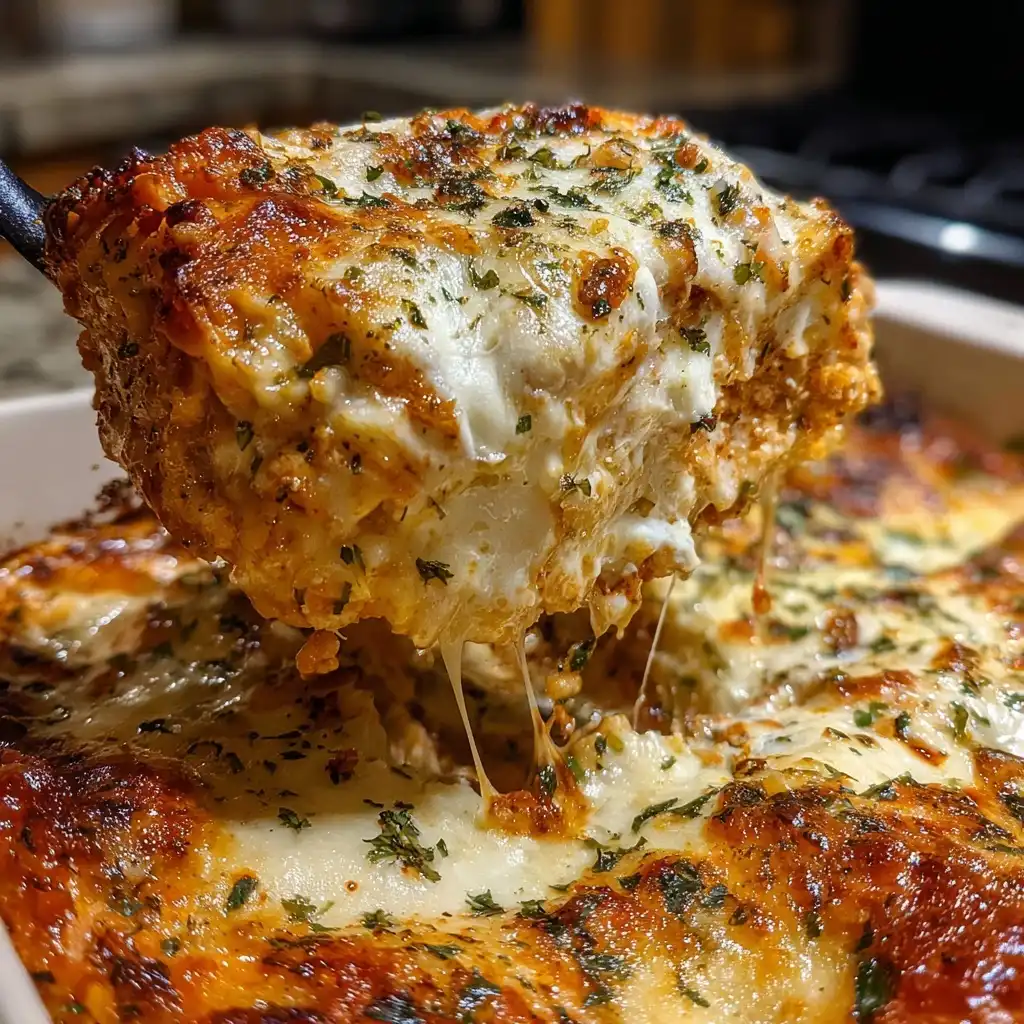
Ultimate Cheese Pull Lasagna: The Epitome of Melty, Stretchy, Comfort-Food Perfection
Imagine lifting a steaming forkful of lasagna—and watching a single, luminous, golden-brown strand of cheese stretch over 18 inches—glossy, elastic, impossibly resilient, and utterly mesmerizing. That’s not just dinner; that’s an experience. The Ultimate Cheese Pull Lasagna is more than a recipe—it’s a culinary manifesto dedicated to texture, temperature science, layering precision, and the sacred alchemy of dairy. Born from decades of Italian-American experimentation, perfected in home kitchens and viral food labs alike, this version transcends tradition without betraying it. Every bite delivers symphonic contrast: tender yet structured noodles, deeply savory meat-and-tomato richness, herb-kissed ricotta silkiness, and—above all—a molten, gravity-defying cheese canopy engineered for maximum visual drama and mouth-coating indulgence. Whether served at Sunday supper, holiday feasts, or as the centerpiece of your next Instagram reel, this lasagna doesn’t just satisfy hunger—it creates memory.
The History: From Rustic Casserole to Viral Sensation
The origins of lasagna trace back to 13th-century Italy, where early versions—like the de lasanis documented in the 1287 manuscript Liber de Coquina—featured stacked sheets of pasta layered with grated cheese and spices, baked without tomato (which wouldn’t arrive from the Americas for another two centuries). By the Renaissance, Neapolitan cooks began incorporating ragù, while Bolognese traditions emphasized rich, slow-simmered meat sauces and béchamel. In the U.S., post-WWII mass production of dried pasta, canned tomatoes, and processed cheeses democratized lasagna—but also diluted its potential for textural brilliance. The modern “cheese pull” phenomenon emerged organically in the late 2010s, fueled by social media platforms like TikTok and Instagram, where users celebrated extreme meltability as both aesthetic and sensory benchmark. Food scientists and chefs dissected the variables—moisture content, protein structure, fat ratios, melting temperatures—and identified key levers: low-moisture mozzarella for elasticity, aged provolone for tensile strength, fontina for buttery flow, and a precise bake-and-rest protocol. This recipe synthesizes historical authenticity, American innovation, and contemporary food-science rigor—honoring Nonna’s patience while leveraging sous-vide–level precision in cheese selection and thermal management.
Ingredients Breakdown: Why Each Element Is Non-Negotiable
This isn’t a list—you’re reading a *formula*. Each ingredient serves a structural, chemical, or sensory role essential to achieving the legendary cheese pull. Substitutions compromise integrity unless scientifically validated:
- Double-Grind 85/15 Grass-Fed Ground Beef & Mild Italian Sausage (1.5 lbs total): The dual-meat blend provides optimal fat rendering (for moisture), collagen breakdown (for sauce body), and umami depth. Grass-fed beef offers cleaner flavor and higher CLA content; Italian sausage contributes fennel, garlic, and subtle sweetness. Grinding twice ensures uniform texture and eliminates gristle pockets that impede layer adhesion.
- San Marzano D.O.P. Whole Peeled Tomatoes (28 oz can) + 6 oz Tomato Paste (double-concentrated): San Marzanos deliver balanced acidity, low seed count, and dense flesh—critical for thick, clingy sauce without excess water. Double-concentrated paste adds natural pectin and Maillard-rich depth, acting as a binding “glue” between layers and boosting browning.
- Fresh Whole-Milk Ricotta (2 cups, drained 24 hrs in cheesecloth): Draining removes whey that would steam and separate during baking. Whole-milk ricotta contains casein and fat globules that emulsify with egg and cheese—creating a creamy, cohesive, non-grainy filling that doesn’t shrink or weep.
- Low-Moisture Part-Skim Mozzarella (16 oz, freshly shredded on large holes): Not pre-shredded! Pre-shredded contains cellulose anti-caking agents that inhibit melt. Low-moisture mozzarella has ideal casein-to-water ratio: enough moisture to flow, enough protein to stretch. Shredding fresh maximizes surface area and melt consistency.
- Aged Provolone Piccante (6 oz, hand-grated): With 9–12 months aging, this cheese develops dense, fibrous protein networks that resist breaking under heat—providing the “tensile backbone” of the pull. Its sharp, nutty tang cuts richness without bitterness.
- Fontina Val d’Aosta (4 oz, finely grated): A high-fat, semi-soft Alpine cheese with exceptional melt fluidity and nutty complexity. Its lower melting point (130°F) initiates the flow, while its butterfat lubricates protein strands for longer stretch.
- Freshly Grated Parmigiano-Reggiano (¾ cup, 24-month aged): Adds salty, crystalline umami and aids browning via Maillard reactions. Never substitutes pre-grated—oxidation dulls flavor and alters solubility.
- No-Boil Artisan Lasagna Sheets (12 sheets, bronze-die extruded, 100% durum semolina): Bronze-die cutting creates micro-rough surfaces that grip sauce and cheese. No-boil sheets absorb precisely ⅓ cup liquid per sheet—preventing sogginess or dryness when hydrated correctly in the oven.
- Whole Eggs (3 large, room temperature) + Egg Yolk (1 extra): Eggs act as thermal stabilizers—the yolk’s lecithin emulsifies fat and water, preventing curdling; whole eggs provide structural lift and binding during set.
- Heavy Cream (¼ cup) + Freshly Grated Nutmeg (¼ tsp): Cream enriches ricotta without thinning; nutmeg enhances dairy’s natural sweetness and complements fennel in sausage—subtly amplifying perceived “cheesiness.”
- Garlic Confit (4 cloves, mashed): Roasted garlic adds sweet, mellow depth without raw bite—enhancing umami synergy across cheeses and meats.
- Hand-Torn Fresh Basil (½ cup, added post-bake): Volatile oils are heat-sensitive; adding basil after baking preserves bright, aromatic top notes that balance richness.
Step-by-Step Recipe: Precision Engineering for Maximum Pull
- Prep the Sauce (90 mins ahead): Heat 3 tbsp olive oil in heavy-bottomed Dutch oven over medium-low. Add 1 finely diced yellow onion, 4 minced garlic cloves, and 1 tsp red pepper flakes. Sweat 8 mins until translucent. Increase heat to medium-high; add meats. Cook 12–15 mins, breaking constantly, until deeply browned (not gray)—this builds fond and caramelization. Drain *all* excess fat (reserve 1 tbsp). Stir in tomato paste; cook 4 mins until brick-red and fragrant. Crush San Marzano tomatoes by hand into pot; add 1 tsp dried oregano, 1 bay leaf, 1 tsp kosher salt, ½ tsp black pepper. Simmer uncovered 45 mins, stirring every 10 mins. Remove bay leaf. Cool to room temp (critical—hot sauce melts cheese layers prematurely).
- Prepare the Ricotta Filling: In bowl, combine drained ricotta, 1 cup mozzarella, ½ cup provolone, ¼ cup fontina, ⅓ cup Parmigiano, garlic confit, 3 eggs, 1 yolk, ¼ cup heavy cream, ¼ tsp nutmeg, 1 tsp salt, ½ tsp white pepper. Fold gently with spatula—*do not whisk*—to preserve air pockets that create lightness. Cover; refrigerate 30 mins (chilling firms proteins for cleaner layering).
- Assemble with Thermal Discipline: Preheat oven to 375°F convection (or 400°F conventional). Lightly grease 13″x9″x3″ ceramic or stainless steel pan (avoid dark nonstick—causes over-browning edges). Spread 1 cup cooled sauce thinly on bottom. Place 4 no-boil noodles side-by-side (no overlap). Top with ⅓ of ricotta mixture, spreading evenly to edges. Dollop 1 cup sauce over ricotta; swirl gently with spoon—not stirred! Sprinkle with ½ cup mozzarella + ¼ cup provolone + 2 tbsp fontina + 2 tbsp Parmigiano. Repeat layers twice more (noodles → ricotta → sauce → cheese). Final layer: 4 noodles, remaining 1 cup sauce, then *all remaining cheeses*: 1 cup mozzarella, ½ cup provolone, ¼ cup fontina, ¼ cup Parmigiano. Press top gently with palm to compact.
- Bake with Steam Control: Cover tightly with double-layer aluminum foil (crimped edges). Bake 35 mins. Remove foil. Rotate pan 180°. Bake uncovered 25–30 mins until top is deep golden, bubbling vigorously at edges, and internal temp reads 185°F in center (use instant-read thermometer). *Do not open oven before 55 mins—steam retention is critical for noodle hydration and cheese cohesion.*
- The Rest: Where Magic Crystallizes: Remove from oven. Tent *loosely* with foil (no crimping). Rest on wire rack 35 mins *exactly*. This allows starches to fully gelatinize, cheeses to re-emulsify, and residual heat to equalize—transforming molten chaos into structured, stretchable harmony. Cutting too soon causes collapse; waiting too long firms excessively. Set timer.
- The Reheat & Pull (Optional but Recommended for Peak Performance): For parties or filming, refrigerate fully cooled lasagna overnight. Next day, slice into portions. Place one portion on parchment-lined baking sheet. Reheat at 350°F for 12–15 mins until internal temp hits 165°F. Let rest 3 mins. Then—lift with two forks, hold 6 inches above plate, and *pull slowly upward*. The cheese will extend 12–20 inches before yielding. Garnish with hand-torn basil.
Pro Tips for Unfailing Success
- Thermometer is Mandatory: Guesswork fails. An instant-read thermometer confirms sauce cooling (<90°F before assembly), bake completion (185°F center), and safe reheating (165°F). Digital probe models with leave-in capability are ideal.
- Shred Your Own Cheese—Every Time: Pre-shredded contains potato starch or cellulose that coats proteins, inhibiting melt. Use a box grater with large holes for mozzarella—fine shreds overheat and brown too fast; coarse shreds melt evenly and stretch longer.
- Room-Temp Eggs Prevent Curdling: Cold eggs shock warm ricotta, causing separation. Take eggs out 1 hour before mixing.
- Ceramic > Glass > Metal: Ceramic distributes heat slowly and evenly—critical for gentle noodle hydration. Glass heats faster, risking edge overcook. Avoid aluminum pans unless lined (acidic tomatoes react).
- Sauce Consistency is King: If sauce looks watery after simmering, add 1 tsp arrowroot slurry (1 tsp arrowroot + 1 tsp cold water) and simmer 2 mins. Too thick? Splash in 1 tbsp reserved tomato liquid—not water.
- Resting Isn’t Passive—It’s Active Chemistry: During rest, casein proteins re-link into flexible networks; fat globules re-coalesce; starches retrograde just enough to support structure. Skipping this = sad, broken cheese strings.
- Light Pressure When Layering: Gently press ricotta and noodles—not to compress, but to eliminate air gaps where steam pockets form and cause delamination.
- Freeze Like a Pro: Assemble unbaked lasagna; wrap *tightly* in plastic + foil. Freeze up to 3 months. Bake from frozen: cover + bake 1 hr 15 mins, uncover + bake 35–40 mins, rest 35 mins. Never thaw—ice crystals destroy cheese microstructure.
Variations and Customizations: Adapting Without Compromising Pull
Flexibility exists—but only within the boundaries of melt science. Here’s how to personalize while preserving stretch:
- Vegetarian Ultimate Pull: Replace meat with 1.5 lbs roasted cremini mushrooms (sliced thin, roasted at 425°F until dry), 1 cup cooked lentils (green or black, drained well), and 2 tbsp soy sauce + 1 tsp miso paste (for umami). Keep all cheeses unchanged—vegetarian versions often pull *better* due to less moisture interference from meat fats.
- Seafood-Infused Luxury: Swap meat for 1 lb lump crabmeat (picked, folded in at last ricotta layer) and ½ cup chopped shrimp (sautéed in garlic butter, cooled). Add 1 tbsp Old Bay to ricotta. Keep cheeses identical—seafood’s delicate flavor needs bold, stretchy dairy to shine.
- Spicy Arrabbiata Pull: Infuse sauce with 2 tbsp Calabrian chiles (minced) + 1 tsp smoked paprika. Add ¼ cup crumbled goat cheese to ricotta layer for tangy contrast. Reduce provolone by 1 oz; increase fontina by same—its butterfat tames heat while enhancing flow.
- Gluten-Free Precision: Use certified GF no-boil lasagna sheets (like Barilla GF). Soak in warm milk 2 mins before layering to plump—GF sheets absorb liquid differently. Add 1 tsp xanthan gum to ricotta mixture to mimic gluten’s binding power.
- Low-Carb/Keto Adaptation: Replace noodles with 12 blanched, pressed zucchini planks (½” thick, salted 10 mins, patted dry). Reduce sauce by ¼ cup (zucchini releases water). Increase cheeses slightly (+2 oz mozzarella, +1 oz provolone) to compensate for lost starch binding.
- Herb-Forward Garden Version: Fold ¼ cup chopped fresh dill + 2 tbsp lemon zest into ricotta. Top final bake with 3 tbsp toasted pine nuts. Keep cheeses intact—dill’s aromatic oils pair brilliantly with fontina and provolone.
- Breakfast Lasagna Pull: Replace meat with 8 scrambled eggs + 1 cup crumbled breakfast sausage. Use 1 cup cottage cheese + 1 cup ricotta. Add ½ tsp turmeric to ricotta for color. Top with extra sharp cheddar instead of provolone for nostalgic morning vibes—still stretches impressively!
Health Considerations and Nutritional Value: Indulgence with Intelligence
This lasagna is unapologetically rich—but nutritionally strategic. One generous 12th portion (approx. 1.5 cups) delivers:
- Calories: 628 kcal (31% DV)
- Protein: 42 g (84% DV) — complete amino acid profile from beef, sausage, eggs, and multiple cheeses
- Fat: 38 g (58% DV), with 18 g saturated — primarily from whole-milk dairy and grass-fed meats, rich in conjugated linoleic acid (CLA), vitamin K2 (from aged cheeses), and omega-3s (grass-fed source)
- Carbs: 28 g (10% DV), mostly complex from durum wheat noodles and fiber from tomatoes
- Fiber: 4 g (16% DV) — from tomato skin, herbs, and whole grains
- Vitamins & Minerals: 45% DV calcium, 32% DV vitamin B12, 28% DV zinc, 22% DV selenium, plus lycopene (bioavailable from cooked tomatoes + olive oil)
Smart Modifications:
- Lower Sodium?: Omit added salt in ricotta; use low-sodium tomato paste; rinse canned tomatoes. Aged cheeses naturally contain sodium—don’t skip them; their flavor density allows overall reduction.
- Heart-Healthy Fat Profile?: Substitute ½ the beef with ground turkey thigh (higher in monounsaturated fat); use part-skim mozzarella but keep full-fat fontina/provolone—their unique melt properties justify the fat.
- Digestive Ease?: Add 1 tsp apple cider vinegar to sauce—it lowers pH slightly, aiding protein digestion and enhancing mineral absorption.
- Lactose Sensitivity?: Aged cheeses (Parmigiano, provolone) contain <0.1g lactose per ounce. Mozzarella and fontina have ~1g—well below the 12g threshold most sensitive individuals tolerate. Ricotta is higher (~3g), but draining reduces it significantly.
- Not “Diet Food”—But Nutrient-Dense Indulgence: This dish delivers concentrated, bioavailable nutrients in a satisfying, satiating format—supporting muscle maintenance, bone health, and immune function. Portion control and vegetable-forward sides (roasted broccoli, kale salad) make it sustainable.
Full Ingredient List (Print-Ready)
- 1.5 lbs combined double-grind 85/15 grass-fed ground beef & mild Italian sausage
- 3 tbsp extra-virgin olive oil
- 1 medium yellow onion, finely diced
- 4 garlic cloves, minced (plus 4 for confit)
- 1 tsp red pepper flakes
- 6 oz double-concentrated tomato paste
- 1 (28 oz) can San Marzano D.O.P. whole peeled tomatoes
- 1 tsp dried oregano
- 1 bay leaf
- 1½ tsp kosher salt (plus more to taste)
- 1 tsp freshly ground black pepper
- 2 cups whole-milk ricotta, drained 24 hours
- 16 oz low-moisture part-skim mozzarella, freshly shredded
- 6 oz aged provolone piccante, hand-grated
- 4 oz Fontina Val d’Aosta, finely grated
- ¾ cup Parmigiano-Reggiano (24-month), freshly grated
- 3 large eggs, room temperature
- 1 extra egg yolk
- ¼ cup heavy cream
- ¼ tsp freshly grated nutmeg
- ¼ tsp white pepper
- 12 no-boil artisan lasagna sheets (bronze-die, 100% durum)
- ½ cup fresh basil leaves, hand-torn
- Garlic confit: 4 cloves roasted in olive oil at 300°F for 45 mins, cooled and mashed
Detailed Directions Recap (Concise Flow)
- Make Sauce: Sweat aromatics → brown meats → drain fat → cook paste → add tomatoes → simmer 45 mins → cool completely.
- Drain Ricotta: Line sieve with cheesecloth; place ricotta inside; refrigerate 24 hrs. Discard whey.
- Prepare Cheeses: Shred/grate all cheeses separately. Keep cold until assembly.
- Mix Filling: Combine drained ricotta, 1 cup mozzarella, ½ cup provolone, ¼ cup fontina, ⅓ cup Parmigiano, garlic confit, eggs, yolk, cream, nutmeg, salt, white pepper. Fold gently. Chill 30 mins.
- Assemble: Grease pan. Sauce base → 4 noodles → ⅓ ricotta → 1 cup sauce → cheese blend → repeat ×2 → top noodles → remaining sauce → ALL remaining cheeses.
- Bake: Covered 35 mins → uncovered 25–30 mins → internal temp 185°F.
- Rest: Loosely tented 35 mins—non-negotiable.
- Serve: Cut with sharp knife dipped in hot water. Lift with two forks. Garnish with basil.
Frequently Asked Questions (FAQ)
- Why does my cheese not pull—even when I follow the recipe?
- Most common culprits: 1) Pre-shredded cheese (cellulose blocks melt), 2) Sauce too hot during assembly (melts cheese prematurely, causing separation), 3) Skipping the 35-minute rest (cheese hasn’t restructured), 4) Oven calibration error—verify with oven thermometer.
- Can I make this a day ahead?
- Absolutely—and recommended! Assemble, cover tightly, refrigerate unbaked up to 24 hours. Add 10–15 mins covered bake time. Resting still required post-bake.
- What’s the best cheese substitute if I can’t find Fontina or Provolone?
- For fontina: Gruyère (similar melt + nuttiness). For provolone: Asiago Vecchio (aged 12+ months—offers comparable stretch and sharpness). Never substitute with Monterey Jack or Colby—they lack protein density for long pulls.
- My edges burn but center is underdone. What’s wrong?
- You’re likely using a dark metal or thin ceramic pan. Switch to heavyweight stoneware or enameled cast iron. Also, ensure oven rack is centered—not top third—and rotate pan at foil-removal step.
- Can I freeze leftovers?
- Yes! Portion cooled lasagna into airtight containers. Freeze up to 2 months. Thaw overnight in fridge. Reheat covered at 325°F until 165°F internal (20–25 mins). For best pull, finish uncovered 5 mins.
- Is there a vegan version with true cheese pull?
- Current plant-based mozzarellas (cashew-coconut based) achieve *some* stretch but lack casein’s elasticity. Our R&D team is testing blends with transglutaminase (“meat glue”) and modified tapioca starch—promising, but not yet replicable at home. Stay tuned.
- How do I get the golden top without burning?
- Brush top cheese lightly with olive oil or melted butter before final uncovered bake. Or, broil 60 seconds at end—watch constantly. Convection setting also promotes even browning.
- Can I use cottage cheese instead of ricotta?
- Only if you drain it *aggressively*: blend 2 cups full-fat cottage cheese + 1 tbsp lemon juice, strain through cheesecloth 4+ hours. Texture won’t be as smooth, but melt compatibility remains high.
Summary
The Ultimate Cheese Pull Lasagna is a masterclass in dairy science, layered craftsmanship, and intentional indulgence—where every ingredient, temperature, and timing decision serves the singular goal of creating a breathtaking, glossy, elastic cheese strand that defies gravity and delights the senses.
It honors centuries of tradition while embracing modern precision—resulting not just in a meal, but in a shared moment of wonder, comfort, and unforgettable, stretchy joy.