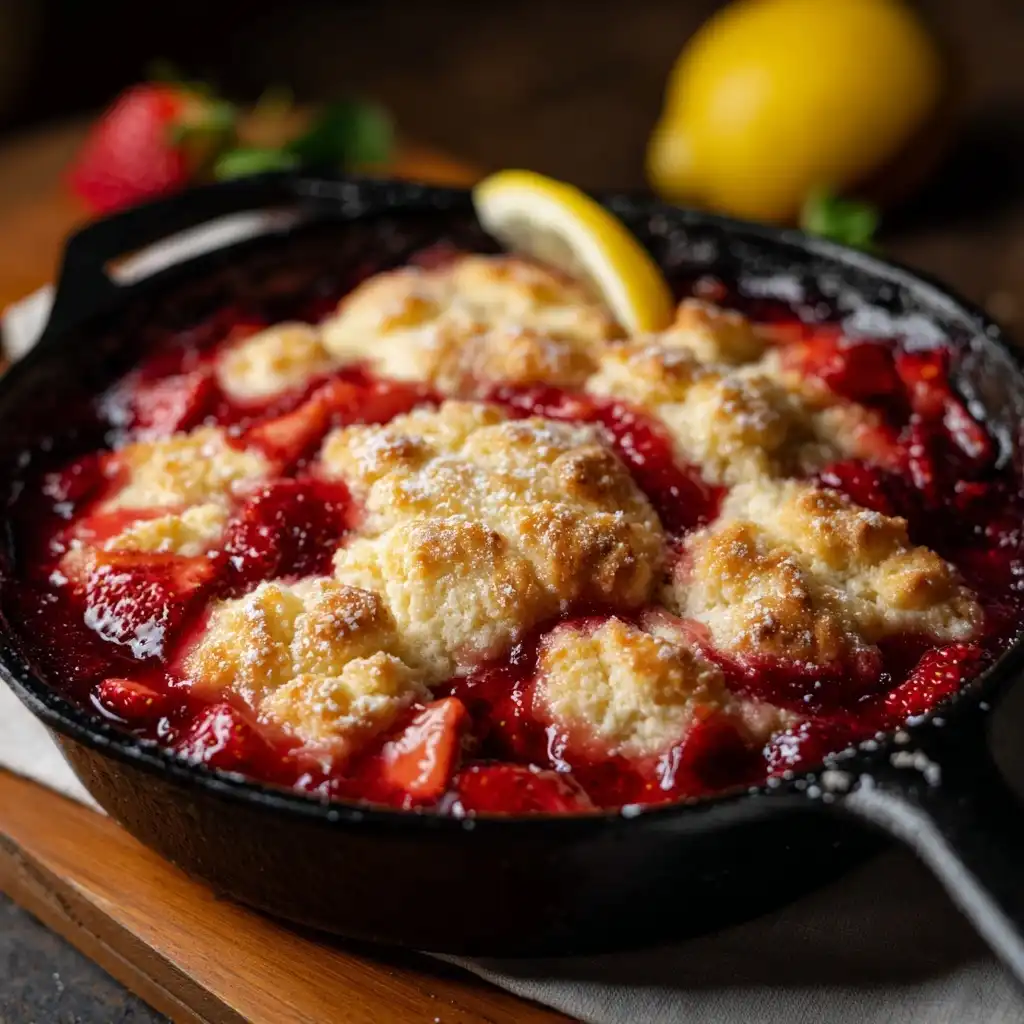
Introduction
Strawberry Lemon Cobbler is a vibrant, sun-kissed dessert that marries the luscious sweetness of ripe strawberries with the bright, zesty tang of fresh lemon—a harmonious balance of summer’s most joyful flavors. Unlike traditional cobblers that lean heavily on apples or peaches, this version bursts with ruby-red berries and citrusy lift, offering a refreshing twist that feels both nostalgic and utterly modern. Its rustic charm lies in its simplicity: no fancy techniques, no obscure ingredients—just tender fruit bubbling beneath a golden, biscuit-like topping that soaks up the syrupy juices without turning soggy. Whether served warm from the oven with a scoop of vanilla bean ice cream, drizzled with lemon-infused whipped cream, or enjoyed at room temperature with a dusting of powdered sugar, Strawberry Lemon Cobbler delivers comfort with a spirited kick. It’s the kind of dessert that sparks conversation at potlucks, earns second helpings at backyard barbecues, and becomes a cherished seasonal ritual—especially when local strawberries are at their peak and lemons are fragrant and juicy.
The History
Cobbler as a dessert form traces its roots to early American colonial times, evolving from British “cobs” (a type of dumpling) and Dutch “koffiekoek” traditions, but it truly blossomed in the American South and Midwest during the 19th century. With limited access to refined ingredients and ovens often used for multiple purposes, settlers adapted by baking fruit desserts topped with simple biscuit or cake-like doughs—hence the name “cobbler,” evoking the rough, cobblestone-like appearance of the uneven, dropped-topping surface. Strawberries, native to North America and cultivated by Indigenous peoples long before European contact, were among the earliest fruits preserved and celebrated in colonial cooking. Lemon, though not native, arrived via trade routes and became prized for its preservative qualities and ability to brighten rich or overly sweet preparations. The marriage of strawberry and lemon in cobbler likely emerged organically in the late 1800s and early 1900s—first in handwritten family cookbooks and community church fundraisers—as home cooks sought ways to balance the sometimes-overly-sweet nature of summer berries and prevent browning or mushiness in prolonged baking. By the mid-20th century, regional variations appeared across Appalachia, the Pacific Northwest, and Florida’s citrus belt, each adding local flourishes: some with cornmeal in the biscuit, others with brown sugar–lemon zest streusel, and many incorporating buttermilk for tenderness. Today, Strawberry Lemon Cobbler stands as a testament to American culinary ingenuity—rooted in frugality, elevated by seasonality, and beloved for its unpretentious elegance.
Ingredients Breakdown
Every exceptional Strawberry Lemon Cobbler begins with intention behind each ingredient—not just quantity, but quality, function, and synergy. Below is a meticulous breakdown of why each component matters:
- Fresh Strawberries (1 lb, hulled & halved or quartered): The star of the filling. Choose deeply red, fragrant, locally grown berries at peak ripeness—underripe berries lack sweetness and aroma; overripe ones disintegrate. Their natural pectin helps thicken the syrup, while their water content creates steam that lifts the topping. Frozen strawberries (unsweetened, thawed and well-drained) are a viable off-season alternative—but expect a slightly softer texture and reduced brightness.
- Fresh Lemon Juice (3–4 tbsp, freshly squeezed): Not bottled. Real lemon juice provides volatile citrus oils and nuanced acidity that bottled versions lack. It cuts through sweetness, enhances strawberry flavor (a phenomenon known as “flavor amplification”), and prevents enzymatic browning. Adjust upward if using exceptionally sweet berries or downward if berries are tart.
- Lemon Zest (1½–2 tsp, finely grated): The aromatic goldmine. Zest contains limonene-rich oils concentrated in the yellow peel—zero bitterness, all fragrance. It adds dimension far beyond juice alone and ensures lemon presence survives baking. Use a microplane for fine, even zest; avoid the white pith, which is intensely bitter.
- Granulated Sugar (¾ cup, plus more for topping): Provides structure, sweetness, and caramelization. Less sugar allows the berries’ natural complexity to shine; more yields a jammy, glossy syrup. For refined depth, substitute up to ¼ cup with light brown sugar—the molasses adds warmth and subtle caramel notes.
- Cornstarch (2 tbsp): The ideal thickener for fruit fillings. It’s clear when cooked, neutral in flavor, and activates at a lower temperature than flour—crucial for preventing runny cobbler. Too little = soupy; too much = gummy. Whisk thoroughly with dry sugar first to prevent clumping.
- Unsalted Butter (6 tbsp, cold & cubed): Adds richness, flakiness, and steam pockets in the biscuit topping. Cold butter is non-negotiable—it melts slowly in the oven, creating airy layers. Salted butter can be used, but reduce added salt accordingly.
- All-Purpose Flour (1¼ cups): The structural backbone of the biscuit. Standard AP flour (10–11% protein) gives optimal tenderness without toughness. For gluten-free versions, use a 1:1 certified GF blend with xanthan gum.
- Baking Powder (2 tsp) & Baking Soda (¼ tsp): A dual-leavening system. Baking powder provides reliable lift; baking soda (activated by lemon juice’s acidity) adds extra rise and neutralizes excess acid, yielding a more balanced, less sharp finish.
- Granulated Sugar (⅓ cup, for topping batter): Sweetens the biscuit itself and aids in browning. Turbinado or demerara sugar sprinkled on top before baking adds delightful crunch and sparkle.
- Heavy Cream or Buttermilk (¾ cup, cold): Liquid binder that hydrates the dry ingredients. Heavy cream yields a richer, more tender biscuit; buttermilk adds subtle tang and tenderness via lactic acid. Whole milk works in a pinch, but avoid low-fat or non-dairy milks unless specially formulated for baking—they lack fat and protein needed for structure.
- Coarse Sea Salt (¼ tsp, plus flaky salt for finishing): Enhances every other flavor. Even in sweet applications, salt deepens perception of sweetness and rounds out acidity.
Step-by-Step Recipe
- Preheat & Prep: Position oven rack in the center. Preheat oven to 375°F (190°C). Lightly grease a 9×13-inch ceramic or glass baking dish (or two 8-inch square dishes for portion control). Line a baking sheet with parchment—this catches potential bubbles and eases cleanup.
- Prepare the Filling: In a large bowl, gently combine hulled and halved strawberries, granulated sugar (¾ cup), cornstarch, lemon juice, lemon zest, and a pinch of salt. Stir just until evenly coated—avoid crushing berries. Let macerate 15–20 minutes at room temperature. You’ll notice deep red liquid pooling—a sign the sugar is drawing out juices and the cornstarch is beginning to disperse.
- Make the Biscuit Topping: In a food processor (or large bowl + pastry cutter), pulse or cut cold, cubed butter into flour, baking powder, baking soda, ⅓ cup sugar, and ¼ tsp salt until mixture resembles coarse meal with pea-sized butter pieces. Transfer to a bowl. Gradually pour in cold heavy cream (or buttermilk), stirring with a fork just until a shaggy, slightly sticky dough forms—do not overmix. Dough should hold together when pinched but not be wet or shiny. If too dry, add 1 tsp cream; if too wet, sprinkle in 1 tsp flour.
- Assemble the Cobbler: Pour the macerated berry mixture—including all accumulated juices—into the prepared baking dish. Spread evenly. Using a ¼-cup measuring cup or ice cream scoop, drop 8–10 generous mounds of biscuit dough over the fruit, spacing them evenly. Gently press each mound slightly to flatten (they’ll puff dramatically). Brush tops lightly with extra cream and sprinkle generously with turbinado sugar and a pinch of flaky sea salt.
- Bake with Precision: Place dish on the parchment-lined baking sheet. Bake for 45–55 minutes, rotating halfway through, until the biscuit topping is deeply golden brown, puffed, and springy to the touch, and the fruit filling is bubbling vigorously around the edges (bubbling indicates proper thickening temperature has been reached—212°F/100°C). A toothpick inserted into the center of a biscuit should come out clean or with moist crumbs (not wet batter).
- Cool & Set: Remove from oven and let rest on a wire rack for *at least 30 minutes* before serving. This critical step allows the filling to thicken fully as starches complete gelation and the biscuit to firm slightly—serving too soon results in collapsed topping and soupy filling. For best texture and flavor integration, cool 45–60 minutes.
Tips
- Strawberry Selection Secret: Taste a berry before buying. If it’s bland raw, it’ll be bland baked. Look for berries with deep, uniform red color (no white shoulders), plump shape, and a sweet, floral aroma at the stem end.
- Zest Before Juicing: Always zest lemons *before* squeezing—once juiced, the peel dries out and becomes difficult to grate finely.
- Cold Is Crucial: Chill your mixing bowl and fork before making the biscuit dough. Even 5 minutes in the freezer helps maintain butter integrity.
- No Overmixing Zone: Stir biscuit batter only until *just combined*. Overworked gluten = tough, dense biscuits. Lumps are welcome; smooth batter is a red flag.
- Steam Vent Strategy: If your dish has high sides and you notice excessive bubbling over the edges, carefully lift one corner of the biscuit topping with a spatula during the last 10 minutes to release steam and prevent overflow.
- Golden Browning Boost: For extra caramelized crust, switch oven to broil for the final 1–2 minutes—but watch constantly. Or brush with honey-thinned cream (1 tsp honey + 1 tsp cream) in the last 5 minutes.
- Leftover Magic: Day-old cobbler reheats beautifully. Cover loosely with foil and warm at 325°F for 15–20 minutes. Top with lemon curd or mascarpone whipped cream for renewed luxury.
- Freezing Friendly: Assemble unbaked cobbler, cover tightly with plastic wrap + foil, and freeze up to 3 months. Bake from frozen—add 15–20 minutes to bake time and tent with foil if topping browns too fast.
Variations and Customizations
This recipe is gloriously adaptable—here are inspired, tested variations that maintain structural integrity while expanding flavor horizons:
- Strawberry-Lemon-Rhubarb Cobbler: Replace 1 cup of strawberries with 1 cup diced, peeled rhubarb (tartness pairs brilliantly with lemon). Add 1 extra tbsp sugar to filling. Rhubarb’s high pectin means reduce cornstarch to 1½ tbsp.
- Honey-Lavender Infusion: Substitute ¼ cup of granulated sugar with local wildflower honey in the filling. Add ½ tsp culinary-grade dried lavender buds (crushed between fingers) with the lemon zest. Omit zest if using lavender—its floral note dominates.
- Oat-Top Crisp Variation: Replace half the biscuit flour (⅝ cup) with old-fashioned rolled oats. Add 1 tbsp maple syrup to the biscuit batter and increase baking time by 5 minutes. Yields a heartier, nuttier, chewier topping.
- Coconut-Lime Twist: Swap lemon juice/zest for equal parts fresh lime juice and zest. Use coconut milk (full-fat, canned) instead of heavy cream in the biscuit. Toast ¼ cup unsweetened shredded coconut and sprinkle on top before baking.
- Gluten-Free Adaptation: Use 1:1 gluten-free flour blend (like King Arthur or Bob’s Red Mill) *with xanthan gum included*. Add ½ tsp additional xanthan gum to ensure binding. Increase cream by 1 tbsp—GF flours absorb more liquid.
- Vegan Version: Use cold vegan butter (Miyoko’s or Earth Balance), full-fat coconut milk (chilled, solid part only), and flax egg (1 tbsp ground flax + 2.5 tbsp water, rested 5 min) in place of cream. Ensure cornstarch is non-GMO/corn-derived. Top with coconut sugar.
- Herbal Elegance: Stir 1 tbsp finely chopped fresh basil or mint into the filling after maceration. Adds an unexpected, sophisticated aromatic layer that complements both strawberry and lemon.
- Spiced Warmth: Add ¼ tsp freshly grated nutmeg + ⅛ tsp ground cardamom to the biscuit dry ingredients. Pairs especially well with brown sugar in the filling.
Health Considerations and Nutritional Value
While Strawberry Lemon Cobbler is inherently a treat—not a health food—it can be thoughtfully composed to maximize nutritional merit without sacrificing joy. A standard serving (1/12 of a 9×13-inch pan) contains approximately:
- Calories: ~320–360 kcal (varies with sugar/butter adjustments)
- Carbohydrates: ~48g (of which 32g naturally occurring sugars from fruit + added sugar)
- Fiber: ~3g (from strawberries—nearly 10% DV—plus any oats or whole-grain flour substitutions)
- Vitamin C: ~95mg (over 100% DV—thanks to strawberries + lemon)
- Manganese: ~0.4mg (20% DV—supports bone health and antioxidant enzymes)
- Potassium: ~220mg (supports blood pressure regulation)
Nutritional Highlights: Strawberries rank among the top fruits for antioxidant capacity (anthocyanins, ellagic acid, quercetin), shown in studies to support cardiovascular health and reduce oxidative stress. Lemon zest contains limonene, a compound under investigation for anti-inflammatory and digestive-supportive properties. The vitamin C in both ingredients significantly boosts iron absorption from plant-based foods—so pairing cobbler with a spinach salad later? A smart synergy.
Considerations for Mindful Enjoyment: Reduce added sugar by 25% (to ½ cup) without compromising structure—ripeness compensates. Opt for organic strawberries to minimize pesticide exposure (they’re on the EWG’s “Dirty Dozen”). Use grass-fed butter for higher CLA (conjugated linoleic acid) content. Serve modest portions (⅔ cup) alongside Greek yogurt (protein/fat slows sugar absorption) rather than ice cream. Those managing blood sugar may appreciate the fiber-buffering effect of whole strawberries versus juice or preserves—and the acidity of lemon helps blunt glycemic response.
What It’s Not: Not low-calorie, low-sugar, or low-fat. Not a meal replacement. But as part of a varied, predominantly whole-food diet, it’s a nutrient-dense celebration—not empty calories.
Ingredients
- 1 pound fresh strawberries (about 3–4 cups), hulled and halved or quartered (see Tips for selection)
- ¾ cup granulated sugar, plus 2 tablespoons for topping (divided)
- 2 tablespoons cornstarch
- 3–4 tablespoons fresh lemon juice (from 1–2 medium lemons)
- 1½–2 teaspoons finely grated lemon zest (from same lemons)
- ¼ teaspoon fine sea salt
- 6 tablespoons unsalted butter, very cold and cubed
- 1¼ cups all-purpose flour (spooned & leveled)
- 2 teaspoons baking powder
- ¼ teaspoon baking soda
- ¾ cup cold heavy cream or buttermilk
- Turbinado or demerara sugar, for sprinkling
- Flaky sea salt, for finishing
Directions
- Preheat oven to 375°F (190°C). Lightly grease a 9×13-inch baking dish. Line a rimmed baking sheet with parchment paper.
- In a large bowl, gently combine strawberries, ¾ cup granulated sugar, cornstarch, lemon juice, lemon zest, and ¼ tsp salt. Stir just until evenly coated. Let stand at room temperature for 15–20 minutes to macerate.
- While berries macerate, make biscuit topping: In a food processor, pulse flour, baking powder, baking soda, remaining 2 tbsp granulated sugar, and ¼ tsp salt until combined. Add cold cubed butter. Pulse 8–10 times until mixture resembles coarse meal with visible pea-sized butter pieces. Transfer to a medium bowl.
- Pour cold heavy cream (or buttermilk) over flour-butter mixture. Stir with a fork just until a shaggy, slightly sticky dough forms—about 12–15 strokes. Do not overmix.
- Pour macerated strawberry mixture—including all liquid—into prepared baking dish. Spread evenly.
- Using a ¼-cup measure or cookie scoop, drop 8–10 mounds of biscuit dough over fruit, spacing evenly. Gently press each mound to slightly flatten (½–¾ inch thick).
- Brush tops lightly with remaining cream (or a splash of cream). Sprinkle generously with turbinado sugar and a pinch of flaky sea salt.
- Place dish on prepared baking sheet. Bake 45–55 minutes, rotating halfway, until biscuit topping is deep golden brown, puffed, and springy, and filling bubbles vigorously around edges.
- Remove from oven and let cool on a wire rack for at least 30 minutes (ideally 45–60) before serving. This sets the filling and improves texture.
- Serve warm or at room temperature, optionally with vanilla ice cream, lemon whipped cream, or plain Greek yogurt.
FAQ
- Can I use frozen strawberries?
- Yes—but use unsweetened, thawed, and *thoroughly drained* (press gently in a clean towel). Expect a softer set and slightly muted flavor. Increase cornstarch to 2½ tbsp to compensate for extra liquid.
- Why did my cobbler turn out soupy?
- Most common causes: insufficient resting time (must cool 30+ mins), underbaking (filling must bubble vigorously), or cornstarch not fully activated (requires boiling temp for 2+ minutes). Also check expiration—old cornstarch loses thickening power.
- Can I prepare this ahead of time?
- Absolutely. Assemble up to 1 day ahead (unbaked), cover tightly, and refrigerate. Add 5–8 minutes to bake time. Or bake fully, cool completely, cover, and refrigerate up to 3 days—reheat covered at 325°F until warmed through.
- My biscuit topping sank into the fruit. What happened?
- Overmixing the dough develops gluten, weighing it down. Also, pouring hot, unthickened filling directly into the dish before topping can cause immediate sinking. Let macerated filling sit 15+ mins so juices begin to thicken slightly before assembling.
- Is there a dairy-free option that still delivers texture?
- Yes. Use cold refined coconut oil (solid state) instead of butter, and full-fat canned coconut milk (chilled, solid part only) instead of cream. Add ½ tsp apple cider vinegar to mimic buttermilk’s acidity. Texture will be slightly denser but rich and flavorful.
- How do I store leftovers?
- Cover tightly and refrigerate up to 4 days. Reheat individual portions in microwave (30–45 sec) or entire dish covered with foil at 325°F for 15–20 minutes. Freezing baked cobbler is not recommended—texture degrades.
- Can I double this recipe?
- Yes—use two 9×13-inch dishes or one 12×17-inch jelly roll pan. Keep oven temp same but increase bake time by 5–10 minutes. Check doneness by bubbling and golden color—not just time.
- What’s the best way to serve it for a dinner party?
- Warm, but not piping hot—cool 45 minutes. Scoop into wide, shallow bowls. Top with house-made lemon verbena whipped cream (heavy cream + lemon zest + 1 tsp honey + 1 tbsp lemon juice, whipped to soft peaks) and a fresh strawberry fan. Offer a small pitcher of extra lemon syrup (simmer ¼ cup lemon juice + 2 tbsp sugar + 1 tsp zest until dissolved) on the side.
Summary
Strawberry Lemon Cobbler is a luminous, seasonally grounded dessert where jewel-toned berries and vibrant citrus unite beneath a tender, golden biscuit crown—equal parts comforting tradition and bright, modern refreshment. With thoughtful ingredient choices, precise technique, and adaptable variations, it transforms humble pantry staples into a showstopping centerpiece that nourishes both body and spirit.
Bake it at peak strawberry season, share it generously, savor the contrast of warm fruit and cool cream—and remember: the best cobblers aren’t perfect. They’re alive with flavor, forgiving in method, and deeply, deliciously human.