Introduction
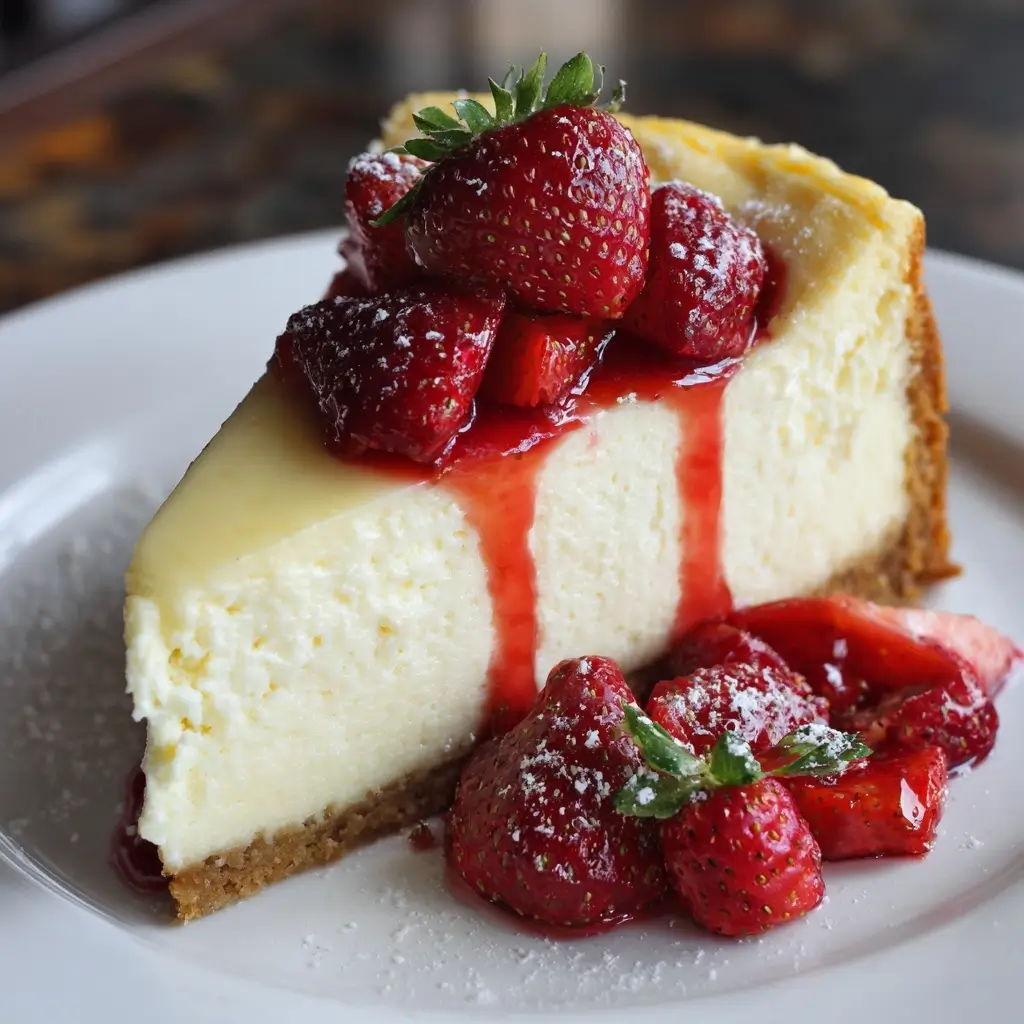
Classic New York Style Cheesecake is more than just a dessert—it’s an iconic culinary institution, revered for its dense, velvety texture, rich tang, and unmistakable elegance. Unlike lighter, fluffier cheesecakes found elsewhere, the true New York version delivers unapologetic decadence: luxuriously thick, remarkably smooth, with a pronounced cream cheese backbone balanced by subtle sweetness and a whisper of citrus. It’s the kind of cake that commands silence after the first bite—no airiness, no fuss, just pure, concentrated flavor and structure. Served chilled, often bare or with a restrained garnish like a single strawberry or a drizzle of sour cream, it epitomizes minimalist mastery. Whether enjoyed at legendary institutions like Junior’s, Lindy’s (in its heyday), or baked lovingly in home kitchens across Brooklyn and the Bronx, this cheesecake stands as a testament to precision, patience, and pride in tradition.
The History
The origins of New York Style Cheesecake trace back to the late 19th and early 20th centuries, rooted in the confluence of European baking traditions and American innovation. German and Eastern European Jewish immigrants brought their versions of *käsekuchen*—dense, farmer’s cheese–based cakes—to Lower Manhattan and the Lower East Side. These early iterations were often baked in springform pans and enriched with cottage or pot cheese. The pivotal evolution came in the 1920s when William Lawrence, a New York dairyman experimenting with French Neufchâtel, accidentally created a richer, creamier version—what we now know as modern cream cheese (marketed under the brand name Philadelphia Cream Cheese by 1880). By the 1930s–40s, restaurants like Reuben’s and later Junior’s in Brooklyn began refining the formula: replacing cottage cheese with full-fat cream cheese, adding heavy cream or sour cream for silkiness, incorporating eggs for structure, and baking in a water bath for unparalleled evenness and crack resistance. The postwar boom cemented its status—Junior’s opened its Flatbush Avenue location in 1950, and its towering, sliceable, silver-foil-wrapped cheesecakes became synonymous with New York indulgence. Today, it’s protected less by law and more by reverence: true New York cheesecake must be dense, not jiggly; tall (at least 3 inches); baked—not no-bake; and crowned with a clean, pale golden surface, never browned.
Ingredients Breakdown
Every ingredient in authentic New York cheesecake plays a non-negotiable functional and flavor role—there are no “fillers” or shortcuts:
- Cream Cheese (full-fat, block-style): The absolute cornerstone—minimum 24 oz (680g), room temperature. Low-moisture, high-fat American cream cheese (e.g., Philadelphia) provides the signature richness, body, and slight tang. Avoid whipped, reduced-fat, or spreadable varieties—they contain stabilizers and excess air that compromise density and cause cracking.
- Granulated Sugar: Not merely for sweetness—it aids in aeration during mixing, contributes to structure via sugar-protein binding, and helps control moisture migration during baking and chilling. Typically 1 ¼ to 1 ½ cups (250–300g), adjusted for preferred sweetness level.
- Sour Cream: Adds acidity for balance, fat for mouthfeel, and moisture without thinning the batter. Full-fat (not light or fat-free) is essential—about 1 cup (240g). It also promotes tenderness and inhibits gluten development in the crust.
- Heavy Cream (or sometimes whipping cream): Provides luxurious fat content (36–40% milkfat) and contributes to the signature melt-in-the-mouth texture. Approximately ⅔ cup (160ml); ultra-pasteurized is acceptable, but avoid ultra-high-temp (UHT) cream if possible for best emulsification.
- Eggs (large, room temperature): Act as both binder and leavening agent. Typically 4–5 eggs provide structural integrity without making the cake rubbery. Overmixing after adding eggs introduces air, increasing crack risk—so fold gently.
- Vanilla Extract (pure, not imitation): Enhances depth and rounds out acidity. 1–2 tsp. Some traditionalists add a tiny pinch of salt to the extract beforehand to heighten complexity.
- Fresh Lemon Juice & Zest: A hallmark of authenticity—1–2 tsp juice and 1 tsp finely grated zest lend bright, clean acidity that cuts through fat and prevents cloying richness. Bottled juice lacks volatile citrus oils and can impart bitterness.
- Graham Cracker Crust Ingredients: 1 ½ cups (150g) finely crushed graham crackers (cinnamon or honey varieties discouraged for classic version), 6 tbsp (85g) unsalted butter (melted), and ¼ cup (50g) granulated sugar. The crust must be *pressed firmly* and *pre-baked* (blind-baked) to prevent sogginess and ensure clean slicing.
Note: No flour, cornstarch, or gelatin is used in traditional recipes—structure comes entirely from eggs, dairy fat, and precise thermal management.
Step-by-Step Recipe
- Prep the Pan (Critical First Step): Wrap the *outside* of a 9-inch (23cm) springform pan *tightly* with two overlapping layers of heavy-duty aluminum foil—ensure no gaps at the seam or base. This prevents water seepage during the water bath. Lightly grease the *inside* of the pan, then line the bottom with a parchment round cut to fit perfectly.
- Make the Crust: Pulse graham crackers in a food processor until fine crumbs form (no lumps). Mix with sugar and melted butter until resembles wet sand. Press *firmly and evenly* into the pan bottom and 1 inch up the sides using the flat bottom of a measuring cup or glass. Chill 15 minutes, then bake at 350°F (175°C) for 10 minutes. Cool completely on a wire rack—do not skip cooling; hot crust + cold batter = steam separation.
- Softening & Prepping Cream Cheese: Remove cream cheese blocks from fridge 2–3 hours ahead. Cut into 1-inch cubes and let sit at room temperature (68–72°F / 20–22°C) until yielding to gentle pressure—*never microwave*. Cold cream cheese won’t emulsify properly and will leave lumps.
- Whipping the Base: Using a stand mixer fitted with the paddle attachment (or hand mixer on low-medium), beat cream cheese on medium speed for 2–3 minutes until completely smooth, scraping bowl frequently. Add sugar gradually in 3 additions, beating 1 minute after each until fully incorporated and glossy—no graininess should remain.
- Incorporating Dairy: Reduce speed to low. Add sour cream and heavy cream in *two alternating additions*, beating just until combined after each (about 15 seconds). Overmixing here warms the batter and incorporates air—both lead to cracks.
- Adding Eggs (The Most Delicate Step): Add eggs *one at a time*, mixing on *lowest possible speed* just until yolk disappears (5–8 seconds per egg). Scrape bowl thoroughly after each. Then add vanilla, lemon juice, and zest—mix 5 seconds only. Batter should be homogenous, satiny, and slightly thick—like soft yogurt. If lumps persist, pass through a fine-mesh sieve *once*.
- Straining & Pouring: Strain batter into a large spouted measuring cup or bowl. Gently pour over cooled crust, smoothing top with an offset spatula. Tap pan sharply 3–4 times on counter to release air bubbles.
- Setting Up the Water Bath: Place springform pan inside a larger roasting pan. Carefully pour *hot* (not boiling) water into the roasting pan until it reaches halfway up the *outside* of the springform pan (~1.5 inches deep). Use a kettle with a spout for control.
- Baking Low & Slow: Bake at 325°F (163°C) for 1 hour 15 minutes to 1 hour 30 minutes. The cake is done when edges are puffed and set, center jiggles *only slightly* (like Jell-O) when nudged, and internal temperature reads 150–155°F (65–68°C) on an instant-read thermometer inserted 1 inch from center.
- The Gradual Cool-Down (Non-Negotiable): Turn oven OFF. Crack oven door open 1–2 inches with a wooden spoon handle. Let cake cool *in the water bath* for 1 hour. Then carefully lift springform pan out of water bath, remove foil, run a thin knife around inner edge to loosen, and cool on wire rack for another 2 hours at room temperature.
- Chilling to Perfection: Refrigerate *uncovered* for minimum 12 hours—but ideally 24–48 hours. This allows starches to fully set, flavors to meld, and texture to tighten into that legendary dense-yet-creamy consistency. Do not cover until fully chilled to prevent condensation-induced surface dullness.
- Unmolding & Serving: Run warm knife around perimeter again. Release springform clasp, lift off ring. Slide thin metal spatula under parchment to transfer to serving plate. Peel off parchment. Slice with a *thin, straight-edged knife* dipped in hot water and wiped dry between cuts for clean, gleaming slices.
Tips
- Temperature Discipline is Everything: All dairy and eggs must be truly room temperature (68–72°F)—cold ingredients cause lumps, curdling, and uneven baking. When in doubt, use a digital thermometer.
- No Substitutions for Cream Cheese: “Neufchâtel” (lower-fat) or “whipped” cream cheese creates a fragile, porous texture prone to collapse and weeping. Stick to full-fat block style.
- Water Bath Integrity: Foil wrapping must be *leak-proof*. Test by filling wrapped pan with water before baking—if any seepage occurs, rewrap with additional layers.
- Avoid Opening the Oven: Especially during the first 75 minutes. Sudden temperature drops cause dramatic contraction and cracking.
- Patience with Chilling: Under-chilled cake crumbles, lacks cohesion, and tastes “raw.” Overnight is the minimum; 48 hours yields optimal texture and flavor development.
- Knife Technique Matters: Use a long, thin, non-serrated knife (e.g., chef’s or boning knife). Heat under hot tap water, wipe *completely dry*, slice cleanly, repeat. Never saw—this tears the delicate crumb.
- Crack Prevention Protocol: Beyond water bath and gradual cooling: avoid overmixing after eggs, don’t overbake (155°F max), and consider adding 1 tbsp cornstarch *only if* you’re a beginner—but purists omit it entirely.
- Room Temperature Environment: Bake on a cool, dry day if possible. High humidity interferes with crust crispness and batter stability.
- Calibrate Your Oven: Many ovens run hot—use an independent oven thermometer. Even 15°F variance affects setting time and crack formation.
- Altitude Adjustment: Above 3,000 ft: reduce sugar by 1 tbsp, increase baking time by 5–10 minutes, and consider adding 1 extra egg yolk for structure.
Variations and Customizations
While the classic recipe remains sacrosanct, thoughtful variations honor its spirit while offering creative expression—always respecting the foundational texture and density:
- Chocolate Swirl: Melt 4 oz bittersweet chocolate with 1 tbsp heavy cream. After pouring batter, drop spoonfuls onto surface and drag a toothpick in figure-eights. Bake as directed.
- Maple-Bourbon: Replace ¼ cup sugar with Grade B maple syrup and add 1 tbsp aged bourbon with vanilla. Garnish with candied pecans.
- Blueberry Compote Topping: Simmer 1 cup fresh blueberries with ¼ cup sugar, 1 tsp lemon juice, and 1 tsp cornstarch until thickened. Cool completely before spooning over individual slices.
- Lemon-Blueberry Swirl: Fold ½ cup lemon curd into 1 cup batter, then marble into main batter pre-bake.
- Espresso-Infused: Dissolve 1 tbsp instant espresso powder in 1 tsp hot water; stir into batter with vanilla.
- Roasted Strawberry Ribbon: Roast hulled strawberries with sugar and balsamic until jammy; cool, then swirl in.
- Crust Variations (Used Sparingly): Digestive biscuits (UK-style), speculoos (for spice), or shortbread (for butteriness)—but always maintain 1:2 butter-to-crumb ratio and pre-bake.
- Mini Cheesecakes: Bake in lined muffin tins with foil-wrapped bottoms. Reduce water bath depth to ½ inch and bake at 325°F for 22–26 minutes. Chill 8+ hours.
- Vegan Adaptation (Advanced): Requires cashew cream base, coconut cream, tofu, and agar—texture differs significantly but achieves richness. Not considered “New York Style” by traditional definition.
- Gluten-Free Classic: Substitute GF graham crackers (certified) or almond flour crust (1 cup almond flour + ¼ cup sugar + 6 tbsp melted butter). Texture remains authentic if batter technique is precise.
Health Considerations and Nutritional Value
A single standard slice (1/12 of a 9-inch cheesecake, approx. 160g) contains approximately:
- Calories: 420–480 kcal
- Total Fat: 32–36g (18–20g saturated)
- Cholesterol: 135–160mg
- Sodium: 280–340mg
- Total Carbohydrates: 28–32g (24–28g sugars)
- Protein: 7–9g
Key Considerations:
- Saturated Fat & Heart Health: Due to cream cheese, sour cream, and butter, New York cheesecake is high in saturated fat. Those managing cholesterol or cardiovascular risk should enjoy sparingly (e.g., 1 small slice monthly) and pair with fiber-rich fruit (berries) and unsaturated fats (a few walnuts).
- Sugar Content: Primarily added sugar from granulated sugar and crust. Natural sugars from dairy are minimal. Consider reducing sugar by 2 tbsp without sacrificing structure—flavor balance improves with longer chilling.
- Lactose Sensitivity: Contains significant lactose from cream cheese, sour cream, and heavy cream. Lactase enzyme supplements may aid digestion, or explore lactose-free dairy alternatives (though texture may vary).
- Gluten Exposure: Traditional graham crackers contain wheat gluten. Certified GF alternatives exist but verify all ingredients (some GF graham brands include barley grass or oats not certified gluten-free).
- Portion Control Strategy: Serve smaller slices (1/16 instead of 1/12), use a decorative rim plate to visually satisfy, and emphasize contrast—e.g., tart raspberry coulis, micro mint, or toasted coconut flakes.
- Nutrient Positives: Provides calcium (≈15% DV), vitamin A (from dairy fat), and high-quality protein. The fat content also supports absorption of fat-soluble vitamins (A, D, E, K).
- Dietary Context: Best positioned as an occasional celebratory food—not daily dessert. Pairing with a leafy green salad or herbal tea post-meal supports digestive harmony.
Ingredients
- For the Crust:
– 1 ½ cups (150g) plain graham cracker crumbs (about 12 full sheets)
– 6 tablespoons (85g) unsalted butter, melted
– ¼ cup (50g) granulated sugar - For the Filling:
– 24 ounces (680g) full-fat brick-style cream cheese (e.g., Philadelphia), room temperature
– 1 ¼ cups (250g) granulated sugar
– 1 cup (240g) full-fat sour cream, room temperature
– ⅔ cup (160ml) heavy cream (36–40% fat), room temperature
– 4 large eggs + 1 large egg yolk, room temperature
– 2 teaspoons pure vanilla extract
– 1 tablespoon fresh lemon juice
– 1 teaspoon finely grated lemon zest
– ¼ teaspoon fine sea salt (optional, enhances flavor)
Directions
- Preheat oven to 350°F (175°C). Prepare a 9-inch springform pan: wrap exterior tightly with two layers of heavy-duty aluminum foil. Line bottom with parchment paper.
- Make crust: In a bowl, combine graham cracker crumbs, melted butter, and sugar until mixture resembles wet sand. Press firmly and evenly into bottom and 1 inch up sides of prepared pan. Chill 15 minutes, then bake 10 minutes. Cool completely on wire rack.
- Reduce oven temperature to 325°F (163°C). Set up water bath: place springform pan inside a large roasting pan.
- In stand mixer with paddle attachment, beat cream cheese on medium speed 2–3 minutes until smooth. Gradually add sugar in 3 parts, beating 1 minute after each addition until glossy and lump-free.
- Reduce speed to low. Add sour cream and heavy cream in two alternating additions, beating 15 seconds after each until just combined.
- Add eggs and yolk one at a time on lowest speed, beating just until yolk disappears (5–8 sec each). Scrape bowl well after each. Add vanilla, lemon juice, zest, and salt; mix 5 seconds only.
- Strain batter through fine-mesh sieve into spouted measuring cup. Pour over cooled crust. Tap pan sharply on counter 4 times to release air bubbles.
- Carefully pour hot water into roasting pan until halfway up springform pan. Transfer to oven.
- Bake 1 hour 15 minutes to 1 hour 30 minutes, until edges are set and center jiggles slightly. Internal temp should read 150–155°F (65–68°C).
- Turn oven OFF. Crack door open 1–2 inches with wooden spoon. Cool cake in water bath 1 hour.
- Remove springform pan from water bath. Carefully peel off foil. Run thin knife around edge. Cool on wire rack 2 hours.
- Refrigerate uncovered 24–48 hours before serving.
- To serve: Run warm knife around edge, release springform ring, slide spatula under parchment, peel off paper, and slice with hot, wiped knife.
FAQ
- Why does my cheesecake crack?
- Most commonly due to rapid temperature change (opening oven too soon, cooling too fast), overmixing after eggs, overbaking, or insufficient water bath coverage. The gradual cool-down in the turned-off oven is the #1 preventative measure.
- Can I make it without a water bath?
- Technically yes—but it will almost certainly crack, bake unevenly, and lack the signature creamy density. The water bath provides gentle, ambient heat critical for slow, even coagulation of proteins. Don’t skip it.
- Can I freeze New York cheesecake?
- Yes—and it freezes exceptionally well. Wrap *fully chilled*, uncut cake tightly in plastic wrap, then in aluminum foil. Freeze up to 3 months. Thaw overnight in refrigerator before slicing. Texture remains nearly identical.
- What’s the difference between New York and regular cheesecake?
- New York style uses *only* cream cheese (no ricotta, cottage cheese, or mascarpone), is *baked* (not no-bake), features a *graham cracker crust*, is *dense and tall*, and relies on *eggs + dairy fat*—not flour—for structure. “Regular” is often vague; many supermarket or café versions are lighter, fluffier, or stabilized with additives.
- My batter looks curdled—can I save it?
- If caused by cold ingredients, gently warm the mixing bowl with hands or a warm (not hot) towel for 2–3 minutes, then mix on low 30 seconds. If severe, strain immediately. Curdling rarely ruins final texture if baked correctly.
- How do I prevent a soggy crust?
- Pre-baking (blind baking) is mandatory. Also ensure crust is pressed *very firmly*, cooled *completely* before batter is added, and water bath water is hot—not boiling—to minimize steam condensation.
- Can I use a different pan size?
- You can use a 10-inch pan, but reduce baking time by ~10 minutes and expect a slightly shorter cake. An 8-inch pan increases height and requires +15 minutes baking—monitor closely with thermometer. Always adjust water bath depth accordingly.
- Is there a lower-fat version that still tastes authentic?
- Not truly. Reducing fat compromises density, mouthfeel, and shelf-life. However, using full-fat dairy *and* practicing strict portion control yields greater satisfaction than “light” versions that taste compromised.
- Why do some recipes add flour or cornstarch?
- As a crutch for beginners to prevent cracking or improve sliceability. Purists reject it—it mutes flavor, adds chalkiness, and alters the clean, dairy-forward profile. Mastery lies in technique, not thickeners.
- Can I make it ahead for a party?
- Absolutely—and recommended. It keeps beautifully refrigerated for 5 days. For best results, bake 2 days ahead, chill 48 hours, then bring to cool room temperature (15 minutes) before serving for ideal slice-and-serve texture.
Summary
Classic New York Style Cheesecake is a triumph of disciplined technique, premium dairy, and unhurried craftsmanship—defined by its dense, velvety crumb, sharp-tangy richness, and flawless pale-gold surface achieved only through a meticulously executed water bath and multi-stage cooling process. It demands patience, precision, and respect for tradition—but rewards with an unforgettable, deeply satisfying bite that has defined American dessert excellence for over a century.