Introduction
The Rose Cardamom Pistachio Tart is a mesmerizing fusion of Persian elegance, Indian spice tradition, and French patisserie finesse—a dessert that transcends geography and season. With its delicate floral aroma, warm aromatic depth, creamy nuttiness, and jewel-toned visual appeal, this tart embodies sophistication without pretension. It’s not merely a sweet treat; it’s an olfactory and textural journey—where the heady sweetness of rose water whispers softly against the bold, citrusy warmth of freshly ground green cardamom, all cradled by the rich, buttery crunch of roasted pistachios. Whether served at an intimate afternoon tea, a festive Eid or Diwali gathering, a wedding dessert table, or as a luxurious self-care indulgence on a quiet Sunday, this tart commands attention—not through excess, but through balance, intention, and layered nuance. Its growing popularity across gourmet bakeries, food blogs, and Michelin-starred tasting menus speaks to a global appetite for desserts that honor heritage while embracing refined modernity.
The History
The lineage of the Rose Cardamom Pistachio Tart is a beautifully interwoven tapestry spanning centuries and civilizations. Its foundational elements trace back to ancient Persia (modern-day Iran), where rose water—distilled as early as the 10th century by the polymath Avicenna—was revered for its medicinal, spiritual, and culinary virtues. Pistachios, native to Central Asia and the Middle East, were cultivated in Mesopotamia over 7,000 years ago and later became a staple in Persian confections like *pesteh* and *gaz*. Cardamom, often called the “queen of spices,” was traded along the Silk Road from southern India and Sri Lanka since at least 400 BCE, prized by Arab, Greek, and Roman apothecaries and chefs alike.
During the Mughal Empire (1526–1857), these three ingredients converged spectacularly in royal kitchens across the Indian subcontinent. Mughal chefs elevated *sherbets*, *mithai*, and *khajur-based sweets* with rose, cardamom, and nuts—creating precursors like *pistachio barfi* infused with kewra and rose, or *shahi tukda* scented with elaichi. Meanwhile, in 17th- and 18th-century France, the tart format—especially the *tarte sablée* (sweet shortcrust) and *tarte aux amandes*—evolved under bakers like Marie-Antoine Carême, who championed precision, laminated crusts, and elegant fillings. The modern Rose Cardamom Pistachio Tart emerged organically in the early 2000s within London’s and New York’s multicultural food scenes, pioneered by pastry chefs like Ravneet Gill, Anna Polyviou, and Greg Malouf, who began deconstructing traditional Middle Eastern and South Asian sweets into Western formats. By 2015, it appeared in influential publications like *Bon Appétit*, *Saveur*, and *The Guardian*, cementing its status as a signature cross-cultural dessert—one that honors ancestral wisdom while celebrating contemporary technique and ethical sourcing.
Ingredients Breakdown
Every component of this tart has been selected for both functional integrity and sensory harmony. Below is an in-depth exploration of each ingredient—not just what it is, but why it matters:
- Unsalted European-Style Butter (82–84% fat): Higher fat content yields superior flakiness and richness in the crust. Cultured varieties add subtle tang, balancing the floral sweetness. Cold temperature is non-negotiable for lamination and preventing gluten overdevelopment.
- Almond Flour (Blanched, Fine): Adds tenderness, moisture retention, and a delicate nutty base to the crust—without competing with pistachios. Its low-gluten profile ensures a melt-in-the-mouth crumb.
- Confectioners’ Sugar (Not Granulated): Provides fine, immediate sweetness and aids in creaming without grittiness. Contains cornstarch, which slightly inhibits gluten formation—critical for shortcrust integrity.
- Egg Yolk (Large, Cold): Emulsifies fat and liquid, adds richness and golden color, and contributes lecithin for binding and tenderness. One yolk—not whole egg—prevents excess water that could toughen the dough.
- Food-Grade Dried Rose Petals (Organic, Pesticide-Free): Not decorative garnish only—they’re steeped to extract nuanced flavor and aroma. Rosa damascena petals offer the most complex terpene profile (geraniol, citronellol). Never use craft-store “dried roses”—only culinary-grade, tested for heavy metals and microbial safety.
- Rose Water (Triple-Distilled, Iranian or Turkish Origin): The soul of the filling. Authentic rose water contains volatile oils—not artificial essences. Look for clear, fragrant liquid with no sediment or alcohol burn. Overuse leads to soapiness; precision dosing (measured in drops) is essential.
- Green Cardamom Pods (Whole, Aromatic, Freshly Cracked): Far superior to pre-ground powder, which oxidizes rapidly and loses eucalyptus-citrus top notes. Toasting pods lightly before grinding releases volatile oils; seeds should be crushed with a mortar and pestle—not a spice grinder—to preserve aromatic compounds.
- Skinless, Unsalted Roasted Pistachios (Iranian or Sicilian Varieties): High chlorophyll content gives vibrant green hue. Iranian *Kerman* pistachios offer balanced sweetness and earthiness; Sicilian *Bronte* are richer and more intensely flavored. Must be finely chopped—not pulverized—to retain texture contrast in the filling.
- Full-Fat Cream Cheese (Room Temperature): Provides structure, acidity, and velvety mouthfeel. Avoid low-fat or spreadable versions—they contain stabilizers and added water that cause weeping and graininess.
- Heavy Cream (36–40% Fat): Whipped to soft peaks and folded in for airy lift and luxurious silkiness. Ultra-pasteurized cream may not whip as well—opt for pasteurized, local dairy when possible.
- Vanilla Bean Paste (Real Madagascar Bourbon): Complements cardamom’s warmth with vanillin’s creamy depth. Seeds add visual elegance; paste ensures even distribution unlike extract alone.
- Flaky Sea Salt (Maldon or Fleur de Sel): A final whisper across the surface enhances every other flavor—particularly lifting rose’s perfume and balancing pistachio’s richness.
Step-by-Step Recipe
This recipe is written for precision, repeatability, and respect for ingredient behavior. Timing, temperature, and tactile cues are emphasized over rigid clock-watching.
- Prepare the Rose-Infused Cream (Day Before Recommended): In a small saucepan, combine ¼ cup heavy cream and 2 tbsp dried culinary rose petals. Heat over low flame until steaming (do not boil), then remove from heat, cover, and steep for 1 hour. Strain through a fine-mesh sieve lined with cheesecloth, pressing gently to extract maximum infusion. Chill overnight—this deepens aromatic complexity and removes any residual petal particles. Discard petals.
- Make the Cardamom-Butter Crust: In a food processor, pulse 1¼ cups all-purpose flour, ½ cup almond flour, ⅓ cup confectioners’ sugar, and ½ tsp flaky sea salt until combined. Add ¾ cup cold, cubed European-style butter and 1 large cold egg yolk. Pulse in 1-second bursts until mixture resembles coarse meal with some pea-sized butter pieces visible (≈12–15 pulses). Transfer to a clean surface; gather into a shaggy mass using a bench scraper. Knead gently 3–4 times just until cohesive—do not overwork. Flatten into a 1-inch-thick disc, wrap tightly in parchment-lined plastic, and refrigerate for at least 2 hours (or up to 3 days).
- Blind-Bake the Crust: Preheat oven to 375°F (190°C) with rack in lower third. Roll chilled dough between two sheets of parchment to a 12-inch circle, ⅛-inch thick. Carefully transfer to a 9-inch fluted tart pan with removable bottom. Trim excess, crimp edges, prick base 12–15 times with fork. Freeze 20 minutes. Line with parchment and fill with ceramic pie weights or dried beans. Bake 20 minutes. Remove weights and parchment; bake 12–15 minutes more until golden and dry to touch. Cool completely on wire rack—minimum 45 minutes.
- Toast & Grind Cardamom: Lightly toast 12 green cardamom pods in a dry skillet over medium-low heat for 1.5 minutes until fragrant. Cool 2 minutes, then crack open and discard husks. Grind seeds with ¼ tsp sugar in mortar and pestle until fine, aromatic powder forms (≈1 tsp). Set aside.
- Prepare Pistachio Filling Base: In stand mixer fitted with paddle attachment, beat 8 oz full-fat cream cheese (room temp), ⅓ cup granulated sugar, and seeds from 1 vanilla bean paste on medium until smooth and glossy (2 min). Scrape bowl. Add cooled rose-infused cream (reserve 1 tbsp for glaze), 1 tsp rose water, and ground cardamom. Beat 1 minute until fully emulsified. Fold in 1 cup finely chopped roasted pistachios by hand until evenly distributed—do not overmix.
- Whip & Fold Cream: In chilled bowl, whip 1 cup cold heavy cream to soft peaks (just before stiff). Gently fold into pistachio mixture in three additions using a silicone spatula, rotating bowl 120° each time and cutting down center, sweeping up and over—until uniform and airy (≈45 seconds per addition). Over-folding deflates air and causes separation.
- Assemble & Chill: Spoon filling into cooled tart shell, smoothing top with offset spatula. Refrigerate uncovered for minimum 6 hours—or ideally overnight—to set fully and allow flavors to harmonize. Do not freeze.
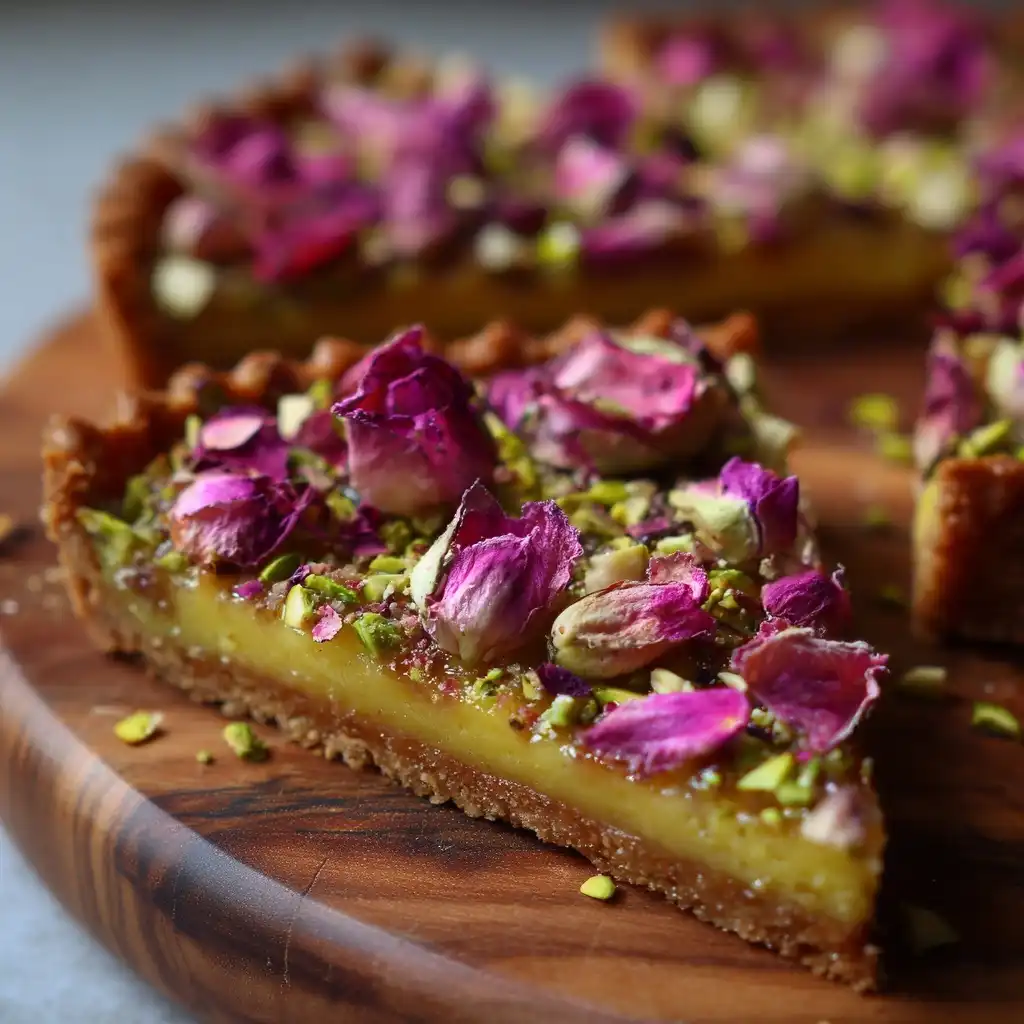
- Finish & Serve: Just before serving, brush top with reserved rose-infused cream. Garnish with: edible dried rose petals, crushed pistachios (toasted 1 min in dry pan), micro mint leaves, and a delicate pinch of flaky sea salt. Slice with hot, dry knife wiped between cuts.
Tips
- Chill Everything—Twice: Butter, eggs, bowls, and even your rolling pin should be refrigerator-cold before making crust. Warm fat melts prematurely, creating greasy, dense pastry instead of flaky layers.
- Rose Water Is Potent—Measure in Drops: Use an eye-dropper or pipette. Start with 12 drops (½ tsp); you can always add more after tasting filling—but you cannot remove excess. If it smells soapy or medicinal, you’ve overdone it.
- Pistachio Texture Is Key: Chop by hand with a sharp chef’s knife on a wooden board—never in a food processor. You want varied sizes: some fine (for creaminess), some small chunks (for texture), and a few whole halves (for visual drama).
- No Substitutions for Almond Flour in Crust: Coconut flour absorbs too much liquid; oat flour adds gumminess; all-purpose alone makes crust tough. Almond flour’s fat and protein matrix is irreplaceable here.
- Crust Cracking? You Rolled Too Thin or Too Warm: Ideal thickness is ⅛ inch. If dough cracks while transferring, patch with scraps and chill 10 minutes before baking.
- Prevent Soggy Bottoms: Always blind-bake with weights, and ensure crust is fully dry and golden before adding filling. A light egg wash (1 yolk + 1 tsp water) brushed inside baked shell before chilling adds extra moisture barrier.
- Temper Your Expectations on Color: Natural rose water and pistachios yield soft sage-green, not neon. Artificial dyes compromise flavor and authenticity—embrace the gentle, botanical palette.
- Room Temperature ≠ Warm: Cream cheese should yield slightly to gentle pressure—not ooze. If too soft, chill 15 minutes. Over-softened cheese causes curdling when mixed with acidic rose water.
- Season with Salt at Every Stage: A pinch in the crust, a pinch in the filling, and a finishing sprinkle on top creates dimensional savoriness that lifts all other flavors.
- Rest Is Non-Negotiable: This tart needs minimum 6 hours to set properly. Rushing results in slumping, weeping, or muted aromas. Think of chilling as part of the cooking process—not just storage.
Variations and Customizations
This tart is a canvas—not a cage. Here are thoughtfully developed adaptations, each preserving structural integrity and aromatic balance:
- Vegan Adaptation: Crust—substitute cold coconut oil (refined for neutral taste) + 1 tbsp apple cider vinegar + ice water for egg yolk. Filling—blend soaked raw cashews (1½ cups), coconut cream (½ cup), maple syrup (⅓ cup), rose water (10 drops), cardamom (1 tsp), lemon juice (1 tsp), and pistachios (¾ cup). Soak cashews 4 hours or boil 15 min. Blend until ultra-smooth, then chill 8+ hours. Top with coconut whipped cream and candied rose petals.
- Gluten-Free Version: Replace all-purpose flour with GF all-purpose blend containing xanthan gum (e.g., King Arthur Measure for Measure). Add 1 tsp psyllium husk powder to dough for elasticity. Ensure almond flour is certified GF (cross-contamination risk).
- Lower-Sugar Option: Reduce granulated sugar in filling to 3 tbsp; replace remaining with erythritol-based monk fruit blend (1:1 ratio). Add 1 tsp inulin fiber to maintain creaminess and prevent cooling-induced grittiness.
- Floral Layering Variation: Infuse cream with lavender buds (½ tsp) alongside rose petals. Add 1 drop orange blossom water to filling—creates a Persian *golab-sherbet* effect. Garnish with crystallized violets.
- Nut-Free Alternative: Replace pistachios with toasted sunflower seeds (hulled, high-oleic) + 1 tbsp matcha powder for green hue and umami depth. Maintain same texture prep and folding method.
- Spice Evolution: For deeper warmth, add ¼ tsp freshly grated ginger (micronized) to cardamom paste. Or substitute 2 pods black cardamom for smoky, camphorous contrast—use sparingly (1 pod max).
- Textural Upgrade: Press a thin layer of crushed pistachio praline (pistachios + sugar + butter, cooled and crushed) onto baked crust before filling. Adds caramelized crunch and nutty depth.
- Mini-Tartlet Format: Use 3½-inch tartlet pans. Reduce blind-baking to 15 min total (10 + 5). Fill and chill same. Yield: 12 tartlets. Perfect for weddings or tasting menus.
- Savory-Sweet Brunch Version: Add 1 tbsp za’atar and 2 tbsp crumbled feta to filling. Omit rose water; use rose-infused honey instead. Garnish with pomegranate arils and mint.
- Boozy Infusion: Add 1 tbsp rose-liqueur (e.g., Rothman & Winter) or cardamom-infused vodka to filling. Reduce rose water by 5 drops to compensate. Age filling 2 hours before assembly for integration.
Health Considerations and Nutritional Value
While undeniably indulgent, this tart offers meaningful nutritional attributes when prepared mindfully—and understanding its composition supports informed enjoyment:
- Cardamom’s Science-Backed Benefits: Rich in antioxidants (quercetin, kaempferol), cardamom has demonstrated anti-inflammatory effects in clinical trials (Journal of Ethnopharmacology, 2021). Its volatile oils support digestive enzyme secretion and may modestly aid blood pressure regulation via calcium channel modulation.
- Pistachios: A Functional Superfood: Among nuts, pistachios rank highest in potassium (300 mg/serving) and phytosterols (which inhibit cholesterol absorption). Their vibrant green color signals high lutein and zeaxanthin—critical for macular health. Roasting enhances bioavailability of phenolic compounds by 20–30% (Food Chemistry, 2020).
- Rose Water: More Than Aroma: Contains polyphenols like gallic acid and ellagic acid with demonstrated antimicrobial and mild anxiolytic properties in rodent models (Phytotherapy Research, 2019). Culinary doses are safe and contribute negligible calories (<1 kcal/tbsp).
- Nutrition Snapshot (Per Standard Slice, 1/12 Tart): Calories: 315 | Fat: 22g (12g sat) | Carbs: 24g (15g sugar) | Fiber: 1.2g | Protein: 5.3g | Sodium: 110mg | Calcium: 42mg | Iron: 0.9mg | Vitamin E: 1.8mg (12% DV). Note: Values vary based on butter fat %, pistachio origin, and sugar type.
- Mindful Modifications: Using grass-fed butter increases CLA (conjugated linoleic acid) and vitamin K2. Swapping refined sugar for date paste reduces glycemic load (GI ≈ 45 vs. 65). Adding chia seeds (1 tsp to filling) boosts omega-3s and soluble fiber.
- Allergen Awareness: Contains tree nuts (pistachios, almonds), dairy (butter, cream cheese, cream), and gluten (crust). Vegan/GF versions eliminate dairy/gluten but retain pistachios—always disclose for guests with anaphylactic risk.
- Portion Wisdom: Due to satiating fats and fiber, one slice delivers sustained energy and satisfaction. Pair with herbal tea (peppermint or fennel) to enhance digestion and reduce perceived sweetness.
- Not a “Diet” Dessert—But a Conscious One: This tart prioritizes whole-food ingredients, minimal processing, and intentional sourcing—making it nutritionally superior to mass-produced alternatives laden with emulsifiers, artificial colors, and high-fructose corn syrup.
Ingredients
Makes one 9-inch tart (12 servings)
For the Cardamom-Almond Crust:
- 1¼ cups (160g) all-purpose flour, spooned & leveled
- ½ cup (50g) blanched almond flour
- ⅓ cup (40g) confectioners’ sugar
- ½ tsp flaky sea salt
- ¾ cup (170g) cold unsalted European-style butter, cubed (¼-inch)
- 1 large egg yolk, cold
For the Rose-Cardamom Pistachio Filling:
- ¼ cup (60ml) heavy cream
- 2 tbsp (3g) culinary-grade dried rose petals
- 12 green cardamom pods
- ¼ tsp granulated sugar (for grinding cardamom)
- 8 oz (227g) full-fat brick cream cheese, room temperature
- ⅓ cup (67g) granulated sugar
- Seeds from 1 vanilla bean or 1 tsp high-quality vanilla bean paste
- 1 tsp (5ml) triple-distilled rose water (plus extra for finishing)
- 1 cup (130g) skinless, unsalted roasted pistachios, finely chopped (reserve 2 tbsp for garnish)
- 1 cup (240ml) cold heavy cream (36–40% fat)
- Flaky sea salt, for finishing
For Garnish:
- Edible dried rose petals
- Additional crushed roasted pistachios
- Fresh mint leaves (optional)
Directions
- Infuse the Cream: In a small saucepan, combine ¼ cup heavy cream and 2 tbsp dried rose petals. Heat over low heat until steaming (do not simmer or boil). Remove from heat, cover, and steep for 1 hour. Strain through a fine-mesh sieve lined with doubled cheesecloth, gently pressing solids to extract liquid. Discard petals. Chill infused cream overnight (minimum 6 hours) in an airtight container.
- Make the Crust: In a food processor, pulse flours, confectioners’ sugar, and salt until combined. Add cold butter and egg yolk. Pulse in 1-second bursts until mixture resembles coarse crumbs with visible pea-sized butter pieces (12–15 pulses). Turn out onto clean surface; gather into shaggy mass using bench scraper. Gently knead 3–4 times until cohesive. Flatten into 1-inch-thick disc, wrap in parchment-lined plastic wrap, and refrigerate minimum 2 hours (up to 3 days).
- Blind-Bake: Preheat oven to 375°F (190°C) with rack in lower third. Roll chilled dough between parchment to 12-inch circle, ⅛-inch thick. Transfer to 9-inch fluted tart pan with removable bottom. Trim excess, crimp edges, prick base 12–15 times. Freeze 20 minutes. Line with parchment, fill with pie weights. Bake 20 minutes. Remove weights and parchment; bake 12–15 minutes more until golden and dry. Cool completely on wire rack (≥45 min).
- Toast & Grind Cardamom: Toast cardamom pods in dry skillet over medium-low 1.5 min until fragrant. Cool 2 min. Crack open, discard husks. Grind seeds with ¼ tsp sugar in mortar until fine powder forms (≈1 tsp). Set aside.
- Prepare Filling: In stand mixer with paddle, beat cream cheese, granulated sugar, and vanilla until smooth and glossy (2 min). Scrape bowl. Add chilled rose-infused cream (reserve 1 tbsp), rose water, and ground cardamom. Beat 1 minute until emulsified. Fold in 1 cup chopped pistachios by hand until evenly distributed.
- Whip & Fold: In chilled bowl, whip 1 cup cold heavy cream to soft peaks. Gently fold into pistachio mixture in three additions, rotating bowl and using silicone spatula—until uniform and airy (≈45 sec/addition).
- Assemble & Chill: Spoon filling into cooled crust. Smooth top. Refrigerate uncovered minimum 6 hours—preferably overnight—for full setting and flavor development.
- Finish & Serve: Just before serving, brush top with reserved rose-infused cream. Garnish with edible rose petals, crushed pistachios, mint (if using), and flaky sea salt. Slice with hot, dry knife wiped between cuts.
FAQ
- Can I make the crust ahead?
- Yes! Dough disc keeps refrigerated up to 3 days or frozen up to 3 months. Thaw overnight in fridge before rolling.
- Why does my filling look curdled?
- Most likely due to cream cheese being too warm or rose water added too quickly. Always use room-temp (not soft) cream cheese and add rose water gradually while mixing on low speed.
- Can I use bottled lemon juice instead of rose water?
- No—lemon juice introduces acidity that destabilizes the filling and clashes aromatically. Rose water is irreplaceable for authentic flavor. If unavailable, omit entirely rather than substituting.
- My crust shrunk during baking. Why?
- Overworking dough, insufficient chilling, or stretching dough while fitting into pan causes gluten recoil. Always chill dough after shaping and avoid stretching.
- How do I store leftovers?
- Keep covered in refrigerator up to 4 days. Do not freeze—the texture of whipped cream breaks down irreversibly. Bring to cool room temperature 15 minutes before serving for optimal mouthfeel.
- Can I use raw pistachios?
- Roasted is strongly recommended. Raw pistachios lack depth, have higher moisture (risk of weeping), and dull green color. Toast unsalted raw pistachios at 325°F for 8–10 minutes before chopping.
- Is there a way to make this without a food processor?
- Absolutely. Use pastry cutter or two knives to cut cold butter into dry ingredients. Mix egg yolk in by hand with fork until shaggy. Gather with bench scraper.
- Can I use pistachio butter instead of chopped nuts?
- Not recommended—it alters fat/water ratio and creates gummy texture. Reserve pistachio butter for swirls or drizzles on finished tart.
- What if I don’t have a tart pan?
- A 9-inch pie plate works—but expect shallower depth and less defined edges. Reduce blind-baking time by 2–3 minutes and monitor closely.
- Why is my rose flavor faint