Introduction
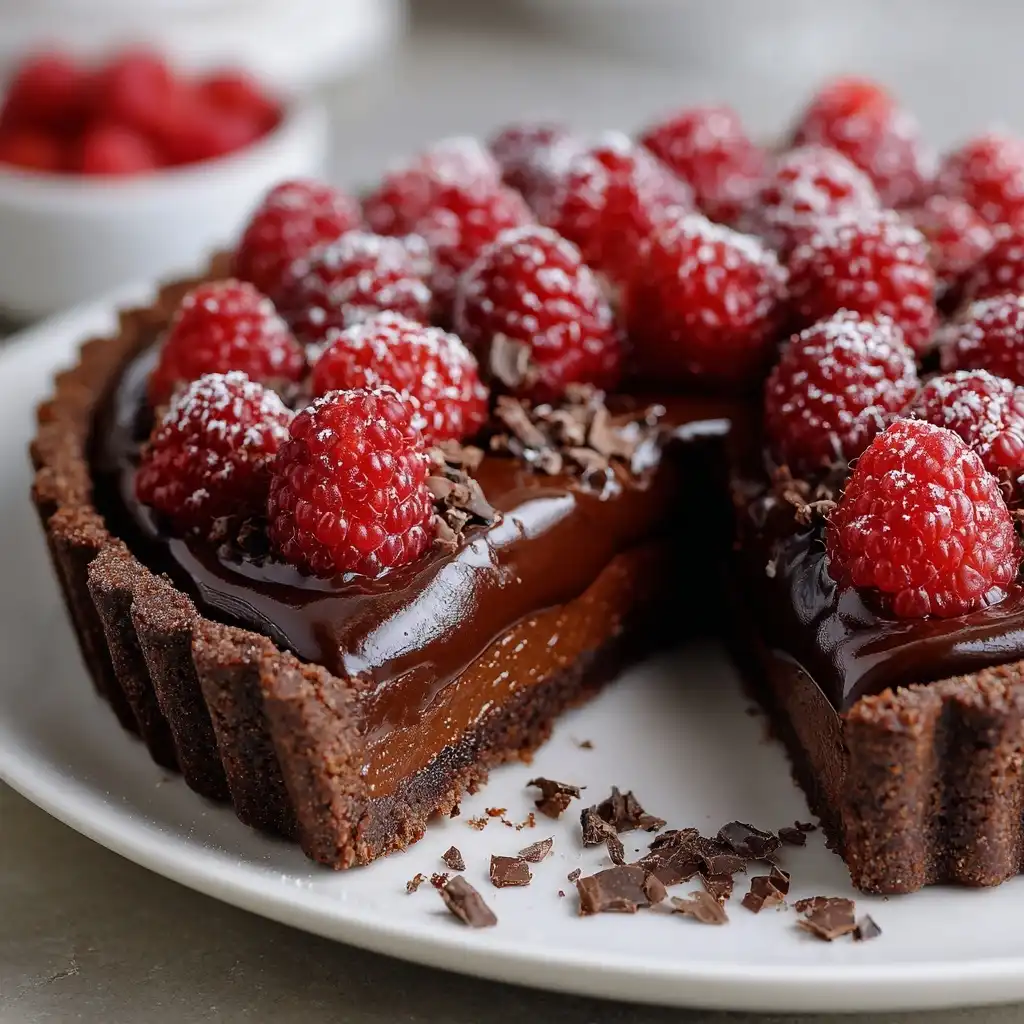
The Chocolate Raspberry Truffle Tart is a luxurious, elegant dessert that marries the deep, velvety richness of dark chocolate with the bright, tangy sweetness of fresh raspberries—creating a harmonious balance of intensity and freshness. Unlike traditional tarts that rely on custard or pastry cream, this version features a luscious, melt-in-your-mouth chocolate truffle filling enrobed in a crisp, buttery shortcrust or almond-based tart shell, crowned with glossy raspberry coulis, whole berries, and delicate edible garnishes. It’s a showstopping centerpiece for dinner parties, holiday gatherings, or special occasions—yet surprisingly approachable for home bakers who appreciate precision, quality ingredients, and layered flavor complexity. More than just a dessert, it’s a sensory experience: visually striking with its deep burgundy drizzle against glossy chocolate, aromatically intoxicating with notes of cocoa, ripe berry, and subtle vanilla, and texturally divine—crisp shell, dense-yet-creamy truffle, juicy burst of raspberry, and a whisper of flaky sea salt to elevate every bite.
The History
The origins of the Chocolate Raspberry Truffle Tart are not tied to a single documented moment but rather represent a sophisticated evolution of several culinary traditions. The concept of pairing chocolate and raspberry dates back to at least the late 19th century, when French pâtissiers began experimenting with fruit-accented ganaches—inspired by the rise of fine Belgian and Swiss chocolate production and the growing availability of preserved and fresh berries across Europe. Early iterations appeared in elite Parisian salons and Viennese cafés, where raspberry purée was folded into bittersweet chocolate ganache to temper its intensity and add acidity—a technique refined by chefs like Auguste Escoffier, who championed “balance” as the cornerstone of classical French dessert composition. The tart format itself draws from the British “flan” tradition (a baked open-faced pastry) and the French tarte aux fruits, though unlike most fruit tarts, this version deliberately subverts expectations by using fruit not as the primary component, but as a vibrant counterpoint to an intensely chocolate-forward filling. The modern truffle tart emerged prominently in the 1980s and ’90s amid the “new wave” of American pastry arts—chefs such as Claudia Fleming and Gale Gand elevated ganache-based desserts beyond simple truffles, incorporating them into structured, plated compositions. By the early 2000s, food magazines like Bon Appétit and Food & Wine featured variations of chocolate-raspberry tarts with glossy coulis finishes, cementing their status as a contemporary classic. Today, it appears on menus from Michelin-starred establishments to artisanal bakeries—and has become a beloved staple in high-end cooking schools for teaching tempering, emulsion stability, and seasonal ingredient integration.
Ingredients Breakdown
Every element of the Chocolate Raspberry Truffle Tart serves a precise functional and sensory purpose—no ingredient is arbitrary. Understanding their roles empowers bakers to troubleshoot, substitute intelligently, and deepen flavor nuance:
- Dark Chocolate (70% cacao): The backbone of the truffle layer. High-cocoa chocolate provides structure, bitterness to offset sweetness, and rich cocoa solids essential for mouthfeel and depth. Lower percentages (60–65%) yield a sweeter, softer set; higher (72–85%) increase firmness and intensity—but may require additional cream or honey for balance.
- Heavy Cream (36–40% fat): Critical for creating a stable, glossy ganache emulsion. Its high fat content coats cocoa particles, yielding smoothness and sheen, while its water content hydrates cocoa solids and aids in proper crystallization during cooling. Ultra-pasteurized cream is preferred for consistency, though not required.
- Unsalted Butter (European-style, 82–84% fat): Adds luxury, gloss, and pliability to the truffle. European butter contributes superior flavor compounds (diacetyl, lactones) and reduces water content, minimizing graininess. Added cold and emulsified at precisely 90°F (32°C), it enhances snap and shine without greasiness.
- Granulated Sugar (for coulis): Not merely sweetener—it lowers the freezing point of raspberry purée, ensuring the coulis remains fluid at room temperature and doesn’t crystallize. Fine caster sugar dissolves more readily than granulated.
- Fresh Raspberries (not frozen): Essential for brightness and volatile aromatic compounds (like raspberry ketone). Frozen berries release excess water, diluting flavor and destabilizing coulis viscosity. A portion is reserved for garnish—ideally plump, deeply colored, and lightly chilled for contrast.
- Lemon Juice (freshly squeezed): Provides necessary acidity to lift the chocolate’s richness and stabilize the raspberry coulis by lowering pH, which preserves color (anthocyanins remain vibrant red rather than turning blue-gray) and inhibits microbial growth.
- Unbleached All-Purpose Flour & Almond Flour (in crust): All-purpose flour delivers gluten structure for flakiness and integrity; almond flour adds nutty depth, tenderness, and moisture retention—preventing a dry, crumbly base. Toasted almond flour intensifies aroma.
- Confectioners’ Sugar (in crust): Finely ground sugar incorporates seamlessly, contributing tenderness without grittiness—and lends subtle sweetness that complements rather than competes with the filling.
- Sea Salt Flakes (Maldon or Fleur de Sel): Applied as a finishing touch, it triggers salivary response, heightens sweetness perception, and creates micro bursts of savory contrast that prevent flavor fatigue.
Step-by-Step Recipe
- Prepare the Tart Shell (at least 1 day ahead): In a food processor, pulse 1¼ cups (160g) all-purpose flour, ½ cup (50g) finely ground toasted almond flour, ¼ cup (30g) confectioners’ sugar, and ½ tsp fine sea salt until combined. Add 10 tbsp (140g) very cold unsalted butter, cut into ½-inch cubes, and pulse 12–15 times until mixture resembles coarse meal with pea-sized butter pieces. Drizzle in 3–4 tbsp ice water, 1 tsp at a time, pulsing just until dough begins to clump. Turn onto parchment, flatten into a 6-inch disc, wrap tightly, and refrigerate ≥2 hours (or freeze up to 1 month). Preheat oven to 375°F (190°C). Roll chilled dough between two sheets of parchment to 12-inch round, ⅛-inch thick. Fit into 9-inch fluted tart pan with removable bottom; trim edges. Prick base with fork, line with parchment and pie weights (or dried beans), and blind bake 20 minutes. Remove weights and parchment; bake 12–15 minutes more until golden and dry. Cool completely in pan on wire rack.
- Make Raspberry Coulis (can be made 3 days ahead): In a saucepan, combine 2 cups (250g) fresh raspberries, ⅓ cup (65g) granulated sugar, and 1 tsp fresh lemon juice. Simmer over medium-low heat 8–10 minutes, stirring, until berries break down and mixture thickens slightly. Strain through fine-mesh sieve into bowl, pressing pulp with spatula. Discard seeds. Stir in remaining ½ tsp lemon juice. Cool to room temperature, then refrigerate uncovered until thoroughly chilled (≥2 hours). For glossy finish, gently re-warm coulis to 95°F (35°C) before use—do not boil.
- Prepare the Chocolate Truffle Filling: Chop 12 oz (340g) high-quality 70% dark chocolate into uniform ¼-inch pieces; place in heatproof bowl. Heat 1 cup (240ml) heavy cream and 2 tbsp (28g) light corn syrup (optional, for extra gloss and shelf stability) in saucepan until steaming and small bubbles form at edges (do not boil)—approx. 185°F (85°C). Pour hot cream over chocolate. Let stand 3 minutes undisturbed. Gently whisk from center outward in concentric circles until fully melted and emulsified (no streaks). Stir in 2 tbsp (28g) cold unsalted butter, one piece at a time, until each is fully incorporated and glossy. Strain through chinois or fine-mesh sieve into clean bowl to remove any unmelted particles or air bubbles. Let cool at room temperature 20 minutes, stirring occasionally, until mixture reaches 90°F (32°C)—use instant-read thermometer.
- Assemble the Tart: Pour tempered truffle filling into cooled tart shell. Tilt pan gently to level surface. Tap base firmly on counter once to release air bubbles. Refrigerate uncovered 4 hours—or preferably overnight—for full set and optimal texture (filling should be firm but yield slightly to gentle pressure).
- Finish and Garnish: Just before serving, drizzle chilled coulis in concentric circles or artistic zigzags over tart surface. Use offset spatula to swirl gently if desired. Arrange 18–24 fresh raspberries (halved if large) atop coulis. Lightly dust with flaky sea salt. Optional: garnish with edible violets, mint leaves, or white chocolate curls. Serve chilled—but allow tart to sit at room temperature 10–15 minutes for ideal truffle consistency and flavor release.
Tips
- Temper Your Expectations (and Your Chocolate): Ganache is an emulsion—like mayonnaise or hollandaise—and requires patience. Never rush cooling; abrupt temperature shifts cause fat separation (“sweating”) or graininess. If mixture appears split, gently re-warm to 95°F (35°C) and whisk vigorously for 30 seconds—it often re-emulsifies.
- Cool Cream, Not Just Chocolate: While many recipes say “pour hot cream over chocolate,” starting with slightly cooler cream (175°F/80°C instead of boiling-hot) gives you more working time before the ganache sets—especially helpful in warm kitchens.
- Chill Tools, Not Just Ingredients: Chill your tart pan, spatula, and even the bowl for the coulis before assembly. Cold surfaces help maintain structure and prevent smudging during garnishing.
- Raspberry Prep Matters: Wash raspberries *just* before use—never soak. Gently pat dry with paper towels. Excess moisture creates watery coulis and causes berries to bleed onto the chocolate.
- Crust Crispness Is Non-Negotiable: A soggy shell ruins the entire texture contrast. Ensure the shell is fully cooled before filling—and never fill while warm. If humidity is high, store unbaked shells in airtight container with silica gel packets.
- Use a Bench Scraper for Clean Slices: Dip scraper in hot water and wipe dry before each cut. This yields pristine edges and prevents dragging the truffle layer.
- Scale Precision Over Volume: Always weigh chocolate and cream (1:1 ratio by weight is ideal for truffle consistency). Measuring cups introduce too much variability—especially with varying densities of chocolate chips vs. bars.
- Room-Temperature Patience Pays Off: Serving straight from the fridge yields muted flavors and stiff texture. The 10–15 minute rest allows volatile aromatic compounds to volatilize and the truffle to soften to silken perfection.
Variations and Customizations
This tart is remarkably adaptable—while honoring its core balance, it welcomes thoughtful innovation:
- White Chocolate Raspberry Version: Substitute 12 oz (340g) high-quality white chocolate (32–35% cocoa butter) and reduce cream to ¾ cup (180ml). Add 1 tsp vanilla bean paste and a pinch of pink Himalayan salt. Pair with blackberry coulis for deeper fruit contrast.
- Vegan Adaptation: Use coconut cream (full-fat, chilled overnight—reserve solid top layer), 12 oz (340g) vegan dark chocolate (cocoa butter-based, no dairy solids), and replace butter with refined coconut oil (2 tbsp). Sweeten coulis with maple syrup instead of sugar. Use gluten-free oat flour blend in crust.
- Boozy Infusion: Add 1 tbsp Chambord, Framboise, or Grand Marnier to warm cream before pouring over chocolate. Reduce cream by 1 tbsp to compensate. For adults-only elegance, brush baked crust with 1 tsp liqueur before filling.
- Nut-Crust Variations: Replace almond flour with hazelnut flour (toasted) for praline notes, or walnut flour for earthy depth. Add 1 tsp orange zest to dough for citrus lift.
- Texture Play: Fold ⅓ cup (40g) crushed freeze-dried raspberries into cooled ganache for bursts of tart powder. Or sprinkle chopped roasted pistachios over coulis for crunch and color.
- Mini Individual Tarts: Press dough into 4-inch tartlet pans. Fill and chill. Pipe coulis in spiral, top with single raspberry and micro mint. Perfect for buffets or weddings.
- Gluten-Free Option: Use 1:1 gluten-free flour blend (with xanthan gum) + ¼ cup (25g) almond flour. Add 1 tsp apple cider vinegar to dough to strengthen binding.
- Seasonal Swaps: In summer, use macerated strawberries; in fall, poached pear and dark chocolate with cardamom; in winter, blood orange zest in coulis and chocolate.
Health Considerations and Nutritional Value
A 1-slice (1/12th) serving of Chocolate Raspberry Truffle Tart (approx. 185g) contains roughly:
- Calories: 420–460 kcal
- Total Fat: 28–31g (18–20g saturated, from chocolate, butter, cream)
- Carbohydrates: 42–46g (32–35g sugars, primarily from chocolate, coulis, and crust)
- Fiber: 3.5–4.2g (from raspberries, almond flour, cocoa solids)
- Protein: 4.5–5.5g (from dairy, almonds, eggs if used in crust)
- Key Micronutrients: Significant manganese (28% DV), copper (22% DV), iron (12% DV), and magnesium (18% DV) from dark chocolate; vitamin C (35% DV) and folate (15% DV) from raspberries; vitamin E and healthy monounsaturated fats from almond flour.
Functional Benefits: Dark chocolate (≥70% cacao) contains flavanols linked to improved endothelial function and mild blood pressure reduction. Raspberries provide ellagic acid and anthocyanins—potent antioxidants associated with reduced oxidative stress and anti-inflammatory activity. The combination supports metabolic health when consumed mindfully.
Considerations: Due to high saturated fat and sugar content, this is best enjoyed in moderation (1 small slice, ~120g, 1–2x weekly) as part of a balanced diet. Those managing diabetes should monitor portion size and consider pairing with a protein-rich snack (e.g., Greek yogurt) to slow glucose absorption. Lactose-intolerant individuals may tolerate small amounts of butter and cream in ganache, but vegan versions eliminate dairy entirely. For low-FODMAP needs, reduce almond flour to 2 tbsp and omit confectioners’ sugar in crust (use maple sugar instead); limit raspberries to 5 per serving.
Ingredients
For the Almond-Infused Shortcrust Tart Shell:
- 1¼ cups (160g) unbleached all-purpose flour
- ½ cup (50g) finely ground toasted almond flour
- ¼ cup (30g) confectioners’ sugar
- ½ teaspoon fine sea salt
- 10 tablespoons (140g) unsalted butter, very cold, cubed
- 3–4 tablespoons ice water
For the Raspberry Coulis:
- 2 cups (250g) fresh raspberries (not frozen)
- ⅓ cup (65g) granulated sugar
- 1½ teaspoons fresh lemon juice (divided)
For the Dark Chocolate Truffle Filling:
- 12 ounces (340g) high-quality 70% dark chocolate, finely chopped
- 1 cup (240ml) heavy cream (36–40% fat)
- 2 tablespoons (28g) light corn syrup (optional, for enhanced gloss and stability)
- 2 tablespoons (28g) unsalted butter, cold, cubed
For Garnish:
- 18–24 fresh raspberries, rinsed and patted dry
- Fine flaky sea salt (e.g., Maldon)
- Optional: edible flowers, mint leaves, white chocolate curls
Directions
- Make the Tart Shell: In a food processor, combine flour, almond flour, confectioners’ sugar, and salt. Pulse 3 times to mix. Add cold butter cubes and pulse 12–15 times, until mixture resembles coarse cornmeal with visible pea-sized butter bits. Drizzle in ice water, 1 teaspoon at a time, pulsing after each addition, until dough just begins to clump together when pinched. Turn dough onto a sheet of parchment paper, gather into a disc, flatten to 1-inch thickness, wrap tightly, and refrigerate for at least 2 hours—or up to 3 days.
- Roll & Blind Bake: Preheat oven to 375°F (190°C). On a lightly floured surface, roll chilled dough between two sheets of parchment into a 12-inch round, ⅛-inch thick. Carefully transfer to a 9-inch fluted tart pan with removable bottom. Gently press into corners and up sides. Trim excess dough with a knife. Prick base all over with a fork. Line with parchment and fill with pie weights or dried beans. Bake 20 minutes. Remove weights and parchment; bake 12–15 minutes more, until golden brown and dry to the touch. Cool completely in pan on a wire rack—minimum 1 hour.
- Prepare Coulis: In a small saucepan, combine raspberries, sugar, and 1 tsp lemon juice. Bring to a gentle simmer over medium-low heat. Cook 8–10 minutes, stirring occasionally, until berries collapse and mixture reduces slightly and thickens. Remove from heat. Strain immediately through a fine-mesh sieve into a bowl, pressing firmly with a silicone spatula to extract all liquid. Discard seeds. Stir in remaining ½ tsp lemon juice. Let cool to room temperature, then refrigerate uncovered until thoroughly chilled (at least 2 hours).
- Make Ganache: Place chopped chocolate in a heatproof bowl. In a small saucepan, heat cream and corn syrup (if using) over medium heat until steaming and tiny bubbles appear at edges—do not boil (target 185°F/85°C). Pour hot cream over chocolate. Let stand 3 minutes without stirring. Starting at center, gently whisk in expanding circles until smooth and glossy (about 1 minute). Whisk in cold butter, one cube at a time, until fully melted and emulsified. Strain through a fine-mesh sieve into a clean bowl. Let cool at room temperature, stirring every 3 minutes, until mixture reaches 90°F (32°C)—use thermometer for accuracy.
- Fill & Set: Pour ganache into cooled tart shell. Tilt pan to spread evenly. Tap base firmly once on counter to release air bubbles. Refrigerate uncovered for minimum 4 hours—or ideally, overnight—for full set and optimal texture.
- Finish & Serve: Just before serving, gently rewarm coulis to 95°F (35°C) (do not boil). Drizzle decoratively over tart. Arrange fresh raspberries artfully on top. Lightly sprinkle with flaky sea salt. Slice with a hot, dry knife for clean cuts. Serve within 2 hours for best texture and appearance.
FAQ
- Can I make this tart ahead of time?
- Yes—this tart actually improves with time. The crust can be baked and stored airtight at room temperature for up to 3 days. The coulis keeps refrigerated for up to 5 days or frozen for 3 months. The filled tart holds beautifully refrigerated for up to 5 days—though best served within 72 hours for peak freshness and texture.
- Why does my ganache look grainy or separated?
- Graininess usually results from overheating chocolate (causing cocoa butter to bloom) or adding cream that’s too hot (>200°F/93°C), which scorches proteins and destabilizes emulsion. Separation occurs when temperature drops too quickly or fat-to-water ratio is off. Fix: Rewarm to 95°F (35°C) and whisk vigorously 45 seconds. If stubborn, add 1 tsp warm cream and whisk until smooth.
- Can I use milk or semi-sweet chocolate?
- You can—but expect significant changes. Milk chocolate yields a softer, sweeter, less intense filling prone to melting faster. Semi-sweet (52–60% cacao) produces a milder, sweeter truffle that may lack structure unless extra butter or corn syrup is added. For authenticity and balance, 68–72% is strongly recommended.
- My crust shrank while baking—what went wrong?
- Shrinkage occurs from overworking dough (developing gluten), insufficient chilling (butter melts too fast), or stretching dough when fitting into pan. Always chill dough ≥2 hours, handle minimally, and avoid pulling or stretching—gently lift and settle instead.
- How do I prevent raspberry bleeding onto the chocolate?
- Pat berries *extremely* dry before placing. Avoid placing berries directly on wet coulis—let coulis set 2 minutes before topping. Use only room-temperature or lightly chilled berries—not cold-from-fridge, which causes condensation.
- Can I freeze the finished tart?
- Yes—with caveats. Freeze unfilled, fully baked crust up to 2 months. Ganache-filled tart freezes well for up to 1 month if wrapped *tightly* in plastic wrap + aluminum foil—thaw overnight in fridge, then bring to room temp 15 minutes before serving. Coulis should be frozen separately in ice cube trays.
- Is there a lower-sugar option?
- Absolutely. Reduce sugar in coulis by 25% and add ½ tsp erythritol or allulose for bulk. Use 85% dark chocolate (naturally lower in sugar) and omit corn syrup. Boost raspberry flavor with ¼ tsp raspberry extract in coulis. Note: texture and shelf life will shift slightly.
- What’s the best way to store leftovers?
- Keep covered with inverted cake dome or loosely tented with foil in refrigerator. Do not store at room temperature longer than 2 hours. For longest freshness, place parchment between slices to prevent sticking.
Summary
The Chocolate Raspberry Truffle Tart is a masterclass in contrast—deep, velvety dark chocolate ganache meets vibrant, tart raspberry coulis atop a crisp, nut-infused shortcrust, finished with flaky sea salt and jewel-toned berries.
It’s a technically refined yet accessible dessert rooted in French patisserie tradition, endlessly customizable for dietary needs or seasonal inspiration, and nutritionally nuanced—offering antioxidants, minerals, and mindful indulgence in every meticulously crafted bite.