Introduction
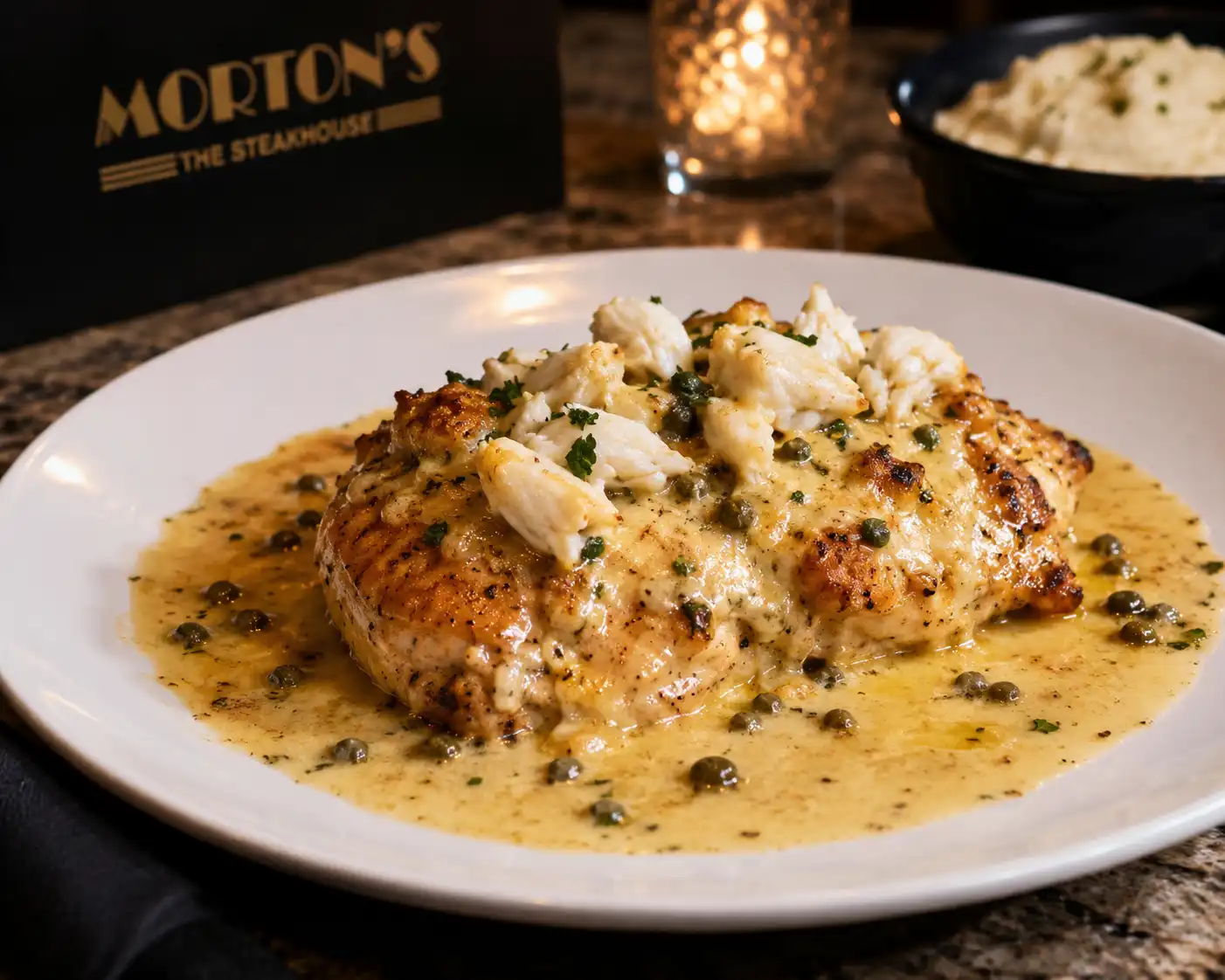
Welcome to the ultimate guide for recreating one of Morton’s Steakhouse’s most iconic and beloved off-menu specialties: Savory Chicken Christopher. Though not officially listed on their standard menu, this dish has achieved near-legendary status among loyal diners, staff, and food enthusiasts who’ve discovered it through word-of-mouth, server recommendations, or exclusive tableside reveals. Known for its rich umami depth, velvety herb-infused sauce, tender pan-seared chicken breast, and elegant yet approachable presentation, Chicken Christopher embodies Morton’s signature commitment to premium ingredients, precise technique, and old-school steakhouse sophistication—now fully adaptable for the home kitchen.
The History
The origins of Chicken Christopher are steeped in Morton’s Steakhouse lore—and a delightful blend of serendipity and culinary ingenuity. While Morton’s is globally renowned for its dry-aged steaks and impeccable service, many of its most cherished dishes were born not in corporate test kitchens, but at individual locations by passionate chefs and longtime servers seeking to delight regular guests with something special. “Christopher” is widely believed to be named after a beloved longtime server—or possibly a frequent guest—at the original Chicago Morton’s (opened in 1978) or the historic New York City location. Over decades, the dish evolved informally: starting as a simple sautéed chicken breast topped with a reduction of shallots, garlic, mushrooms, and brandy, it gradually incorporated elements like fresh tarragon, Dijon mustard, crème fraîche, and a delicate finish of lemon zest and chives—reflecting both French bistro influence and American steakhouse boldness.
By the early 2000s, Chicken Christopher had become a quietly guarded secret—a “menu whisper”—passed between servers and repeated by guests requesting it by name. Its unofficial status only heightened its allure, turning it into a culinary rite of passage for Morton’s devotees. Food bloggers, Reddit threads (notably r/Steakhouse), and YouTube recreations further cemented its fame—sparking demand for accessible, chef-level instructions that honor its integrity without requiring restaurant-grade equipment or industrial pan sauces. This guide honors that legacy—not as a copycat, but as a faithful, elevated homage grounded in technique, balance, and respect for every component.
Ingredients Breakdown
Every element in Savory Chicken Christopher serves a distinct sensory and structural purpose. Below is a meticulous breakdown—not just of *what* goes in, but *why* each ingredient matters:
- Chicken Breast (boneless, skin-on preferred): Skin-on breasts provide superior moisture retention during searing and render flavorful fat that enriches the pan sauce. If skinless is used, extra attention to brining and temperature control becomes essential.
- High-Smoke-Point Fat (duck fat, clarified butter, or avocado oil): Duck fat delivers unparalleled richness and mouth-coating depth; clarified butter adds nuttiness and emulsifying power; avocado oil ensures clean, neutral searing without burning. Never substitute with extra-virgin olive oil—it smokes too early and imparts bitterness.
- Shallots (finely minced): Sweeter and more delicate than onions, shallots dissolve seamlessly into the sauce, lending aromatic complexity without sharpness.
- Crimini or Wild Mushroom Blend (cremini, oyster, shiitake, dried porcini): Provides deep, savory *umami* and textural contrast. Dried porcini—rehydrated in warm sherry—adds an intense, almost meaty backbone that mirrors the soul of a great steakhouse sauce.
- Brandy (VSOP Cognac preferred): Not merely for alcohol burn-off—the specific esters and oak-derived vanillins in aged brandy contribute floral, toasted notes that lift the entire sauce. Substituting with cheaper brandy or grain alcohol yields a one-dimensional, harsh result.
- Dry Sherry (Fino or Amontillado): Adds bright acidity, saline nuance, and oxidative depth—balancing the sauce’s richness far more elegantly than white wine alone.
- Low-Sodium Chicken Stock (homemade or high-quality carton): The hydrophilic collagen in properly reduced stock creates natural body and silkiness. Low-sodium allows precise salt control—critical when finishing with Parmesan and capers.
- Crème Fraîche (not sour cream): Higher fat content (30–45%) and natural culturing create unmatched stability and tangy roundness. Sour cream curdles easily under heat and lacks the nuanced lactic brightness needed.
- Fresh Tarragon (leaves only, chopped at the end): The definitive aromatic—its anise-tinged sweetness harmonizes with brandy and mushrooms while cutting through fat. Dried tarragon is a poor substitute (bitter, dusty); if unavailable, use a 50/50 blend of chervil + flat-leaf parsley.
- Lemon Zest (microplaned, no pith): Introduces volatile citrus oils—not juice—that perfume the sauce without adding wateriness or acidity that could destabilize the emulsion.
- Caprese-Style Garnish (not mozzarella—think aged Parmigiano-Reggiano shavings + micro chives): Salty, crystalline cheese contrasts the sauce’s lushness; chives add oniony freshness and visual finesse.
Step-by-Step Recipe
This recipe is engineered for success—even for intermediate home cooks—with built-in safeguards against common pitfalls (dry chicken, broken sauce, muted flavor). Follow chronologically for optimal results:
- Prep & Brine (30 min–2 hrs ahead): Gently score the skin of two 6–7 oz boneless, skin-on chicken breasts in a shallow diamond pattern. Combine 1 quart cold water, ¼ cup kosher salt, 2 tbsp brown sugar, 1 tsp black peppercorns, 1 bay leaf, and 4 sprigs thyme. Submerge chicken, refrigerate 30 minutes (or up to 2 hours). Rinse, pat *extremely* dry with paper towels—skin must be desiccated for crackling crispness.
- Season & Rest: Lightly season both sides with white pepper (black pepper can scorch) and a whisper of garlic powder. Let sit uncovered at room temp 20 minutes—this equalizes internal temp for even cooking.
- Render Skin (Low & Slow): Place chicken skin-side down in a cold, heavy-bottomed stainless steel or cast-iron skillet. Add 1 tbsp duck fat. Turn heat to medium-low. Cook undisturbed 12–15 minutes until skin is golden-brown, ultra-crisp, and 90% of fat is rendered. Pour off excess fat into a heatproof bowl (reserve for roasting vegetables later).
- Finish Cooking: Flip chicken, increase heat to medium. Cook 4–5 minutes until internal temp reaches 155°F (carryover will bring it to 160–165°F). Transfer to a wire rack; tent loosely with foil. Rest 10 minutes—*do not skip*. This allows juices to redistribute, preventing leakage when sliced.
- Build the Sauce Base: In same skillet (leave all browned bits!), reduce heat to medium. Add 2 tbsp reserved duck fat, then ½ cup finely minced shallots. Sauté 3 minutes until translucent. Add 8 oz sliced cremini mushrooms and ¼ cup rehydrated, finely chopped porcini (with 2 tbsp soaking liquid). Cook 6–8 minutes until deeply browned and moisture evaporates.
- Flambé & Deglaze: Increase heat to high. Carefully pour in ¼ cup brandy—tilt pan slightly to ignite (use long match or lighter). Let flames subside naturally (~60 sec). Immediately stir in ¼ cup dry sherry and 1 cup low-sodium chicken stock. Scrape vigorously with wooden spoon to lift all fond.
- Reduce & Refine: Simmer 8–10 minutes until reduced by half and nappé consistency (coats back of spoon). Strain through fine-mesh sieve into clean saucepan, pressing solids to extract maximum flavor. Discard solids.
- Emulsify & Finish: Whisk in ⅓ cup crème fraîche over low heat (do not boil). Stir in 1 tsp Dijon mustard for binding and subtle heat. Off heat, whisk in 1 tbsp cold unsalted butter, 1 tsp lemon zest, and 1 tbsp finely chopped fresh tarragon. Season with flaky sea salt and white pepper only to taste—sauce should be luxuriously balanced, not salty.
- Plate with Precision: Slice rested chicken on a sharp bias into ½-inch medallions. Fan over warm plates. Spoon warm sauce generously over and around. Finish with delicate shavings of aged Parmigiano-Reggiano, micro chives, and a single edible flower (e.g., viola or nasturtium) for visual elegance.
Tips
- Dryness is Non-Negotiable: Moisture is the enemy of crispy skin. Pat chicken *twice*: once after brining, again right before seasoning. Let it air-dry uncovered in fridge 15 minutes pre-sear if time allows.
- Skin-Side Down Only—No Flipping Early: Resist the urge to move or flip during initial rendering. That first 12+ minutes builds structural integrity in the skin. Premature flipping causes tearing and uneven browning.
- Thermometer Required: Visual cues fail with chicken. Use an instant-read thermometer inserted horizontally into thickest part—target 155°F. Overcooking past 165°F guarantees dryness.
- Straining is Worth It: Skipping straining leaves gritty mushroom fibers and uneven texture. A silky, refined sauce is core to the Chicken Christopher experience.
- Crème Fraîche Must Be Cold: Adding cold crème fraîche off heat prevents curdling. Never add it while sauce is actively simmering.
- Acid Last, Always: Lemon zest added at the end preserves volatile aromatics. Adding it earlier cooks off the brightness—robbing the dish of its signature lift.
- Resting = Juiciness: Cutting too soon releases 30% more moisture. Resting reabsorbs juices into muscle fibers. Set a timer.
- Sauce Consistency Check: Nappé means when you run a finger across the back of a spoon coated in sauce, it leaves a clean trail that holds for 2 seconds. Too thin? Simmer 1–2 more minutes. Too thick? Whisk in 1 tsp warm stock.
- Make-Ahead Friendly: Brined chicken keeps 2 days refrigerated. Sauce base (pre-crème fraîche) holds 3 days chilled; reheat gently, then finish with dairy and aromatics day-of.
- Wine Pairing Tip: Serve with a chilled, mineral-driven white Burgundy (e.g., Bourgogne Blanc) or an unoaked Chardonnay—its acidity and subtle stone fruit mirror the sauce’s balance.
Variations and Customizations
While authenticity honors tradition, thoughtful adaptations ensure accessibility and personal expression—without sacrificing soul. Here are chef-tested options:
Dietary & Lifestyle Adaptations
- Keto/Low-Carb: Already compliant! Ensure stock is sugar-free; omit brown sugar from brine (replace with 1 tsp monk fruit blend if desired sweetness).
- Gluten-Free: Naturally GF—just verify stock and Dijon are certified GF (most major brands are).
- Dairy-Free: Substitute crème fraîche with full-fat coconut milk (chilled, solid portion only) + ½ tsp nutritional yeast for umami. Add 1 tsp arrowroot slurry at end for body.
- Poultry Alternatives: Try with duck breast (score skin, longer render time) or turkey cutlets (brine 15 min only—turkey dries faster).
Flavor & Texture Twists
- Truffle Infusion: Add ½ tsp white truffle oil to finished sauce—or shave fresh Périgord truffle over plated dish.
- Herb Garden Variation: Replace tarragon with 1 tsp fresh marjoram + 1 tsp lemon thyme for earthier, citrus-forward notes.
- Spice-Forward: Infuse the brandy with 2 crushed pink peppercorns and 1 star anise pod (steep 10 min, strain before flambeing).
- Umami Bomb: Stir in 1 tsp fish sauce (Red Boat preferred) with crème fraîche—undetectable as fish, purely amplifying savoriness.
- Vegetarian “Christopher”: Seared king oyster mushrooms (cut like scallops), roasted celeriac “chicken” medallions, or grilled cauliflower steaks—served with identical sauce and garnish.
Service & Presentation Upgrades
- Deconstructed Plating: Serve sauce in a small ramekin alongside whole, skin-on chicken breast halves—let guests spoon and savor at their pace.
- Family-Style Roast: Roast 4–6 chicken breasts skin-up at 425°F for 25–30 min (until 155°F), then slice and bathe in warm sauce tableside from a heated copper saucier.
- Brunch Version: Top with a soft-poached egg, hollandaise drizzle, and chive oil—transform into a luxurious weekend centerpiece.
Health Considerations and Nutritional Value
A single serving (1 chicken breast + ⅓ cup sauce) provides approximately:
- Calories: 485 kcal
- Protein: 42 g (excellent complete protein source—supports muscle maintenance and satiety)
- Fat: 31 g (predominantly monounsaturated from duck fat + crème fraîche; includes beneficial CLA from pasture-raised duck fat)
- Carbohydrates: 4 g (naturally low—primarily from shallots/mushrooms)
- Sodium: 420 mg (moderate; controlled via low-sodium stock and mindful finishing salt)
- Vitamins & Minerals: Rich in B6 and B12 (chicken), selenium (antioxidant support), vitamin K (from tarragon), and prebiotic fiber (mushrooms).
Key Health Notes:
- No Added Sugars: The subtle sweetness comes solely from natural fructose in shallots and mushrooms—not refined sweeteners.
- Anti-Inflammatory Elements: Tarragon contains eugenol and estragole; mushrooms offer beta-glucans; lemon zest delivers limonene—all linked to reduced oxidative stress.
- Digestive Support: Crème fraîche’s live cultures aid gut health; tarragon stimulates bile production for fat digestion.
- Heart-Healthy Fat Profile: Duck fat is ~50% monounsaturated fat (similar to olive oil), with significant oleic acid—shown to support healthy cholesterol ratios.
- Considerations: While nutrient-dense, the dish is calorie-rich due to premium fats. Those managing hypertension should monitor sodium via stock selection and avoid added salt post-cooking. For weight management, pairing with a large side of roasted asparagus or spinach salad balances volume and nutrients.
Ingredients
Makes 2 generous servings
- 2 boneless, skin-on chicken breasts (6–7 oz each, ~1 inch thick)
- ¼ cup cold water
- 2 tbsp kosher salt
- 1 tbsp brown sugar
- 1 tsp black peppercorns, lightly crushed
- 1 large bay leaf
- 4 sprigs fresh thyme
- 2 tbsp duck fat (or clarified butter or avocado oil)
- ½ cup finely minced shallots (about 3 large shallots)
- 8 oz cremini mushrooms, stems removed, thinly sliced
- ¼ cup dried porcini mushrooms
- ½ cup warm dry sherry (Fino or Amontillado)
- ¼ cup VSOP Cognac or high-quality brandy
- 1 cup low-sodium chicken stock (preferably homemade or Swanson Unsalted)
- ⅓ cup crème fraîche (full-fat, cold)
- 1 tbsp Dijon mustard
- 1 tbsp cold unsalted butter
- 1 tsp lemon zest (from 1 organic lemon, microplaned)
- 2 tbsp fresh tarragon leaves, finely chopped (plus extra for garnish)
- Flaky sea salt and white pepper, to taste
- For garnish: Aged Parmigiano-Reggiano (shaved with vegetable peeler), micro chives, edible flowers (optional)
Directions
- Brine the Chicken: In a medium bowl, combine cold water, kosher salt, brown sugar, crushed peppercorns, bay leaf, and thyme. Stir until salt and sugar dissolve. Submerge chicken breasts completely. Refrigerate 30 minutes (no longer than 2 hours).
- Prepare Mushrooms: Place dried porcini in a small heatproof bowl. Pour warm sherry over them. Let soak 20 minutes. Strain through a fine-mesh sieve lined with cheesecloth into a small bowl, reserving liquid. Finely chop rehydrated porcini.
- Dry & Season: Remove chicken from brine; rinse under cold water. Pat *thoroughly* dry with paper towels—especially skin. Place on a wire rack over a tray. Let air-dry uncovered in refrigerator 15 minutes. Pat dry again. Season both sides lightly with white pepper only.
- Render Skin: Heat cold skillet over medium-low. Add 1 tbsp duck fat. Place chicken skin-side down. Cook undisturbed 12–15 minutes until skin is deep golden, blistered, and crisp. Pour off rendered fat into heatproof bowl (reserve).
- Finish Chicken: Flip chicken. Increase heat to medium. Cook 4–5 minutes until internal temperature reaches 155°F. Transfer to wire rack; tent loosely with foil. Rest 10 minutes.
- Build Sauce Base: In same skillet, reduce heat to medium. Add 1 tbsp reserved duck fat. Add shallots; cook 3 minutes until soft. Add cremini and chopped porcini; cook 6–8 minutes until deeply browned and dry.
- Flambé & Deglaze: Increase heat to high. Carefully pour in brandy. Ignite and let burn off (~60 sec). Immediately add reserved porcini liquid, sherry, and chicken stock. Scrape pan vigorously.
- Reduce: Simmer 8–10 minutes until reduced by half and coats spoon. Strain into clean saucepan; press solids. Discard solids.
- Finish Sauce: Reduce heat to low. Whisk in crème fraîche and Dijon. Remove from heat. Whisk in cold butter, lemon zest, and tarragon. Season with flaky salt and white pepper to taste—start with ⅛ tsp salt.
- Plate: Slice rested chicken on bias. Fan over warm plates. Spoon warm sauce generously. Garnish with Parmigiano shavings, chives, and optional edible flower.
FAQ
- Q: Can I make Chicken Christopher without alcohol?
- A: Yes—but flavor depth will be reduced. Substitute brandy with 2 tbsp apple cider vinegar + 1 tsp maple syrup. Replace sherry with 3 tbsp unsweetened apple juice + 1 tsp rice vinegar. Simmer 2 extra minutes to mellow acidity.
- Q: Why skin-on chicken? Can I use skinless?
- A: Skin provides insulation, locks in moisture, and renders fat that flavors the sauce. Skinless works but requires precise temp control (150°F max) and a quick brine (10 min only). Add 1 tsp rendered bacon fat to sauce for richness.
- Q: My sauce broke—what went wrong?
- A: Most often caused by overheating crème fraîche or adding it to boiling liquid. Fix it: Whisk 1 tsp cold crème fraîche into 1 tbsp warm sauce in a separate bowl until smooth, then slowly whisk mixture back into main sauce off heat.
- Q: How do I store leftovers?
- A: Store chicken and sauce separately in airtight containers. Refrigerate up to 3 days. Reheat chicken gently in oven (325°F, 10 min) or air fryer (350°F, 4 min). Warm sauce in saucepan over low heat—do not boil.
- Q: What sides pair best?
- A: Classic steakhouse sides: Truffle mashed potatoes, roasted asparagus with lemon zest, wild rice pilaf with dried cherries, or a simple frisée salad with champagne vinaigrette.
- Q: Can I freeze this dish?
- A: Not recommended—the crème fraîche-based sauce may separate upon thawing and reheating. Freeze uncooked brined chicken (up to 3 months) and make sauce fresh.
- Q: Is there a shortcut for the porcini step?
- A: Yes: Substitute 1 tsp porcini powder (available at gourmet markets or online) stirred into the stock before reducing. Adds instant umami—no soaking needed.
- Q: Can I use frozen chicken?
- A: Thaw completely in fridge (never at room temp) and pat *extra* dry. Brining time remains the same, but expect 1–2 minutes longer sear time per side.
- Q: Why tarragon specifically? Can I use basil or rosemary?
- A: Tarragon’s anise-laced sweetness is irreplaceable here—it complements brandy and mushrooms uniquely. Basil clashes; rosemary overpowers. Chervil is the closest fresh alternative.
- Q: What’s the secret to Morton’s-level presentation?
- A: Temperature contrast (warm chicken, hot sauce, cool garnishes), negative space (don’t overcrowd the plate), and intentional height (fan slices, mound sauce slightly, place garnish asymmetrically).
Summary
Savory Chicken Christopher is far more than a restaurant-inspired recipe—it’s a masterclass in layered umami, textural harmony, and refined technique, distilled for the home cook with uncompromising attention to detail, ingredient integrity, and historical reverence.
By honoring its Morton’s roots—crisp skin, brandy-kissed mushroom sauce, crème fraîche luxury, and tarragon’s aromatic grace—you don’t just recreate a dish; you invite the timeless elegance of America’s finest steakhouses onto your own table.